行业周期反转

Search documents
山西焦化的背离谜题:业绩爆雷日,股价涨停时
市值风云· 2026-02-02 10:24
Core Viewpoint - The future performance of Shanxi Coking Coal (山西焦化) is closely tied to the steel industry, with significant declines in profit projections for 2025, indicating a challenging outlook for the company and its operations [4][22]. Group 1: Financial Performance - Shanxi Coking Coal expects a drastic decline in net profit for 2025, projecting a drop of 66.31% to 71.82%, with non-recurring net profit expected to fall by 79.36% to 85.43%, resulting in profits of less than 1 billion [4]. - The company's revenue and net profit have been in continuous decline since reaching historical peaks in 2022, with a cumulative loss of 50 million in the first three quarters of 2025 despite a single-quarter profit in Q3 [8]. - The net profit margin is projected to plummet from 21.4% in 2022 to just 1.0% in 2025, reflecting a significant deterioration in financial health [9]. Group 2: Market Reaction - Despite the negative earnings forecast, the stock price surged, hitting the upper limit on January 28 and closing up 7.95% on January 29, indicating a market reaction that diverges from the underlying fundamentals [7]. - This market behavior suggests a potential valuation correction or early bets on a cyclical recovery in the industry, highlighting a disconnect between stock performance and financial realities [7]. Group 3: Industry Dynamics - Shanxi Coking Coal's primary product, metallurgical coke, accounts for nearly two-thirds of its revenue, making it highly dependent on the steel industry [13]. - The gross margin for coke production has been declining for three consecutive years, with a significant drop to -24.06% in 2024, indicating that the company incurs losses on each ton produced [14]. - The steel industry's reduced demand and purchasing power, coupled with rising coal prices, have severely impacted the profitability of Shanxi Coking Coal's coke business, leading to a drastic decline in average profit margins [17][18]. Group 4: Investment Insights - The company's strong performance in 2022 was largely due to high coal prices and favorable conditions in the steel industry, which have since reversed, leading to a bleak outlook for future earnings [21]. - The steel industry's production targets are set for reduction, and the ongoing weakness in real estate investment is unlikely to be offset by infrastructure and manufacturing growth, further complicating the outlook for Shanxi Coking Coal [22].


彻底爆发!资金狂买两大顶流
Ge Long Hui· 2026-01-28 09:21
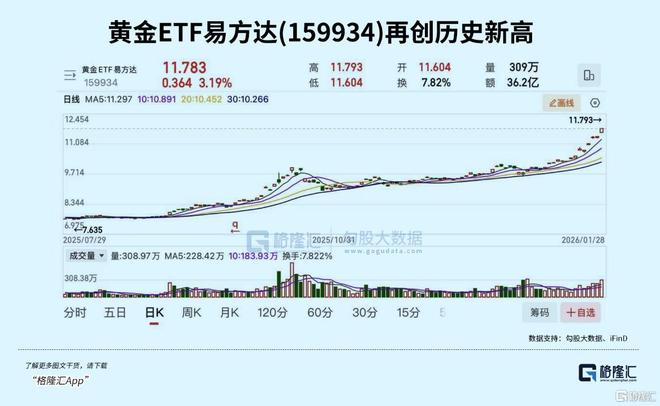
Core Viewpoint - The article highlights the significant rise in gold and oil prices, driven by a weak US dollar and geopolitical tensions, creating investment opportunities in these sectors [1][10]. Group 1: Gold Market - Gold prices have reached historical highs, with New York futures surpassing $5,300 per ounce and spot gold touching $5,270 per ounce [1]. - The gold ETF E Fund (159934) surged by 3.19%, marking a 21.37% increase year-to-date and over 175% in the past three years [1]. - Central banks globally have consistently increased gold reserves, with over 1,000 tons added for four consecutive years, indicating strong demand [11]. - The SPDR Gold Shares (GLD) attracted approximately $3.2 billion in inflows during early 2026, reflecting robust investor interest [12]. Group 2: Oil Market - WTI and Brent crude oil futures have both seen significant price increases due to geopolitical tensions and extreme weather conditions affecting production [1][10]. - The Baltic Dry Index (BDI) rose by 12.30% due to heightened sensitivity to Middle Eastern tensions, particularly regarding oil trade routes [9]. - OPEC+ representatives indicated plans to maintain current oil production levels, which could help stabilize prices amid global supply concerns [9]. Group 3: Economic Factors - The US dollar index fell to its lowest level in nearly four years, down 2.6% since the beginning of 2026, contributing to rising commodity prices [5][6]. - The weak dollar enhances the purchasing power of other currencies, further driving demand for commodities like gold and oil [9]. - The US government's increasing budget deficit and political polarization are expected to exert long-term downward pressure on the dollar [6][18]. Group 4: Chemical Industry - The chemical sector is experiencing a recovery, with demand expected to grow due to economic stimulus measures and a shift in consumer behavior [14]. - Deutsche Bank raised its Brent crude oil price forecast to $61.50 per barrel, anticipating a narrowing of supply surplus in the latter half of 2026 [14]. - The chemical industry ETF E Fund (516570) saw a net inflow of over 2.26 billion yuan in recent trading days, indicating renewed investor interest [15]. Group 5: Future Outlook - Geopolitical tensions and a weak dollar are likely to sustain demand for gold and oil, with investors seeking safe-haven assets [17][18]. - The chemical industry is expected to face limited new supply in the coming years, with capital expenditure growth turning negative [19]. - Despite potential market corrections, both gold and the chemical sector may continue to see upward trends due to underlying demand dynamics [25].
石化ETF(159731)已连续11日吸金,合计流入超4亿元
Sou Hu Cai Jing· 2026-01-22 06:55
Group 1 - The sudden surge in the Petrochemical ETF (159731) during the closing auction phase was likely due to a "fat finger" error, where an investor mistakenly entered a buy price of 1.10 instead of 1.01, leading to the unusual price movement [1] - The Petrochemical ETF has seen continuous inflows, with a total net inflow of 414 million yuan over 11 consecutive trading days since January 7, making it the top performer among similar products [1] Group 2 - The PTA industry has effectively boosted profitability through joint production cuts, with no clear plans for new capacity additions until the end of 2026, indicating a stable outlook for the industry [2] - Recent earnings forecasts for chemical companies in 2025 are promising, with leading firms in potassium fertilizers, fluorochemicals, pesticides, and lithium salts showing signs of profit recovery, signaling an improvement in industry conditions [2] - The chemical industry is currently at the bottom of a four-year downcycle, with capital expenditures experiencing negative growth for seven consecutive quarters since Q4 2023, suggesting a potential turnaround as the industry focuses on capacity reduction and expanding domestic demand [2] Group 3 - The Petrochemical ETF (159731) closely tracks the CSI Petrochemical Industry Index and is the largest in its category, with key holdings including Wanhua Chemical (global MDI leader), China Petroleum (domestic oil and gas leader), Sinopec (domestic refining leader), and Salt Lake Potash (domestic potassium fertilizer leader) [3]
尾盘突发涨停!石化ETF(159731)已连续11日“吸金”,合计流入超4亿元,居同标的第一
Sou Hu Cai Jing· 2026-01-22 02:54
Group 1 - The core point of the news is the sudden surge in the Petrochemical ETF (159731) during the closing auction phase, which raised concerns about a potential "fat finger" error leading to the price spike [1] - The Petrochemical ETF has seen continuous inflows, with a total net inflow of 414 million yuan over 11 consecutive trading days since January 7, making it the top performer among similar products [1] - The ETF closed at 1.1 yuan, but opened lower the next day, indicating a price correction after the previous day's surge [1] Group 2 - In the PTA industry, recent joint production cuts have effectively boosted profitability, with no clear plans for new capacity additions until the end of 2026 [2] - The chemical industry is currently at the bottom of a four-year down cycle, with capital expenditure showing negative growth for seven consecutive quarters since Q4 2023 [2] - The chemical sector is expected to see a turnaround in the industry cycle as supply-side measures continue to focus on capacity reduction and expanding domestic demand [2] Group 3 - The Petrochemical ETF closely tracks the CSI Petrochemical Industry Index and is the largest in its category, with key holdings including Wanhua Chemical, China Petroleum, China Petrochemical, and Salt Lake Potash [3]




机构看好化工板块供给侧改革下周期反转,化工ETF嘉实(159129)聚焦化工板块投资机遇
Xin Lang Cai Jing· 2026-01-20 03:51
Group 1 - The core viewpoint of the news highlights the positive changes in the chemical industry supply side, driven by capital expenditure decline and policy support, which may lead to a reversal in the industry cycle [2] - The Ministry of Industry and Information Technology has issued guidelines for zero-carbon factory construction, focusing on industries with urgent decarbonization needs and aiming to establish a batch of zero-carbon factories in various sectors by 2027 and 2030 [1] - The top ten weighted stocks in the CSI Chemical Industry Theme Index account for 45.31% of the index, indicating a concentrated investment opportunity within the sector [2] Group 2 - The chemical sector is expected to benefit from the "14th Five-Year Plan" aimed at expanding domestic demand and the onset of a U.S. interest rate cut cycle, which could stimulate demand for chemical products [2] - Investors can also explore investment opportunities in the chemical sector through the Chemical ETF linked fund [3]
化工行业景气度迎来全面修复!化工ETF天弘(159133)标的指数一度涨超1%,开盘半小时净申购达2000万份
Sou Hu Cai Jing· 2026-01-20 02:37
Core Viewpoint - The chemical ETF Tianhong (159133) is experiencing significant capital inflow and positive market performance, driven by macroeconomic factors and industry dynamics [1][2][3]. Group 1: Market Performance - As of January 20, 2026, the chemical ETF Tianhong (159133) recorded a transaction volume of 6.5777 million yuan, with the underlying index rising by 0.46% [1]. - The ETF has seen a net subscription of 20 million shares within the first half hour of trading, indicating strong investor interest [1]. - The ETF's latest scale and share count have reached new highs since its inception, with a total net inflow of 312 million yuan over the past 14 days [2]. Group 2: Industry Dynamics - The Tianhong ETF tracks the CSI Sub-Industry Chemical Theme Index, focusing on various sub-sectors within the Chinese chemical industry, including chemical raw materials and manufacturing [2]. - The chemical sector is experiencing a rebound, supported by macroeconomic factors such as an unexpected rise in PMI and a stronger yuan, which reduces import costs [2]. - The industry is witnessing a reduction in capital expenditure, with a shift towards "de-involution" strategies that help mitigate risks of oversupply [2][3]. Group 3: Price Trends and Future Outlook - Recent data shows that 44.1% of 170 tracked chemical products have seen price increases, with notable rises in lithium carbonate, ABS, and epoxy propane [3]. - The dual forces of supply-side contraction and demand-side growth, driven by national policies and external economic conditions, are expected to support a cyclical recovery in the chemical industry [3].


海外模拟芯片吹响涨价号角,国产厂商迎估值业绩修复曙光?
第一财经· 2025-12-25 03:30
Core Viewpoint - The recent surge in the semiconductor sector has shifted focus to analog chips, with leading stocks like Shengbang Co., Jihua Te, and Zhenlei Technology experiencing significant gains, indicating a potential recovery in the industry [3][4]. Group 1: Price Increases and Market Signals - Analog Devices (ADI) announced a price increase for its entire product line, effective February 1, 2026, with military-grade products seeing a rise of up to 30% [3][5]. - Texas Instruments (TI) initiated a price hike in August 2023, affecting over 60,000 models with increases ranging from 10% to 30% [3][5]. - The collective price increases from these industry giants are interpreted as strong signals of a cyclical reversal in the analog chip market, which has struggled with inventory and demand issues over the past two years [3][5][6]. Group 2: Demand Recovery and Market Dynamics - The demand for analog chips is closely tied to macroeconomic conditions, with signs of recovery in smartphone shipments, electric vehicle demand, and industrial automation driven by policy support [5][6]. - The current price increases differ fundamentally from the panic-driven hikes of 2020-2021, as they reflect strategic moves by leading companies to stabilize prices and restore profit margins rather than a response to supply chain disruptions [5][6]. Group 3: Implications for A-share Analog Chip Companies - A-share analog chip companies like Shengbang Co. and Jihua Te are expected to benefit from improved profit margins as a result of the price hikes initiated by global leaders [8][9]. - The average gross margin for the analog chip sector has declined from 42.2% in 2022 to 35.72% in 2024, with a slight recovery to 36.01% by Q3 2023, indicating the pressure faced by domestic manufacturers [9]. - If the price stability and potential increases lead to enhanced demand from downstream customers, A-share companies may experience a "volume-price rise" scenario, particularly in key areas like power management and automotive-grade chips [9].




海外模拟芯片吹响涨价号角,国产厂商迎估值业绩修复曙光?
Di Yi Cai Jing· 2025-12-25 03:13
Core Viewpoint - The recent price hikes by global semiconductor giants Analog Devices (ADI) and Texas Instruments (TI) signal a potential reversal in the semiconductor industry's cycle, particularly for the analog chip sector, which has been underperforming due to inventory digestion and weak demand over the past two years [1][2]. Group 1: Price Increases and Market Reactions - Analog Devices plans to increase prices across its entire product range by up to 30% for military-grade products starting February 1, 2026, following Texas Instruments' earlier price hikes of 10%-30% for over 60,000 models [1][2]. - The collective price increases from industry leaders are interpreted as a strong signal of a cyclical recovery, suggesting that the prolonged downturn may have reached its bottom [1][2][3]. - The market is shifting from a broad price war to a more structured "volume-price game," with high-end and automotive products showing stronger price rigidity compared to low-end general products [3]. Group 2: Demand Recovery and Industry Outlook - The demand for analog chips is closely tied to macroeconomic conditions, with signs of recovery in downstream markets, including a rebound in smartphone shipments and increased demand for electric and smart vehicles [2][4]. - The average gross margin for the analog chip sector has declined from 42.2% in 2022 to 35.72% in 2024, with a slight recovery to 36.01% by the end of Q3 this year, indicating the pressure domestic manufacturers faced during the downturn [4][5]. - The price stabilization initiated by leading companies could create a more favorable pricing environment for domestic firms, potentially aiding in gross margin recovery [5][6]. Group 3: Challenges and Future Prospects - Despite signs of recovery, domestic analog chip manufacturers face challenges, including reliance on international suppliers in consumer electronics and automotive sectors, and a need to observe the recovery strength in various fields [6]. - The potential for a "volume-price rise" scenario hinges on substantial recovery in downstream demand, particularly in key areas like power management and signal chain chips [6].
食品饮料板块拉升,乳业股亮眼,阳光乳业等涨停
Zheng Quan Shi Bao Wang· 2025-12-15 03:17
Group 1 - The food and beverage sector experienced a strong rally on December 15, with dairy stocks performing exceptionally well, including companies like Huanlejia, Huangshi Group, and Sunshine Dairy reaching their daily limit, while Knight Dairy rose over 8% and Beiyinmei and Chenguang Biological increased by approximately 5% [1] - The National Medical Insurance Administration announced several measures during the National Medical Security Work Conference on December 13, aiming for a nationwide implementation of "no out-of-pocket" expenses for childbirth within the policy scope by 2026, which includes expanding maternity insurance coverage to flexible employees, migrant workers, and new employment forms [1] Group 2 - According to Kaiyuan Securities, the infant formula powder industry has faced demand pressure in recent years, but policy stimuli are expected to restore demand and consumer confidence [2] - The dairy industry is anticipated to benefit from long-term improvements in population issues due to policy support, with domestic dairy companies beginning to develop deep-processing products like whey during the current low milk price period, which is expected to increase downstream demand for raw milk [2] - The industry is also exploring export potential, with domestic bulk powder prices being competitive, leading dairy companies to attempt exports while ensuring compliance with relevant standards, which could provide new demand momentum alongside ongoing supply-side adjustments [2]


伊利净利下滑,静待周期反转
YOUNG财经 漾财经· 2025-11-03 12:50
Core Viewpoint - Yili's revenue has slightly increased while net profit has declined, indicating ongoing pressure in its core liquid milk business, despite growth in milk powder and ice cream segments. The industry faces challenges from weak consumption and a declining population dividend, raising questions about the sustainability of Yili's growth logic and whether investors should continue to hold or reassess their positions [2][3][4]. Financial Performance - In the first three quarters of 2025, Yili achieved revenue of 905.64 billion yuan, a year-on-year increase of 1.71%, while net profit was 104.26 billion yuan, down 4.07% [3]. - The revenue growth rate has slowed, with Q1 at 1.46%, Q2 rebounding to 5.77%, and Q3 showing a decline of 1.63% [3]. - The company announced a dividend plan of 0.48 yuan per share, totaling approximately 30.36 billion yuan, which represents 29.12% of net profit [4]. Industry Context - The overall dairy industry is under pressure, with over 60% of A-share listed dairy companies facing revenue declines. Yili remains the industry leader with 903.41 billion yuan in revenue and 104.26 billion yuan in net profit [5]. - The third quarter saw a decline in revenue and net profit, with Q3 revenue at 285.64 billion yuan, down 1.63%, and net profit at 32.26 billion yuan, down 3.35% [5]. Cost and Expense Management - Yili has been cautious with sales expenses, which decreased by 5.5% in Q3 to 52.2 billion yuan, while management expenses rose by 10.58% to 11.39 billion yuan [6]. - R&D expenses increased by 15.1% to 2.47 billion yuan, reflecting ongoing investment in product innovation [6]. Cash Flow and Inventory - Operating cash flow decreased by 32.23% to 94 billion yuan, attributed to a decline in pre-received payments from distributors, indicating potential inventory buildup and weakened market confidence [7]. Business Segment Analysis - The liquid milk segment is the main drag on Yili's overall performance, with revenue down 4.5% to 549.4 billion yuan in the first three quarters [8]. - The milk powder and dairy products segment showed strong growth, with revenue of 242.61 billion yuan, up 13.74%, and the ice cream segment also performed well with a 13% increase in revenue [10][11]. Market Outlook - The dairy industry is experiencing an oversupply of raw milk, with a projected surplus of 636,000 tons in 2024, indicating ongoing challenges for the sector [12]. - The long-term outlook is complicated by a declining birth rate, which is expected to shrink the market for infant formula, a key growth area for Yili [14]. Investor Sentiment - Following the earnings report, Yili's stock price reacted negatively, reflecting market skepticism about the company's future performance [12][15]. - Despite past profit growth, the company's market valuation has not increased, indicating a "valuation kill" phenomenon [15]. Future Prospects - Yili expresses confidence in benefiting from a potential industry turnaround as raw milk prices stabilize and consumer demand gradually recovers [16].