
铁矿石开采

Search documents
二季度四大矿山铁矿石产量同比均有增长
Qi Huo Ri Bao Wang· 2025-08-11 23:22
Core Insights - The global iron ore shipment volume in the first half of 2025 was 78.387 million tons, a slight year-on-year decrease of 0.23%, with the four major mining companies accounting for 67.2% of the total shipments, an increase of 0.4 percentage points from the previous year [1] - The production of the four major mining companies is expected to see a slight increase in the second half of the year, following a historical high in the second quarter [1] Group 1: Vale - Vale's iron ore production in Q2 reached 83.6 million tons, a quarter-on-quarter increase of 14.2% and a year-on-year increase of 4% [2] - The production showed regional differentiation, with the Northern system increasing production by 2.2 million tons, while the Southern system saw a decrease due to maintenance [2][6] - Vale maintained its annual production target of 325 million to 335 million tons, expecting to achieve the midpoint of this range [2] Group 2: Rio Tinto - Rio Tinto's Pilbara iron ore production in Q2 reached 83.74 million tons, a year-on-year increase of 20%, while shipments were 79.9 million tons, a slight decrease of 0.5% [7] - The West Angelas project is progressing well, with first shipments expected in November 2025, and a total output of 5 to 10 million tons anticipated for that year [7] - The company is also advancing other projects, including the Brockman Syncline 1, which has a projected investment of $1.8 billion and a design capacity of 34 million tons [8] Group 3: BHP - BHP's iron ore production in Q2 reached 70.3 million tons, a year-on-year increase of 2%, while shipments were 76.7 million tons, a year-on-year increase of 1.1% [10] - The company expects its total production for the 2025 fiscal year to reach 262.98 million tons, a year-on-year increase of 1% [10] - The South Flank project has significantly contributed to production, achieving over 80 million tons in its first year [12] Group 4: Fortescue Metals Group (FMG) - FMG's iron ore production in Q2 reached 54.4 million tons, a year-on-year increase of 14.3%, while shipments were 55.2 million tons, a year-on-year increase of 2.8% [13] - The company achieved record shipping volumes despite disruptions from tropical cyclones, demonstrating strong operational efficiency [14] - FMG's guidance for the 2026 fiscal year is set at 195 million to 205 million tons, indicating continued growth potential [14] Group 5: Overall Market Outlook - The four major mining companies collectively increased production in Q2, with a total estimated production of approximately 29.6 million tons, reflecting a significant recovery [15] - The overall market is expected to maintain stability in iron ore supply, with ongoing projects and production guidance indicating a slight increase in output for the second half of the year [15]




Fortescue Ltd.:获142亿人民币贷款推进脱碳计划
Sou Hu Cai Jing· 2025-08-08 01:30
Core Viewpoint - Fortescue Ltd., an Australian mining giant, has secured a loan of 14.2 billion RMB to advance its decarbonization plans, marking a significant step in its commitment to becoming a green energy leader [1] Group 1: Loan Details - The loan of 14.2 billion RMB is the first of its kind for an Australian company [1] - The participating banks include Chinese, Australian, and multinational institutions [1] Group 2: Company Profile - Fortescue is one of the largest iron ore producers globally [1] - The company aims to transition into a major player in the green energy sector [1]
中州期货:2025年“基石计划”铁矿石产量目标完成难度较大
Qi Huo Ri Bao· 2025-08-07 06:03
Core Viewpoint - In 2024, China's iron ore production and import statistics indicate a slight increase in domestic production but a significant reliance on imports, highlighting challenges in achieving the "Cornerstone Plan" targets for 2025 [1][8]. Group 1: Production and Import Data - In 2024, China's iron ore raw ore production reached 104.194 million tons, a year-on-year increase of 1.2%, while iron concentrate production was 28.402 million tons, a decrease of 1.5% [1]. - Iron ore imports reached 123.655 million tons, a year-on-year increase of 4.9%, accounting for approximately 72% of global iron ore imports, with a dependency rate of 81.3% [1]. Group 2: "Cornerstone Plan" Goals - The "Cornerstone Plan" aims for domestic iron concentrate production of 37 million tons, scrap consumption of 30 million tons, and overseas equity ore production of 22 million tons by 2025 [1]. - As of the first half of 2025, domestic iron concentrate production was only 13.775 million tons, a year-on-year decrease of 7.97%, indicating significant challenges in meeting the plan's targets [1][8]. Group 3: New Mining Projects - Six new iron ore mining projects are expected to contribute an additional 6.565 million tons of iron concentrate production in 2025 [2]. - Key projects include: - Taihe Iron Mine, which will expand to a processing capacity of 10 million tons and produce 360,000 tons of iron concentrate annually [2]. - Xichang Mine's 500,000-ton ultra-poor comprehensive recovery project, expected to produce 50,000 tons of iron concentrate annually [3]. - Zhongjiu Iron Mine, with a capacity of 200,000 tons and an expected annual output of 77,000 tons of iron concentrate [4]. - Lunan Macheng Iron Mine, projected to produce 737,500 tons of iron concentrate annually [5]. - Cuihongshan Iron Polymetallic Mine, expected to produce 85,000 tons of iron concentrate annually [6]. - Sishanling Iron Mine, anticipated to produce 125,000 tons of iron concentrate in 2025 [7]. Group 4: Challenges to Achieving Production Goals - The decline in iron ore prices has reduced the willingness of domestic mining companies to invest in new projects, as prices fell from $137 per ton to below $100 per ton [9][10]. - Environmental policies and resource consolidation have increased entry barriers for mining companies, leading to higher capital expenditures for compliance [11]. - Investment growth in the iron ore mining sector has lagged behind other sectors, further limiting capacity expansion [12].
2025年“基石计划”铁矿石产量目标完成难度较大
Qi Huo Ri Bao· 2025-08-06 14:57
Core Viewpoint - In 2024, China's iron ore production and import statistics indicate a slight increase in domestic production but a significant reliance on imports, highlighting challenges in achieving the "Cornerstone Plan" targets for 2025 [1][8]. Group 1: Production and Import Data - In 2024, China's iron ore raw ore production reached 104.194 million tons, a year-on-year increase of 1.2%, while iron concentrate production was 28.402 million tons, a decrease of 1.5% [1]. - Iron ore imports reached 123.655 million tons, a year-on-year increase of 4.9%, accounting for approximately 72% of global iron ore imports, with a dependency rate of 81.3% [1]. Group 2: "Cornerstone Plan" Goals - The "Cornerstone Plan" aims to achieve a domestic iron concentrate production of 37 million tons, scrap consumption of 30 million tons, and overseas equity ore production of 22 million tons by 2025 [1]. - As of January to June 2025, domestic iron concentrate production was only 13.775 million tons, a year-on-year decrease of 7.97%, indicating significant challenges in meeting the "Cornerstone Plan" targets [1][8]. Group 3: New Mining Projects - Six new iron ore mining projects are expected to contribute an additional 6.565 million tons of iron concentrate production in 2025 [2]. - The Taihe Iron Mine expansion project aims to increase its processing capacity to 10 million tons, with an expected annual production of 360,000 tons of iron concentrate upon completion [2]. - The Xichang Mine's 5 million tons ultra-poor comprehensive recovery project is expected to produce 50,000 tons of iron concentrate annually, contributing positively to the "Cornerstone Plan" [3]. Group 4: Challenges in Achieving Production Targets - The decline in iron ore prices has reduced the willingness of domestic mining companies to invest in new mining projects, as the average cost of domestic iron ore extraction is significantly higher than that of imported ore [9][10]. - Environmental policies and resource integration efforts have raised entry barriers for new mining projects, leading to increased capital expenditures for compliance [11]. - The fixed asset investment growth rate in the iron ore mining sector is relatively low compared to other mining sectors, further limiting capacity expansion [12]. Group 5: Overall Outlook - The combination of declining iron ore prices, stringent environmental regulations, and low investment growth suggests that the iron ore industry is undergoing a transition that may hinder the achievement of the "Cornerstone Plan" targets for 2025 [13].
铁矿石四大矿山季度运营情况跟踪:主流矿山Q2产运追赶节奏显著加快
Guo Tai Jun An Qi Huo· 2025-08-04 11:55
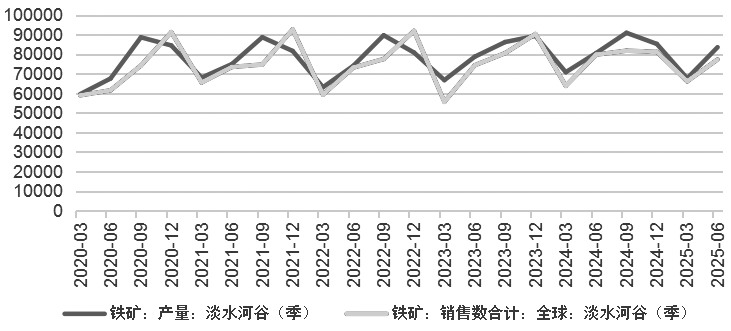
Group 1: Report's Investment Rating - There is no information about the industry investment rating in the report. Group 2: Core Views of the Report - In Q2 2025, the production and transportation volume of the four major iron ore mines increased significantly, with a year - on - year growth of 3.5% and a quarter - on - quarter increase of nearly 20%, basically catching up to last year's level in the first half of the year [1][5]. - The trend of "increase in mainstream mines and decrease in non - mainstream mines" was further reflected in Q2, and the dominant position of mainstream mines in Australia and Brazil in the global seaborne iron ore market may be further strengthened [2][44]. Group 3: Summary of Each Section 1. Overview of the Four Major Mines' Q2 2025 Operations - The total production/transportation volume of the four major mines in Q2 2025 was 293 million tons, with a year - on - year increase of 3.5% and a quarter - on - quarter increase of nearly 20%. The significant volume boost by BHP and Fortescue in June was the main driver of the excellent performance in Q2 [1][5]. - In the first half of 2025, only Rio Tinto's production was still significantly behind last year's level. BHP and Fortescue both raised their production and transportation targets for FY26, indicating confidence in their supply chain efficiency and new production capacity [6]. 2. Key Points of the Four Major Mines' Quarterly Reports 2.1 Vale - **Overall Situation**: In Q2, Vale's iron ore production was 83.599 million tons, a year - on - year increase of 3.7%. Sales volume was 77.346 million tons, a year - on - year decrease of 3.1%. The C1 cash cost was 22.2 US dollars/wet ton, a year - on - year decrease of 10.8%. The AIC was 55.3 US dollars/wet ton, a year - on - year decrease of 9.6% [8][12][13]. - **Operation Details**: The northern system's Q2 production reached 41.222 million tons, a record high since 2021. The southeast system performed well, with the fourth processing line of Brucutu driving production to a new high. The southern system's production declined due to construction issues. The company plans to conduct maintenance on the São Luis pellet plant in Q3. Pellet sales in Q2 were about 7.5 million tons, a year - on - year decrease of 16% [15][16][19]. 2.2 Rio Tinto - **Overall Situation**: In Q2, Rio Tinto's Pilbara mine production was 83.743 million tons, a year - on - year increase of 5.4%, reaching a new high since 2018. The shipping volume was 79.887 million tons, a year - on - year decrease of 0.5%. The company maintained its Pilbara shipping volume guidance range of 323 - 338 million tons but expected the actual volume to be closer to the lower limit [22][23]. - **Operation Details**: The Western Range project was put into production in March and is expected to reach full production by the end of 2025. The Brockman Syncline 1 project is planned to be put into production in 2027, and the Hope Downs - 2 project started construction in June. The first shipment of the Guinea Simandou iron ore project is still expected in November, with an estimated shipment of 50 - 100 million tons in 2025 [25][27]. 2.3 BHP - **Overall Situation**: In Q2, BHP's equity production was 70.339 million tons, a year - on - year increase of 1.6%. Sales volume was 69.843 million tons, a year - on - year increase of 2.2%. In FY2025, the full - year equity production was about 263 million tons, higher than the previous guidance range. The company announced an upward - adjusted equity production guidance range of 258 - 269 million tons for FY2026 [31][32]. - **Operation Details**: In the Western Australia WAIO mine, the improvement of logistics efficiency and the full - production of the South Slope project contributed to the production increase. In the Brazilian Samarco, the production continued to rise with the help of the capacity ramp - up of the No. 2 concentrator [34][35]. 2.4 Fortescue - **Overall Situation**: In Q2, the company's iron ore shipping volume was 55.2 million tons, a year - on - year increase of 2.8%. In FY2025, the full - year shipping volume was 198.4 million tons, a year - on - year increase of 3.5%. The C1 cost of Pilbara hematite in Q2 was 16.29 US dollars/wet ton, a quarter - on - quarter decrease of 7.1%. The company announced a shipping volume guidance range of 195 - 205 million tons and a C1 cost guidance range of 17.50 - 18.50 US dollars/wet ton for FY2026 [37][38]. - **Operation Details**: The shipping volume of the Iron Bridge project in Q2 was 2.4 million tons, and the full - year volume in FY2025 was 7.1 million tons. The company aims to reach full production of 22 million tons/year in FY2028 [41]. 3. Summary and Future Outlook - In Q2, the four major mines made efforts to increase production. Rio Tinto and Vale contributed over 7 million tons of year - on - year incremental production. - The trend of "increase in mainstream mines and decrease in non - mainstream mines" was further strengthened. From January to June 2025, the global seaborne iron ore shipment volume decreased slightly year - on - year, while the shipments from Australia and Brazil increased, and their share in the global market reached 83.3% [44].
铁矿石巨头淡水河谷二季度:营收下滑11%、净利下滑24%
Xin Lang Cai Jing· 2025-08-03 23:09
Core Insights - Vale, one of the world's largest iron ore producers, reported a 24% year-on-year decline in net profit to $2.12 billion for Q2, which was still better than analyst expectations [1] - Revenue for the period from April to June fell 11% year-on-year to $8.8 billion, aligning with market forecasts [1] - The average price of iron ore fines for the quarter was $85.1 per ton, reflecting a more than 13% decline compared to the previous year [1] Financial Performance - The adjusted EBITDA decreased by 15% to $3.39 billion due to weak iron ore prices [1] - The company managed to reduce costs across all categories: iron ore costs down by 10%, copper by 60%, and nickel by 30% [1] - Capital expenditures were reduced by $200 million year-on-year, with a budget target of $5.9 billion for 2025 likely to be achieved [1] Operational Developments - Vale has received preliminary approval for the Bacaba copper mine, which will extend the service life of the Sossego mining area [1] - The second furnace at the Osapama mine began trial operations this month, with nickel product production expected to commence in Q4 [1]
铁矿石周度观点-20250803
Guo Tai Jun An Qi Huo· 2025-08-03 06:26
1. Report Industry Investment Rating There is no information provided regarding the report industry investment rating in the given content. 2. Core Viewpoint of the Report The sentiment in the iron ore market has declined, leading to a downward adjustment in a volatile manner. The previous significant increase in the valuation of the black - sector under the support of theme trading and macro - policy expectations might have been an over - rise. Considering the relatively limited marginal changes in fundamentals, the recent decline in sentiment has caused the iron ore price to fall [3][5]. 3. Summary by Relevant Catalogs 3.1 Supply - Overseas shipments continued to recover, with the increase in the recent week mainly coming from Australia. The global shipment volume was 3200.9 million tons, with a week - on - week increase of 91.8 million tons and a year - on - year increase of 181.9 million tons. Australian shipments were 1793.5 million tons, up 222.3 million tons week - on - week and 225.3 million tons year - on - year. Brazilian shipments were 884.3 million tons, down 23.5 million tons week - on - week and 35.1 million tons year - on - year [4][5]. - Among Australian shipments, FMG contributed the main increase in shipments to China, with a week - on - week increase of 84.9 million tons and a year - on - year increase of 170.4 million tons. Vale's global shipments decreased by 46.8 million tons week - on - week and 96.8 million tons year - on - year [4]. - In terms of non - mainstream mines, Peru's shipments recovered poorly. In the domestic market, the operating rate in North China declined significantly recently [20][27]. 3.2 Demand - The downstream iron - making production slightly decreased, with the 247 - enterprise hot metal output at 240.71 million tons, down 1.52 million tons week - on - week but up 1.10 million tons year - on - year. The output of the five major steel products still had a large year - on - year increase [4][30]. - The arrival of scrap steel increased recently, but the scrap steel price remained basically flat week - on - week. The scrap - iron price difference continued to narrow, but the narrowing slope slowed down [31]. 3.3 Contract Performance The price of the main 09 contract was volatile and weak, closing at 783.0 yuan/ton. The open interest was 410,000 lots, a decrease of 119,000 lots. The average daily trading volume was 369,000 lots, a week - on - week decrease of 150,000 lots [7]. 3.4 Spot Price Performance The spot price basically followed the futures market, showing a phased peak - to - trough decline. For example, the price of Carajás fines (64.5%) at Qingdao Port dropped from 882 yuan/ton last week to 870 yuan/ton this week [11]. 3.5 Inventory - The inflection point of port inventory had not arrived yet. The inventory of imported ores at 45 ports was 13,657.9 million tons, down 132.5 million tons week - on - week and 1386.1 million tons year - on - year [4][35]. - Due to production - increasing demand and the decline in Indian shipments, the pellet inventory continued to be depleted [36]. 3.6 Downstream Profit The profit of finished steel products reached a high and then declined, including the spot profit of rebar, hot - rolled coil, and the disk profit of rebar and hot - rolled coil contracts [38]. 3.7 Spot Category Price Difference The price of imported ores continued to decline, and the price difference between domestic and imported ores further widened [40]. 3.8 Futures Monthly Spread - The 09 - 01 monthly spread closed at 26 yuan/ton this week, narrowing week - on - week. - The 01 - 05 monthly spread closed at 23.5 yuan/ton this week, widening week - on - week [47]. 3.9 Basis Performance The decline of the spot and futures prices was comparable this week, and the basis remained basically flat week - on - week [48].
矿石:给端表现增量,矿价或震偏弱运行
Zhong Hui Qi Huo· 2025-08-01 10:14
Report Summary 1. Industry Investment Rating No information provided on the industry investment rating. 2. Core View - In August, the global iron ore supply is expected to increase while demand decreases, leading to a relatively loose supply - demand balance. Prices are likely to fluctuate and trend weakly [7]. 3. Summary by Relevant Catalogs 3.1 Market Review - In July, the futures and spot prices of iron ore fluctuated and trended strongly. As of July 30, the futures price of the main contract increased by 73.5 yuan/ton month - on - month [5]. 3.2 Supply - Side Analysis - **Mainstream Mines**: The shipments of the four major mines are expected to rebound in August, with an estimated month - on - month increase of about 258.5 million tons. Vale is expected to ship 27.1 million tons in August, a month - on - month increase of 3.5 million tons; Rio Tinto is expected to ship 28 million tons, a month - on - month increase of 235 million tons; BHP is expected to ship 23.5 million tons, a month - on - month decrease of about 75 million tons; FMG is expected to ship 16.5 million tons, a month - on - month increase of 95 million tons [25][28][30]. - **Non - mainstream Mines**: Global non - mainstream shipments are relatively stable overall. In August, the estimated shipment is 43.2 million tons, a decrease of about 40 million tons [33]. - **Domestic Mines**: The domestic iron concentrate production in July is estimated to be 20.85 million tons, and the production in August is expected to be 21.15 million tons, a month - on - month increase of 30 million tons [36]. - **Total Supply**: The global supply in August is expected to increase by about 248.5 million tons month - on - month [6]. 3.3 Demand - Side Analysis - **Domestic Demand**: According to the statistics of Mysteel, the national pig iron production in July is estimated to be 74.81 million tons, a year - on - year increase of 1.1%. In August, the blast furnace hot metal production is expected to be 74.84 million tons, a month - on - month increase of 3 million tons. The demand for 61% grade iron ore is expected to increase slightly by 5 million tons [6][18][22]. - **Overseas Demand**: Except for China, the daily average pig iron production is decreasing. In August, the pig iron production is estimated to decrease slightly by 62,000 tons, and the demand for 61% grade iron ore is expected to decrease slightly by about 10 million tons [6][21][22]. - **Global Demand**: In August, the demand for 61% grade iron ore is expected to decrease by about 5 million tons globally [6][22]. 3.4 Steel Mill Profit - In July, the profits of long - and short - process steel mills reached a high level, and short - process steel mills turned losses into profits. At the end of July, the blast furnace operating rate of 247 steel mills was 83.46%, a year - on - year increase of 1.13 percentage points; the blast furnace ironmaking capacity utilization rate was 90.81%, a year - on - year increase of 1.20 percentage points; the steel mill profitability rate was 63.64%, a year - on - year increase of 48.49 percentage points; the daily average hot metal production was 2.4223 million tons, a year - on - year increase of 26,200 tons [9][13][15]. 3.5 Inventory - At the end of July, the inventory of imported iron ore at 45 ports across the country was 138 million tons, a month - on - month decrease of 100 tons. In August, the inventory is expected to accumulate, but the overall inventory accumulation rate will slow down [40]. - Steel mills mainly replenish inventory as needed, with narrow inventory fluctuations and a stable inventory - to - consumption ratio [42]. 3.6 Supply - Demand Balance Table | Date | Supply (million tons) | Demand (million tons) | Export (million tons) | Supply - Demand Surplus (million tons) | | --- | --- | --- | --- | --- | | 2025 - 01 | 127.3078 | 122.0185 | 1.7907 | 3.4987 | | 2025 - 02 | 102.2437 | 123.5627 | 2.2287 | - 23.5478 | | 2025 - 03 | 130.8431 | 126.6254 | 1.9641 | 2.2536 | | 2025 - 04 | 128.6777 | 130.4944 | 1.8359 | - 3.6526 | | 2025 - 05 | 132.3421 | 132.7831 | 2.3730 | - 2.8140 | | 2025 - 06 | 137.1990 | 126.9900 | 1.2567 | 8.9523 | | 2025 - 07 | 135.2500 | 130.6900 | 1.2600 | 3.3000 | | 2025 - 08 | 135.3800 | 130.7500 | 1.6700 | 2.9600 | | 2025 - 09 | 124.4500 | 129.7500 | 1.9600 | - 7.2600 | | 2025 - 10 | 134.7500 | 132.1000 | 1.5700 | 1.0800 | | 2025 - 11 | 128.4500 | 124.4000 | 1.5600 | 2.4900 | | 2025 - 12 | 133.3000 | 123.1000 | 1.6700 | 8.5300 | [48]
淡水河谷(Vale)公布的第二季度净营业收入88.0亿美元,预期为88.7亿美元,息税折旧摊销前利润34.2亿美元,预期为33.1亿美元。
news flash· 2025-07-31 21:51
淡水河谷(Vale)公布的第二季度净营业收入88.0亿美元,预期为88.7亿美元,息税折旧摊销前利润 34.2亿美元,预期为33.1亿美元。 ...
市场情绪趋弱,钢矿高位回落
Bao Cheng Qi Huo· 2025-07-31 10:15
投资咨询业务资格:证监许可【2011】1778 号 钢材&铁矿石 | 日报 2025 年 7 月 31 日 钢材&铁矿石日报 专业研究·创造价值 市场情绪趋弱,钢矿高位回落 核心观点 螺纹钢:主力期价大幅下跌,录得 4.19%日跌幅,量仓收缩。现阶段, 政策预期兑现,前期乐观预期开始修正,且供需双弱局面螺纹基本面矛 盾在累积,钢价有所承压,偏弱情绪主导下预计螺纹短期延续震荡走弱 态势,关注钢厂生产情况。 热轧卷板:主力期价弱势下行,录得 3.56%日跌幅,量仓收缩。目前来 看,乐观情绪消退,钢市运行重回产业端,供需双增局面下热卷基本面 在走弱,库存持续增加,叠加原料下行拖累,利空因素发酵,预计热卷 价格承压弱势下行,关注海外风险情况。 铁矿石:主力期价延续弱势,录得 2.38%日跌幅,量仓收缩。现阶 段,矿石需求韧性尚可,给予矿价支撑,但矿石供应将回升,需求表现 弱稳,供增需稳局面下矿市基本面预期走弱,叠加市场情绪不佳,矿价 延续弱势震荡态势,关注成材表现情况。 (仅供参考,不构成任何投资建议) 姓名:涂伟华 宝城期货投资咨询部 从业资格证号:F3060359 投资咨询证号:Z0011688 电话:0571- ...