
物流

Search documents
中物联:2025年全国社会物流总额368.2万亿元 同比增长5.1%
智通财经网· 2026-02-17 05:45
智通财经APP获悉,中国物流与采购联合会发文称,2025年,全国社会物流总额368.2万亿元,按可比 价格计算,同比增长5.1%。从年内走势看,一、二、三、四季度分别增长5.7%、5.5%、5.2%、5.0%, 全年各季度物流需求增速保持稳定增长,物流对实体经济的拉动作用强劲。重点调查数据显示,大型工 商企业物流管理水平和社会化程度持续提升,工业、批发零售企业物流外包比例近70%,企业物流费用 率同比下降0.2个百分点,产业与物流联动降本、效率共进的态势有所显现。 原文如下: 社会物流运行稳中有进 发展质量与效率双提升 ——2025年全国物流运行情况分析 中国物流与采购联合会 中国物流信息中心 一、社会物流总额稳健增长,多元需求结构协同优化 2025年,全国社会物流总额368.2万亿元,按可比价格计算,同比增长5.1%。从年内走势看,一、二、 三、四季度分别增长5.7%、5.5%、5.2%、5.0%,全年各季度物流需求增速保持稳定增长,物流对实体 经济的拉动作用强劲。 工业品物流锚定高端化转型,支撑工业经济高质量发展。2025年,我国工业品物流总额同比增长 5.3%,对社会物流总额增长的贡献率达82%,核心支 ...
比特币下跌,AI担忧情绪打压人气
Sou Hu Cai Jing· 2026-02-16 08:52
Core Viewpoint - Bitcoin has slightly declined amid ongoing concerns about potential disruptions caused by artificial intelligence (AI), leading investors to remain cautious about significantly increasing their investments in the cryptocurrency market [1] Group 1: Market Sentiment - The dominant theme in the market is the disruption caused by AI, with investors showing caution towards industries that may face challenges from AI [1] - Industries such as software, financial intermediaries, real estate investment trusts, legal, and logistics are experiencing impacts from AI disruption concerns [1] Group 2: Cryptocurrency Market Dynamics - Analysts from Saxo Bank indicate that the movements in the cryptocurrency market suggest a phase of consolidation rather than panic [1] - Bitcoin's price decreased by 0.3%, reaching $68,688 [1] Group 3: Broader Market Context - The U.S. stock market was closed on Presidents' Day, resulting in reduced catalysts for risk appetite and decreased liquidity [1]
美银Hartnett:“AI颠覆交易”加速扩散,一旦有科技巨头削减开支,将引发美股“轮动海啸”
Hua Er Jie Jian Wen· 2026-02-16 07:02
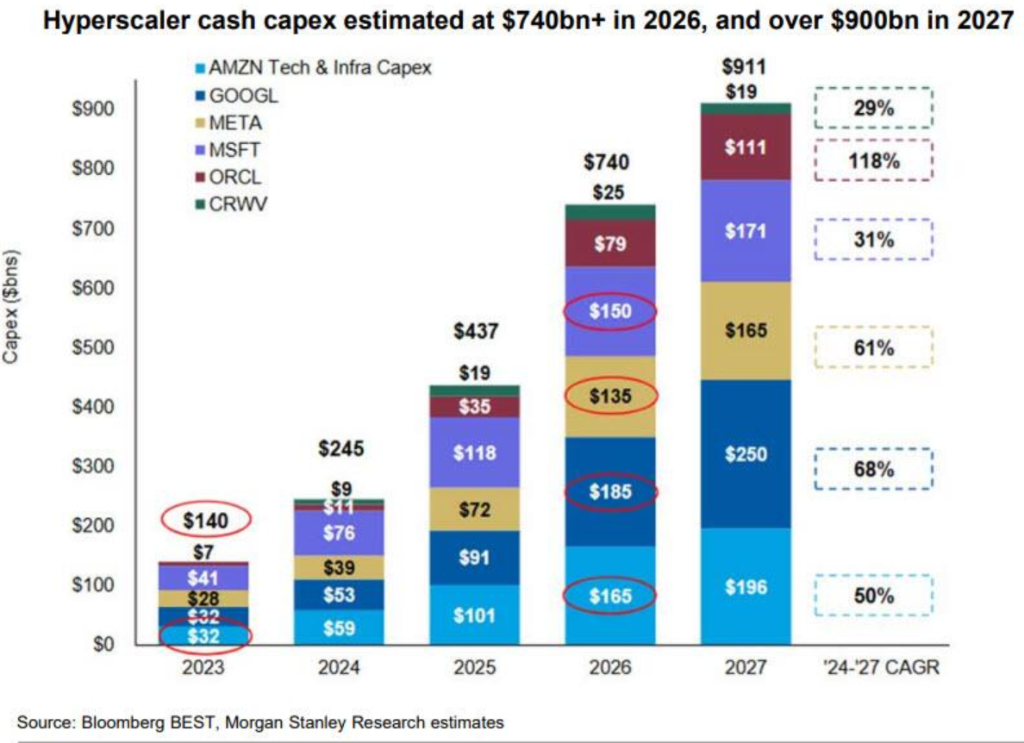
Group 1 - The core message of the report indicates a significant shift in AI capital expenditure from a "money printing machine" to a "money shredding machine," suggesting potential liquidity and asset pricing turmoil [1] - The expected capital expenditure for hyperscalers has surged to $740 billion by 2026, up from a previous estimate of $670 billion, raising concerns about extreme financial consequences for major tech companies [2] - The narrative in the market is shifting from "awe of AI" to "being impoverished by AI," with a clear signal for investors being the announcement of capital expenditure cuts by a major AI player [4] Group 2 - The report highlights a rapid spread of AI disruption effects into traditional service sectors, described as "wildfire AI disruption," impacting various industries sequentially [5][6] - The first sector affected by AI disruption was Indian tech stocks, which have not seen any buying support since being labeled as "AI victims," indicating a prolonged recovery period for such stocks [6] Group 3 - Political factors are intensifying the asset rotation, with a notable divergence in support for Trump between Wall Street and Main Street, leading to potential aggressive affordability policies ahead of the midterm elections [10][11] - The report suggests a strategy of "long Main Street, short Wall Street" is becoming effective, with significant asset performance divergence since the interest rate cut on October 29 [11] Group 4 - A historical shift in the correlation between the Japanese yen and the Nikkei index has been noted, indicating a potential long-term bull market for Japan, although a strong yen could negatively impact exporters [12][13] - Despite a $463 billion inflow into global equities, the Bull & Bear Indicator remains in the "sell" zone, suggesting that the adjustment in risk assets is not yet over [16] Group 5 - The report outlines a "great rotation" in asset leadership over the past 50 years, with significant political and financial events altering the flow of investments, indicating a potential shift towards emerging markets and small-cap stocks as the next structural leaders [17][20] - Emerging markets and small-cap stocks are expected to benefit from a transition in service-oriented to manufacturing-oriented investments, alongside rising costs in the AI arms race [20]

香港不是美国随意开启的提款机!中国这一拳重重打向特朗普!
Sou Hu Cai Jing· 2026-02-16 06:40
Group 1 - The ongoing trade war initiated by Trump has led to significant losses for the U.S., with the stock market losing $4 trillion in just half a month [3][5] - The U.S. government is attempting to shift focus to Hong Kong as a new target for its policies, aiming to undermine its financial sector through a report filled with negative portrayals and threats of sanctions [5][8] - Despite U.S. efforts to destabilize Hong Kong, the region has shown resilience, with no significant market panic or withdrawal of international capital, indicating strong investor confidence [9][11] Group 2 - China's response to U.S. sanctions includes placing 16 American companies on an export control list, primarily targeting those in the financial and technology sectors with significant operations in Hong Kong [13] - The Chinese government is also implementing strategies to enhance Hong Kong's financial position, such as expanding the Shanghai-Hong Kong Stock Connect and promoting the internationalization of the Renminbi, which could attract international capital [15][22] - Hong Kong's unique institutional advantages and its role as the largest offshore Renminbi market, handling 75% of cross-border payments, solidify its critical position in the global financial system, making it less susceptible to U.S. sanctions [22]

智通港股早知道 | 恒生指数成份股增加至90只 注意行业政策引导性
Zhi Tong Cai Jing· 2026-02-16 00:00
Group 1: Market Updates - The Hang Seng Index will increase its constituent stocks from 88 to 90, adding CATL, Luoyang Molybdenum, and Laopu Gold [1] - The Dow Jones Industrial Average rose by 48.95 points to 49,500.93, a gain of 0.1%, while the S&P 500 increased by 3.41 points to 6,836.17, a rise of 0.05%. The Nasdaq Composite fell by 50.48 points to 22,546.67, a decline of 0.22% [2] - Gold and silver futures both rose over 2%, with gold prices surpassing $5,000, closing at $5,063.80 per ounce, and silver at $77.27 per ounce [3] Group 2: Regulatory Developments - The State Administration for Market Regulation issued the "Antitrust Compliance Guidelines for Internet Platforms," aimed at clarifying the boundaries of competitive behavior for platform operators [4] - The Financial Regulatory Bureau, in conjunction with the Market Regulation Bureau and the People's Bank of China, held discussions with six travel platform companies regarding compliance in lending practices [5] - The People's Bank of China and the Financial Regulatory Bureau released a list of 21 systemically important banks, categorized into five groups based on their importance scores [6] Group 3: Industry Performance - In January, the national port equipment operating rate was 33.85%, an increase of 2.97 percentage points year-on-year, indicating strong demand in foreign trade [7] - SF Holding reported a total revenue of 26.86 billion yuan in January, a year-on-year increase of 2.22%, driven by growth in supply chain and international logistics [9] - Sands China Limited reported a net profit of $896 million for 2025, a decrease of 14.3%, while total revenue increased by 5.1% to $7.44 billion [10] Group 4: Technological Advancements - MIKRON Heart Technology announced that its new generation implantable cardioverter-defibrillator (ICD) is entering the special review process for innovative medical devices, potentially becoming the first domestically approved MRI-safe ICD [8] - The release of the national certification standard for automotive steering systems is seen as a significant step towards the mass production of steer-by-wire technology, which offers advantages such as improved cabin space and enhanced driving comfort [11]



AI推动全球物流深度脱碳
Ke Ji Ri Bao· 2026-02-15 04:01
Core Insights - The transportation sector is at a crossroads between climate and development, contributing 16%-25% of global carbon emissions, with freight logistics accounting for 7%-8% of total emissions [1] - AI is identified as a powerful catalyst for deep emissions reduction in the logistics industry, potentially reducing greenhouse gas emissions from transportation by up to 15% [1] Group 1: Optimizing Transportation Routes - AI algorithms can analyze real-time data on traffic flow, weather changes, and delivery timelines to match the most energy-efficient routes for freight, significantly reducing fuel consumption and carbon emissions [2] - UPS's ORION system saves 10 million gallons of fuel annually, equivalent to a reduction of approximately 100,000 tons of CO2 emissions [2] - Alaska Airlines, in collaboration with Air Intelligence, implemented the Flyways AI system, which optimizes flight paths and can reduce fuel consumption by 3%-5% for flights over four hours [2] Group 2: Reducing Empty Transport Losses - The U.S. trucking industry incurs over $150 billion annually due to idle capacity, which AI can help mitigate through smart freight matching and loading planning [3] - AI demand forecasting models in air cargo can improve load factors by 8%, potentially reducing CO2 emissions by 80,000 to 85,000 tons annually if widely adopted [3] - If similar AI solutions are implemented across the U.S. trucking industry, empty truck rates could decrease by 50%, avoiding 43 billion kilograms of CO2 emissions, equivalent to burning 16 billion liters of diesel [3] Group 3: Promoting Low-Carbon Alternatives - The choice of transportation mode significantly impacts carbon footprints, with rail transport reducing energy consumption by 75% compared to road transport for long-distance freight [4] - AI-driven predictive analytics can guide logistics companies to shift from high-emission modes to low-carbon alternatives, potentially reducing global freight emissions by 3%-4% [4] - DHL's collaboration with a major automotive manufacturer successfully transitioned from heavy trucks to a multi-modal transport solution, resulting in a 58% reduction in carbon emissions per ton-kilometer [5] Group 4: Enhancing Rail Transport Efficiency - AI is being utilized to address inefficiencies in the first and last mile of rail transport, improving overall timeliness and making rail a viable option for high-priority freight [5] - Despite 75% of inland freight in the EU relying on road transport, there is significant potential for transformation through digitalization and AI, as emphasized in the EU's Green Deal [5] - The International Transport Forum recommends establishing governance frameworks to ensure data security, accuracy, and privacy in AI systems to prevent misuse and systemic risks [5]
美股点金丨AI恐慌交易蔓延,美股“2月寒流”何时结束?
Di Yi Cai Jing Zi Xun· 2026-02-15 03:25
Group 1 - The US stock market experienced a decline this week due to "AI panic trading" and increased probabilities of the Federal Reserve maintaining its policy unchanged after the January non-farm employment report [1] - Concerns over cost and profit margin pressures for technology companies have suppressed optimism, despite a generally favorable macroeconomic environment characterized by steady job growth and easing inflation [1] - The ability of technology stocks to stabilize and the strengthening of interest rate cut expectations from the Federal Reserve will be critical for market recovery in the coming week [1] Group 2 - The retail sales data showed weakness, with December retail sales unchanged month-on-month, below the previous value of 0.6% and the expected 0.4% [2] - The Atlanta Fed's GDPNow model revised its forecast for Q4 GDP from 4.2% to 3.7% due to the retail sales performance [2] - The January non-farm payrolls increased by 130,000, significantly above the market expectation of 65,000, with the unemployment rate dropping to 4.3% from 4.4% [2] - The Consumer Price Index (CPI) for January rose by 0.2% month-on-month, lower than the expected 0.3%, and the year-on-year increase was 2.4%, also below the expected 2.5% [2] Group 3 - Economic signals are mixed, with the January employment report contradicting the narrative of stagnant hiring, while retail sales data challenges the view of strong consumer spending [3] - The flattening of the US Treasury yield curve indicates a significant drop in long-term yields, with the 2-year yield approaching 3.40%, and the probability of two rate cuts this year nearing 90% [3] - The inflation report shows encouraging signs, particularly with housing prices slowing and tariff-related impacts diminishing, which may lead the Federal Reserve to consider rate cuts later this year [3] Group 4 - The recent signals are unlikely to persist, as the decline in retail sales may be a temporary pause following strong spending, and the sustainability of the significant increase in non-farm employment is questionable [4] - The cooling inflation data provides a favorable environment for the Federal Reserve to potentially restart rate cuts later in the year [4] Group 5 - The US stock indices fell over the past week, with investors continuing to reduce exposure to technology sectors, and the S&P 500 index turned negative for the year [5] - Concerns regarding the impact of new AI tools on specific industries have led to market volatility, initially affecting software and financial stocks, and later spreading to real estate and logistics sectors [5] Group 6 - The financial sector experienced the largest decline this week, down 4.8%, followed by communication services down 3.5%, and both non-essential consumer goods and technology sectors fell over 2% [6] - Utility stocks surged by 7.1% due to safe-haven inflows, while real estate and materials rose over 3% [6] Group 7 - The launch of AI tools by companies like Altruist and Anthropic has heightened fears of job displacement, leading to a cautious sentiment among traders regarding US stock exposure [7] - The sell-off pressure in the market is primarily driven by concerns over the disruptive effects of AI, affecting not only software stocks but also real estate and logistics [7] Group 8 - The significant decline in US Treasury yields typically serves as a bullish catalyst for the stock market, but bearish confirmation signals in the Nasdaq indicate potential further downside risks [8] - The volatility index (VIX) remains around 20, suggesting that the market is seeking protective measures and may maintain higher-than-average volatility in the short term [8]
黑色星期四:AI没崩,但“卖AI的”先崩了
Sou Hu Cai Jing· 2026-02-14 20:03
Core Viewpoint - The recent market turmoil is driven by fears surrounding AI's potential to replace jobs, leading to significant declines in stock prices across various sectors, particularly in software, financial services, logistics, and commercial real estate [1][3][4][5][6]. Group 1: Market Reactions - The Dow Jones Industrial Average dropped over 660 points, and the Nasdaq fell by 2%, with Apple losing nearly 1.4 trillion RMB in market value [1]. - CBRE experienced a 26% decline in stock price, reminiscent of the 2008 financial crisis [1]. - The S&P 500 consumer staples sector reached a historical closing high, indicating a shift in investor sentiment towards stable companies like Coca-Cola and Walmart [9]. Group 2: Sector-Specific Impacts - **Software Sector**: The S&P 500 software and services index fell by 15% as companies that previously benefited from AI hype faced valuation corrections [4]. - **Financial Services and Logistics**: The introduction of AI tools led to significant stock drops for companies like Willis Towers Watson and C.H. Robinson, with declines of 7.4% and 14.5% respectively [5]. - **Commercial Real Estate**: Concerns about reduced office space demand due to AI's efficiency led to fears about the viability of high-rent office spaces in Manhattan [6]. Group 3: Investor Sentiment and Future Outlook - There is a notable shift in investment strategy from "buying the future" to "buying stability," as evidenced by the performance of consumer staples [9]. - Major tech companies are investing heavily in AI infrastructure, with combined capital expenditures reaching $650 billion, raising concerns about the return on these investments [10][11]. - The current market environment reflects a mix of anxiety and excitement about AI, with some companies experiencing significant funding and valuation increases despite broader market declines [12]. Group 4: Historical Context and Comparisons - The current situation is compared to the late 1990s tech bubble, where initial excitement about the internet led to market volatility when profitability questions arose [13]. - The narrative surrounding AI is shifting from grand promises to practical applications, causing investor panic as the technology matures [13][16]. - The survival of companies post-crisis will depend on their ability to adapt and effectively leverage AI, similar to how internet companies evolved after the 1999 downturn [19][20].

“我们正在目睹一场AI创造性破坏席卷全球各行各业”!高盛合伙人:本质上,这是一次“护城河检查”
华尔街见闻· 2026-02-14 13:46
Core Viewpoint - A wave of "creative destruction" driven by artificial intelligence (AI) is testing the competitive advantages of companies across various industries, leading to a reassessment of their business models and resilience against technological disruptions [1][2]. Group 1: Market Dynamics - The sentiment of "sell first, ask questions later" is spreading in the market, with accelerated sell-offs primarily driven by AI concerns, lacking clear catalysts [2]. - High volatility in the software sector is observed, with valuations under pressure as AI raises questions about the terminal value of software and technology stocks [6][7]. - The current market environment is characterized by a potential growth shock, with a flattening yield curve and rising bond prices [18]. Group 2: Valuation Concerns - Valuation multiples for public companies have decreased from over 30 times earnings to just above 20 times, while private equity valuations remain significantly higher [7]. - The market is witnessing a chain reaction from public markets to private equity and private credit, particularly affecting the leveraged loan market [8]. Group 3: Investment Recommendations - Investors are advised to focus on companies with genuine competitive advantages and tangible assets, as these are likely to perform better in the current environment [13][22]. - The aerospace sector is highlighted as a promising area, with companies like Airbus being worth attention, while industrial stocks should be selected based on their benefits from the investment cycle rather than just short-term cyclicality [14]. - Real estate investment trusts (REITs) in Europe, particularly in German residential properties, are viewed positively, while office REITs are advised against due to potential risks [15]. Group 4: CTA Sell-off Signals - There is a need to be cautious of CTA (Commodity Trading Advisor) trigger points in major U.S. indices, with expectations of significant sell-offs, particularly in the Nasdaq 100 index [16][17]. - Goldman Sachs estimates that CTAs may sell off between $1.5 billion to $2 billion worth of U.S. stocks in the coming week, with the S&P 500 index remaining above critical thresholds for now [19].

贵州发文!在白酒等领域培育世界500强企业,严禁新设或异化产生各类融资平台
Sou Hu Cai Jing· 2026-02-14 13:26
Group 1 - The core objective is to enhance the quantity, structure, and quality of business entities in Guizhou Province by 2030, aiming for a total of approximately 25,000 "Four Up" enterprises and a 30% share of enterprises in the total business entities [3][4] - The plan includes fostering a world-class enterprise in the liquor sector and creating billion-level enterprise groups in energy, chemicals, finance, and transportation, with a target of one world 500 company, five billion-level, one five-hundred-million-level, and seven hundred-million-level provincial backbone enterprises by 2030 [4][3] Group 2 - The initiative emphasizes the optimization of state-owned enterprises by focusing resources on six major industrial clusters and three characteristic industries, aiming to enhance their leading positions [4][5] - A new round of reforms for state-owned enterprises will be implemented, including labor, personnel, and distribution system reforms, to improve the efficiency of state asset supervision [4][5] Group 3 - The plan aims to expand the space for private enterprises, with a target for the private economy to account for approximately 58% of the regional GDP by 2030 [6] - A mechanism for assisting private enterprises will be established, including regular communication between government leaders and private businesses to address their concerns [7] Group 4 - The initiative includes measures to support the growth of "Four Up" enterprises, with a focus on helping them meet standards and improve efficiency through various support mechanisms [8][9] - Specific action plans will be implemented to enhance the industrial, service, and agricultural sectors, with annual targets for new enterprises in these areas [9][10] Group 5 - The plan emphasizes the importance of innovation and the cultivation of high-tech enterprises, with a goal of reaching 1,200 high-tech enterprises by 2030 [11][12] - Support for the establishment of listed companies will be enhanced, with a structured approach to guide enterprises through the listing process [12] Group 6 - The initiative aims to attract strong enterprises by creating a comprehensive service system for project recruitment and implementation [14] - Collaboration with central enterprises will be strengthened to support the development of key industries in Guizhou [14] Group 7 - The plan includes measures to optimize the business environment, focusing on fair competition and improving government services for enterprises [16][17] - Financial and tax support will be enhanced, with specific incentives for growth-oriented enterprises and high-tech companies [18] Group 8 - A collaborative mechanism will be established to ensure the effective implementation of policies aimed at nurturing and expanding business entities [19]