
信息传输

Search documents
中国经济三季报|消费市场稳健有力、向上向好 服务业“压舱石”作用显效
Yang Shi Wang· 2025-10-21 02:08
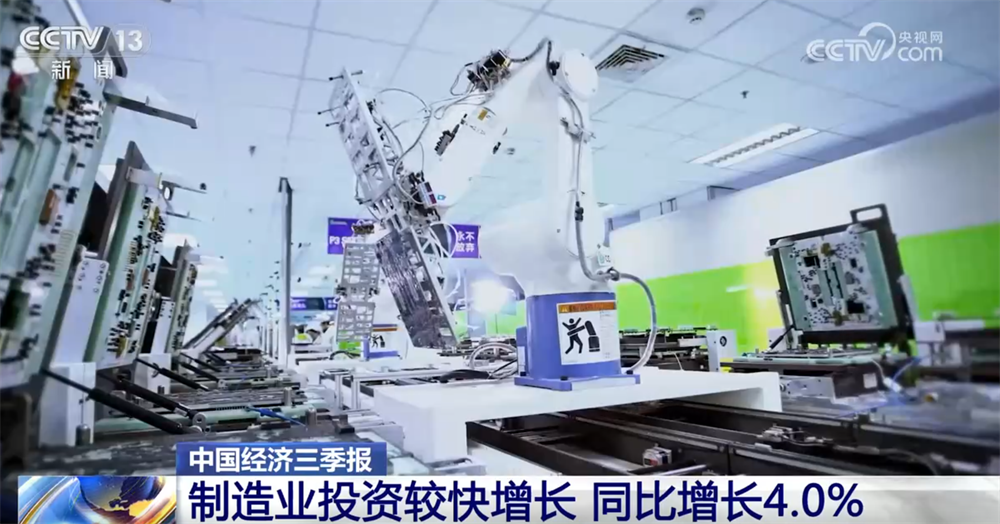
Economic Growth - China's GDP grew by 5.2% year-on-year in the first three quarters of this year, with industrial production increasing by 6.2% [1][3] - Manufacturing investment saw a rapid growth of 4.0% year-on-year [1] Consumer Market - The total retail sales of consumer goods reached 365,877 billion yuan, with a year-on-year growth of 4.5%, accelerating by 1.2 percentage points compared to the same period last year [4] - Urban and rural markets are expanding, with urban retail sales growing by 4.4% and rural retail sales by 4.6%, the latter outpacing urban growth by 0.2 percentage points [4] Income and Consumption - Rural residents' per capita disposable income increased by 6%, surpassing urban growth of 1.5% and the national average [7] - Online retail sales grew by 9.8% year-on-year, with green consumption and high-efficiency appliances also seeing significant growth [7] Service Sector - The service sector achieved a year-on-year growth of 5.4%, contributing 60.7% to the national economic growth [10] - Key areas such as information transmission, software, and IT services saw increases of 11.2% and 9.2% respectively [10] Innovation and New Consumption Models - The integration of "AI + consumption" is accelerating, with new technologies enhancing consumer experiences and meeting demands for quality and diversity [9][13] - The "service +" model is expanding, linking various service sectors like dining, accommodation, and travel, driving service consumption growth [16]

国家统计局公布2025年三季度国内生产总值初步核算结果
Mei Ri Jing Ji Xin Wen· 2025-10-21 01:49
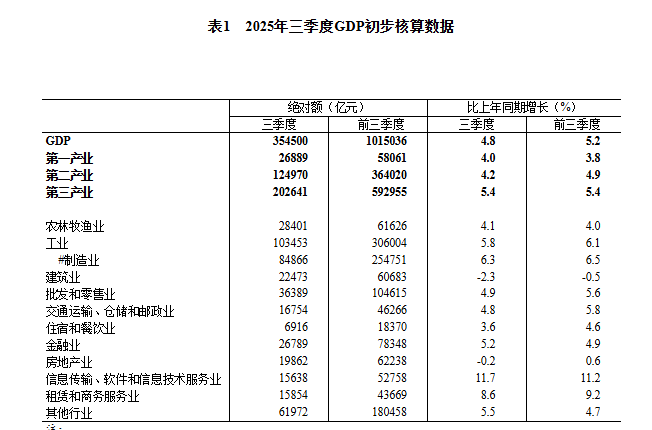
Core Insights - The National Bureau of Statistics reported a preliminary calculation of GDP for Q3 2025, indicating a year-on-year growth of 4.8% [1] - The information transmission, software, and information technology services industry experienced a significant growth of 11.7% year-on-year in Q3 [1] GDP Overview - Q3 GDP reached 354,500 billion, with a cumulative total of 1,015,036 billion for the first three quarters [3] - The growth rates for various sectors in Q3 include: - Primary industry: 4.0% - Secondary industry: 4.2% - Tertiary industry: 5.4% [3] Sector Performance - Information transmission, software, and information technology services industry: - Q3 revenue: 15,638 billion - Year-on-year growth: 11.7% - First three quarters revenue: 52,758 billion [3] - Other notable sectors: - Manufacturing: 6.3% growth - Wholesale and retail: 4.0% growth - Real estate: -0.2% growth [3]
2025年三季度国内生产总值初步核算结果
Guo Jia Tong Ji Ju· 2025-10-21 01:30
Core Points - The preliminary GDP results for the third quarter of 2025 indicate a GDP of 354,500 billion with a year-on-year growth of 4.8% and a growth of 5.2% for the first three quarters [8][5][4] - The primary industry grew by 4.0%, the secondary industry by 4.2%, and the tertiary industry by 5.4% in the third quarter [8][5] - The manufacturing sector showed a robust growth of 6.3%, while the construction industry faced a decline of 2.3% [8][5] GDP Growth Rates - Year-on-year growth rates for GDP from 2020 to 2025 show fluctuations, with 2025 projected to have a growth of 5.4% in Q1, 5.2% in Q2, and 4.8% in Q3 [5][4] - The quarterly growth rates indicate a consistent recovery post-pandemic, with 2023 showing a growth of 4.7% in Q1 and 6.5% in Q2 [5][4] Industry Performance - The agricultural sector (including forestry, animal husbandry, and fishery) reported a growth of 4.1% in Q3 2025 [8] - The industrial sector, particularly manufacturing, continues to be a strong contributor to GDP, with a growth rate of 6.3% [8] - The financial sector also showed positive growth at 5.2%, while the real estate sector faced challenges with a slight decline of 0.2% [8] Data Sources and Methodology - The GDP data is calculated using the production method, which reflects the value added by various industries [12][11] - The classification of industries follows the national standards set by the National Bureau of Statistics, ensuring consistency in reporting [22][23] - The GDP figures are subject to revisions as more comprehensive data becomes available, ensuring accuracy in reflecting economic conditions [33][34]
国民经济稳中有进显韧性——国家统计局相关部门负责人解读前三季度主要经济数据
Jing Ji Ri Bao· 2025-10-21 00:52
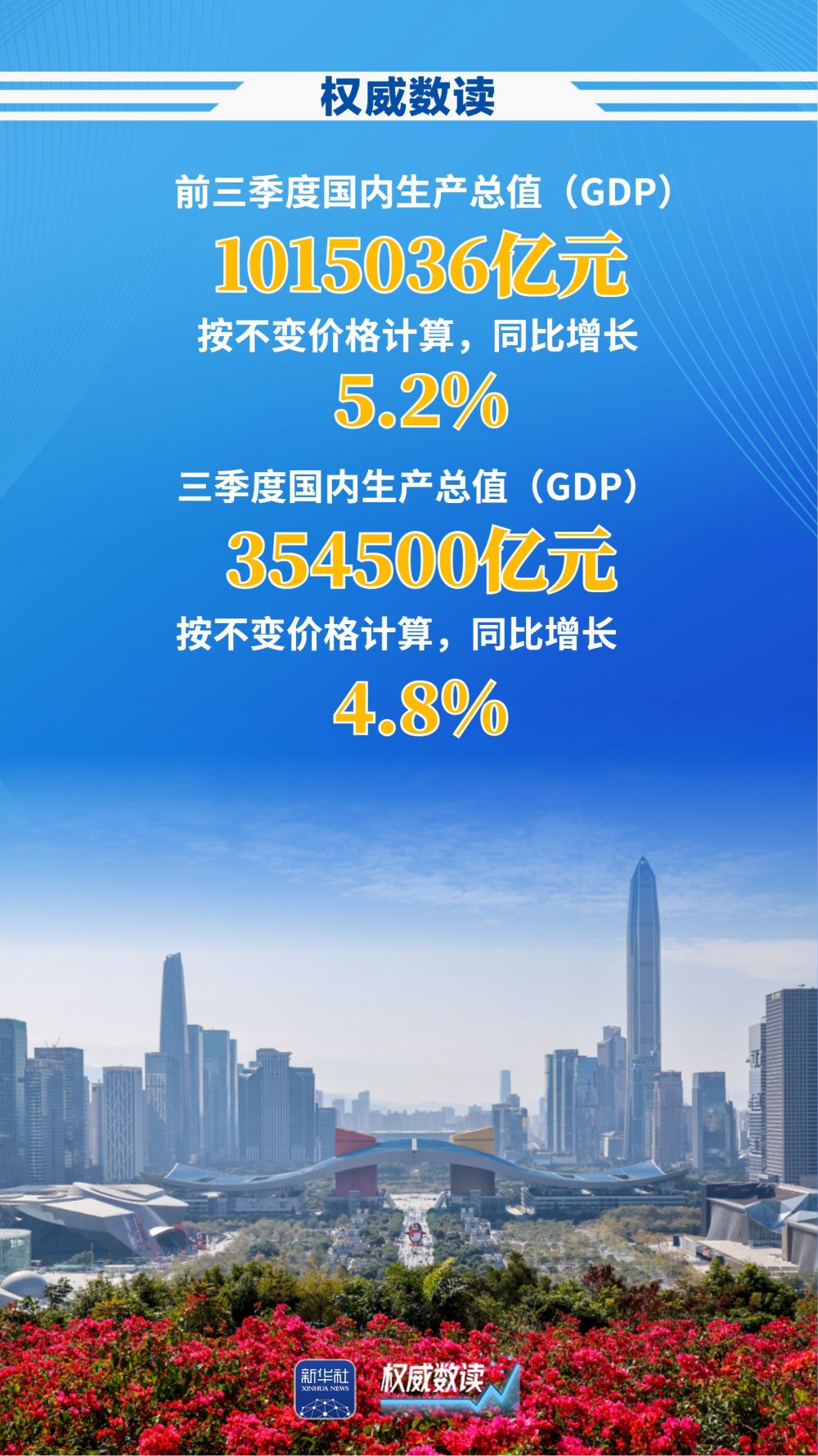
Economic Overview - The national economy is operating smoothly with high-quality development being steadily advanced under the strong leadership of the central government [1] - In the first three quarters, China's GDP reached 10,150.36 billion yuan, growing by 5.2% year-on-year [2] - The GDP for the third quarter was 3,545 billion yuan, with a year-on-year growth of 4.8% [3] Production and Supply - All sectors showed stable growth, with agriculture, industry, and services contributing positively to economic growth [4] - Agricultural production increased by 4.0%, contributing 0.3 percentage points to economic growth [4] - Industrial production grew by 6.1%, contributing 1.8 percentage points to economic growth [4] - The service sector's value added increased by 5.4%, contributing 3.1 percentage points to GDP growth [23] Domestic Demand and Trade - Final consumption expenditure contributed 53.5% to economic growth, adding 2.8 percentage points to GDP [5] - Capital formation contributed 17.5% to economic growth, adding 0.9 percentage points to GDP [6] - Net exports contributed 29.0% to economic growth, adding 1.5 percentage points to GDP [6] Market Dynamics and New Growth Drivers - The digital economy showed significant support, with revenue from information transmission and software services growing by 12.1% [7] - The manufacturing sector is undergoing transformation, with high-tech manufacturing increasing by 9.6% [7] - Investment in high-tech services grew by 6.1%, indicating a shift towards new growth drivers [30] Agricultural Sector - The agricultural economy is showing a stable and positive trend, with autumn grain production expected to be stable [8] - Livestock production is also stable, with pork production increasing by 3.0% [10] Industrial Development - Industrial production increased by 6.2% in the first three quarters, with 37 out of 41 major industrial sectors showing growth [14] - The export value of industrial products grew by 3.3%, indicating resilience in the industrial sector [14] Energy Sector - Energy production is steadily increasing, with coal production at 3.57 billion tons, up 2.0% year-on-year [18] - The share of non-fossil energy consumption is steadily rising, with a 1.7 percentage point increase compared to the previous year [21] Service Sector Growth - The service sector's value added reached 592,955 million yuan, growing by 5.4% [23] - The modern service industry is thriving, with significant growth in information technology and business services [24] Investment Trends - Fixed asset investment reached 371,535 billion yuan, a slight decline of 0.5% year-on-year, primarily due to real estate investment [26] - Industrial investment grew by 6.4%, contributing positively to overall investment growth [27] Consumer Market Expansion - Retail sales of consumer goods reached 365,877 billion yuan, growing by 4.5% year-on-year [33] - Online retail sales increased by 9.8%, indicating a shift towards digital consumption [36] Employment Stability - The urban unemployment rate averaged 5.2%, with major cities showing slightly lower rates [38] - Employment in key sectors such as transportation and hospitality has increased, reflecting a stable job market [39] Resident Income and Consumption - Per capita disposable income reached 32,509 yuan, growing by 5.1% year-on-year [41] - Per capita consumption expenditure was 21,575 yuan, with significant growth in categories like household goods and services [43]
前三季度增长5.2%,政策需持续加力提效
2 1 Shi Ji Jing Ji Bao Dao· 2025-10-20 22:45
国家统计局新闻发言人表示,三季度GDP增速回落是多种因素共同作用的结果。尽管经济增速有所回 落,但经济稳中有进发展态势没有变。实现全年预期目标(5%左右)有基础有支撑,但也需要付出艰 苦努力。 二是生产继续强于需求。9月工业增加值同比增长6.5%,与9月中国出口增速8.3%相呼应,其中高技术 制造业同比增长10.3%。9月服务业生产指数同比增长5.6%,其中信息传输、软件和信息技术服务业同 比增长12.8%,体现出产业转型升级对经济的支撑力度。 供需分化的"温差"也在价格中有所体现。三季度GDP平减指数为-1.1%,相比二季度的-1.3%略有收窄, 还需要通过改革发力、政策给力来着力缩小"温差"。尽管四季度受高基数影响,经济增速或许会面临一 定挑战,但通过政策发力,相信全年能够顺利实现5%的增长目标。 一方面,消费和出口的韧性仍强。四季度社零增速或在高基数等因素的影响下,有所放缓。但值得关注 的是,目前政策正在加大对服务消费的支持力度,且服务消费的韧性更强,预计最终消费对GDP的支撑 或有望维持一定韧性。今年9月,商务部等9部门印发《关于扩大服务消费的若干政策措施》,提出培育 服务消费促进平台、丰富高品质服务 ...
前三季度国内生产总值同比增长5.2%
Ren Min Ri Bao· 2025-10-20 22:10
Economic Overview - The preliminary data for the first three quarters indicates that the GDP reached 10,150.36 billion yuan, reflecting a year-on-year growth of 5.2% at constant prices, showcasing a stable and progressive economic operation with positive outcomes in high-quality development [1] Agriculture Sector - The agricultural production situation is favorable, with the value added in agriculture (planting) increasing by 3.6% year-on-year. The summer grain and early rice output increased by 190,000 tons compared to the previous year, and the overall autumn grain production remains stable, indicating a potential for another bumper harvest for the year [1] Industrial Sector - The industrial production has shown rapid growth, with the value added of large-scale industrial enterprises increasing by 6.2% year-on-year in the first three quarters. Specifically, the value added in equipment manufacturing and high-tech manufacturing grew by 9.7% and 9.6% respectively [1] Service Sector - The service industry has experienced steady growth, with a year-on-year increase of 5.4% in value added. Notably, the information transmission, software, and IT services sector saw an increase of 11.2%, while leasing and business services, as well as transportation, warehousing, and postal services, grew by 9.2% and 5.8% respectively [1] Consumer Spending and Investment - The total retail sales of consumer goods reached 3,658.77 billion yuan, marking a year-on-year growth of 4.5%. Additionally, manufacturing investment increased by 4.0% year-on-year [1] Income Growth - The per capita disposable income for residents reached 32,509 yuan, reflecting a nominal year-on-year growth of 5.1%, and a real growth of 5.2% after adjusting for price factors [2]
前三季度国内生产总值同比增长5.2% 经济运行保持稳中有进态势
Ren Min Ri Bao· 2025-10-20 21:57
Economic Overview - The preliminary data for the first three quarters indicates that the GDP reached 10,150.36 billion yuan, reflecting a year-on-year growth of 5.2% at constant prices, demonstrating a stable and progressive economic operation with positive outcomes in high-quality development [1] Agriculture Sector - The agricultural production situation is favorable, with the value added in agriculture (planting) increasing by 3.6% year-on-year. The summer grain and early rice production increased by 190,000 tons compared to the previous year, and the overall autumn grain production remains stable, suggesting a potential for another bumper harvest for the year [1] Industrial Sector - The industrial production has shown rapid growth, with the value added of large-scale industrial enterprises increasing by 6.2% year-on-year in the first three quarters. Specifically, the value added in equipment manufacturing and high-tech manufacturing grew by 9.7% and 9.6% respectively [1] Service Sector - The service industry has experienced steady growth, with the value added increasing by 5.4% year-on-year. Notably, the information transmission, software, and IT services sector saw an increase of 11.2%, while leasing and business services, as well as transportation, warehousing, and postal services, grew by 9.2% and 5.8% respectively [1] Consumer Spending and Investment - The total retail sales of consumer goods reached 3,658.77 billion yuan, marking a year-on-year growth of 4.5%. Additionally, manufacturing investment increased by 4.0% year-on-year [1] Income Growth - The per capita disposable income of residents reached 32,509 yuan, reflecting a nominal year-on-year growth of 5.1%, and a real growth of 5.2% after adjusting for price factors [2]
权威数读|5.2%!前三季度经济延续稳中有进态势
Xin Hua She· 2025-10-20 08:33
Economic Overview - The Chinese economy has shown resilience and vitality, maintaining a steady development trend despite external pressures and internal challenges [1]. Agriculture Sector - The added value of agriculture (planting industry) increased by 3.6% year-on-year, with the total summer grain and early rice output reaching 178.25 million tons, an increase of 190,000 tons or 0.1% compared to the previous year [7]. Manufacturing Sector - The industrial added value of enterprises above designated size grew by 6.2% year-on-year, with the added value of equipment manufacturing increasing by 9.7% and high-tech manufacturing by 9.6% [11]. Service Sector - The modern service industry has developed well, with the added value of information transmission, software, and IT services growing by 11.2%, leasing and business services by 9.2%, and transportation, warehousing, and postal services by 5.8% [15]. Retail Sector - The total retail sales of consumer goods reached 3.65877 trillion yuan, a year-on-year increase of 4.5%, while online retail sales amounted to 1.1283 trillion yuan, growing by 9.8% year-on-year [18]. Trade Sector - The import and export of goods continued to grow, with an ongoing optimization of the trade structure [19].
2025年前三季度与9月宏观经济数据
Guan Tong Qi Huo· 2025-10-20 07:26
Report Summary 1. Report Industry Investment Rating No information provided in the content. 2. Core Viewpoints - China's economy showed stable growth in the first three quarters of 2025, with GDP growing by 5.2% year - on - year at constant prices. The service and industrial sectors played important roles, and consumption, investment, and net exports all contributed to economic growth [3]. - Industrial production was stable, and the service industry was on an upward trend, strongly supporting economic growth. Consumption potential continued to be released, and investment played a key role in promoting traditional industrial transformation and upgrading. Net exports maintained stable growth [3][4][5][6]. 3. Summary by Relevant Catalogs GDP - In the first three quarters of 2025, China's GDP was 1,015,036 billion yuan, growing by 5.2% year - on - year at constant prices. In Q3, GDP was 354,500 billion yuan, growing by 4.8% year - on - year and 1.1% quarter - on - quarter [3]. - The added values of the primary, secondary, and tertiary industries in the first three quarters were 58,061 billion yuan, 364,020 billion yuan, and 592,955 billion yuan respectively, with year - on - year growth rates of 3.8%, 4.9%, and 5.4%, and contributions to economic growth of 4.7%, 34.6%, and 60.7% [3]. Industry - In the first three quarters, industrial added value increased by 6.1% year - on - year, driving economic growth by 1.8 percentage points. Manufacturing added value grew by 6.5%, higher than the industrial growth rate. In Q3, industrial added value increased by 5.8% year - on - year, driving economic growth by 1.7 percentage points [3]. - The capacity utilization rate of large - scale industrial enterprises in Q3 2025 was 74.6%, up 0.6 percentage points from Q2 and down 0.5 percentage points from the same period last year [3]. Service - In the first three quarters, service industry added value was 592,955 billion yuan, growing by 5.4% year - on - year, accounting for 58.4% of GDP, up 0.8 percentage points from the same period last year, and contributing 60.7% to national economic growth, driving GDP growth by 3.1 percentage points [4]. - In Q3, service industry added value was 202,641 billion yuan, growing by 5.4% year - on - year, accounting for 57.2% of GDP, contributing 61.8% to national economic growth, and driving GDP growth by 3.0 percentage points [4]. Consumption - Consumption potential continued to be released. In the first three quarters, the contribution rate of final consumption expenditure to economic growth was 53.5%, driving GDP growth by 2.8 percentage points. In Q3, it was 56.6%, driving GDP growth by 2.7 percentage points [4]. Investment - Investment played a key role. In the first three quarters, the contribution rate of capital formation to economic growth was 17.5%, driving GDP growth by 0.9 percentage points. In Q3, it was 18.9%, driving GDP growth by 0.9 percentage points [5]. - In the first three quarters, infrastructure investment increased by 1.1% year - on - year, driving total investment growth by 0.2 percentage points. Internet and related service investment grew by 20.6%, and water transportation investment grew by 12.8% [5]. - From January to September, real estate development investment was 677.06 billion yuan, a year - on - year decrease of 13.9%. Residential investment was 520.46 billion yuan, a decrease of 12.9% [5]. Import and Export - Net exports maintained stable growth. In the first three quarters, the contribution rate of goods and services net exports to economic growth was 29.0%, driving GDP growth by 1.5 percentage points. In Q3, it was 24.5%, driving GDP growth by 1.2 percentage points [6]. Prices - In the first three quarters, consumer prices were generally stable, with CPI down 0.1% year - on - year. Core CPI increased by 0.6% year - on - year, with the growth rate expanding by 0.2 percentage points compared to the first half of the year [6]. - PPI was down 2.8% year - on - year in the first three quarters, with a decline of 2.9% in Q3, narrowing by 0.3 percentage points compared to Q2 [6].
服务业调查中心主任:服务业经济平稳运行,新动能加快发展
Guo Jia Tong Ji Ju· 2025-10-20 02:44
Group 1: Economic Growth of the Service Sector - The service sector's contribution to economic growth is significant, with a value added of 592,955 billion yuan in the first three quarters, representing a year-on-year growth of 5.4% [2] - The service sector accounted for 58.4% of GDP, an increase of 0.8 percentage points from the previous year, contributing 60.7% to national economic growth [2] - In September, the service production index grew by 5.6% year-on-year, indicating sustained growth [2] Group 2: Innovation and New Momentum - The modern service industry is thriving, with significant growth in information transmission, software, and IT services, which saw a year-on-year increase of 11.2% and 9.2% respectively [3] - These sectors contributed 1.7 percentage points to the growth of the service sector's value added [3] - The high-tech service industry is also expanding, with fixed asset investment growing by 6.1% year-on-year [4] Group 3: Service Consumption Upgrade - Service retail sales increased by 5.2% year-on-year, outpacing the growth of goods retail sales by 0.6 percentage points [5] - Online retail sales grew by 9.8% in the first three quarters, reflecting a shift towards digital consumption [5] - The cultural and tourism sectors are experiencing robust growth, with significant increases in revenue for cultural arts and travel services [5] Group 4: High-Level Opening of the Service Sector - Service trade is steadily increasing, with a total import and export value of 52,476.9 billion yuan, a year-on-year growth of 7.4% [6] - The number of foreign visitors benefiting from visa-free policies increased by 52.1% [6] - The actual use of foreign capital in the service sector reached 3,661.9 billion yuan, accounting for over 70% of total foreign capital utilization [6] Group 5: Business Activity and Future Outlook - The business activity index for the service sector was at 50.1% in September, indicating expansion [7] - The business activity expectation index remained stable and optimistic at 56.3% [7] - Overall, the service sector is maintaining a steady operational trend, with ongoing improvements in development quality [8]