
家电制造

Search documents
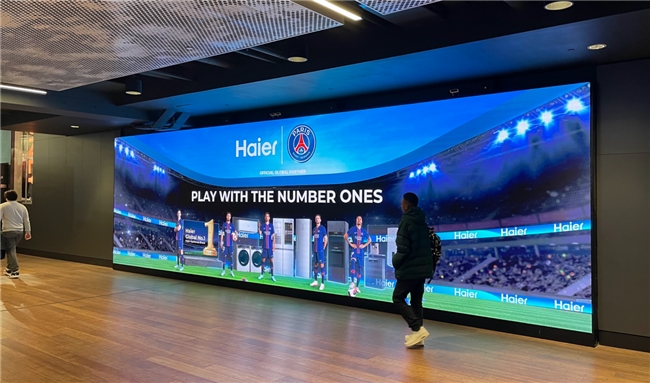
海尔携手巴黎圣日耳曼发布新年TVC在13国上线
Jin Tou Wang· 2026-01-04 03:25
Core Viewpoint - Haier's collaboration with Paris Saint-Germain (PSG) exemplifies the company's effective use of sports marketing to enhance its global brand presence and drive its globalization strategy [1][3][7]. Group 1: Partnership and Brand Alignment - The partnership between Haier and PSG began in September 2025, marking Haier as PSG's global official partner, which garnered significant industry attention [3]. - 2025 was a landmark year for PSG, as the team won its first UEFA Champions League title and achieved a "five crowns" honor, showcasing its dominance in football [3]. - The New Year TVC reflects the synergy between the two brands, illustrating Haier's brand philosophy of "walking with champions" through the connection of PSG players' on-field efforts and Haier's home appliance lifestyle [3]. Group 2: Sports Marketing Strategy - Haier's commitment to sports marketing dates back to 2003, starting with a partnership with the UK’s Shark Rugby Team, and has since expanded to various sports including tennis, football, volleyball, and more [5]. - The company has developed a comprehensive sports interaction system that utilizes events, brand displays, and community engagement to break cultural barriers and effectively communicate its brand values [5]. - This long-term dedication to sports marketing has significantly enhanced Haier's global brand recognition and competitive position, leading to substantial market share in regions such as Southeast Asia, Europe, Australia, Pakistan, and the Middle East [5]. Group 3: Future Globalization Strategy - The New Year TVC marks the culmination of Haier's 2025 sports marketing efforts and signals the beginning of a new phase in its globalization strategy for 2026 [7]. - Haier's deep collaboration with PSG serves as a model for Chinese brands aiming for global expansion, emphasizing the importance of quality and cultural connection [7]. - The company plans to continue advancing its globalization strategy, aiming to showcase the strength of Chinese brands on the world stage [7].


2026年“两新”工作优化升级、精准发力首批支持以旧换新资金计划提前下达
Xin Lang Cai Jing· 2026-01-03 23:23
Core Insights - The National Development and Reform Commission and the Ministry of Finance have issued a notice for the implementation of a large-scale equipment update and consumer goods replacement policy for 2026, with a focus on optimizing and upgrading the "Two New" work [1] Group 1: Policy Implementation - A total of 625 billion yuan in special bonds will be allocated to support the consumer goods replacement program, with funds being distributed ahead of the peak consumption seasons [1] - The policy will expand support for equipment updates in various sectors, including public safety, elderly care, and commercial facilities, to better meet public needs [1][2] Group 2: Consumer Subsidies - The policy will provide subsidies for scrapping and replacing vehicles, offering 12% of the purchase price (up to 20,000 yuan) for new energy vehicles and 10% (up to 15,000 yuan) for fuel vehicles with an engine size of 2.0 liters or less [2] - For household appliances, consumers will receive a 15% subsidy on the purchase price (up to 1,500 yuan) for energy-efficient products such as refrigerators, washing machines, and air conditioners [2][3] Group 3: Digital and Smart Products - The policy will also support the purchase of digital and smart products, providing a 15% subsidy (up to 500 yuan) for items like smartphones and smartwatches, with a focus on expanding the range to include smart glasses [3]
去年以旧换新商品销售额超2.6万亿元
Xin Lang Cai Jing· 2026-01-02 22:39
Group 1 - The core viewpoint of the articles highlights the significant impact of the "trade-in for new" policy on consumer spending and economic growth, projecting a sales volume exceeding 2.6 trillion yuan by 2025, benefiting over 360 million people [1][2] Group 2 - In the automotive sector, over 11.5 million vehicles are expected to be traded in, with nearly 60% being new energy vehicles, contributing to a retail market share of over 50% for new energy passenger cars for nine consecutive months [1] - The home appliance sector anticipates over 129 million units to be traded in, with over 90% of new products being first-class energy efficiency [1] - The retail sales of consumer goods increased by 4.0% year-on-year in the first eleven months of the previous year, with the trade-in policy contributing over 1 percentage point to this growth [1] Group 3 - The policy is expected to promote a green economic transformation, with a projected 24.5% increase in scrapped vehicle recovery by 2025, leading to the recycling of approximately 9.6 million tons of steel and 1.3 million tons of non-ferrous metals, while reducing carbon emissions by about 24.5 million tons [1] - Since the full implementation of the policy in September 2024, over 480 million direct subsidies have been issued to consumers, facilitating the entry of numerous green, low-carbon, and smart products into daily life [2] Group 4 - The trade-in policy has stimulated offline retail, with consumers increasingly opting for in-store experiences, leading to a 30% increase in consumer spending in areas with concentrated home appliance trade-in stores [2]
2026开门红!多板块共振上涨,港股半导体股领涨,百度拟分拆昆仑芯催化科网股
Zheng Quan Shi Bao· 2026-01-02 04:48
Market Overview - The Hong Kong stock market opened strong on the first trading day of 2026, with the Hang Seng Technology Index rising over 3.5% and the Hang Seng Index increasing by more than 2% [1] - Key sectors such as semiconductors, internet giants, home appliances, and automobiles showed significant gains, driven by favorable policies [1] Semiconductor Sector - The semiconductor sector experienced a collective surge, with companies like Hua Hong Semiconductor rising over 10% and SMIC increasing by more than 5% [1] - Hua Hong Semiconductor announced plans to acquire a 97.4988% stake in Huali Micro for a transaction price of 8.268 billion yuan, aiming to enhance its 12-inch wafer foundry capacity [2] - The semiconductor industry is benefiting from a price surge in the supply chain, sustained AI demand, and a strengthened domestic substitution logic [2] Internet Sector - Internet giants such as Baidu, NetEase, Tencent, and Alibaba saw significant stock price increases, with Baidu rising over 8% following its announcement to spin off Kunlun Chip for an independent listing on the Hong Kong Stock Exchange [3] - The move to list Kunlun Chip is expected to stimulate Baidu's stock performance further [3] Home Appliances and Automotive Sector - The home appliance and automotive sectors are also experiencing strong performance, supported by government policies promoting the replacement of old appliances and vehicles [3] - The National Development and Reform Commission and the Ministry of Finance announced continued subsidies for vehicle scrappage and replacement, as well as for home appliance upgrades, which are expected to boost domestic consumption [4] - Analysts suggest that the continuation of these policies will stabilize the automotive market and alleviate consumer hesitation, benefiting companies in the new car cycle and those focusing on high-end and intelligent products [5]
刚刚,全线大涨!
券商中国· 2026-01-02 03:51
Core Viewpoint - The Hong Kong stock market experienced a strong opening on the first trading day of 2026, with significant gains in various sectors, particularly in technology, home appliances, and automotive, driven by favorable policies and market dynamics [1][2]. Semiconductor Sector - The semiconductor sector saw a collective surge, with notable increases in stock prices: Huahong Semiconductor rose over 10%, SMIC increased by over 5%, and Shanghai Fudan gained over 4% [2]. - Huahong Semiconductor announced plans to acquire a 97.4988% stake in Huahong Micro for a transaction price of 8.268 billion, aiming to enhance its 12-inch wafer foundry capacity [2]. - The semiconductor industry is benefiting from a price surge in the supply chain, sustained AI demand, and a strengthened domestic substitution logic, indicating a structural market trend [3]. Internet, Home Appliances, and Automotive Sectors - Major internet companies like Baidu, NetEase, Tencent, and Alibaba saw significant stock price increases, with Baidu rising over 8% following its announcement to spin off Kunlun Chip for independent listing on the Hong Kong Stock Exchange [4]. - The home appliance sector is expected to benefit from the continuation of the "old-for-new" policy, which includes subsidies for replacing old appliances, thus stabilizing domestic consumption [5]. - The automotive sector is also poised for recovery due to supportive policies, with a focus on high-end, intelligent, and export-oriented vehicles, as well as components related to automotive technology [5].

AR眼镜可省500元!今年首单国补落地广州
Nan Fang Du Shi Bao· 2026-01-01 23:58
Group 1 - The 2026 consumer goods trade-in subsidy policy was officially launched in Guangzhou on January 1, 2026, allowing consumers to receive subsidies for purchasing certain digital products and home appliances [2][3] - Consumers can receive a subsidy of 15% of the sales price for digital products such as smartphones, tablets, and smart wearables, with a maximum subsidy of 500 yuan per item [2] - The policy also covers six categories of home appliances, including refrigerators, washing machines, televisions, air conditioners, computers, and water heaters, which must meet specific energy efficiency standards [2] Group 2 - The automobile trade-in subsidy has shifted from a fixed amount to a subsidy based on the tax-inclusive transaction price of new cars, with set limits [3] - For scrapping and updating vehicles, consumers can receive a subsidy of 12% (up to 20,000 yuan) for purchasing new energy vehicles and 10% (up to 15,000 yuan) for fuel vehicles [3] - When replacing old vehicles with new ones, consumers can receive an 8% subsidy (up to 15,000 yuan) for new energy vehicles and a 6% subsidy (up to 13,000 yuan) for fuel vehicles [3]
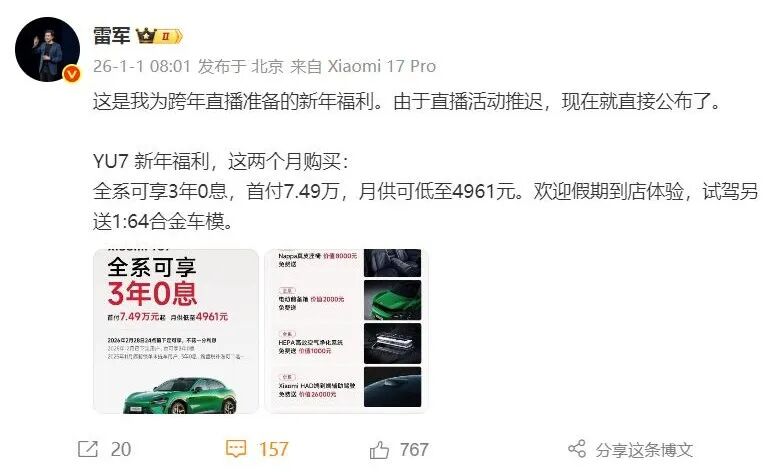
雷军公布,小米汽车新年福利
Zhong Guo Zheng Quan Bao· 2026-01-01 05:13
Core Viewpoint - Xiaomi Group is promoting its new energy vehicle, YU7, with a three-year interest-free installment plan, aiming to enhance sales and customer engagement through promotional activities and live events [1][3]. Group 1: Product Promotion and Sales Strategy - Xiaomi's chairman Lei Jun announced a promotional campaign for the YU7, offering a three-year interest-free financing option with a down payment of 74,900 yuan and monthly payments as low as 4,961 yuan [1]. - The promotion is designed to attract customers during the holiday season, with additional incentives such as a 1:64 scale model car for test drivers [1]. Group 2: Production and Delivery Milestones - Xiaomi's automotive division reached a significant milestone by producing its 500,000th vehicle in just over one year and seven months [3]. - As of December 2025, Xiaomi has delivered over 500,000 vehicles, with more than 350,000 units delivered in that year alone [3]. Group 3: Financial Performance - In November 2025, Xiaomi reported a third-quarter revenue of 113.12 billion yuan, a year-on-year increase of 22.3%, with an adjusted net profit of 11.3 billion yuan, up 80.9% [4]. - The revenue from the smart electric vehicle and AI innovation segment reached 29 billion yuan, showing a growth of over 199% year-on-year, with the electric vehicle segment contributing 28.3 billion yuan [4]. - This segment achieved its first quarterly operating profit of 700 million yuan [4].

政策落地,未来三十年大机遇在等你
Sou Hu Cai Jing· 2026-01-01 01:48
今天是2025年最后一个交易日,利好很多: 一个利好是12月制造业PMI50.1%,久违的回归荣枯线以上,预示着12月制造业显著回暖,从细分行业数据看,制造业回暖主要受益于节前备货,集中于食 品饮料、纺织服装、消费电子等行业,可能也受到12月大宗商品市场活跃的影响,希望26年初能够保持这种趋势,毕竟经济才是股市上涨的底气。 还有一个政策利好是国补政策基本落地。发改委、财政部印发《关于2026年实施大规模设备更新和消费品以旧换新政策的通知》。 有观点认为国补政策略有遗憾,因为没有2025年力度大,虽然多了一个AI眼镜,但少了微波炉、净水器、洗碗机和电饭煲等,且家电上限从2000下降到 1500,汽车国补还有比例限制。 的确,2026年的国补的确针对性更强,力度有所减弱,但话又说回来了,有,总比没有好吧。要知道,2025年10月之后,事实上国补资金已经用完,耐用消 费品的消费热度瞬间下滑,所以,有国补,势必让2026年上半年的市场恢复热度。 当然,也要考虑耐用消费品的特性,25年买了,26年就不会有需求,但话还是要两说,中国人多,市场纵深大,没那么容易饱和。 所以,有国补,就是好消息,就能让汽车制造、家电制造、数 ...
2025家电收官:空调价格战白热化,港股上市潮涌
Bei Ke Cai Jing· 2025-12-31 13:41
谈及家电行业"内卷",格力电器董事长董明珠向记者表示,家电行业竞争非常激烈,大家不再追求技术 突破,简单地偷工减料,以价格忽悠用户。如果图便宜买1000元的空调,面临的维修成本远远大于购买 一台质量好的产品,劣质产品耗电量也是正常产品耗电量的翻倍。 市场"价格战"悄然改变行业格局。小米集团合伙人、总裁卢伟冰在2025年年初提到,"小米空调2024年 是中国市场第四名,今年目标坐稳第三名,最近提出2030年目标,在中国市场空调要做到数一数二。虽 然目标蛮难,但我认为小米机会很大。" 2025年收官,家电行业经历了市场竞争与资本布局的双重变革。空调赛道成为最热门领域,政策引导下 的多重补贴引发激烈价格战,"千元机"频现,行业均价结构性下探,不仅导致头部品牌市场份额收缩, 也让小米等新势力借机崛起,行业格局悄然生变。 资本市场方面,A股家电及消费电子企业赴港上市热潮涌动,奥克斯电气成功登陆港股,石头科技、极 米科技、视源股份等纷纷推进"H股上市"计划,以"A股+H股"双平台布局拓展融资渠道、加速全球化进 程,为行业发展注入新的资本动力,2026年行业竞争与布局或将更趋激烈。 价格战下,空调头部企业份额收缩 2025 ...
深圳市将于2026年1月1日全面启动以旧换新
Di Yi Cai Jing· 2025-12-31 12:50
Group 1 - The core point of the article is that Shenzhen will fully implement subsidies for vehicle scrapping and replacement, as well as for the replacement of certain home appliances and digital products starting January 1, 2026 [1] Group 2 - For vehicle scrapping and replacement, the maximum subsidy for new energy vehicles is 20,000 yuan, while for fuel vehicles it is 15,000 yuan [1] - The subsidy for purchasing new energy passenger vehicles is up to 15,000 yuan, and for fuel passenger vehicles, it is up to 13,000 yuan [1] Group 3 - Subsidies for six categories of home appliances will be 15% of the product sales price, with a cap of 1,500 yuan per item for each consumer, limited to one item per category [1] - For four categories of digital and smart products, the subsidy will also be 15% of the product sales price, with a cap of 500 yuan per item for each consumer, limited to one item per category [1]