军工

Search documents
*ST亚太2026年2月3日涨停分析:重整成功+战略投资+双轮驱动
Xin Lang Cai Jing· 2026-02-03 05:17
Group 1 - The core point of the article is that *ST Asia Pacific has reached a trading limit with a price of 8.72 yuan, reflecting a 5.06% increase, and a total market value of 4.228 billion yuan, driven by successful restructuring and strategic investments [1] Group 2 - The company has completed its restructuring plan, with the court ruling to terminate the restructuring process, resolving debt issues [1] - Seven strategic investors, including Beijing Xingrui Qiyuan, have invested a total of 404 million yuan, along with a cash donation of 73 million yuan, significantly improving the company's financial situation [1] - The company has proposed a "fine chemicals + military industry" dual-driven strategy, clarifying its operational direction and tapping into growth potential in both sectors [1] - On January 26, 2026, major shareholder Zhang Wenfeng increased his holdings by 500,000 shares, indicating confidence in the company's future and potentially attracting market interest [1]

港股午评:恒指微涨0.2%、科指跌1.32%,商业航天概念股走高,黄金股反弹,科网股集体低迷
Jin Rong Jie· 2026-02-03 04:10
Market Overview - The Hong Kong stock index experienced a "V" shaped movement, with the Hang Seng Index rising by 0.2% to 26,830.23 points, while the Hang Seng Tech Index fell by 1.32% to 5,453.46 points [1] - Major technology stocks declined, with Alibaba down 1.78%, Tencent down 3.09%, and JD Group down 0.45% [1] - Commercial aerospace stocks saw significant gains, with Asia Pacific Satellite rising over 9% [1] - Chinese brokerage stocks weakened, with CICC falling over 2% [1] - Gold and silver stocks rebounded, with WanGuo Gold rising over 6% and Luoyang Molybdenum up over 4% [1] Company News - Cloud Factory (02512.HK) secured a contract for the second phase of an AI industrial base project valued at RMB 520 million [2] - ZTE Corporation (00763.HK) plans to invest RMB 117 million in the Jianxing Zhanlu Fund to support innovation businesses and related industries [2] - XPeng Motors (09868.HK) delivered 20,011 new vehicles in January [3] - Laijin Entertainment (08172.HK) received authorization from Ant Group to become an official service provider for "Ant Treasure Box" [4] - Jun Dong Holdings (08277.HK) signed a timber harvesting and sales agreement with Jinda Forestry [5] - Universal Medical (02666.HK) plans to issue corporate bonds totaling up to RMB 1 billion [6] - Blue River Holdings (00498.HK) entered into a cooperation framework agreement with Energy Storage Investment Company [7] - China Merchants Jinling (00978.HK) reported a contract sales total of approximately RMB 32.308 billion for 2025, a year-on-year decrease of 23.91% [8] - Junsheng Tai Pharmaceutical (02511.HK) appointed Dr. Filip Surmont as Chief Medical Officer to strengthen its focus on cardiovascular and metabolic diseases [8] Institutional Insights - Huatai Securities noted a significant pullback in A-shares and Hong Kong stocks, driven by the "Wall Street" trading sentiment, leading to liquidity pressure [9] - The adjustment is seen as more technical and emotional, with a positive medium-term outlook for Chinese assets [9] - Galaxy Securities highlighted ongoing geopolitical risks and a decrease in expectations for Fed rate cuts, predicting continued volatility in Hong Kong stocks [9] - Recommended sectors include technology, energy, precious metals, and consumer stocks, which are expected to rebound as consumption policies increase ahead of the Spring Festival [9] - Huatai Securities indicated that the sentiment index has shifted from panic to optimism, suggesting that current volatility may persist but is more likely to be a pullback rather than a reversal [10]
港股午评:科技股下挫,科指跌1.32%,恒指回升转涨,黄金股反弹
Jin Rong Jie· 2026-02-03 04:08
受科技股下跌影响,港股三大指数盘中快速下挫集体转跌。截止午盘,恒生指数回升转涨0.2%,国企 指数跌0.22%,恒生科技指数跌1.32%。受市场传闻影响科技股多数下跌,其中百度、腾讯跌超3%,盘 中一度跌超6%以上;企稳信号初现! 黄金 白银盘中反攻,黄金股领衔 有色金属股反弹,重型机械 股、 电力设备股、 军工股、航空股多数活跃。另外,中资券商股、汽车股、 AI应用概念股低迷。(格 隆汇) ...
多股业绩暴增,军工领跑全市场!军工ETF华宝劲涨超3%,14只成份股净利翻倍,最高增超22倍!
Xin Lang Ji Jin· 2026-02-03 03:12
Core Viewpoint - The military industry sector has seen a significant rise, with the military ETF Huabao (512810) increasing over 3%, and many constituent stocks experiencing substantial rebounds, indicating strong market interest and positive performance expectations for 2025 [1][2]. Group 1: Market Performance - The military ETF Huabao (512810) rose by 3.17%, reaching a price of 0.847 [1]. - Key stocks in the military sector, such as Hailanxin, surged over 16%, while Hangfa Control hit the daily limit [1]. - A total of 45 constituent stocks of the military ETF have disclosed their 2025 performance forecasts, with 30 stocks expected to see profit increases [2]. Group 2: Earnings Forecasts - Among the 45 stocks, 14 are projected to double their net profits, with Huafeng Technology showing the highest expected increase of over 2285% [2]. - Hailanxin anticipates a net profit of 40 million to 60 million yuan for 2025, representing a year-on-year growth of 387.47% to 631.20% [1][2]. - Other companies like Zhenlei Technology and Aerospace Science and Technology are also expected to see significant profit growth, exceeding six times their previous earnings [2]. Group 3: Detailed Earnings Projections - A detailed table lists various companies with their projected net profit ranges and year-on-year growth percentages, highlighting significant expected increases across the board [3]. - For instance, Laoshiyuan Technology forecasts a net profit of 33.8 million to 38.8 million yuan, with a growth rate between 2004.17% and 2285.85% [3]. - Aerospace Science and Technology expects a net profit of 6 million to 9 million yuan, with a growth rate of 388.74% to 633.11% [3].


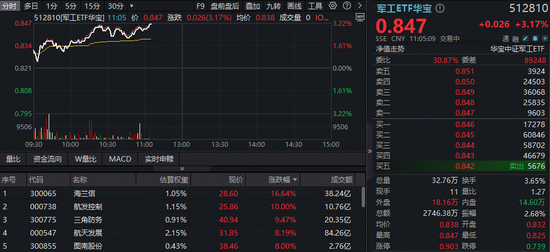
多股业绩暴增,军工领跑全市场!军工ETF华宝(512810)劲涨超3%,14只成份股净利翻倍,最高增超22倍!
Xin Lang Ji Jin· 2026-02-03 03:10
Core Viewpoint - The military industry sector has seen a significant rise, with the military ETF Huabao (512810) increasing by over 3%, driven by strong performances from constituent stocks like Hailanxin, which surged over 16% [1][2]. Group 1: Market Performance - The military ETF Huabao (512810) has shown a notable increase of 3.17%, reaching a price of 0.847 [1]. - Hailanxin's stock price increased by over 16%, while Hangfa Control reached its daily limit [1]. - A total of 45 constituent stocks of the military ETF have disclosed their 2025 performance forecasts, with 30 stocks expected to see profit increases [2]. Group 2: Earnings Forecasts - Among the 45 stocks, 14 are projected to double their net profits, with Huafeng Technology showing the highest expected increase of over 2285% [2]. - Hailanxin anticipates a net profit of 40 million to 60 million yuan for 2025, representing a year-on-year growth of 387.47% to 631.20% [1][2]. - Other companies like Zhenlei Technology and Aerospace Science and Technology are also expected to see significant profit growth, exceeding six times their previous profits [2]. Group 3: Detailed Earnings Projections - A detailed table lists various companies with their projected net profit ranges and year-on-year growth percentages, highlighting significant increases for companies like Laoshiyuan Technology and Qiangxintujing [3]. - For instance, Laoshiyuan Technology forecasts a net profit between 338 million to 388 million yuan, with a year-on-year growth of approximately 2004.17% to 2285.85% [3].
广东宏大:宏大卫星将基于自身发展战略,积极探索前沿技术应用场景、构建多元化产业生态
Zheng Quan Ri Bao Wang· 2026-02-03 02:49
Core Viewpoint - Guangdong Hongda (002683) is committed to exploring cutting-edge technology applications and building a diversified industrial ecosystem based on its development strategy, with specific implementation details and timelines to be advanced in an orderly manner according to the company's strategic goals [1] Group 1 - The company is actively engaging with investors through interactive platforms to communicate its strategic direction [1] - Hongda Satellite will focus on its own development strategy while exploring new technology applications [1] - The implementation of the company's plans will be aligned with its overall development strategy [1]

春季行情未完,调整是布局机会
Huajin Securities· 2026-02-03 00:50
Market Overview - On February 2, 2026, the Shanghai Composite Index fell by nearly 2.5%[1] - The decline was attributed to expectations of tightening overseas liquidity and adjustments in cyclical sectors[6] Market Trends - The spring market rally is not over; adjustments present opportunities for low-cost positioning[11] - Short-term policy expectations remain positive, with limited external risks anticipated[11] Industry Insights - Adjustments in technology growth and certain cyclical sectors are expected to outperform in the near term[12] - From January 30, 2026, the declines in cyclical sectors included a 14.8% drop in non-ferrous metals and an 8.6% drop in steel[13] Performance Forecasts - High growth rates are projected for sectors such as beauty care (451.0%), non-bank financials (271.2%), and defense industry (140.3%) for 2025[17] - The transportation sector and non-ferrous metals are expected to see significant year-on-year profit growth of 31.2% and 22.6%, respectively[19] Risk Factors - Historical experiences may not apply to future market conditions, and unexpected policy changes could impact investment decisions[33] - Economic recovery may not meet expectations due to external disruptions or unforeseen events[33]
“奥库斯”核潜艇遇阻,澳大利亚或改买B-2隐形轰炸机?
Xin Lang Cai Jing· 2026-02-02 23:10
Group 1 - The AUKUS trilateral security pact, signed by the US, UK, and Australia, involves a $368 billion investment to assist Australia in building a nuclear submarine fleet to counter perceived threats from China, but its implementation is increasingly doubtful [1] - Australia is currently paying the US and UK for the AUKUS agreement, with approximately $4.6 billion already received by the US for enhancing its submarine construction capabilities, and an additional $4.8 billion expected by the UK over the next decade, yet Australia has not received any substantial returns [1] - Experts indicate that the US is unlikely to provide Australia with Virginia-class submarines due to its own shortages, with a backlog of 12 orders and an average production rate of only 1.2 submarines per year, which is insufficient to meet both US and Australian demands [2] Group 2 - The UK is also facing challenges in meeting Australia's submarine needs, with its submarine fleet described as "chaotic" and "precarious," leading to a significant shortage of operational submarines [2] - Defense experts suggest that Australia should consider acquiring B-2 stealth bombers instead of nuclear submarines, as they could provide a more cost-effective and flexible strategic strike capability in the Indo-Pacific region [3] - The Chinese government has expressed opposition to the AUKUS pact, citing concerns over increased nuclear proliferation and an arms race in the region [3]
多维度展现发展韧性,百余家央企控股上市公司2025年业绩报喜
Xin Lang Cai Jing· 2026-02-02 23:09
近期,A股央企控股上市公司2025年全年业绩预告密集披露。总体来看,中央企业业绩呈现多层次、立 体化改善的积极态势:一部分企业在优势赛道实现业绩大幅预增;一部分企业成功扭亏为盈,重归健康 发展轨道;还有一部分企业虽仍面临挑战,但通过深刻变革实现了亏损额显著收窄。总体来看,共有 110余家央企控股上市公司2025年业绩"预喜",其中23家实现归母净利润扭亏为盈、46家企业实现净利 润同比增长、41家企业亏损幅度收窄。从行业来看,军工、钢铁、化工等行业表现亮眼。(上证报) ...
多维度展现发展韧性 百余家央企控股上市公司2025年业绩报喜
Shang Hai Zheng Quan Bao· 2026-02-02 18:44
Core Viewpoint - The overall performance of central enterprises listed on A-shares is showing a multi-dimensional improvement for the year 2025, with over 110 companies expected to report positive earnings, including 23 companies turning losses into profits, 46 companies experiencing profit growth, and 41 companies significantly reducing their losses [1] Group 1: Companies Turning Losses into Profits - 23 central enterprises, including South Grid Energy, China Ordnance, and China Chengxin, are expected to turn losses into profits in 2025, indicating a significant improvement in operational conditions [2] - South Grid Energy is focusing on energy-saving services and biomass sectors, projecting a net profit of 300 million to 360 million yuan for 2025 [2] - Military enterprises like China Aerospace South Lake and China Ordnance are also expected to report profits due to increased delivery of special equipment and defense products [2] Group 2: Companies with Significant Profit Growth - A group of central enterprises, such as Salt Lake Co., Longxin Bochuang, and China Shipbuilding Defense, are expected to see substantial profit growth in 2025, with some companies projecting profit increases of over 300% [4] - China Shipbuilding Defense is benefiting from a booming global shipbuilding market, with a projected profit growth of 149.61% to 196.88% for 2025 [4] - Longxin Bochuang is experiencing revenue growth due to demand from cloud computing and artificial intelligence, with expected profit growth exceeding 300% [4] Group 3: Companies Reducing Losses - 41 central enterprises, including China First Heavy Industries and China Great Wall, are expected to significantly reduce their losses in 2025, indicating positive signals during their transformation periods [6] - China First Heavy Industries is expected to reduce losses by 3.276 billion to 3.426 billion yuan through structural reforms and asset optimization [6] - In the steel industry, companies like Maanshan Steel and Chongqing Iron and Steel are also expected to reduce losses amid ongoing market challenges [6] Group 4: Cost Control and Operational Efficiency - Many central enterprises are implementing refined measures such as cost control and investment optimization to improve their financial performance [3] - Companies like China Chengxin and Blue Science High-tech emphasize the importance of cost control and efficiency improvements in their earnings announcements [3] - In the chemical sector, China National Chemical is enhancing operational capabilities and controlling costs to mitigate revenue pressures while achieving significant loss reductions [7]