数字经济

Search documents
海南“封关”倒计时!这可能是你离财富自由最近的一次?
Sou Hu Cai Jing· 2025-12-14 06:55
Core Insights - Hainan will officially "close its borders" on December 18, 2025, transforming into a "super economic zone" with significant implications for wealth generation and investment opportunities. Group 1: Economic Transformation - Hainan will become the first domestic region with a "first-line open, second-line controlled" policy, allowing foreign goods to enter with essentially "zero tariffs" while treating goods entering the mainland from Hainan as imports [3][4]. - This transformation is not just an upgrade to a shopping paradise but also a "systemic highland" for the free flow of capital, trade, and personnel [3][4]. Group 2: Investment Opportunities - The retail sector will see a significant upgrade, with zero tariffs making luxury goods, electronics, and imported cars more accessible, leading to explosive growth in high-end tourism and retail [4]. - Hainan is set to become a new logistics and warehousing hub in the Asia-Pacific region, creating abundant opportunities in cross-border e-commerce, international warehousing, and supply chain finance [4]. - The region will serve as a testing ground for financial openness, facilitating cross-border capital flows, offshore trade, and new international settlement methods, positioning it as a battleground for financial elites [4]. - Hainan will attract high-end industries with a preferential corporate tax rate of 15% for encouraged enterprises, significantly lower than the mainland's 25%, drawing interest from sectors like biomedicine, new energy vehicles, and the digital economy [4].


印尼前驻华大使答21:关键矿产遇上中国技术,两国合作前景广阔
2 1 Shi Ji Jing Ji Bao Dao· 2025-12-13 14:15
Group 1 - Indonesia is rich in mineral resources, while China has strong technological capabilities, indicating a high potential for economic cooperation between the two countries [1] - The former Indonesian ambassador to China emphasized the need to upgrade the partnership from a traditional supply chain relationship to a more equal innovation partnership focused on high-end product production in Indonesia [1] - The 75th anniversary of diplomatic relations between China and Indonesia was marked by a forum discussing the achievements and future of bilateral relations, highlighting the importance of the "One China" principle as a political foundation [1] Group 2 - The ambassador expressed satisfaction with the experience of using a Chinese-made electric vehicle, suggesting that such positive experiences should symbolize the shared benefits of cooperation between the two nations [1] - Indonesia and China are encouraged to strengthen coordination and cooperation in trade, climate change, technology transfer, and global development agendas, with significant prospects in electric vehicles, green energy, digital economy, and critical mineral development [1] - China has officially taken over the role of host for the 2026 APEC, which is expected to deepen regional cooperation and promote peace and development in the Asia-Pacific region [2]
LP周报丨投入60亿,一座山城放大招了
投中网· 2025-12-13 06:49
Core Viewpoint - The article highlights the increasing trend of local governments and enterprises in China establishing substantial investment funds to drive economic development and innovation in various sectors, particularly in technology and infrastructure. Group 1: Local Investment Initiatives - Lishui City in Zhejiang Province has established a private equity investment partnership with a capital contribution of 6 billion RMB, focusing on integrated circuits and intelligent manufacturing, indicating a strong commitment to developing strategic industries [6][7][8]. - The Hubei Water Development Fund has been launched with a total scale of 10 billion RMB, aimed at supporting water infrastructure and ecological projects, showcasing the government's role in guiding market operations [18][19]. - The establishment of the "Guangxi Wuwei Investment Fund" and "Guangxi Gongchuang No. 1 Fund" with a total scale of 700 million RMB reflects a diversified investment strategy targeting local industries and cross-border supply chains [29]. Group 2: Fundraising Activities - Jia Yu Capital has successfully raised over 4 billion RMB for multiple new funds, attracting a mix of institutional investors, which underscores the confidence in its past performance and team capabilities [10]. - Jing Shui Lake Venture Capital has completed the first closing of a 500 million RMB blind pool fund, with a 70% re-investment rate from existing investors, indicating strong market validation [11]. - Zhongke Chuangxing's fund has reached a final closing of 4.08 billion RMB, focusing on hard technology investments, demonstrating a commitment to early-stage funding in high-tech sectors [12][13]. Group 3: New Fund Establishments - The establishment of the "Fudan Science and Technology Investment Fund" with a total scale of 1 billion RMB aims to support the commercialization of scientific research and technology transfer from Fudan University [21]. - The "Henan Artificial Intelligence Industry Fund" has been set up with a scale of 1 billion RMB, focusing on AI applications and technology, reflecting the province's ambition to become a hub for AI innovation [27][28]. - The "AIC Fund" in Fujian, with a target scale of 2 billion RMB, aims to invest in key sectors such as new materials and AI, highlighting the province's strategic focus on emerging industries [35][36]. Group 4: Strategic Partnerships and Collaborations - The establishment of the "Qinhuangdao Talent Entrepreneurship Fund" with a scale of 100 million RMB aims to leverage academic resources from Tsinghua University to drive local industry development [39]. - The partnership between Tianqi Lithium and local investment entities in Anhui, with a capital contribution of 500 million RMB, aims to enhance the province's capabilities in the lithium battery supply chain [40]. - The collaboration between China Galaxy and local firms in Wuhan to establish a 405 million RMB fund emphasizes the integration of local resources with national financial capabilities [31][32].

现代服务业质效双升添动能——青岛市市南区深挖机遇破解瓶颈
Jing Ji Ri Bao· 2025-12-13 05:26
经济日报记者 刘成 青岛数字经济产业园里,松立控股集团智慧停车指挥中心屏幕上实时显示着停车泊位状态;航运贸 易金融总部大厦内,工作人员盯着屏幕实时跟踪集装箱物流信息;在浮山湾商圈,年轻人手举奶茶打卡 首店;在中山路历史文化街区,老里院现代喜剧演出座无虚席……近年来,青岛市市南区深挖现代服务 业发展机遇、破解发展瓶颈,推动现代服务业质效双升。 数据显示,2025年1月至11月,市南区服务业增加值占地区生产总值比重达91.4%。"我们聚焦回答 好现代服务业'服务于谁、谁来服务',构建起总部经济集群,数字经济、现代金融、高端商务、时尚消 费、航运贸易、文化旅游和新兴产业、未来产业的'1+6+1'主导+创新产业体系,加快建设现代服务业强 区。"市南区委书记王锋说。 数智赋能 风速、气温、降水、海浪……走进青岛埃克曼科技有限公司,其围绕海洋气象环境精准预报自主研 发的服务系统——智慧海洋管理平台iocean正在对海洋预报数据进行实时跟踪、动态分析。"平台能够 为核电、风电及港口提供数据监测分析以及决策建议等。"青岛埃克曼科技有限公司总经理李德明说。 埃克曼以数字化赋能实体经济高质量发展,是市南区在生产性服务业领域创新探 ...
征求对市委“十五五”规划《建议》的意见
Nan Jing Ri Bao· 2025-12-13 05:11
Core Viewpoint - The Nanjing Municipal Committee of the Communist Party of China held a meeting to gather opinions from various democratic parties and non-party representatives regarding the formulation of the 15th Five-Year Plan for economic and social development, emphasizing the importance of collective effort and collaboration in achieving the plan's goals [1][2]. Group 1: Meeting Outcomes - The meeting was chaired by Secretary Zhou Hongbo, who highlighted the significance of democratic participation and collective wisdom in addressing major issues and formulating important documents [2]. - Representatives from various democratic parties and the Federation of Industry and Commerce expressed high praise for the achievements during the 14th Five-Year period and supported the suggestions for the 15th Five-Year Plan [1]. Group 2: Suggestions and Focus Areas - Specific suggestions were made regarding the development of a new power system, acceleration of the biopharmaceutical industry, promotion of digital economy to enhance consumer upgrades, and strengthening the development of the private economy [1]. - Additional focus areas included urban innovation, enhancing financial support, optimizing the business environment for Taiwanese enterprises, exploring modern agricultural development, and tapping into the consumption potential of cultural and tourism industries [1].
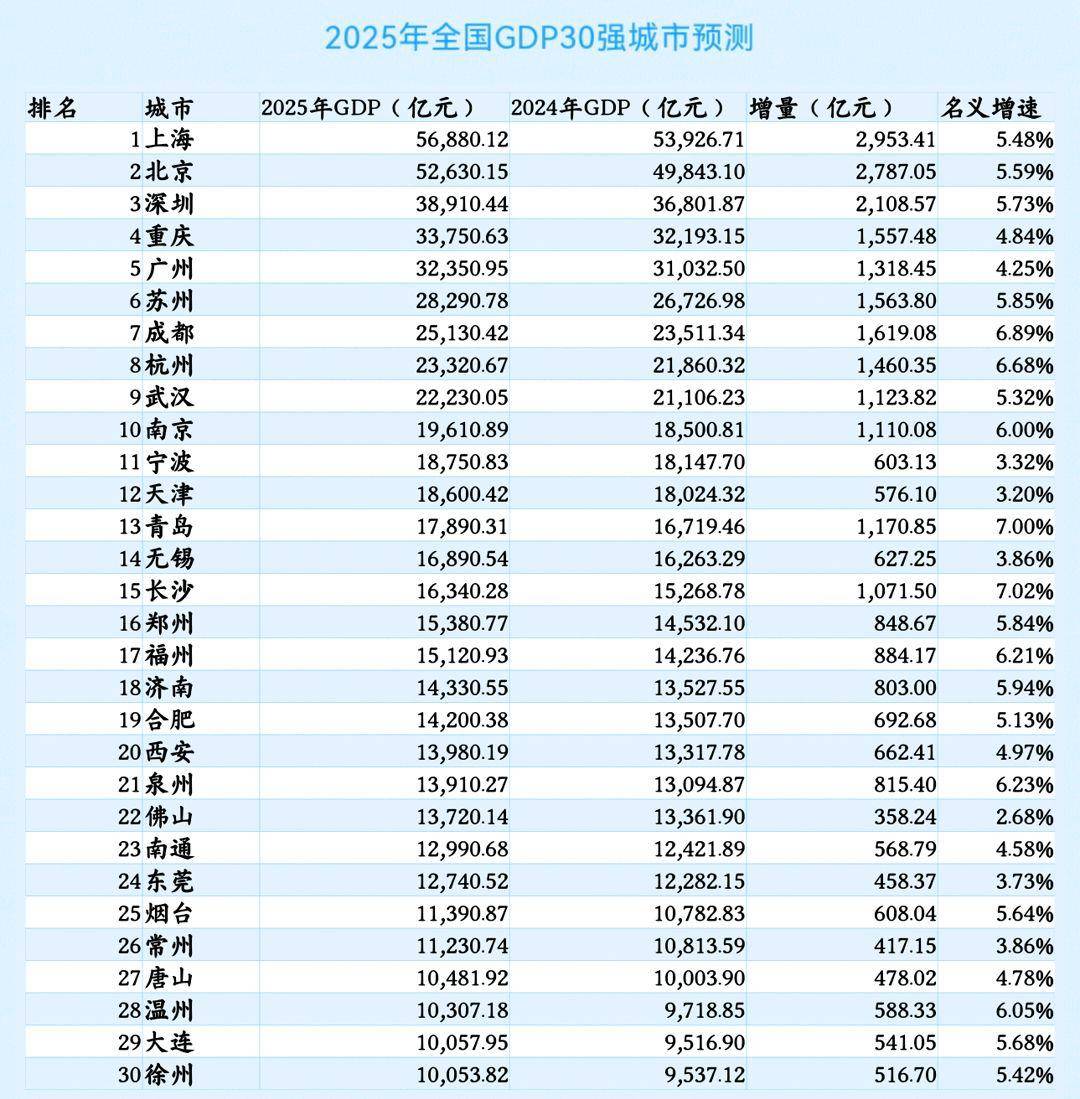
2025年GDP30强城市预测:深圳近4万亿,福州接近郑州,温州破万亿
Sou Hu Cai Jing· 2025-12-12 17:35
Core Insights - The 2025 GDP forecast for major Chinese cities highlights significant economic growth, with Shanghai leading at 56,880 billion yuan, followed by Beijing at 52,630 billion yuan, and Shenzhen at 38,910 billion yuan [1][2] Group 1: Major Cities and Economic Growth - Shanghai is projected to maintain its position as the top city with a GDP of 56,880 billion yuan, showing a nominal growth rate of 5.48% [2] - Beijing is expected to reach a GDP of 52,630 billion yuan, with a nominal growth rate of 5.59% [2] - Shenzhen's GDP is forecasted to be 38,910 billion yuan, with a nominal growth rate of 5.73%, driven by its status as a global tech innovation hub [2][3] Group 2: Emerging Cities - New first-tier cities like Chengdu and Hangzhou are showing impressive growth rates, contributing to a more balanced economic development across China [1] - Wenzhou is notable for being the first city to surpass a GDP of 1 trillion yuan, reaching 10,307 billion yuan, marking a significant milestone in regional economic development [1][6] Group 3: Shenzhen's Economic Model - Shenzhen's economy is characterized by a strong innovation ecosystem, with an expected annual patent authorization exceeding 100,000, accounting for 15% of the national total [3] - The city is projected to attract over 100 billion USD in foreign investment, with strategic emerging industries expected to grow by 12% [2][3] Group 4: Fuzhou's Economic Development - Fuzhou is forecasted to achieve a GDP of 15,120 billion yuan, with a growth rate of 6.21%, benefiting from free trade zone policies and a focus on digital economy [5] - The city aims to enhance its marine economy, with expected output surpassing 500 billion yuan and a 10% increase in port throughput [5] Group 5: Wenzhou's Economic Transformation - Wenzhou's GDP is projected to reach 10,307 billion yuan, with a growth rate of 6.05%, driven by its vibrant private economy [6][8] - The city is focusing on innovation, with an expected 5,000 new patents annually and a significant increase in cross-border e-commerce activities [6][8]
前沿研究丨数字福祉如何衡量?清华徐心团队以GDP-B方法测度数字经济隐形价值
腾讯研究院· 2025-12-12 08:00
Core Viewpoint - The article discusses the innovative research led by Professor Xu Xin from Tsinghua University, focusing on measuring the social value created by free digital products and services in the context of the digital economy [2][5]. Group 1: Research Background and Motivation - Professor Xu Xin emphasizes the need to scientifically measure the social value of free digital products, such as AR glasses that help hearing-impaired individuals, which significantly enhance their learning and workplace integration [5][6]. - The research aims to redefine the essence of value in the digital economy, especially as traditional price signals become less relevant [5][6]. Group 2: Methodology and Framework - The research introduces the "GDP-B" (Gross Domestic Product-Benefit) measurement method, which combines empirical research and experimental design to create a scientific measurement system for digital welfare [7][9]. - This method aims to balance objective price data and subjective survey data, making the intangible digital welfare measurable and comparable [9][10]. Group 3: Findings and Insights - A large-scale pre-survey involving 13,000 respondents across 11 cities revealed that Chinese consumers have a significantly higher perception of value from digital services compared to international counterparts [10][11]. - The research also indicates that digital welfare is dynamic, changing with usage scenarios and service states, suggesting a need for a more nuanced understanding of digital value [11][12]. Group 4: Future Research Directions - The research team plans to conduct quarterly nationwide surveys to establish a dynamic database on digital welfare in China, aiming to uncover underlying patterns and relationships with economic development [14][15]. - The study seeks to provide a scientific basis for policy-making in the digital economy, collaborating with organizations like Tencent to create a long-term observation system for digital welfare [15][17]. Group 5: Broader Implications - The research not only contributes to academic theory but also aims to enhance the understanding of social value in the digital economy, highlighting the importance of measuring digital welfare for high-quality development [15][17]. - The initiative is expected to foster a research ecosystem that supports data openness and the development of intelligent economic models, addressing deeper questions about value creation in the digital age [17].

山东投资聚集新质生产力,5000万保理融资助力区域数字经济“强底座”
Qi Lu Wan Bao· 2025-12-12 03:54
近年来,人工智能与数字经济已成为推动产业升级、培育新质生产力的关键引擎。在这一进程中,稳定 可靠的算力基础设施不仅是技术创新的"加速器",更是区域经济高质量发展的"数字底座"。山东省投资 有限公司(以下简称"山东投资")通过直管企业山东省鲁信商业保理有限公司(以下简称"鲁信保理"), 以"应收账款池保理"这一创新金融模式,为济宁某生命科学园区提供5000万元长期资金支持,专项用于 AI服务器的购置与部署,有效破解高新技术企业在算力建设中的融资难题,为区域生命科学研发与数 字产业集群协同发展注入持续金融活水。 创新"池保理"模式,破解高新技术企业融资瓶颈 高新技术企业在发展过程中,常面临研发投入大、设备采购急、应收账款分散等多重资金压力。尤其是 以数据处理、软件开发、算力服务为主的企业,其业务回款往往呈现"小额、高频、周期不一"的特点, 与传统信贷产品难以匹配,导致融资难、融资贵问题凸显。 未来,山东投资将继续深化对人工智能、智能制造、数字经济等新兴领域的金融支持,持续优化"池保 理"等场景化、定制化金融工具,引导更多长期资本投向培育新质生产力的前沿阵地,为山东省构建现 代化产业体系、推动经济高质量发展贡献更强 ...
资本开支激增39%倾斜AI,数字经济ETF(560800)受益AI产业全面爆发
Sou Hu Cai Jing· 2025-12-12 03:00
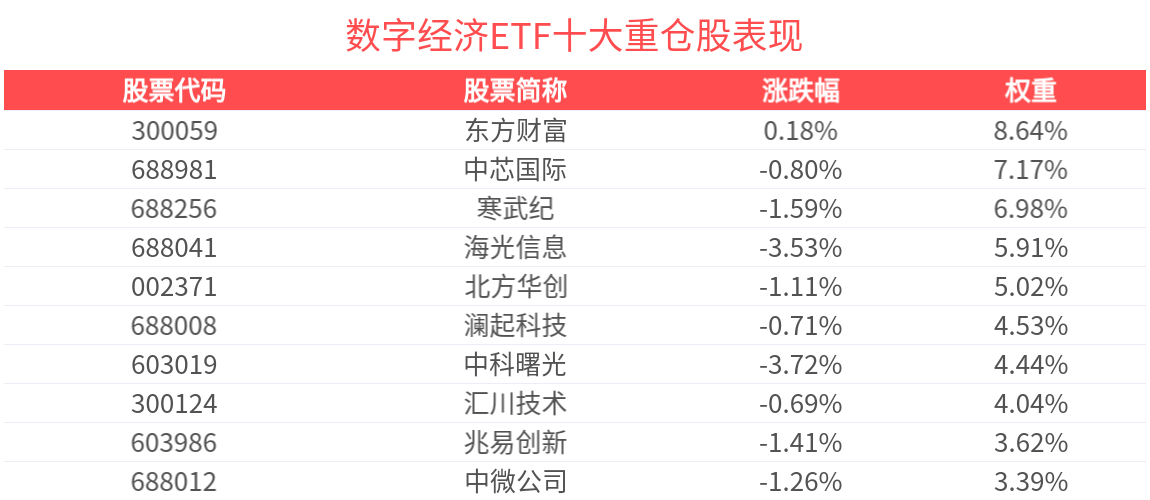
Core Viewpoint - The digital economy theme index has experienced a decline, with significant movements in component stocks, reflecting the current trends in the AI and digital economy sectors [1][2]. Industry Insights - The AI industry is undergoing a comprehensive explosion from infrastructure to application, with a consensus among international investment banks and domestic brokerages that AI computing power demand is growing exponentially [1][2]. - Global tech giants are increasingly directing capital expenditures towards AI, with NVIDIA's CEO stating that "AI demand is infinite," and Alibaba Cloud announcing a plan to invest 100 billion yuan in expanding its intelligent computing centers over the next three years [1][2]. - Capital expenditures for cloud service providers are expected to rise significantly this year, with the four major overseas cloud service providers projected to spend $167.9 billion, a 39% increase year-on-year [1][2]. Company Performance - The top ten weighted stocks in the digital economy theme index account for 54.6% of the index, with notable companies including Dongfang Wealth, Cambricon, and SMIC [2][4]. - The performance of individual stocks within the index varies, with Dongfang Wealth showing a slight increase of 0.18%, while companies like Haiguang Information and Zhongke Shuguang experienced declines of 3.53% and 3.72%, respectively [4].
海南省国资委党委书记、主任马咏华:为自贸港建设发挥主力军顶梁柱作用 进一步推进海南国资国企做强做优做大
Xin Lang Cai Jing· 2025-12-11 10:16
Core Viewpoint - Hainan's state-owned enterprises have achieved significant growth, with total assets exceeding 739 billion yuan and revenue surpassing 142 billion yuan by the end of October 2023, marking 2.8 times and 3.5 times increases since 2020 respectively, while tax contributions have also increased by 2.3 times since 2020 [2][3][15] Group 1: Economic Performance - By the end of October 2023, Hainan's state-owned enterprises' assets reached 739 billion yuan, with revenues of 142 billion yuan, representing increases of 2.8 times and 3.5 times compared to 2020 [2][3][15] - Tax contributions from these enterprises have also increased by 2.3 times since 2020, indicating a strong fiscal performance [2][3][15] Group 2: Strategic Development - The Hainan State-owned Assets Supervision and Administration Commission (SASAC) is focusing on optimizing the structure and layout of state-owned enterprises, aiming to enhance their quality and efficiency in alignment with national strategies [3][15] - The SASAC plans to continue deepening reforms and adjustments in state-owned enterprises to better support the construction of the Hainan Free Trade Port [3][15] Group 3: Future Planning - Looking ahead to the "15th Five-Year Plan," the SASAC aims to further enhance the role of state-owned enterprises as a backbone in the development of Hainan's economy, particularly in the context of the Free Trade Port [3][20] - The focus will be on fostering new productive forces in key industries such as tourism, modern services, high-tech industries, and tropical agriculture [3][20] Group 4: Infrastructure and Investment - During the "14th Five-Year Plan" period, state-owned enterprises in Hainan completed fixed asset investments totaling approximately 145.68 billion yuan, averaging an annual growth rate of over 20%, accounting for about one-seventh of the province's total fixed investment [6][18] - Investments have been particularly emphasized in infrastructure projects such as water resources, highways, and airports, showcasing the commitment to enhancing the province's foundational capabilities [6][18]