
软件

Search documents
黑天鹅之父警告软件行业有破产和市场波动之虞
Xin Lang Cai Jing· 2026-02-24 00:04
Core Viewpoint - Taleb warns investors that as the AI-driven surge enters a more fragile phase, volatility in the software industry will increase, and bankruptcies may occur, necessitating preparedness [1][2]. Group 1: Market Risks - The market is underestimating structural risks while overestimating the sustainability of current AI-leading companies [1][2]. - Taleb emphasizes that while AI will generate significant profits, historical trends indicate that early pioneers are often replaced [1][2]. Group 2: Industry Dynamics - There is a high likelihood of bankruptcy among some companies in the software sector due to technological instability, intensified competition, and changing geopolitical landscapes [1][2]. - The S&P 500 index fell by approximately 1% on Monday, as investors grapple with tariff uncertainties and conflicting viewpoints that heighten anxiety around AI [1][2]. Group 3: Competitive Landscape - Investors are concerned that rapidly evolving AI tools may disrupt subscription-based software companies as coding becomes easier [1][2]. - Tech giants competing to develop and build AI infrastructure have initiated a dangerous borrowing spree, which may take years to yield results [1][2].
华尔街见闻早餐FM-Radio | 2026年2月24日
Hua Er Jie Jian Wen· 2026-02-23 23:26
Market Overview - Concerns over AI and renewed risks from trade wars led to a decline of at least 1% in all three major US stock indices, with financial and software stocks dragging down the market [2] - IBM's stock plummeted 13%, marking its largest single-day drop in 25 years, due to threats posed by Anthropic's products to programming languages [2][9] - The financial sector fell over 3%, with American Express down more than 7% and KKR dropping nearly 9% [2] - Retail stocks sensitive to tariffs also fell, with Wayfair down nearly 10% [2] - European and UK stock indices dropped from record highs, with Novo Nordisk's stock falling over 16% after trial results showed its weight loss drug was less effective than Eli Lilly's [2] US Treasury and Currency Markets - US Treasury yields rebounded, with the 10-year yield approaching a three-month low [3] - Following the Supreme Court's overturning of Trump's tariffs, the US dollar fell from a four-week high over two days [3] - The offshore RMB rose above 6.89, nearing a three-year high [3] AI and Technology Developments - Anthropic announced its Claude Code tool could modernize Cobol systems, causing IBM's stock to drop significantly [9] - Nvidia launched a new laptop chip aimed at re-entering the consumer PC market, focusing on lightweight designs with long battery life [22] - ASML revealed breakthroughs in EUV light source technology, potentially increasing chip production by 50% by 2030 [22] Trade and Tariff Developments - The US Customs announced it would stop collecting tariffs deemed illegal by the Supreme Court starting February 24 [19] - The Democratic Party aims to block any attempts to extend tariffs and is pushing for a refund scheme for previously paid tariffs [19] - The European Parliament has paused the approval of the US-EU trade agreement, with the UK potentially facing the largest impact from new tariffs [20] Private Equity and Market Conditions - Bain & Company reported that the private equity industry is facing a prolonged downturn, with a backlog of $3.8 trillion in assets [24] - The report indicated that profit return rates have dropped to a 16-year low, and investor expectations have risen to a 20% return threshold [24] AI and Economic Predictions - A hypothetical report from Citrini Research suggested that while AI productivity may exceed expectations, it could lead to significant job losses and economic contraction by 2028 [21] - The report triggered a sell-off in various sectors, including food delivery and payment software, as investors reacted to potential risks associated with AI [21] Robotics and AI Applications - The performance of humanoid robots during the Spring Festival Gala highlighted significant advancements in hardware, with expectations for a surge in shipments from 20,000 to 76,000 units by 2026-2027 [29] - The introduction of AI capabilities in robotics is anticipated to drive further applications and market growth [29]


金十数据全球财经早餐 | 2026年2月24日
Jin Shi Shu Ju· 2026-02-23 23:00
Group 1 - The article highlights that Trump is signaling a preference for a diplomatic agreement with Iran rather than military action, amidst ongoing nuclear negotiations [2][7] - The U.S. government is considering imposing new national security tariffs on six industries, including large batteries and industrial chemicals, which could impact trade relations [2][7] - The market is reacting to uncertainties surrounding Trump's tariff policies, leading to increased demand for safe-haven assets like gold and silver, which saw price increases of 2.46% and 4.24% respectively [2][5] Group 2 - U.S. stock indices experienced declines, with the Dow Jones falling by 1.66%, while the technology sector faced significant losses, particularly IBM, which dropped 13% [3] - European stock indices mostly closed lower, with the German DAX30 down 1.06%, reflecting broader market concerns [3] - The Hong Kong Hang Seng Index rose by 2.53%, driven by gains in technology stocks and resource sectors [3]

在金融潮汐中把握财富节奏——读《周期与财富》
Shang Hai Zheng Quan Bao· 2026-02-23 18:37
Core Insights - The book "Cycles and Wealth" by Peter Oppenheimer explores the cyclical nature of financial markets and their impact on wealth creation and destruction, emphasizing the historical patterns that repeat over time [4][5][6]. Financial Market Cycles - Financial market cycles are influenced by economic trends, historical, cultural, and political factors, with elements like social equity, international cooperation, and technological innovation playing significant roles [4][5]. - The cyclical pattern in the stock market is characterized by four stages: despair, hope, growth, and optimism, each with distinct characteristics and average durations [5][6]. Stages of Stock Market Cycles - In the despair stage, stock prices decline significantly, with an average duration of 14 months and a year-on-year price-earnings ratio drop exceeding 30% [5]. - The hope stage sees stock prices rebound despite stagnant corporate profits, lasting about 10 months with an average annual return exceeding 60% [5]. - The growth stage, lasting approximately 45 months, features corporate profit growth outpacing price-earnings ratio increases, but with lower investment returns compared to other stages [6]. - The optimism stage lasts around 21 months, characterized by rising investor confidence and valuations exceeding profit growth, yielding an average annual return of about 30% [6]. Indicators of Market Transition - Key indicators for transitioning from bear to bull markets include valuation levels, economic growth, and interest rate trends, with historical data suggesting that low market valuations and specific economic indicators can signal market recovery [6][7]. Historical Super Cycles - The book outlines three major bull market super cycles post-World War II, each marked by unique economic conditions but sharing common traits such as low initial valuations and strong economic growth [7][8]. - The first cycle (1949-1968) saw a 1100% real return in the S&P 500, driven by post-war economic policies and technological advancements [7]. - The second cycle (1982-2000) was characterized by low volatility and high returns, with the S&P 500 generating over 1300% real returns [8]. - The third cycle (2009-2020) was marked by weak economic recovery and reliance on aggressive monetary policies, leading to significant disparities in wealth [8][9]. Post-Modern Cycle Characteristics - The post-modern cycle exhibits a blend of classical and modern cycle traits, with rising inflation and government spending alongside low economic growth and interest rates [10][11]. - This cycle presents new opportunities in sectors like carbon reduction and artificial intelligence, while also posing challenges due to rising labor costs and regulatory pressures [11][12]. Technological Impact - Technological advancements remain a crucial driver of economic and market growth, with historical patterns indicating that innovations often lead to speculative bubbles followed by corrections [12]. - The technology sector has consistently held a leading position in market capitalization, and future trends suggest a shift towards increased investment in defense, infrastructure, and green initiatives [12][13]. Nostalgic Economic Forces - There is a growing consumer interest in simpler, pre-internet experiences, which may benefit businesses that cater to nostalgic preferences, such as second-hand clothing platforms and vinyl record sales [13].

欧洲股市因关税不确定性再现而下跌 诺和诺德股价重挫
Xin Lang Cai Jing· 2026-02-23 17:24
Group 1 - European stock markets declined, with the Stoxx 600 index closing down 0.5%, driven by losses in financial services, media, and tourism sectors, while personal care and utilities outperformed the market [1] - Novo Nordisk's stock plummeted after its new weight-loss injection drug underperformed compared to a competing product from Eli Lilly in a recent trial [1] - The European Parliament's major political groups announced a suspension of legislative work to approve the US-EU trade agreement following the US Supreme Court's overturning of Trump's global tariff measures, leading to new global tariffs announced by Trump [1] Group 2 - KBC Securities' global equity head noted that the current options seem limited and less impactful, which could be beneficial for consumer stocks, but concerns remain about market participants' willingness to endure upcoming volatility from tariff news [3] - Investors are already grappling with worries over high valuations and the disruptive impact of artificial intelligence, with tariff-related news adding complexity to the market landscape [3] - Significant upcoming events include Trump's State of the Union address and Nvidia's earnings report, with potential for increased volatility in software stocks following the release of Anthropic's new model [3]


关税动荡和AI焦虑拖累美股走低 软件股领跌
Xin Lang Cai Jing· 2026-02-23 16:35
Group 1 - Concerns over the potential impact of AI on corporate profits and ongoing tariff uncertainties have led to a decline in the US stock market, with bonds rising [1][4] - The S&P 500 index fell nearly 1%, with software stocks leading the decline, particularly DoorDash and American Express [1][4] - Bitcoin briefly dropped below $65,000, while gold prices increased [1][4] Group 2 - Following the US Supreme Court's ruling to abolish President Trump's "reciprocal" tariffs, the White House responded with a new 15% global tariff [3][6] - The EU has frozen the approval process for trade agreements with the US until further clarity on tariff plans is provided, adding economic uncertainty to transatlantic relations [3][6] - Michael Landsberg from Landsberg Bennett Private Wealth Management indicated that tariff disputes may continue to disrupt the market for the remainder of the year, but volatility is expected to be less than the initial shock experienced in April of last year [3][6] Group 3 - US Treasury yields have declined, despite traders fully pricing in the Federal Reserve's next rate cut expected in September [3][6] - Federal Reserve Governor Christopher Waller stated that his support for a rate cut in the next meeting will depend on upcoming employment data [3][6] - A winter storm is affecting the New York area, but both the New York Stock Exchange and Nasdaq plan to operate normally on Monday [3][6]
华尔街顶级分析师最新评级:谷歌、英伟达获上调
Xin Lang Cai Jing· 2026-02-23 16:35
Core Viewpoint - The article summarizes significant rating changes from Wall Street that could impact market trends, highlighting upgrades, downgrades, and new coverage by various financial institutions [1][5]. Upgrades - Wells Fargo upgraded Alphabet (GOOGL) from Hold to Buy, raising the target price from $354 to $387, citing Google's leading position in key AI traits such as user data, channels, and computing power [7]. - Aletheia upgraded NVIDIA (NVDA) from Hold to Buy with a target price of $250, stating the stock is "too cheap to ignore" ahead of its quarterly earnings report [7]. - Lake Street upgraded Tandem Diabetes (TNDM) from Hold to Buy, increasing the target price from $14 to $50, believing the shift to a pharmacy model will yield stable growth and higher profit margins [7]. - UBS upgraded BlackRock (BLK) from Neutral to Buy, setting a target price of $1,280, based on strong Q4 performance and positive outlook from the UBS Financial Conference [7]. - Baird upgraded Henry Schein (HSIC) from Neutral to Outperform, raising the target price from $78 to $100, citing growth potential in its dental-related business [7]. Downgrades - Jefferies downgraded Workday (WDAY) from Buy to Hold, lowering the target price from $325 to $150, noting that application software stocks have underperformed the overall software sector [8]. - Bank of America downgraded General Mills (GIS) from Buy to Neutral, reducing the target price from $55 to $48, stating that previous growth expectations for the pet business and North American retail have failed [8]. - Baird downgraded Arcellx (ACLX) from Outperform to Neutral, with a target price adjustment from $106 to $115, following Gilead's acquisition announcement at $115 per share [8]. - JPMorgan downgraded VF Corporation (VFC) from Neutral to Underweight, lowering the target price from $19 to $18, and reducing earnings forecasts for 2027 and 2028 below market consensus [8]. - Jefferies downgraded Deere (DE) from Hold to Underperform, raising the target price from $475 to $550, indicating that the agricultural cycle is expected to bottom out this year [8]. New Coverage - Citigroup initiated coverage on York Space Systems (YSS) with a Buy rating and a target price of $37, describing it as a high-risk, high-reward opportunity in the space trend [9]. - Oppenheimer initiated coverage on Public Policy Holding Co (PPHC) with an Outperform rating and a target price of $16, noting its expansion into state and international lobbying [9]. - Citigroup initiated coverage on PicPay (PICS) with a Buy rating and a target price of $28, projecting an 85% potential upside due to its credit-related business growth [9]. - JPMorgan initiated coverage on Ethos (LIFE) with a Buy rating and a target price of $13, believing there is still growth potential through agency channels [9]. - DA Davidson initiated coverage on Bob's Discount Furniture (BOBS) with a Buy rating and a target price of $26, citing a large and fragmented industry poised for recovery [9].

软件和支付类股下跌 此前Citrini就人工智能风险发文
Xin Lang Cai Jing· 2026-02-23 16:14
Core Insights - DoorDash and American Express led declines in software and payment stocks, respectively, following a report from Citrini Research discussing hypothetical scenarios of AI's impact on the market and global economy [1] Group 1: Stock Performance - DoorDash's stock fell by 6.3% [1] - Uber's stock decreased by 3.8% [1] - Salesforce's stock dropped by 5.3% [1] - ServiceNow's stock declined by 4.3% [1] Group 2: Payment Stocks - Mastercard's stock fell by 3.65% [1] - Visa's stock decreased by 3.0% [1] - American Express's stock dropped by 7.5% [1] - First Capital Financial's stock declined by 6.4% [1] - Apollo Global Management's stock fell by 5.0% [1] - Blackstone's stock decreased by 7.4% [1] - KKR's stock dropped by 7.5% [1]


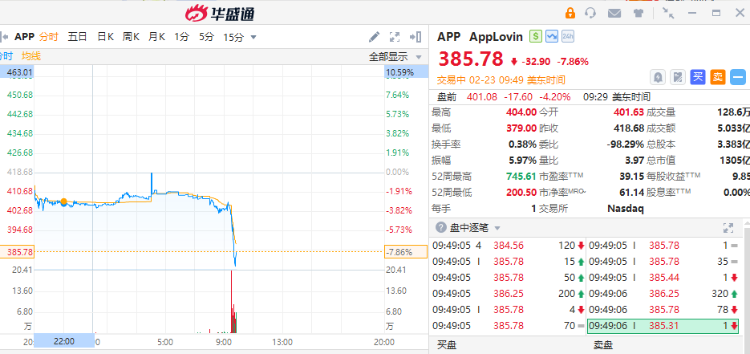
美股异动 | 存储概念Sandisk逆势领涨5%!软件板块再度暴跌,AppLovin大跌超8%
Xin Lang Cai Jing· 2026-02-23 15:32
Core Viewpoint - The U.S. stock market opened lower with significant fluctuations, while the storage concept Sandisk rose by 5%, contrasting with the mixed performance of major tech stocks, where Nvidia increased by over 1% and Tesla, Microsoft, and Amazon fell by more than 2% [1] Group 1: Stock Performance - The three major U.S. stock indices experienced a low opening and volatility [1] - Sandisk, a storage concept stock, led the gains with a rise of 5% [1] - Major tech stocks showed a mixed performance, with Nvidia up over 1% and Tesla, Microsoft, and Amazon down more than 2% [1] Group 2: Software Sector - The software sector faced a significant decline, with AppLovin dropping over 8% [1] - DoorDash saw a decrease of over 7%, while Palantir and CrowdStrike fell by more than 5% [1] - Other companies like ServiceNow and Datadog also experienced declines of over 4% [1] Group 3: Pharmaceutical Sector - Novo Nordisk's stock plummeted by 14% after the company reported that its weight loss drug Cagrisema was less effective than Eli Lilly's Zepbound [1] - In contrast, Eli Lilly's stock rose by 3% following this news [1]
A股策略周报:节后主线将更加清晰-20260223
SINOLINK SECURITIES· 2026-02-23 13:49
Global Assets: Rebalancing Continues - The current market rebalancing is based on internal and external recovery, with AI trading entering its second phase, leading to a focus on the actual impact of AI on various industries [3][13] - From February 16 to February 20, 2026, global risk assets showed an overall upward trend, but internal performance was mixed, with industrial, financial, and energy sectors gaining favor [3][13] - The focus has shifted from whether AI is a bubble to identifying the real industrial impacts and critical supply-demand issues as AI transitions from a thematic to a macro factor [3][13] Manufacturing Cycle Further Rising - The U.S. GDP data for Q4 2025 showed slower growth primarily due to government spending disruptions, while AI-related investments remained strong [4][25] - Non-AI and residential investment growth is showing signs of bottoming out, indicating a broader recovery in investment activities beyond just AI [4][25] - The February manufacturing PMI data indicated a recovery in global manufacturing, with Europe exceeding expectations and the U.S. maintaining expansion, suggesting a positive trend in manufacturing cycles [4][25][34] Commodities: Transitioning from Financial Overtrading to Industrial Pricing - Recent fluctuations in industrial and precious metals prices are attributed to macro and industrial events, with a return to real supply-demand signals expected [5][44] - Geopolitical risks continue to support industrial metal prices, while demand from tech giants for AI investments remains robust, indicating a potential new support for demand [5][44] - Historical data suggests that current copper and aluminum price ratios are low compared to historical manufacturing PMI levels, indicating potential for price recovery [5][44][45] Focus on Global Physical Assets vs. Chinese Assets - The core of market rebalancing is not about the existence of an AI bubble but rather the macro impacts of AI combined with monetary and major country policy choices [6][56] - The relative smooth path for future U.S. interest rate cuts is expected to support the recovery of the global manufacturing cycle, which may lead to a revaluation of Chinese asset capacity [6][56] - Specific investment recommendations include physical assets like copper, aluminum, and oil, as well as sectors benefiting from capital inflows and consumption recovery in China [6][56]