
直播

Search documents
平台捆绑与合规高压,千万网红童锦程的“洗白”困局
3 6 Ke· 2025-06-17 08:39
Core Viewpoint - The article discusses the challenges and transformations within the live streaming industry, particularly focusing on the case of streamer Tong Jincheng, highlighting the impact of platform algorithms and regulatory changes on content creation and monetization strategies [20][21]. Group 1: Company Performance - In Q1 2025, Huya reported revenue of 1.51 billion yuan, a slight year-on-year increase of 0.3%, but net profit plummeted by 99% to 927,000 yuan, indicating ongoing struggles [1]. - The decline in profitability reflects broader issues within the live streaming sector, where platforms are grappling with content regulation and user engagement [19]. Group 2: Streamer Dynamics - Streamer Tong Jincheng, known for his controversial "pick-up artist" persona, has a significant following of 7.556 million on Huya and 10.91 million on Douyin, showcasing the potential for high engagement through provocative content [4][6]. - Despite his popularity, Tong faces challenges due to high penalties for contract breaches, which limit his ability to switch platforms despite interest from competitors [2][5]. Group 3: Content Creation and Regulation - The content production model employed by Tong involves scripted interactions that often push ethical boundaries, raising concerns about the impact on viewers' perceptions of relationships [6][8]. - The platform's algorithm tends to favor controversial content that drives user engagement, creating a cycle where streamers feel compelled to produce increasingly provocative material to maintain visibility and revenue [7][14]. Group 4: Industry Trends and Future Outlook - The establishment of Tong's live streaming agency, "Dahai Xingchen," reflects a shift towards a more structured approach in the live streaming industry, allowing for diversified revenue streams and scalability [15][17]. - Regulatory tightening is reshaping the live streaming landscape, compelling streamers to adapt their content strategies to comply with new standards while maintaining audience engagement [19][20].



网红主播美颜泛滥成灾,平时是美女,忘记开美颜瞬间变老太太
Xin Lang Cai Jing· 2025-06-14 22:20
Group 1 - The core issue highlighted is the excessive use of beauty filters in live streaming, which creates a distorted perception of reality for viewers [1][3] - Beauty technology has become a crucial tool for streamers to gain traffic and revenue, often leading to a homogenization of content where authenticity and talent are overshadowed [3][7] - The incident of a streamer accidentally turning off the beauty filter serves as a reflection of the industry's need for introspection regarding the balance between authenticity and the use of artificial enhancements [9][11] Group 2 - Viewers, particularly those seeking emotional connections, are often misled by the enhanced appearances of streamers, leading to misguided behaviors such as excessive gifting [5][7] - The reliance on beauty filters not only misguides audiences but also risks damaging the credibility of streamers when the truth is revealed, resulting in a significant psychological impact on viewers [7][9] - The industry is urged to consider implementing regulations to ensure that beauty filters are used responsibly, promoting self-confidence rather than deception [11][13]

两年前悄悄开始的抢人大战,浙江是怎样击败广东江苏的
Xin Lang Cai Jing· 2025-06-12 17:27
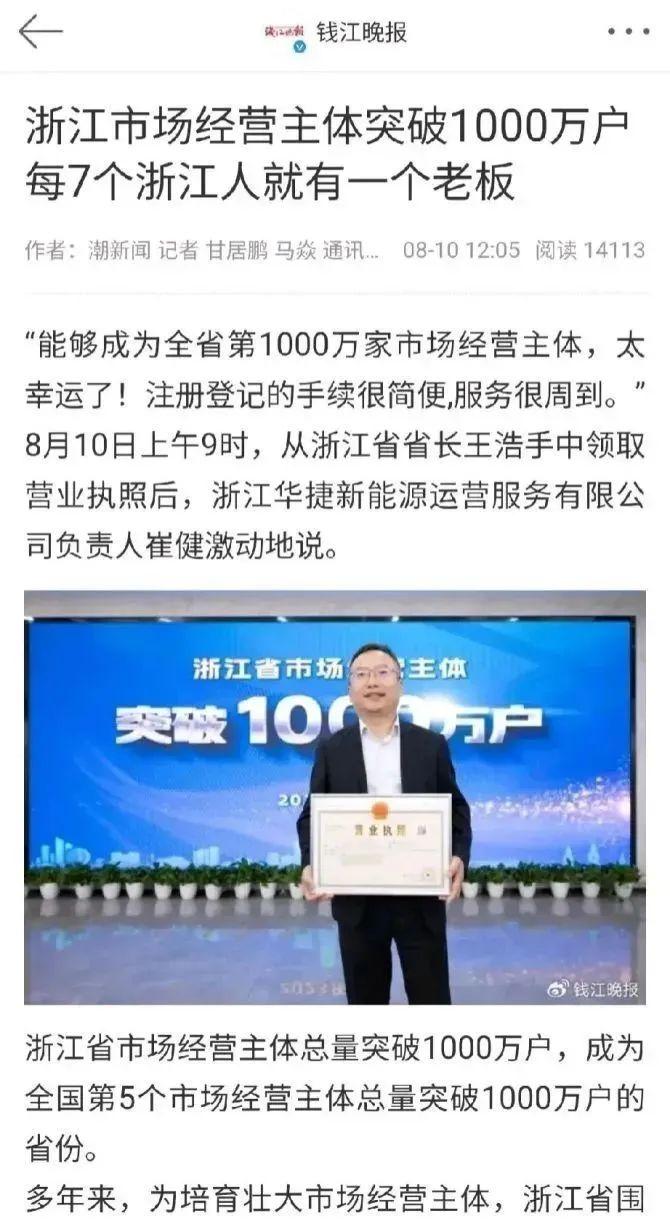
Core Insights - Zhejiang is experiencing a significant influx of talent, attracting 557,000 immigrants in 2023 at an average rate of 1,526 people per day, with a notable portion coming from Guizhou, indicating a shift in regional economic dynamics [1][11] - The province's competitive advantages include higher salaries for tech workers, faster loan approvals for small businesses, and better educational opportunities for migrant workers' children compared to Guangdong [1][3][12] Economic Landscape - Zhejiang boasts a high density of market entities, with 1 in 7.8 people being a business owner, and an average of 24,000 new enterprises established daily, significantly outpacing Guangdong [3][4] - The province's private sector contributes 67% of GDP and 87% of employment, highlighting its robust economic foundation [3][4] Innovation and Development - Zhejiang's industries are moving beyond traditional manufacturing, with significant investments in high-tech sectors such as AI and robotics, leading to higher profit margins and advanced production techniques [8][12] - The region is also focusing on infrastructure development, with substantial investments in transportation and digital trade centers to enhance connectivity and economic activity [11][12] Governance and Services - The efficiency of government services in Zhejiang is notable, with talent subsidies processed faster than in other provinces, and a streamlined approach to administrative tasks [12][13] - The average time for residency applications is 1.8 days, significantly quicker than in Guangdong, reflecting a proactive governance model [12] Wealth Distribution - Zhejiang has the highest per capita disposable income for farmers in China, with a low urban-rural income disparity, indicating effective wealth distribution policies [12][13] - The province's fiscal strategy allocates 78% of expenditures to public welfare, creating a cycle of economic growth that benefits both businesses and residents [12][13] Labor Market Dynamics - The influx of workers from other provinces is reshaping the labor market, with a focus on transforming laborers into partners in wealth creation rather than mere employees [14] - The region's approach to skill development and digital economy integration is fostering a more skilled workforce, enhancing overall productivity [14]
新职业青年涌入直播间
Zhong Guo Qing Nian Bao· 2025-06-11 08:18
Core Viewpoint - The emergence of new professions, particularly in the live streaming sector, has significantly expanded job opportunities and increased income, contributing to employment stability in China [1][3]. Group 1: New Professions and Employment Opportunities - New professions such as live streaming recruiters and lifestyle service experience officers have been included in the new occupational directory released by the Ministry of Human Resources and Social Security, broadening China's occupational landscape [1][3]. - The rapid development of the live streaming industry has led to the creation of diverse roles, reshaping traditional industry operations and providing new career paths for young people [2][4]. - The live streaming sector is expected to mature, with increasing specialization and professionalization among various roles involved in live streaming operations, from planning to analysis [6]. Group 2: Role of AI in Live Streaming - AI application specialists are utilizing advanced AI tools to enhance live streaming experiences, from generating creative scenes to analyzing viewer preferences post-broadcast, significantly improving efficiency [4]. - The integration of AI in live streaming is seen as a transformative force, enabling new forms of content creation and audience engagement [4][8]. Group 3: Impact on Traditional Industries - Live streaming has provided a new digital transformation pathway for traditional industries, creating high-quality job opportunities and driving industry upgrades [7]. - The rise of live streaming hosts in sectors like real estate has improved transparency and information access for consumers, fostering industry progress [7]. Group 4: Innovative Recruitment Models - The "live streaming recruitment" model has emerged as a response to employment needs, allowing job seekers to access information and apply for positions in a more interactive manner [9][10]. - This model has proven effective in breaking geographical barriers, enabling job seekers from remote areas to connect with potential employers [10][11]. Group 5: Future Employment Trends - The digital transformation and green development trends are shaping the future of employment, with live streaming becoming a typical practice in promoting job opportunities within the platform economy [12]. - There is a call for the establishment of a new occupational training system to support young people in navigating these emerging career paths [12].
企业添动力就业有底气(经济时评)
Ren Min Ri Bao· 2025-06-09 22:02
Group 1 - The employment situation in China is generally stable, with urban employment steadily increasing from January to April, and the urban survey unemployment rate remaining below the regulatory target [1] - Small and medium-sized enterprises (SMEs) play a crucial role in employment, accounting for over 80% of job absorption, and their operational status directly impacts job quantity and quality [1] - A series of employment stabilization policies have been implemented, including the issuance of over 640 billion yuan in special loans to stabilize and expand employment, creating more than 5.3 million job opportunities [1] Group 2 - New employment forms are emerging due to the application of internet technology and the development of the digital economy, with platform companies playing a significant role in expanding employment capacity [2] - Companies are increasingly investing in employee training, with the market expected to reach nearly 1 trillion yuan by 2025, providing diverse growth opportunities for young people [2] - The government is also supporting skills training initiatives, aiming to subsidize vocational skills training for over 10 million people annually for three consecutive years [2]
1亿直男也救不了虎扑
虎嗅APP· 2025-06-07 13:52
Core Viewpoint - The article discusses the sale of Hupu for 500 million RMB, highlighting the decline of the platform and contrasting it with the valuation of Xiaohongshu at approximately 26 billion USD, suggesting a disparity in male consumer power [3][4]. Group 1: Hupu's Decline - Hupu's revenue model has become heavily reliant on advertising, with reports indicating that advertising could account for up to 90% of total revenue after the separation of its e-commerce businesses [6][8]. - The community forum model has entered a vicious cycle of low monetization, leading to significant user attrition, with monthly active users dropping from 55 million in 2017 to only 5.79 million by 2020 [9][10]. - Hupu's inability to retain users has weakened its community ecosystem, making it difficult to attract advertisers, which in turn exacerbates the decline [9][10]. Group 2: Acquisition by Xunlei - The acquisition of Hupu by Xunlei, a company also facing challenges, raises questions about the strategic value of the purchase, as both companies are seen as struggling [13][14]. - Despite its difficulties, Xunlei reported a slight increase in total revenue and gross profit in Q1 2025, reaching 8.88 million USD in revenue [17][19]. - Xunlei has diversified its business, successfully expanding into overseas live streaming, which has become its fastest-growing segment [23][25]. Group 3: Market Perception and Potential - The article argues that the perception of low male consumer power is misleading, as platforms like Dewu demonstrate significant male purchasing power, with Dewu's monthly active users exceeding 10 million and a valuation of 71 billion RMB [29]. - Hupu still holds value in the sports information sector, with its unique community structure providing a platform for discussions that cannot be easily replicated by video-based platforms [32][34]. - The article suggests that Xunlei's acquisition could potentially revitalize Hupu by leveraging its user base and content to enhance Xunlei's ecosystem, particularly in live streaming [35].


“直播五巨头”,难讲新故事
3 6 Ke· 2025-06-06 01:03
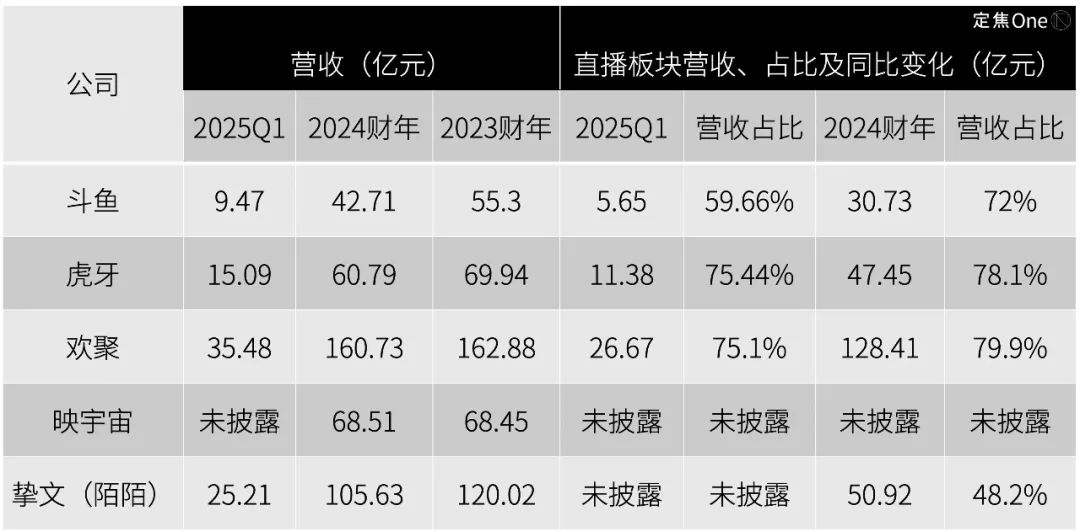
Core Insights - The "easy profit era" of the live streaming industry is coming to an end, with companies facing growth pressures and profitability anxieties, leading to a collective transformation phase [1][2] - The five major players in the live streaming sector—Douyu, Huya, Huanju, Yingyu Universe, and Zhihui Group—are struggling to adapt and move away from their reliance on live streaming [2][12] Revenue Performance - In Q1 2025, Douyu reported revenue of 9.47 billion yuan, down 8.94% year-on-year; Huya's revenue was 15.09 billion yuan, a slight increase of 0.3%; Zhihui's revenue was 25.21 billion yuan, down 1.5%; Huanju's revenue was 4.94 billion USD (approximately 35.48 billion yuan), down 12% [4][6] - For the fiscal year 2024, the revenue ranking of the five companies was led by Huanju (22.38 billion USD), followed by Zhihui (105.63 billion yuan), Yingyu Universe (68.51 billion yuan), Huya (60.79 billion yuan), and Douyu (42.71 billion yuan) [4][6] Revenue Structure - Despite efforts to decentralize from live streaming, it remains the main revenue source for most companies: in 2024, Douyu, Huya, and Huanju had live streaming revenue shares of 72%, 78%, and approximately 80%, respectively [7][8] - In Q1 2025, the live streaming revenue shares were approximately 60% for Douyu, 75% for Huya, and 75% for Huanju, indicating a continued reliance on this segment [7][8] User Engagement - User engagement is declining, with Douyu's monthly active users (MAU) at 41.4 million, down 8.7% year-on-year, and average paying users at 2.9 million, down 14.71% [9][10] - Huanju's global MAU was 260 million, down 6.1%, with its products Bigo Live and Likee also experiencing significant declines in user numbers [10] Profitability - Huanju showed relative stability in profitability, with a net profit of 298.5 million USD for 2024 and 63.2 million USD for Q1 2025, indicating some resilience [11] - Douyu, however, reported a net loss of 240 million yuan for 2024 and continued to lose 79.61 million yuan in Q1 2025, marking a significant decline in profitability [11] Market Response - The market has reacted negatively to the performance of these companies, with their market capitalizations significantly reduced compared to their peak values [12] - As of the latest reports, the market values were Huanju (2.45 billion USD), Zhihui (1.004 billion USD), Huya (876 million USD), Yingyu Universe (2.557 billion HKD), and Douyu (200 million USD) [12] Transformation Efforts - Companies are attempting to find new growth avenues, with Douyu and Huya focusing on innovative business models and advertising [15][16] - Huanju has successfully expanded its overseas operations, while Yingyu Universe has pivoted towards short dramas, showing some signs of recovery [19][20] Future Outlook - The ability of these companies to successfully transition away from live streaming will determine their survival in the evolving market landscape [12][26] - Emphasis on technological advancements, particularly AI, is seen as crucial for enhancing content generation and user engagement [23][25]


俞敏洪率东方甄选团队深入玉树,探秘三江源生态与康巴文化
Huan Qiu Wang Zi Xun· 2025-06-05 09:32
Core Viewpoint - New Oriental Education Technology Group, led by Chairman Yu Minhong, is actively involved in educational and ecological initiatives in Yushu, Qinghai, enhancing local education and promoting ecological protection through strategic partnerships and live streaming events [1][3][8]. Group 1: Educational Initiatives - New Oriental's educational charity projects have been rooted in Yushu since 2008, significantly supporting the region's recovery after the 2010 earthquake [1]. - The dual-teacher classroom project supported by New Oriental has benefited nearly 10,000 students in Yushu [1]. Group 2: Ecological Protection - Qinghai is recognized as a crucial ecological barrier in China, with seven national nature reserves forming a complete ecological protection system [3]. - The team visited key ecological sites, including the Sanjiangyuan Nature Reserve, to highlight the region's ecological achievements [3]. - New Oriental signed a strategic cooperation agreement with the Sanjiangyuan Ecological Protection Foundation, donating 1 million yuan to support ecological protection efforts [3]. Group 3: Cultural Promotion - The team engaged in immersive cultural experiences, showcasing Tibetan traditions and local products through live streaming [7][8]. - The exploration of local industries, such as yak farming, aims to connect highland specialty products with national consumers, enhancing local economic development [7][8]. - The collaboration with local tourism authorities aims to promote Yushu's natural beauty and cultural heritage through a "cultural tourism + live streaming" approach [8].


小红书娱乐直播公会申请条件
Sou Hu Cai Jing· 2025-06-04 12:12
小红书娱乐直播公会申请条件 还得提供外站直播平台最近连续三个月直播公会流水大于 100 万人民币,以及外站直播平台主播人数大于 50 名, 且要是优秀网红主播,这是在向小红书展示咱在其他平台的 "战绩" 和实力。 公司资质方面 必须是合法注册的企业或组织,要有独立法人资格哦,得提供有效的营业执照、税务登记证这些相关证件,证明咱 公司是正规军。 营业执照上的经营范围可不能少了直播、内容创作、电商服务这些相关内容,不然就像没带钥匙想开门,可进不去 申请的大门。 部分区域,比如中国台湾,可能要求公司在中国大陆以外注册,这一点要特别注意,申请前一定要搞清楚自己所在 区域的要求。 公司注册时间最少得半年以上,注册资金 50 万以上,而且最好是一般纳税人公司,这代表着公司有一定的实力和 稳定性。 有些类目还得办理《营业性演出许可证》,并且可能要缴纳 1 万元保证金(具体金额还是要以最新政策为准哈)。 **公会申请(薇:hs)(cm)(mcn) 宝子们,最近很多人问我小红书娱乐直播公会的申请条件,今天就来给大家详细讲讲~ 得有 20 个线下配套完整的娱乐直播间,还得拍照上传,这也是证明公司实力的一方面。 团队实力方面 要有 ...

银行职员6000多万诈骗款直播打赏追缴背后:平台公司异议被驳,银行是否监管缺失引争议
Tai Mei Ti A P P· 2025-06-04 05:34
Core Viewpoint - The case involving Beijing Milaiwu Network Technology Co., Ltd. (referred to as "Milaiwu") highlights the legal complexities surrounding the recovery of funds obtained through fraudulent activities, particularly in the context of live streaming platforms and the concept of "good faith acquisition" [1][3][9] Group 1: Legal Proceedings and Financial Implications - Milaiwu has appealed against the Zhengzhou Intermediate People's Court's ruling to recover over 18.87 million yuan in live streaming rewards, which the court did not support, leading to a further appeal to the Henan Provincial High Court [1] - The case stems from a fraud committed by former bank employee Xi Wei, who misled clients into investing in fictitious financial products, resulting in a total fraud amount of approximately 94.48 million yuan [2][6] - The court's decision to pursue the recovery of Milaiwu's earnings raises questions about whether the funds obtained through live streaming should be classified as "good faith acquisition" and whether banks have a regulatory responsibility in fraud cases [1][3][6] Group 2: Financial Crime and Banking Responsibility - Legal experts argue that the case reflects a deeper conflict between financial crime governance and the legal boundaries of emerging business models, particularly in the context of online platforms [1][9] - Milaiwu's legal representatives assert that the bank should bear primary responsibility for the fraud, as Xi Wei exploited her position to commit the crime, which undermined the trust clients placed in the bank [7][8] - The case draws parallels with previous rulings where banks were held accountable for employees' fraudulent actions, emphasizing the need for banks to fulfill their anti-money laundering obligations [6][8]
