铁路

Search documents
中邮人寿保险增持中国通号115.8万股 每股作价约3.45港元
Zhi Tong Cai Jing· 2025-11-25 11:08
Group 1 - Hong Kong Stock Exchange data shows that on November 21, China Post Life Insurance increased its stake in China Communication Construction Company (China Tonghao) by 1.158 million shares at a price of HKD 3.4517 per share, totaling approximately HKD 3.9971 million [1] - After the increase, China Post Life Insurance holds approximately 119 million shares, representing a 6.05% stake in China Communication Construction Company [1]

中国通号:中标约25.39亿元项目
2 1 Shi Ji Jing Ji Bao Dao· 2025-11-25 09:56
南财智讯11月25日电,中国通号公告,公司于2025年9月至10月中标共计十个重要项目,其中铁路市场 五个,分别为新建川藏铁路雅安至康定段站后"四电"及相关工程CZRDJC-1标段项目,中标金额3.88亿 元;时速350公里复兴号动车组配套电务车载设备(CTCS-3级列控系统车载设备)采购项目,中标金额 3.63亿元;北京市郊铁路东北环线工程KF标段项目,中标金额2.54亿元;京广高铁武广段安全标准示范 线建设通信工程WGBFSG-3标段项目,中标金额1.24亿元;成都市域铁路公交化运营改造二期工程 SYS06标段项目,中标金额1.06亿元。城市轨道交通市场五个,分别为上海市轨道交通1号线信号系统 及配套更新改造工程信号系统集成项目,中标金额5.51亿元;墨西哥城STE轻轨项目,中标金额折合人 民币约3.09亿元;上海市轨道交通1号线信号系统及配套更新改造工程信号系统安装施工项目,中标金 额1.89亿元;上海市轨道交通12号线西延伸工程信号系统采购项目,中标金额1.53亿元;长春市轨道交 通3、4号线应对极端天气、消除安全隐患及设施设备安全性提升改造(2025年第一批)项目,中标金额 1.02亿元。以上项目中 ...
全省唯一!刘仕远入选首批“国家级杰出计量领军人才”
Yang Zi Wan Bao Wang· 2025-11-25 09:04
作为国家级杰出计量领军人才,刘仕远的研究方向将紧密对接国家"十五五"规划、《计量发展规划 (2021—2035年)》及《计量测试关键技术创新攻关行动方案》等战略部署,重点聚焦前沿领域测量技术 存在的短板与空白,着力解决"测不了、测不全、测不准"等行业难题,推动体系化科研攻关,助力提升 国家计量创新体系的整体效能。 王中洲张春艳 校对陶善工 近日,国家市场监管总局公布了首批国家级计量高水平人才名单。常州市中车戚墅堰机车车辆工艺研究 所股份有限公司的技术骨干刘仕远成功入选,荣获"国家级杰出计量领军人才"称号,是江苏省内唯一获 此殊荣的专业人才。 此次遴选严格遵循国家相关政策规定,经过个人申报、单位推荐、专家评审及社会公示等多项严谨程 序,最终在全国范围内选拔出一批在计量领域贡献突出、具备引领能力的高层次人才。 ...
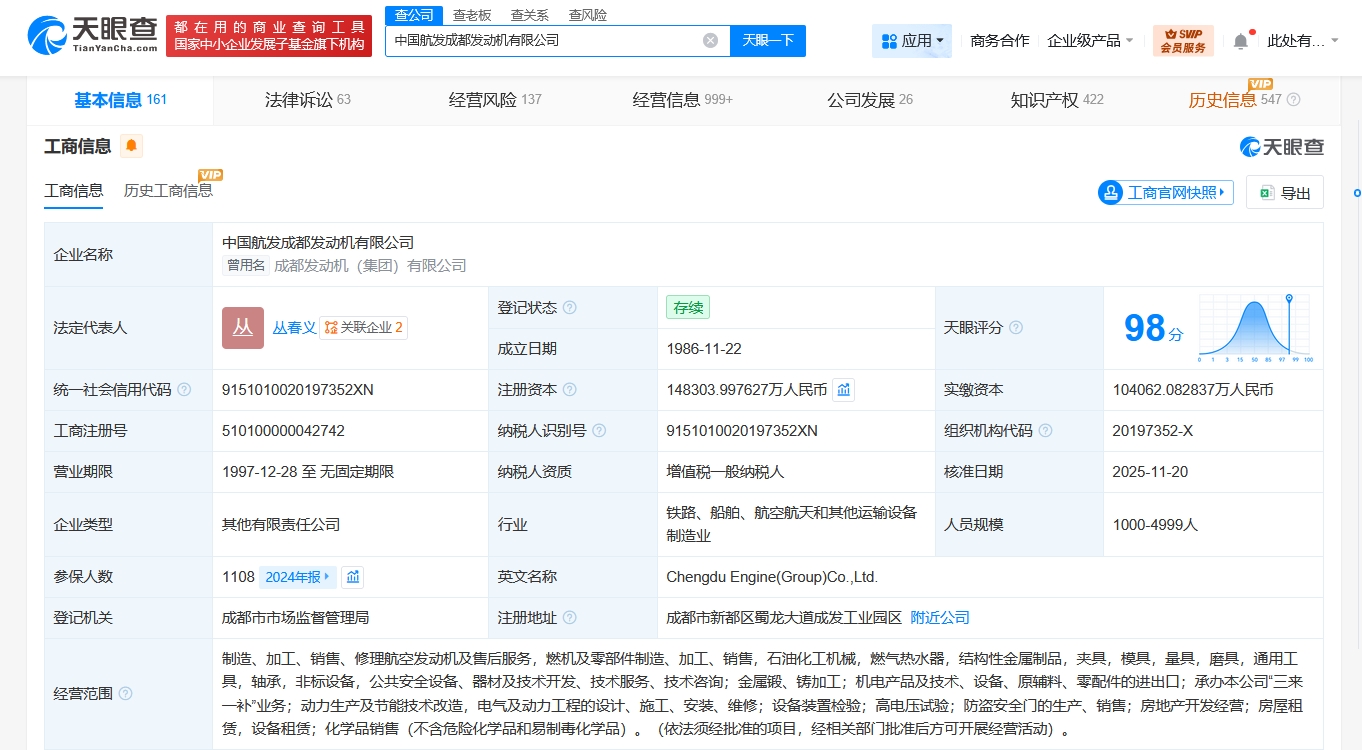
中国航发成都发动机公司增资至14.8亿元 增幅约42.5%
Mei Ri Jing Ji Xin Wen· 2025-11-25 04:43
Core Insights - China Aviation Engine Corporation Chengdu Engine Co., Ltd. has undergone significant changes in its shareholder structure and registered capital, indicating a strategic shift in its ownership and investment landscape [1] Shareholder Changes - Sichuan Investment Group Co., Ltd. has exited its position as a shareholder, while Chengdu Aerospace Power Technology Co., Ltd., Sichuan Energy Development Group Co., Ltd., and the National Military-Civilian Integration Industry Investment Fund II have been added as new shareholders [1][2] - The registered capital of the company has increased from approximately 1.04 billion RMB to about 1.48 billion RMB, reflecting a growth of approximately 42.5% [1][3] Management Changes - Several high-level executives have changed, indicating potential shifts in company strategy and operations [1][3] Company Overview - Chengdu Engine Co., Ltd. was established in November 1986 and is involved in the manufacturing, processing, sales, and repair of aircraft engines, as well as providing after-sales services [1][2] - The company operates under the legal representation of Cong Chunyi and is classified within the aerospace and transportation equipment manufacturing industry [1][2]

中国这条新运河明年或通航
3 6 Ke· 2025-11-25 02:13
Core Viewpoint - China is accelerating the improvement of its modern comprehensive transportation system during the "14th Five-Year Plan" period, aiming to build a strong transportation nation by 2035, with significant investments in key projects like the Pinglu Canal and various technological innovations [1][2]. Group 1: Transportation Infrastructure Development - The Pinglu Canal, a landmark project with an investment of 72.7 billion yuan, is set to be completed by the end of 2026, enhancing connectivity from Nanning to the Beibu Gulf [3]. - China's high-speed rail and highway networks are the largest in the world, covering 99% of cities with over 200,000 people and 97% of cities with over 500,000 people, respectively [4]. - The "14th Five-Year Plan" emphasizes the need for a comprehensive transportation network, focusing on optimizing the "6 axes, 7 corridors, and 8 channels" framework [5]. Group 2: Logistics and Cost Reduction - The importance of transportation logistics has been elevated, with new specialized planning being developed by transportation management departments for the first time [7]. - The goal is to reduce the logistics cost-to-GDP ratio to around 13.5% by 2027, compared to the current 14.0%, which is already the lowest level recorded [8][9]. - The plan includes optimizing transportation structures, increasing the share of rail freight, and enhancing intermodal transport efficiency [9][10]. Group 3: Technological Innovations - Six major innovative projects, including intelligent driving for freight trucks and autonomous navigation for inland cargo ships, will be fully deployed during the "14th Five-Year Plan" period [12]. - The integration of artificial intelligence in transportation is being promoted, with over 100 pilot projects planned to enhance smart logistics and safety [13][15]. - The development of a unified system for multimodal transport is underway, aiming to streamline operations and reduce costs through standardized practices [10][11].
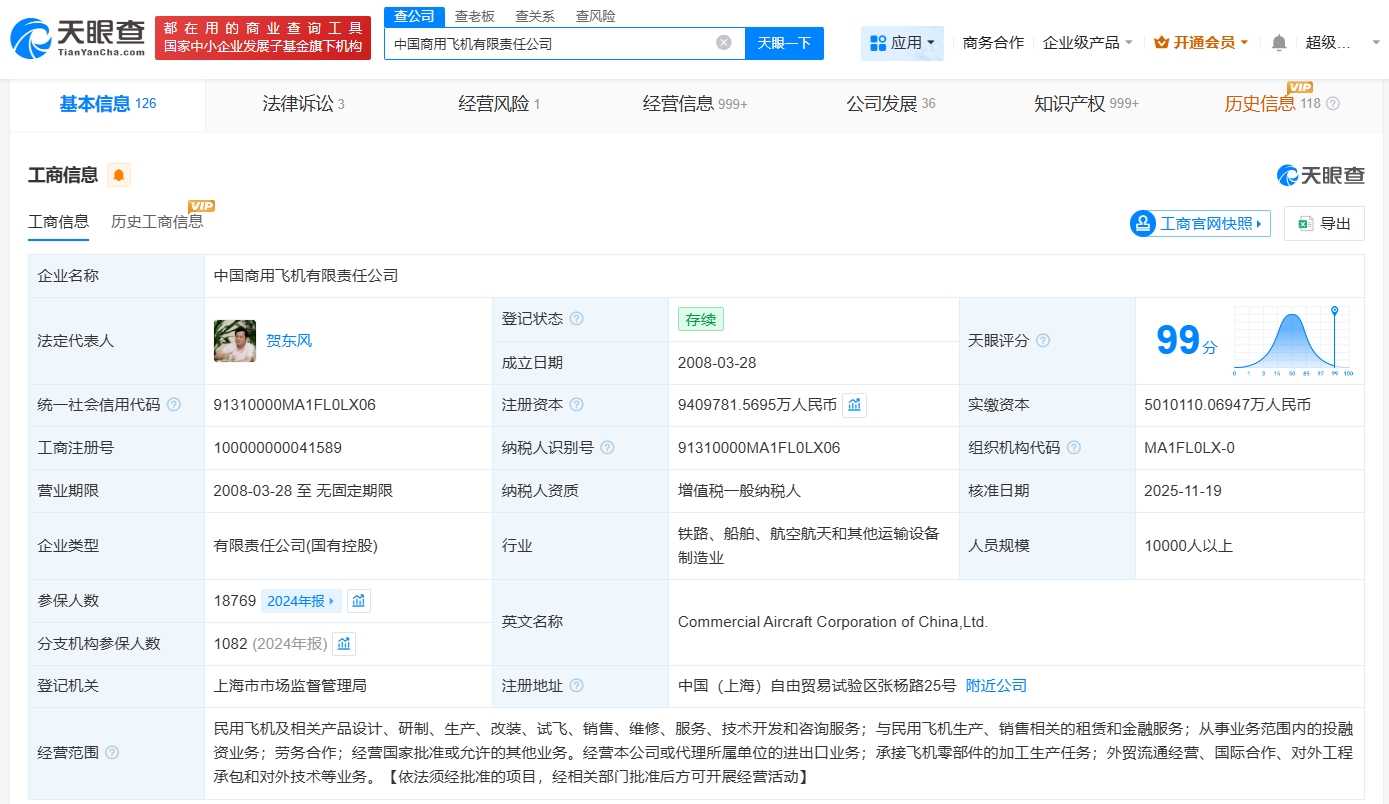
中国商飞增资至940.98亿元 增幅约88%
Mei Ri Jing Ji Xin Wen· 2025-11-24 02:58
Core Insights - China Commercial Aircraft Corporation (COMAC) has increased its registered capital from approximately 50.1 billion RMB to about 94.1 billion RMB, marking an increase of approximately 88% [1]. Company Overview - COMAC was established in March 2008 and is involved in the design, research, production, modification, test flight, sales, maintenance, and consulting services related to civil aircraft and related products [1]. - The company is state-owned and is jointly held by the State-owned Assets Supervision and Administration Commission, Shanghai Guosheng (Group) Co., Ltd., and Aviation Industry Corporation of China [1][3]. Shareholder Information - The major shareholders include: - State-owned Assets Supervision and Administration Commission: 53.08% [3]. - Shanghai Guosheng (Group) Co., Ltd.: 19.64% [3]. - Aviation Industry Corporation of China: 6.90% [3]. - Other significant shareholders include China Aluminum Corporation, China National Building Material Group, and China Baowu Steel Group [3]. Business Scope - COMAC's business scope includes the design, research, production, modification, test flight, sales, maintenance, and consulting services for civil aircraft and related products, as well as leasing and labor cooperation related to civil aircraft production and sales [2].
中金 | 股市长牛之美国经验:呵护成长性
中金点睛· 2025-11-23 23:39
Core Viewpoint - The article discusses the long-term bull market in the U.S. stock market since the 1980s, driven by economic structural transformation and the information technology revolution, leading to a significant increase in market capitalization relative to GDP, which has risen from 60% in the 1980s to over 200% currently [2][5]. Group 1: Macroeconomic Policy - The "腾笼换鸟" (tenglong huan niao) policy initiated by the Reagan administration aimed to enhance economic efficiency by phasing out outdated industries and promoting high-tech sectors, which helped reverse the long-term decline in U.S. economic efficiency [16][17]. - The policy included measures such as reducing subsidies, promoting international trade, and stimulating high-tech manufacturing, contributing to productivity growth [16][17]. Group 2: Microeconomic Enterprises - U.S. companies have shifted focus towards profitability quality and shareholder returns, with an increasing emphasis on cash flow and dividends since the 1980s [17][23]. - The introduction of SEC Rule 10b-18 in 1982 facilitated stock buybacks, allowing companies to manage their stock prices more effectively, which became a common practice post-1980s [23][24]. Group 3: Asset Side - Incremental Capital Flow - Long-term capital has steadily flowed into the U.S. stock market, supported by the rise of institutional investors and changes in retirement savings plans, significantly increasing household participation in equity markets [28][31]. - The share of long-term investors, such as pension funds and mutual funds, in the U.S. stock market rose to nearly 40% in the 1980s, enhancing market stability and price discovery [31][33]. Group 4: Globalization and Foreign Capital - The globalization process initiated in the 1980s led to significant inflows of foreign capital into the U.S. stock market, with overseas investors accumulating $2.36 trillion in U.S. equities from 1980 to mid-2025 [36][38]. - The "美元大循环" (dollar circulation) phenomenon facilitated the return of overseas dollars to the U.S., further supporting the bull market [36][38]. Group 5: Federal Reserve's Role - The Federal Reserve's "put option" policy has provided a safety net for the stock market, with interventions during major downturns since the late 1980s, reinforcing market confidence [40][41]. - The Fed's increasing focus on stock market performance has been evident, with more frequent mentions of the stock market in FOMC minutes since the 1980s [40][41].

8572亿度电里的经济密码:10.4%增速背后,这三个数字更值得关注
Sou Hu Cai Jing· 2025-11-22 11:18
Core Insights - In October, China's total electricity consumption reached 857.2 billion kWh, marking a year-on-year growth of 10.4%, the first monthly increase exceeding 10% this year [1][3] Group 1: Electricity Consumption by Industry - The primary industry saw a 13.2% increase in electricity consumption, significantly driven by the electrification transformation in livestock and fishery sectors [3] - The secondary industry, which accounts for over 60% of total electricity consumption, experienced a growth rate of 6.2%. Notably, high-tech and equipment manufacturing led with an 11.0% increase, while electrical machinery and equipment manufacturing surged by 19.8% [3] - The tertiary industry exhibited the most remarkable growth at 17.1%, largely fueled by the rapid advancement of the digital economy, with internet data services related to big data and AI skyrocketing by 46% [3] Group 2: Factors Influencing Growth - The consumption surge during the National Day and Mid-Autumn Festival contributed significantly, with the accommodation and catering sectors increasing electricity usage by 18.4% [5] - The electric vehicle industry experienced explosive growth, with charging and swapping services seeing a staggering 61.8% increase in electricity consumption [5] - Urban and rural residential electricity consumption grew by 23.9%, attributed to the unusual weather conditions in October, particularly the high temperatures in southern regions [5] Group 3: Economic Implications - The electricity consumption data reflects three new trends in the Chinese economy: a shift towards high-tech manufacturing, rapid growth in the service sector driven by digitalization and holiday consumption, and resilient consumer spending [5] - The overall electricity usage illustrates a vivid narrative of economic recovery, showcasing the dynamic pulse of China's economy through various sectors [5]

AI与19世纪铁路热相似,破产潮是必然?
3 6 Ke· 2025-11-21 02:59
Core Viewpoint - The infrastructure investment supporting the development and popularization of artificial intelligence (AI) is becoming overheated, drawing parallels to the 19th-century railway investment boom that led to numerous failures [1][3]. Group 1: AI Investment Landscape - OpenAI's CEO Sam Altman warns that some investors may suffer severe losses due to "stranded assets" as infrastructure costs decrease, allowing anyone to use general-purpose AI on personal devices [2]. - Major hyperscalers like OpenAI, Google, Meta, and Amazon are making unprecedented large-scale investments, with McKinsey estimating nearly $7 trillion will be invested in data centers by 2030 [2]. - The current investment climate is likened to the early days of the railway boom, with significant capital being funneled into AI infrastructure [2]. Group 2: Historical Context of Investment Booms - The 19th-century railway investment boom in the UK and the US saw massive capital influxes, leading to many bankruptcies due to over-speculation and mismanagement [3][4]. - In the US, 55 companies went bankrupt in 1877 alone, with further failures in subsequent years, highlighting the risks associated with over-investment [4]. - The financial turmoil led to the development of financial technologies and investment banking practices, as institutions like J.P. Morgan began underwriting railway bonds [4]. Group 3: Current Challenges and Market Reactions - The financial community is grappling with the timing of returns on AI investments, as companies like Meta and Alphabet face declining return on assets (ROA) [5][6]. - Meta announced a capital expenditure of $72 billion for the year, predicting further increases, which resulted in a significant stock sell-off [6]. - Approximately 95% of organizations are currently unable to profit from generative AI investments, raising concerns about the sustainability of ongoing investments in AI infrastructure [6].
中国中车获中国平安增持858万股
Ge Long Hui· 2025-11-20 23:33
格隆汇11月21日丨根据联交所最新权益披露资料显示,2025年11月17日,中国中车(01766.HK)获中国平安保险(集团)股份有限公司在场内以每股均价 6.3429港元增持858万股,涉资约5442.21万港元。 | 表格序號 | 大股東/董事/最高行政人員名稱 作出披露的 買入 / 賣出或涉及的股每股的平均價 | | 持有權益的股份數目 佔已發行的 有關事件的日 | | | --- | --- | --- | --- | --- | | | | | (請參聞上述*註解)有技票權版(日/月/年) | | | | | | 分自分库 | | | CS20251120E00027 | 中国平安保险(集团)股份有 (1001(L) | 8,580,000(L) | HKD 6.3429 265,816,000(L) | 6.08(L)17/11/2025 | | | 限公司 | | | | 增持后,中国平安保险(集团)股份有限公司最新持股数目为265,816,000股,持股比例由5.88%上升至6.08%。 ...