乘用车

Search documents
今年10月自主品牌乘用车零售155万辆
Bei Jing Shang Bao· 2025-11-10 08:59
Core Insights - In October, retail sales of self-owned brand passenger vehicles reached 1.55 million units, representing a year-on-year increase of 4% and a month-on-month increase of 3% [1] - The domestic retail market share of self-owned brands was 68.7% in October, which is a year-on-year increase of 3 percentage points [1]
今年10月主流合资乘用车品牌零售51万辆
Bei Jing Shang Bao· 2025-11-10 08:59
北京商报讯(记者刘晓梦)11月10日,中国汽车流通协会乘用车市场信息联席分会发布的数据显示,今年 10月主流合资乘用品牌零售51万辆,同比下降10%,环比增长3%。期中,德系品牌零售份额13.5%,同 比下降2.3个百分点;日系品牌零售份额12.3%,同比下降0.6个百分点。 ...
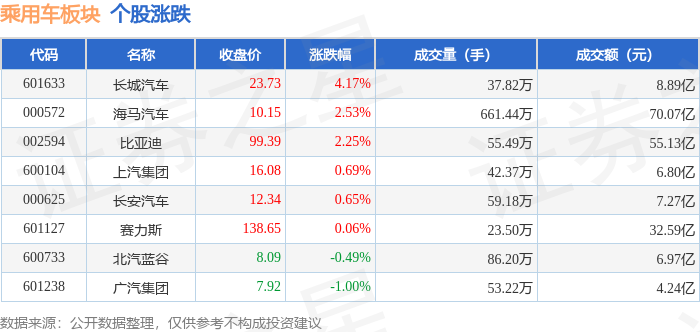
乘用车板块11月10日涨1.4%,长城汽车领涨,主力资金净流出6.23亿元
Zheng Xing Xing Ye Ri Bao· 2025-11-10 08:49
Core Insights - The passenger car sector experienced a 1.4% increase on November 10, with Great Wall Motors leading the gains [1] - The Shanghai Composite Index closed at 4018.6, up 0.53%, while the Shenzhen Component Index closed at 13427.61, up 0.18% [1] Passenger Car Sector Performance - Great Wall Motors (601633) closed at 23.73, up 4.17% with a trading volume of 378,200 shares and a transaction value of 889 million [1] - Other notable performers include: - Meizu Tianao (000572) at 10.15, up 2.53%, with a transaction value of 7 billion [1] - BYD (002594) at 99.39, up 2.25%, with a transaction value of 5.51 billion [1] - SAIC Motor (600104) at 16.08, up 0.69%, with a transaction value of 680 million [1] - Changan Automobile (000625) at 12.34, up 0.65%, with a transaction value of 727 million [1] Capital Flow Analysis - The passenger car sector saw a net outflow of 623 million from institutional investors, while retail investors contributed a net inflow of 615 million [1] - Specific stock capital flows include: - BYD (002594) had a net inflow of 5.87 billion from institutional investors, but a net outflow of 3.42 billion from speculative funds [2] - Great Wall Motors (601633) experienced a net inflow of 1 billion from institutional investors, with significant outflows from both speculative and retail investors [2] - Changan Automobile (000625) had a net inflow of 790 million from institutional investors, while experiencing outflows from speculative and retail investors [2]





今年前10个月乘用车零售同比增长7.9%
Bei Jing Shang Bao· 2025-11-10 08:23
Core Insights - The China Automobile Circulation Association reported that retail sales of vehicles reached 19.25 million units in the first ten months of this year, representing a year-on-year increase of 7.9% [1] - In October, the national retail sales of passenger vehicles were 2.242 million units, showing a year-on-year decline of 0.8% and a month-on-month decrease of 0.1% [1] Summary by Categories - **Sales Performance** - Cumulative retail sales for the first ten months of the year reached 19.25 million units, up 7.9% year-on-year [1] - October's retail sales of passenger vehicles were 2.242 million units, down 0.8% year-on-year and down 0.1% month-on-month [1]
乘联分会:10月乘用车出口(含整车与CKD)56.8万辆 同比增长27.7%
Mei Ri Jing Ji Xin Wen· 2025-11-10 08:23
Core Insights - In October, passenger car exports (including complete vehicles and CKD) reached 568,000 units, representing a year-on-year increase of 27.7% and a month-on-month increase of 7.5% [1] - From January to October, total passenger car exports amounted to 4.567 million units, showing a year-on-year growth of 14.2% [1] - In October, new energy vehicles accounted for 44.2% of total exports, an increase of 17 percentage points compared to the same period last year [1] Summary by Category - **Export Performance** - October passenger car exports reached 568,000 units, up 27.7% year-on-year and 7.5% month-on-month [1] - Total exports from January to October were 4.567 million units, reflecting a 14.2% year-on-year increase [1] - **New Energy Vehicle Contribution** - New energy vehicles made up 44.2% of total exports in October, a significant increase of 17 percentage points year-on-year [1] - **Brand Performance** - Exports of domestic brands in October reached 476,000 units, marking a year-on-year increase of 27% and a month-on-month increase of 3% [1] - Joint venture and luxury brand exports totaled 92,000 units, showing a year-on-year growth of 31% [1]
每周股票复盘:北汽蓝谷(600733)10月销量同比增112.02%
Sou Hu Cai Jing· 2025-11-08 17:31
Group 1 - The stock price of Beiqi Blue Valley (600733) closed at 8.13 yuan on November 7, 2025, down 2.63% from the previous week's closing price of 8.35 yuan [1] - The highest intraday price for Beiqi Blue Valley on November 3 was 8.56 yuan, while the lowest intraday price on November 7 was 8.13 yuan [1] - The current total market capitalization of Beiqi Blue Valley is 45.313 billion yuan, ranking 7th in the passenger car sector and 401st among 5,166 A-shares [1] Group 2 - Beijing New Energy Automobile Co., Ltd. produced 29,382 vehicles in October 2025, representing a year-on-year increase of 137.26%, with a cumulative production of 138,768 vehicles for the year, up 104.36% [2] - The sales volume for October 2025 was 30,542 vehicles, showing a year-on-year growth of 112.02%, with cumulative sales for the year reaching 142,043 vehicles, up 72.69% compared to the same period last year [2] - Beiqi Blue Valley's application for a specific stock issuance has been approved by the Shanghai Stock Exchange, pending registration with the China Securities Regulatory Commission [2][3]

乘用车板块11月7日跌0.39%,赛力斯领跌,主力资金净流出10.06亿元
Zheng Xing Xing Ye Ri Bao· 2025-11-07 08:41
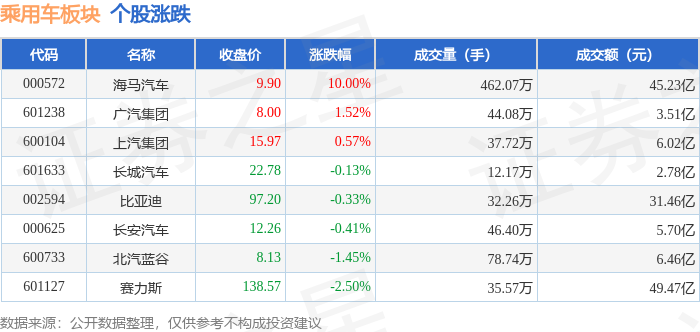
Market Overview - The passenger car sector experienced a decline of 0.39% on November 7, with the leading stock, Seres, falling by 2.50% [1] - The Shanghai Composite Index closed at 3997.56, down 0.25%, while the Shenzhen Component Index closed at 13404.06, down 0.36% [1] Stock Performance - Notable stock performances included: - China International Marine Containers (CIMC) rose by 10.00% to a closing price of 9.90 [1] - GAC Group increased by 1.52% to 8.00 [1] - BYD decreased by 0.33% to 97.20 [1] - Changan Automobile fell by 0.41% to 12.26 [1] - Seres closed at 138.57, down 2.50% [1] Capital Flow - The passenger car sector saw a net outflow of 1.006 billion yuan from institutional investors, while retail investors contributed a net inflow of 754 million yuan [1] - The capital flow for individual stocks showed: - Haima Automobile had a net inflow of 358 million yuan from retail investors [2] - GAC Group experienced a net outflow of 81.96 million yuan from institutional investors [2] - BYD had a significant net outflow of 3.07 billion yuan from institutional investors [2] - Seres faced a net outflow of 887 million yuan from institutional investors [2]

晨会纪要:2025年第190期-20251107
Guohai Securities· 2025-11-07 02:49
Group 1: Meinian Health / Medical Services - The company achieved a revenue of 6.925 billion yuan in the first three quarters of 2025, a decrease of 3% year-on-year, while the net profit attributable to shareholders was 52 million yuan, an increase of 111% [3] - In Q3 2025, the company reported a revenue of 2.816 billion yuan, down 4% year-on-year, with a net profit of 273 million yuan, up 14% [3] - The revenue generated from AI technology amounted to 250 million yuan, reflecting a growth of 71% [3] - The company has implemented cost reduction and efficiency improvement measures, as evidenced by a 0.63 percentage point increase in gross margin to 46.06% in Q3 2025 [4] Group 2: BYD / Passenger Vehicles - In Q3 2025, BYD reported a revenue of 194.985 billion yuan, a decrease of 3.05% year-on-year, while the net profit attributable to shareholders was 7.823 billion yuan, down 32.60% [6][7] - The automotive business gross margin was 20.6%, reflecting a 1.9 percentage point increase quarter-on-quarter [7] - The company sold 1.1142 million vehicles in Q3 2025, a decrease of 1.8% year-on-year, but showed improvements in single-vehicle profitability [7][8] - BYD is accelerating its global expansion, entering new markets such as Argentina and Cambodia, and has launched its high-level intelligent driving system [8] Group 3: SAIC Motor Corporation / Passenger Vehicles - SAIC Motor reported a total revenue of 169.4 billion yuan in Q3 2025, an increase of 16.2% year-on-year, with a net profit of 2.08 billion yuan, up 644.9% [10][11] - The company sold 1.141 million vehicles in Q3 2025, with a gross margin of 9.0%, reflecting a 0.5 percentage point increase quarter-on-quarter [11][12] - The company has been adjusting its product structure to meet market demand, which has led to significant improvements in operational efficiency [12]


赛力斯(601127):2025年三季报及港股上市点评:Q3业绩符合预期,港股上市募资140亿港元
Huachuang Securities· 2025-11-06 15:27
Investment Rating - The report maintains a "Strong Buy" rating for the company, expecting it to outperform the benchmark index by over 20% in the next six months [6][17]. Core Insights - The company reported Q3 2025 results that met expectations, with revenue of 48.1 billion yuan, a year-on-year increase of 16% and a quarter-on-quarter increase of 11%. The net profit attributable to shareholders was 2.37 billion yuan, down 1.7% year-on-year but up 8.1% quarter-on-quarter. The company successfully listed on the Hong Kong Stock Exchange, raising approximately 14.2 billion HKD [2][6]. - The company is leveraging its "A+H" dual capital platform strategy to enhance brand recognition in international markets and accelerate global expansion [2][6]. - The new model, Wanjie M8, has shown strong sales performance, contributing to the overall sales growth of 142,000 vehicles in Q3 2025, a year-on-year increase of 6.3% and a quarter-on-quarter increase of 9.1% [6][7]. Financial Performance Summary - Q3 2025 sales volume reached 142,000 units, with Wanjie sales at 124,000 units, reflecting a year-on-year increase of 12% and a quarter-on-quarter increase of 16%. The average selling price (ASP) was 339,000 yuan, up 2,800 yuan year-on-year and 700 yuan quarter-on-quarter [6][7]. - The gross margin for Q3 2025 was 29.9%, an increase of 4.4 percentage points year-on-year and 0.4 percentage points quarter-on-quarter [6][7]. - The company plans to allocate the funds raised from the IPO as follows: 40% for technology R&D, 30% for product development, 20% for marketing and overseas sales, and 10% for working capital [6][7]. Future Outlook - The company expects steady growth in sales and profitability, driven by the successful launch of new models and the internationalization process accelerated by the Hong Kong IPO. Revenue forecasts for 2025-2027 have been adjusted to 168.8 billion, 237.1 billion, and 268.3 billion yuan, respectively, with net profit forecasts adjusted to 8.3 billion, 13.6 billion, and 15.5 billion yuan [6][7]. - The target price for the company's stock is set at 195.80 yuan, indicating a potential upside of 38% based on a 25x PE ratio for 2026 [6][7].
“大空头”惨败
Ge Long Hui· 2025-11-06 12:18
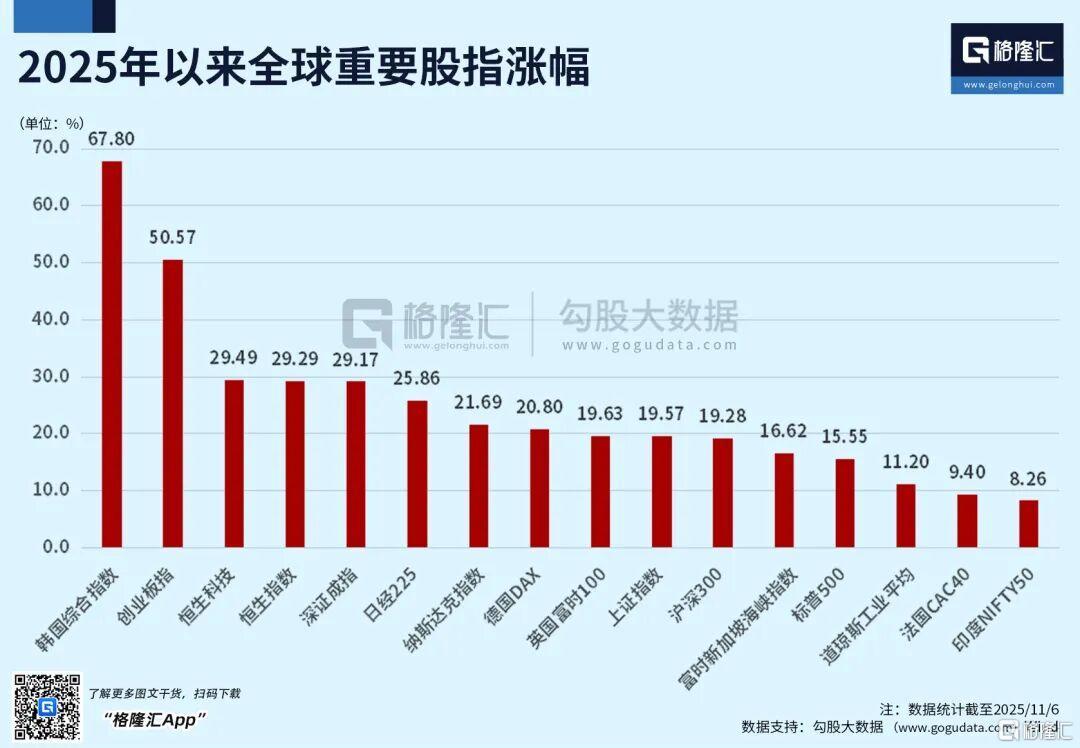
Core Viewpoint - The Hong Kong stock market has rebounded significantly since 2025, driven by improvements in the macroeconomic environment, strong performance in the technology sector, and increased liquidity, positioning it as a key investment opportunity globally [1][3][33]. Group 1: Fundamental Reversal - The technology sector in Hong Kong has seen substantial improvement in fundamentals, with major companies reporting strong revenue and profit growth. For instance, Alibaba's Q1 revenue reached 236.45 billion RMB, a 7% year-on-year increase, while its Non-IFRS net profit grew by 22% to 29.85 billion RMB [4]. - Tencent reported a 14% year-on-year revenue increase to 364.53 billion RMB in the first half of 2025, with a Non-IFRS net profit of 124.4 billion RMB, up 16% [4]. - Xiaomi's revenue for the first half of 2025 was 227.25 billion RMB, reflecting a 38.2% year-on-year growth, with a Non-IFRS net profit increase of 69.8% to 2.15 billion RMB [5]. - Other sectors, including innovative pharmaceuticals and semiconductors, also reported strong mid-year results, indicating a broad recovery in profitability across industries [6][7]. Group 2: Liquidity Support - The liquidity environment for Hong Kong stocks has improved significantly in 2025, with a cumulative net inflow of over 1,285.69 billion HKD as of November 4, 2025, marking a historical high [11]. - Monthly net inflows have consistently exceeded 110 billion HKD, with a record single-day net purchase of 35.88 billion HKD on August 5, 2025 [12]. - The inflow of capital has primarily targeted technology stocks, financials, and high-dividend assets, with Tencent and Alibaba being the most significant beneficiaries [10][12]. - The average daily trading volume in the Hong Kong market has stabilized at over 30 billion USD, nearly doubling year-on-year, indicating enhanced market liquidity [18]. Group 3: Future Key Points - The rapid development of AI technology represents a significant industrial revolution, with China poised to play a crucial role in this transformation [21]. - Major companies are increasing investments in AI infrastructure and cloud computing, with Alibaba announcing a 380 billion RMB investment in AI and cloud services [24]. - The innovative pharmaceutical sector has seen remarkable growth, with over 100 billion USD in overseas licensing agreements for Chinese innovative drugs in the first ten months of 2025 [27]. - The semiconductor industry is also expanding, with SMIC increasing its monthly production capacity significantly to meet domestic demand [27]. - The National Index of Hong Kong Technology Stocks, which includes leading companies like Tencent, Alibaba, and Xiaomi, has shown strong performance, with a cumulative increase of 179.56% since 2017 [31].