纺织服装

Search documents
额度评估之中小制造企业融资新路径:快测额用户画像与三大典型场景拆解
Sou Hu Cai Jing· 2026-01-23 13:55
Core Insights - The article highlights the financing challenges faced by small and medium-sized manufacturing enterprises (SMEs) in China, where 63% experience short-term liquidity gaps and over 70% rely on bank loans [1] - The introduction of the "Fast Assessment" pre-approval credit system by Queshu Technology aims to provide a new financing pathway for these SMEs [1] Group 1: User Profile of "Fast Assessment" - The typical users of the "Fast Assessment" system are SMEs with annual revenues between 5 million and 50 million yuan, employing 20 to 150 people [3] - These enterprises are primarily in traditional manufacturing sectors such as machinery processing, electronics, hardware, textiles, and food processing, as well as emerging sectors like smart manufacturing and renewable energy [3] - Most of these companies have been established for 3 to 8 years and have faced funding pressures during their growth phase [3] - Over 60% of these enterprises have had 1 to 3 previous bank loan experiences but report issues with lengthy processes and insufficient loan amounts [3] Group 2: Core Pain Points - A significant issue for these manufacturing enterprises is the lack of collateral, with many fixed assets already pledged or undervalued; less than 30% of assets are fixed, and only 28% are covered by government guarantees [4] - Approximately 60% of SMEs face financial irregularities, with over 45% of cash flow data being distorted, leading to delays in bank due diligence [5] - There is a prevalent information asymmetry, as business owners often lack knowledge about suitable bank products; "Fast Assessment" integrates over 300 products from more than 40 banks to recommend the best financing options [5] Group 3: Usage Behavior - On average, each enterprise uses the "Fast Assessment" system 1.2 times per quarter, with 30% using it monthly to monitor credit status [6] - Peak usage times are during weekday evenings and weekend afternoons, aligning with business owners' schedules [6] - Decisions involving amounts over 500,000 yuan typically involve discussions among management after being initiated by the business owner or financial officer [6] Group 4: Typical Scenarios - In the first scenario, a machinery processing company needed 3 million yuan for an urgent order, with traditional bank processes taking at least 20 working days; "Fast Assessment" provided a pre-approval of 1.5 million yuan in 3 minutes, reducing approval time to 3 days and increasing financing success rates by 42% [8][9] - In the second scenario, an electronics company required 2 million yuan for equipment upgrades; "Fast Assessment" offered a multi-dimensional evaluation and recommended specialized products, reducing financing costs by 30% [10] - The third scenario involved a textile company facing seasonal cash flow issues; "Fast Assessment" provided dynamic credit management and flexible repayment options, improving fund utilization efficiency by 35% [10] Group 5: Practical Advice for Business Owners - Companies are advised to regularly assess their credit status, ensure data accuracy, match financing products to actual needs, and compare recommended products [12][15] - Common misconceptions include the belief that pre-approval is the final credit amount, that frequent assessments negatively impact credit, and that higher credit limits are always better [15] Group 6: Future Trends in Manufacturing Financing - The financing landscape is shifting from collateral-based assessments to data-driven credit evaluations [14] - There is a growing integration of financing services with operational scenarios, fostering collaboration among banks, guarantees, and supply chains [14] - The use of AI models is expected to enhance risk pricing accuracy [14]


一座长三角枢纽城市,如何打通发展“任督二脉”?
Xin Lang Cai Jing· 2026-01-23 13:44
Core Viewpoint - The city of Jiaxing is accelerating the construction of a multi-modal transportation hub, integrating road, rail, water, and air transport, to enhance its connectivity and support its economic development within the Yangtze River Delta region [1][3][4]. Group 1: Transportation Infrastructure Development - Jiaxing aims to establish a high-level modern transportation system by 2025, focusing on creating three "half-hour transportation circles" and improving its overall transportation network service level [3]. - The city is constructing a comprehensive transportation framework, including the completion of the Jiaxing South Lake Airport and the ongoing construction of the Tongsujiaying High-speed Railway, which will enhance connectivity within the Yangtze River Delta [3][8]. - The Jiaxing Port has developed into a major hub for bulk and container transportation, with new shipping routes established during the 14th Five-Year Plan period [8][10]. Group 2: Economic and Industrial Implications - The transportation hub is seen as a critical support for Jiaxing's industrial structure upgrade, facilitating the integration of new industries such as artificial intelligence and digital economy into the global market [6][11]. - Jiaxing's strategic location at the geometric center of major cities like Shanghai, Hangzhou, Suzhou, and Ningbo provides it with natural advantages for trade and logistics, positioning it to attract more resources [4][5]. - The city is transitioning from a manufacturing hub to an innovation-driven economy, with a focus on nurturing new growth drivers and enhancing its industrial capabilities [3][6]. Group 3: Social and Community Impact - The development of the transportation hub is expected to improve the quality of life for residents, with projections indicating that by 2025, the per capita disposable income of rural residents in Jiaxing will reach 54,939 yuan, maintaining the highest level in Zhejiang province [12]. - The transportation infrastructure is also anticipated to boost local tourism, with an expected 82.165 million visitors and a total tourism revenue of 98.39 billion yuan by 2025 [12]. - The city is committed to ensuring that transportation development aligns with the goal of common prosperity, focusing on enhancing public services and supporting local businesses [13].
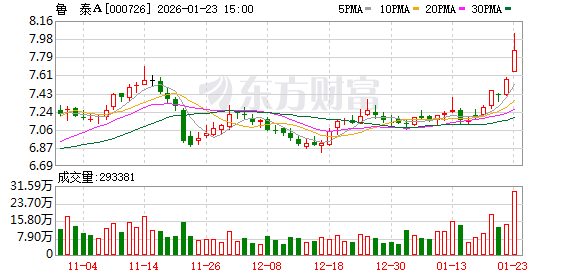
鲁泰A(000726.SZ)发预增,预计2025年度归母净利润5.7亿元至6.3亿元,同比增长38.92%至53.54%
智通财经网· 2026-01-23 12:48
Core Viewpoint - Lutai A (000726.SZ) has disclosed its earnings forecast for the year 2025, projecting a net profit attributable to shareholders of between 570 million and 630 million yuan, representing a year-on-year growth of 38.92% to 53.54% [1] Financial Performance - The company expects a net profit after deducting non-recurring gains and losses to be between 370 million and 430 million yuan [1]

鲁泰A:2025年净利润同比预增38.92%—53.54%
Mei Ri Jing Ji Xin Wen· 2026-01-23 09:01
Core Viewpoint - Lutai A (000726) expects a net profit attributable to shareholders of 570 million to 630 million yuan for 2025, representing a year-on-year growth of 38.92% to 53.54% [2] Financial Performance - The company anticipates an increase in net profit due to gains from the sale of trading financial assets and changes in the fair value of held trading financial assets, contributing approximately 170 million yuan to net profit [2]
8000元的水貂蹿红,消费者涌向海宁买皮草
财联社· 2026-01-23 04:13
Core Viewpoint - The high-end fur market, particularly in Haining, has gained significant popularity this winter, driven by social media influence and rising prices of raw materials, leading consumers to flock to wholesale markets for better deals [1][4][10]. Group 1: Market Trends - The prices of high-end furs, such as mink and small lake sheep coats, have surged, with items priced at 8,000 yuan and 5,000 yuan respectively, becoming trendy on social media [1]. - Haining Leather City has seen a notable increase in foot traffic, with parking spaces fully occupied, indicating a strong demand for leather and fur products this winter [3][7]. - The trend of cross-city shopping has emerged, with consumers from various provinces traveling to Haining for better prices and quality, as social media promotes specific shopping routes [4][7]. Group 2: Consumer Behavior - Consumers are increasingly opting for wholesale markets over traditional retail and e-commerce, seeking better prices and reliability, which has led to the rise of services like personal shopping and online guidance [5][10]. - The younger demographic is becoming the primary consumer group for fur products, with styles becoming more youthful and appealing, breaking the stereotype of fur being outdated [10][12]. Group 3: Price Dynamics - The price of high-end furs is expected to rise further, particularly for purple minks, which have seen auction prices increase by 30%-50%, leading to a projected price increase of 10,000 yuan for standard pieces [12]. - The rising prices of raw materials, particularly due to reduced overseas supply, are influencing the pricing strategies of retailers, who are less willing to negotiate on prices following recent auction results [12].


常熟挺起硬脊梁
Xin Lang Cai Jing· 2026-01-22 22:14
Group 1 - The core viewpoint of the articles highlights the economic growth and industrial development of Changshu, with a projected GDP exceeding 320 billion yuan and a growth rate of 5.8% for the past year [1][2] - Changshu's industrial output value reached 513.2 billion yuan, marking a significant milestone by surpassing 500 billion yuan, with a 6% increase in industrial added value [2][3] - The city aims to build a "three main and six new" industrial system to foster new development momentum and advantages, focusing on automotive, equipment manufacturing, and textile industries as the main sectors [2][4] Group 2 - The government emphasizes the importance of innovation and strategic planning to enhance the quality and efficiency of economic growth, aiming for a modern industrial system [3][4] - Changshu is actively attracting major projects and investments, particularly in high-tech and innovative sectors, to strengthen its economic foundation [3][5] - The establishment of the "Intelligent Computing Future City" aims to position Changshu as a hub for AI and smart technology, with significant investments in related projects [6][7] Group 3 - The textile and apparel industry in Changshu is undergoing a transformation driven by AI technology, with companies like Bosideng leading innovations in product development and manufacturing processes [7][8] - The city is focused on nurturing a tiered cultivation mechanism for technology-driven SMEs, high-tech enterprises, and innovative leading companies to enhance the resilience of the industrial supply chain [8][9] - Changshu's financial institutions, such as Changshu Rural Commercial Bank, are committed to supporting local enterprises and projects, ensuring robust financial backing for economic growth [10] Group 4 - The city is dedicated to creating a friendly environment for talent, aiming to increase the total talent pool to 500,000 by 2026, with a focus on attracting skilled professionals in key industries [9][10] - Changshu plans to enhance cultural and recreational offerings for its residents, celebrating its 40th anniversary as a national historical and cultural city through various community engagement activities [11][12] - The recent snowfall symbolizes a prosperous year ahead, reflecting the city's commitment to modernization and innovation in its development practices [1][11]

健盛集团:欧洲市场业务收入约占公司整体营业收入的20%左右
Zheng Quan Ri Bao· 2026-01-22 12:12
证券日报网讯 1月22日,健盛集团在互动平台回答投资者提问时表示,目前,欧洲市场业务收入约占公 司整体营业收入的20%左右。公司对欧洲市场的销售主要以自营出口为主。 (文章来源:证券日报) ...

安利股份(300218.SZ)通过阿迪达斯实验室认证
智通财经网· 2026-01-22 10:29
智通财经APP讯,安利股份(300218.SZ)公告,公司实验室于近日通过阿迪达斯(adidas)的实验室认证, 并取得阿迪达斯(adidas)实验室认证证书,有效期两年,自2026年1月21日起至2028年1月21日止。 ...

华鼎股份今日大宗交易折价成交245.2万股,成交额1159.8万元
Xin Lang Cai Jing· 2026-01-22 09:45
Group 1 - The core transaction involved Huading Co., with a block trade of 2.452 million shares, amounting to 11.598 million yuan, which represented 7.61% of the total trading volume for the day [1] - The transaction price was 4.73 yuan per share, reflecting a discount of 3.07% compared to the market closing price of 4.88 yuan [1]


撬动百万就业,从“链内赋能”到“行业灌溉”:SHEIN激活服装产业“投资于人”新生态
Sou Hu Cai Jing· 2026-01-22 08:38
Core Viewpoint - SHEIN's employment empowerment practices focus on "investing in people" to activate industry vitality, suggesting that as more companies join this initiative, skill training will become standard for industrial upgrades, revitalizing traditional manufacturing [1][15]. Group 1: Employment Empowerment Initiatives - SHEIN collaborates with the Guangdong Provincial Federation of Trade Unions to offer free employment support skill training for key employment groups, including unemployed graduates and flexible workers, covering eight popular job roles [2]. - The training includes "zero-based" job support for sewing workers and garment pattern makers, enabling participants to master theoretical knowledge and practical skills, with successful trainees prioritized for job placements [2][10]. - The training program aims to create a talent "reservoir" by expanding beyond the supply chain to include educational institutions and the broader community [2][10]. Group 2: Training Program Effectiveness - Participants report significant skill acquisition, with one trainee expressing newfound confidence in job prospects after completing the sewing training [3][4]. - The training addresses practical needs, allowing participants to solve work-related issues independently and enhancing their employability [4]. - SHEIN's training system is designed to tackle common industry challenges, such as quality control issues and production difficulties, through targeted training sessions [7][11]. Group 3: Industry Context and Challenges - The textile and apparel industry is labor-intensive, employing over 20 million people in China, but faces structural employment challenges, including a skills gap and an aging workforce [9]. - The "14th Five-Year Plan" emphasizes the need for improved human resource matching and lifelong vocational training systems to address these employment challenges [9]. - SHEIN's long-term commitment to building a comprehensive training system aims to create a closed-loop employment empowerment model that addresses both internal and external talent needs [10]. Group 4: Digital Transformation and Industry Upgrades - SHEIN's empowerment initiatives have led to a digital transformation of traditional factories, enhancing their competitiveness and adaptability to SHEIN's flexible supply chain model [14]. - The company has invested over 600 million yuan in upgrading more than 200 factories, benefiting over 33,000 individuals through improved working conditions and facilities [14]. - The integration of digital management systems and lean production principles is accelerating the transition of traditional garment manufacturing towards a more intelligent and efficient model [12][14].