
金融衍生品

Search documents
股指期权周报:三大指数再创年内新高,日成交额1.8万亿-20250728
Zhong Yuan Qi Huo· 2025-07-28 11:22
Report Title - "Three major indices hit new highs for the year, with daily trading volume reaching 1.8 trillion" - Stock Index Option Weekly Report 2025.7.28 [1] Core View - This week, the A-share market continued its upward trend, with the three major indices hitting new highs for the year and daily trading volume exceeding 1.7 trillion. For the CSI 300 Index, the moving averages showed a long - position arrangement, and the three - color K - line indicators remained red both daily and weekly. The IF futures' current - month contract's basis to the underlying first shrank and then expanded, while the next - month contract's discount to the current - month contract narrowed. The IO option's trading volume decreased, but the open interest increased, and both the trading volume PCR and open interest PCR rose, with implied volatility increasing, and the underlying index exceeding the strike - price range of the maximum open interest of call and put options. The CSI 1000 Index's daily and weekly K - line indicators were also positive. The IM futures' current - month contract's discount to the underlying first expanded and then shrank, and the next - month contract's discount to the current - month contract narrowed. The MO option's trading volume increased, and the open interest rose, with both PCRs rising, implied volatility increasing, and the strike prices of the maximum open interest of call and put options moving up. The SSE 50 Index also had positive K - line indicators. The IH futures' current - month contract turned to a premium over the underlying, and the next - month contract remained at a premium to the current - month contract. The HO option's trading volume decreased, the open interest increased, the trading volume PCR rose, the open interest PCR decreased, implied volatility increased, and the strike - price range of the maximum open interest of call and put options narrowed [2]. Summary by Directory 1. CSI 300 Stock Index Option (IO) - **Index Performance**: The CSI 300 Index had five consecutive weekly positive K - lines, and the three - color K - line indicator remained red. The daily moving averages were in a long - position arrangement, and the three - color K - line indicator also remained red [10][13]. - **Futures Basis**: The IF futures' current - month contract's basis to the underlying first shrank and then expanded, and the next - month contract's discount to the current - month contract narrowed [20][23]. - **Futures Trading Volume and Open Interest**: The trading volume of CSI 300 stock index futures decreased, and the open interest also decreased [25]. - **Option Trading Volume and Open Interest**: The trading volume of IO options decreased, but the open interest increased [28]. - **Option PCR**: Both the trading volume PCR and open interest PCR of IO options increased [31]. - **Option Strike Price**: The underlying index exceeded the strike - price range of the maximum open interest of call and put options, and the strike prices of the maximum open interest of call and put options for the 2508 contract were both 4100, with the option pain point at 4000 [15][34]. - **Implied Volatility**: The implied volatility of IO options increased [17] 2. CSI 1000 Stock Index Option (MO) - **Index Performance**: The CSI 1000 Index's daily moving averages were in a long - position arrangement, hitting a new high for the year, and the three - color K - line indicators remained red both daily and weekly [38][41]. - **Futures Basis**: The IM futures' current - month contract's discount to the underlying first expanded and then shrank, and the next - month contract's discount to the current - month contract narrowed [49][51]. - **Futures Trading Volume and Open Interest**: The trading volume of CSI 1000 stock index futures decreased, and the open interest also decreased [54]. - **Option Trading Volume and Open Interest**: The trading volume of MO options increased, and the open interest rose [57]. - **Option PCR**: Both the trading volume PCR and open interest PCR of MO options increased [60]. - **Option Strike Price**: The strike prices of the maximum open interest of call and put options for the 2508 contract were 6800 and 6500 respectively, and the option pain point was 6500. The strike prices of the maximum open interest of call and put options both moved up [43][63]. - **Implied Volatility**: The implied volatility of MO options increased [46] 3. SSE 50 Stock Index Option (HO) - **Index Performance**: The SSE 50 Index had five consecutive weekly positive K - lines, and the three - color K - line indicator remained red. The daily moving averages were in a long - position arrangement, and the three - color K - line indicator also remained red [67][70]. - **Futures Basis**: The IH futures' current - month contract turned to a premium over the underlying, and the next - month contract remained at a premium to the current - month contract [78][80]. - **Futures Trading Volume and Open Interest**: The trading volume of SSE 50 stock index futures decreased, and the open interest also decreased [83]. - **Option Trading Volume and Open Interest**: The trading volume of HO options decreased, but the open interest increased [85]. - **Option PCR**: The trading volume PCR of HO options increased, while the open interest PCR decreased [87]. - **Option Strike Price**: The strike prices of the maximum open interest of call and put options for the 2508 contract were 2800 and 2750 respectively, and the option pain point was 2750. The strike - price range of the maximum open interest of call and put options narrowed [72][88]. - **Implied Volatility**: The implied volatility of HO options increased [75] Strategy Recommendations - **Trend Strategy**: Pay attention to the strength - weakness arbitrage opportunities among varieties [2]. - **Volatility Strategy**: Buy a strangle to go long on volatility [2]
华尔街恐慌指数创新低,空头纷纷缴械投降
Jin Shi Shu Ju· 2025-07-25 02:44
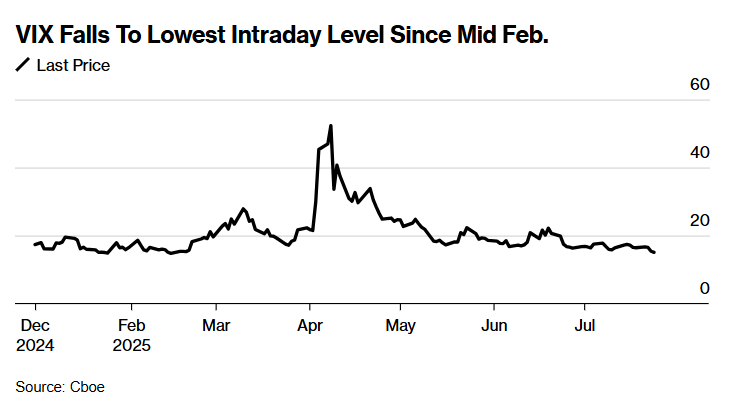
Group 1 - The VIX index has dropped to its lowest intraday level since mid-February, indicating a decrease in Wall Street's expectations for volatility in the coming month [1][4] - The decline in the VIX suggests that some investors betting on a decline in the S&P 500 are closing their positions, particularly "volatility buyers" who profit from market downturns [4] - The realized volatility of the S&P 500 has fallen significantly, with a one-month realized volatility of only 6.9%, which is notably lower than the VIX [4] Group 2 - Despite the low VIX indicating complacency in the summer market, historical trends suggest that volatility may rise in August, often accompanied by a decline in the stock market [5] - Concerns over market liquidity during the vacation season in August could exacerbate volatility, as many seasoned traders take time off, leading to a potential liquidity vacuum [5] - The VIX's low levels may not last, with expectations from RBC Capital Markets indicating a potential rebound in the VIX next month [4]

隐含波动率处于低位
Qi Huo Ri Bao· 2025-07-23 22:57
Market Overview - On July 23, the Shanghai and Shenzhen stock markets experienced a slight pullback after an initial rise, with a total trading volume of 1.8645 trillion yuan. The four major indices showed mixed results, with the Shanghai 50 Index up by 0.32% and the CSI 300 Index up by 0.02%, while the CSI 500 Index and CSI 1000 Index fell by 0.27% and 0.45% respectively [1]. Options Market Activity - The options market saw increased trading activity, with a continued rise in open interest. Specific trading volumes included 2,055,628 contracts for the Shanghai 50 ETF options, 2,037,994 contracts for the CSI 300 ETF options, and 1,811,686 contracts for the CSI 500 ETF options, among others. The total trading volume for various options reached significant amounts, with the CSI 1000 index options having a trading volume of 225,207 contracts and a total transaction value of 2.58 billion yuan [2]. Implied Volatility - There was a slight rebound in implied volatility across various options, although it remained at relatively low levels, indicating cautious market sentiment. The weighted implied volatility for the Shanghai 50 ETF options was recorded at 0.1578, while the CSI 300 ETF options had a volatility of 0.1455. The highest implied volatility was noted for the Huaxia Sci-Tech 50 ETF options at 0.2578 [3]. Market Sentiment and Strategy - Following positive news, the stock markets had seen significant gains recently, but on July 23, the upward momentum appeared to weaken. The options market remained active with increasing open interest. The current low implied volatility suggests a decline in the cost-effectiveness for sellers, prompting a need for tail risk management. Investors with a bullish outlook are advised to consider buying strategies, while those holding stocks may benefit from rolling out-of-the-money call options to enhance returns [4].
股票股指期权:上行升波,ETF期权临近到期,注意末日风险
Guo Tai Jun An Qi Huo· 2025-07-22 12:45
Report Summary 1. Report Industry Investment Rating No investment rating information is provided in the report. 2. Core View The report focuses on the stock index and ETF options market on July 22, 2025, presenting data on market trends, including price changes, trading volume, open interest, and volatility, and warns about the expiration risk of ETF options [1]. 3. Summary by Category Market Data - **Underlying Market Statistics**: The closing prices of major indices and ETFs rose, with varying trading volume changes. For example, the Shanghai Composite 50 Index closed at 2792.18, up 19.94, and its trading volume was 68.31 billion hands, an increase of 18.36 billion hands [1]. - **Options Market Statistics**: Trading volume and open interest of most options increased. The PCR values (Volume - PCR and Open Interest - PCR) varied among different options, reflecting different market sentiment. For instance, the Volume - PCR of CSI 1000 Index Options was 72.54% [1]. - **Options Volatility Statistics**: Implied volatility (IV) and historical volatility (HV) of options showed different trends. For example, the near - month ATM - IV of Shanghai Composite 50 Index Options was 14.56%, with a 0.22% increase [4]. Index and ETF Options Analysis - **Shanghai Composite 50 Index Options**: Analyzed through full - contract PCR,主力 contract skew, volatility cone, and volatility term structure charts, showing market sentiment and volatility characteristics [7][8]. - **CSI 300 Index Options**: Similar analysis methods were used, with data presented in corresponding charts to reflect market conditions [11][12]. - **CSI 1000 Index Options**: The report analyzed its market performance from multiple perspectives, including trading volume, open interest, and volatility [14][15]. - **ETF Options**: Options such as Shanghai Composite 50ETF, Huatai - Berry 300ETF, and others were analyzed using PCR, skew, volatility cone, and term structure charts to understand their market trends [19][20].
标普500股息衍生品交易量激增40%,欧美股息曲线分化暗藏套利密码
智通财经网· 2025-07-21 00:44
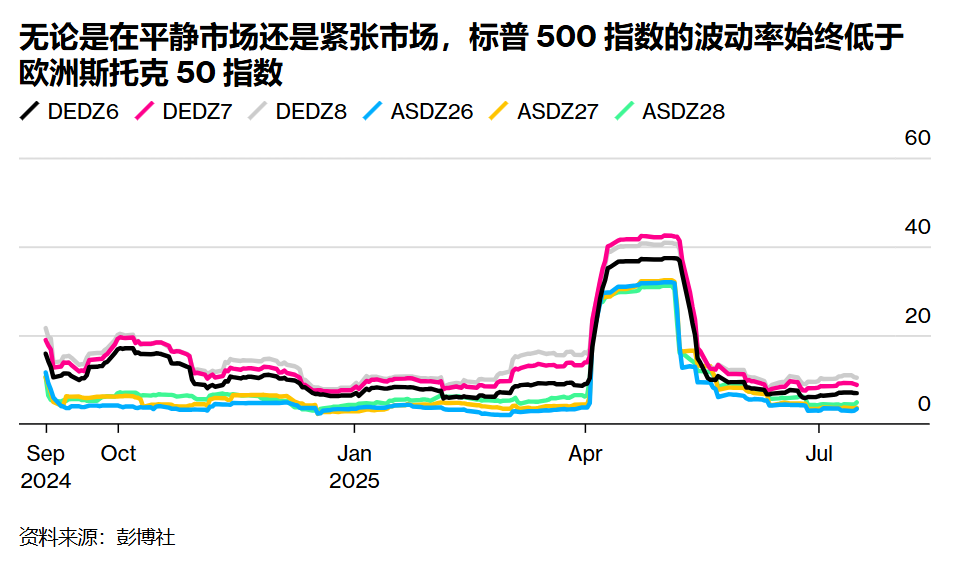
Core Insights - The urgent demand for yields among American investors is driving the rapid expansion of the S&P 500 dividend futures and options market, which was previously considered a niche segment overshadowed by the European market [1] - The Chicago Mercantile Exchange (CME) data indicates a 40% year-on-year increase in S&P 500 dividend futures trading volume for the first half of 2025, with open interest in S&P 500 dividend options more than doubling [1] - The structural differences between the U.S. and European markets are evident in the shape of the derivatives curve, with U.S. long-term dividend contracts holding higher value compared to declining futures prices in Europe [4] Market Dynamics - The rise of dividend derivatives provides investors with more refined risk management tools, although market volatility remains a concern, as evidenced by an 11% drop in S&P 500 dividend contracts due to market crash fears in April [7] - External factors such as tariff policies may create a volatile environment, attracting a more diverse range of trading participants [7] - The focus of both U.S. and European markets is shifting towards 2027, with cautious sentiment regarding mid-term dividend growth reflected in the futures prices [9] Regulatory Environment - The regulatory landscape further shapes market characteristics, with the U.S. SEC enforcing stricter regulations on over-the-counter derivatives, while the European market remains more lenient, attracting U.S. financial institutions to shift some operations to London [11] - Despite price corrections in April, the misalignment of S&P 500 dividends is expected to be less severe than in Europe due to the balanced performance of S&P 500 constituents [11] Market Efficiency - The maturity of the dividend options market has significantly improved the accuracy of the futures curve, allowing for clearer reflections of market consensus on future dividend paths [12] - A dynamic balance mechanism is emerging, pushing the global dividend derivatives market towards a more efficient pricing era [12]
股票股指期权:正偏增加,看涨情绪上升,股指期权临近到期
Guo Tai Jun An Qi Huo· 2025-07-17 12:35
Report Summary 1. Report Industry Investment Rating No relevant content provided. 2. Core Viewpoint As of July 17, 2025, the positive skew of stock index options has increased, indicating a rise in bullish sentiment, and the index options are approaching expiration [1]. 3. Summary by Relevant Catalog 3.1 Option Market Data Statistics - **Underlying Market Statistics**: The closing prices of the Shanghai Stock Exchange 50 Index, CSI 300 Index, and CSI 1000 Index were 2744.26, 4034.49, and 6535.67 respectively, with increases of 3.36, 27.29, and 73.61. The trading volumes were 36.15 billion, 161.25 billion, and 227.83 billion hands respectively, with changes of 1.91 billion, 10.22 billion, and 7.60 billion hands [2]. - **Option Market Statistics**: The trading volume and open interest of various options showed different changes. For example, the trading volume of Shanghai Stock Exchange 50 Index Options was 39,744, a decrease of 2,611, and the open interest was 77,564, an increase of 2,283 [2]. 3.2 Option Volatility Statistics - **Near - month Volatility**: The ATM - IV of Shanghai Stock Exchange 50 Index Options was 13.16%, with a change of 0.10%. The ATM - IV of CSI 300 Index Options was 11.69%, with a change of 0.81% [5]. - **Next - month Volatility**: The ATM - IV of Shanghai Stock Exchange 50 Index Options was 14.31%, with a change of 0.43%. The ATM - IV of CSI 300 Index Options was 14.05%, with a change of - 0.13% [5]. 3.3 Option Index Data Statistics No specific text description provided, but there are multiple charts for different option types, including PCR charts, skewness charts, volatility cone charts, and volatility term structure charts, which visually show the characteristics and trends of each option [9][13][22].
短期美国利率期货继续上涨,交易员增加对美联储降息的押注。
news flash· 2025-07-16 15:35
Core Insights - Short-term U.S. interest rate futures continue to rise as traders increase bets on Federal Reserve interest rate cuts [1] Group 1 - The market sentiment indicates a growing expectation for the Federal Reserve to lower interest rates in the near future [1]
期指日增仓7.6万手,衍生品市场释放回暖信号
Xinda Securities· 2025-07-12 08:39
Quantitative Models and Construction Methods 1. Model Name: Continuous Hedging Strategy - **Model Construction Idea**: This strategy is based on the analysis of basis convergence factors and optimization strategies, as detailed in the Cinda Derivatives Research Report Series. It aims to continuously hedge using futures contracts to minimize basis risk[44][45] - **Model Construction Process**: - **Backtesting Period**: From July 22, 2022, to July 11, 2025[45] - **Spot Side**: Hold the total return index of the corresponding underlying index[45] - **Futures Side**: Use 70% of the funds for the spot side and allocate the same nominal principal to short futures contracts, occupying the remaining 30% of the funds. After each rebalancing, recalculate the quantities for both the spot and futures sides based on the product's net value[45] - **Rebalancing Rules**: Continuously hold quarterly/monthly contracts until the remaining time to maturity is less than two days. On that day, close the position at the closing price and simultaneously short the next quarterly/monthly contract at the closing price[45] - **Assumptions**: Equal principal allocation between the spot and futures sides, excluding transaction fees, impact costs, and the indivisibility of futures contracts[45] 2. Model Name: Minimum Basis Strategy - **Model Construction Idea**: This strategy selects futures contracts with the smallest annualized basis discount to optimize hedging performance[46] - **Model Construction Process**: - **Backtesting Period**: From July 22, 2022, to July 11, 2025[46] - **Spot Side**: Hold the total return index of the corresponding underlying index[46] - **Futures Side**: Use 70% of the funds for the spot side and allocate the same nominal principal to short futures contracts, occupying the remaining 30% of the funds. After each rebalancing, recalculate the quantities for both the spot and futures sides based on the product's net value[46] - **Rebalancing Rules**: Calculate the annualized basis for all tradable futures contracts on the day of rebalancing and select the contract with the smallest basis discount for opening positions. Hold the same contract for eight trading days or until the remaining time to maturity is less than two days before selecting a new contract[46] - **Assumptions**: Equal principal allocation between the spot and futures sides, excluding transaction fees, impact costs, and the indivisibility of futures contracts[46] --- Model Backtesting Results 1. Continuous Hedging Strategy - **IC (CSI 500 Futures)**: - Annualized Return: -2.83% (monthly), -2.06% (quarterly)[48] - Volatility: 3.87% (monthly), 4.77% (quarterly)[48] - Maximum Drawdown: -8.26% (monthly), -8.34% (quarterly)[48] - Net Value: 0.9188 (monthly), 0.9405 (quarterly)[48] - Annual Turnover: 12 (monthly), 4 (quarterly)[48] - 2025 YTD Return: -3.58% (monthly), -1.35% (quarterly)[48] - **IF (CSI 300 Futures)**: - Annualized Return: 0.49% (monthly), 0.71% (quarterly)[51] - Volatility: 3.01% (monthly), 3.35% (quarterly)[51] - Maximum Drawdown: -3.95% (monthly), -4.03% (quarterly)[51] - Net Value: 1.0144 (monthly), 1.0211 (quarterly)[51] - Annual Turnover: 12 (monthly), 4 (quarterly)[51] - 2025 YTD Return: -0.89% (monthly), 0.12% (quarterly)[51] - **IH (SSE 50 Futures)**: - Annualized Return: 1.03% (monthly), 1.97% (quarterly)[54] - Volatility: 3.12% (monthly), 3.54% (quarterly)[54] - Maximum Drawdown: -4.22% (monthly), -3.76% (quarterly)[54] - Net Value: 1.0307 (monthly), 1.0593 (quarterly)[54] - Annual Turnover: 12 (monthly), 4 (quarterly)[54] - 2025 YTD Return: -0.01% (monthly), 0.99% (quarterly)[54] - **IM (CSI 1000 Futures)**: - Annualized Return: -6.04% (monthly), -4.45% (quarterly)[59] - Volatility: 4.74% (monthly), 5.79% (quarterly)[59] - Maximum Drawdown: -14.01% (monthly), -12.63% (quarterly)[59] - Net Value: 0.8469 (monthly), 0.8805 (quarterly)[59] - Annual Turnover: 12 (monthly), 4 (quarterly)[59] - 2025 YTD Return: -9.11% (monthly), -4.54% (quarterly)[59] 2. Minimum Basis Strategy - **IC (CSI 500 Futures)**: - Annualized Return: -1.06%[48] - Volatility: 4.67%[48] - Maximum Drawdown: -7.97%[48] - Net Value: 0.9692[48] - Annual Turnover: 17.28[48] - 2025 YTD Return: -0.96%[48] - **IF (CSI 300 Futures)**: - Annualized Return: 1.31%[51] - Volatility: 3.14%[51] - Maximum Drawdown: -4.06%[51] - Net Value: 1.0392[51] - Annual Turnover: 15.25[51] - 2025 YTD Return: 0.56%[51] - **IH (SSE 50 Futures)**: - Annualized Return: 1.72%[54] - Volatility: 3.14%[54] - Maximum Drawdown: -3.91%[54] - Net Value: 1.0516[54] - Annual Turnover: 15.93[54] - 2025 YTD Return: 1.04%[54] - **IM (CSI 1000 Futures)**: - Annualized Return: -3.83%[59] - Volatility: 5.59%[59] - Maximum Drawdown: -11.11%[59] - Net Value: 0.8949[59] - Annual Turnover: 15.91[59] - 2025 YTD Return: -3.89%[59] --- Quantitative Factors and Construction Methods 1. Factor Name: Cinda-VIX - **Factor Construction Idea**: Reflects investors' expectations of future volatility in the options market, with a term structure to capture expectations over different time horizons[61] - **Factor Construction Process**: Adjusted based on overseas methodologies and tailored to China's options market. The index reflects implied volatility from options pricing[61] - **Factor Evaluation**: Provides insights into market sentiment and risk expectations[61] 2. Factor Name: Cinda-SKEW - **Factor Construction Idea**: Measures the skewness of implied volatility across different strike prices, capturing market expectations of extreme events[69][70] - **Factor Construction Process**: Analyzes the slope of implied volatility curves to quantify the degree of skewness, with higher values indicating greater concern for tail risks[69][70] - **Factor Evaluation**: Useful for identifying market concerns about potential extreme downside risks[70] --- Factor Backtesting Results 1. Cinda-VIX - **30-Day VIX Values**: - SSE 50: 19.77[61] - CSI 300: 18.92[61] - CSI 500: 25.01[61] - CSI 1000: 23.34[61] 2. Cinda-SKEW - **SKEW Values**: - SSE 50: 97.27[70] - CSI 300: 99.19[70] - CSI 500: 102.27[70] - CSI 1000: 101.82[70]
股市温和上?,债市情绪偏弱
Zhong Xin Qi Huo· 2025-07-11 00:24
1. Report Industry Investment Ratings - The investment ratings for stock index futures, stock index options, and treasury bond futures are all "oscillation" [6][7] 2. Core Views of the Report - Stock index futures continued their moderate upward trend, influenced by factors such as expectations of real - estate policy implementation, strengthened anti - involution and supply - side expectations, and the high - dividend characteristics of banks and insurance attracting long - term funds. The short - term upside is related to the sustainability of the large - finance sector [6]. - Stock index options maintained a cautious outlook. Although the underlying assets performed strongly, the market did not see large - scale chasing trades, and investor sentiment became more cautious. The recommended operation is to focus on covered strategies and appropriately add buying put options to construct a collar [6]. - Treasury bond futures had weak sentiment. The market was pressured by the strong performance of the equity market and the tightening of the capital market. With potential capital fluctuations in the future, the market should be dealt with from an oscillation perspective [7]. 3. Summary by Relevant Catalogs 3.1 Market Views Stock Index Futures - **Performance Data**: The basis of IF, IH, IC, and IM current - month contracts were - 12.82 points, - 11.53 points, - 24.25 points, and - 31.37 points respectively, with month - on - month changes of 1.58 points, - 1.41 points, - 0.76 points, and 0.30 points. The spreads between current - month and next - month contracts were 18.0 points, 3.4 points, 54.4 points, and 71.2 points, with month - on - month changes of 2.8 points, - 2.6 points, 1.0 points, and 1.4 points. The total open interest changes were 11835 lots, 9632 lots, 5291 lots, and 11313 lots [6]. - **Logic**: The market continued its upward trend, with real estate, insurance, coal, and oil and gas leading the gains. The short - term upside depends on the large - finance sector [6]. - **Operation Suggestion**: Wait and see [6]. Stock Index Options - **Logic**: The underlying assets were strong, but the trading volume changed little, and the volatility increased slightly. Investor sentiment became more cautious. [6] - **Operation Suggestion**: Focus on covered strategies and appropriately add buying put options to construct a collar [6]. Treasury Bond Futures - **Performance Data**: The trading volumes of T, TF, TS, and TL current - quarter contracts were 77570 lots, 65698 lots, 42333 lots, and 107326 lots respectively, with daily changes of 18031 lots, 19470 lots, 7862 lots, and 33059 lots. The open interests were 202427 lots, 158575 lots, 115251 lots, and 119369 lots, with daily changes of - 1254 lots, 1095 lots, - 144 lots, and 418 lots. The spreads between current - quarter and next - quarter contracts, cross - variety spreads, and basis also had corresponding changes [6][7]. - **Logic**: The market declined due to the strong equity market and tightened capital. Future capital fluctuations need attention, but there may be value in entering the market after the recent adjustment [7]. - **Operation Suggestion**: For trend strategies, maintain an oscillation view. For hedging strategies, pay attention to short - hedging at low basis levels. For basis strategies, appropriately pay attention to basis widening. For curve strategies, steepening the curve in the medium - term has higher odds [7] 3.2 Economic Calendar - On July 7, 2025, the annual retail sales growth rate in the Eurozone in May was 1.8%, with a previous value of 2.3% and a forecast of 1.2% [9]. - On July 9, 2025, China's CPI annual rate in June was 0.1%, with a previous value of - 0.1% and a forecast of 0%; the PPI annual rate was - 3.6%, with a previous value of - 3.3% and a forecast of - 3.2% [9] 3.3 Important Information and News Tracking - The latest Fed meeting minutes showed that some participants were willing to consider lowering the policy interest rate if data met expectations, while others thought the federal funds rate might not be lowered this year [9]. - China has launched a special campaign to combat the smuggling of strategic minerals such as antimony and gallium, and will also review and approve legal export license applications [10] 3.4 Derivatives Market Monitoring - The report mentions data monitoring for stock index futures, stock index options, and treasury bond futures, but specific data details are not fully presented in the provided text [11][15][27]
达利凯普: 套期保值业务管理制度
Zheng Quan Zhi Xing· 2025-07-10 12:10
Core Viewpoint - The company has established a comprehensive set of guidelines for its hedging activities to mitigate market price volatility risks, ensuring that these activities align with its operational needs and comply with relevant regulations [1][2]. Group 1: Hedging Business Overview - The hedging business includes financial derivatives and commodity futures hedging to mitigate risks associated with exchange rates, interest rates, and commodity prices [1][2]. - The company must conduct hedging activities in a legal, prudent, safe, and effective manner, ensuring that these activities do not interfere with normal operations or involve speculative trading [2]. Group 2: Organizational Structure - The company's board of directors and shareholders' meeting serve as the decision-making bodies for hedging activities [3]. - A dedicated working group is established to manage hedging activities, comprising key executives such as the chairman, general manager, and financial officers [3][4]. Group 3: Approval Authority - The company must prepare a feasibility analysis report for hedging activities, which requires approval from the board of directors [5]. - Certain transactions, particularly those involving significant financial commitments, must also be submitted for shareholders' approval [5]. Group 4: Risk Management - The company is required to conduct thorough assessments of financial institutions before engaging in hedging activities [27]. - Regular audits and checks are mandated to ensure compliance with risk management policies and to identify any operational risks [28][30]. Group 5: Emergency Procedures - In the event of significant market changes or natural disasters, the company must promptly report and take necessary actions to mitigate risks, including closing or locking positions [37][39]. - Contingency plans are in place for operational disruptions, ensuring that trading can continue through alternative means [40][41]. Group 6: Documentation and Record Keeping - All documentation related to hedging activities, including applications, approvals, and transaction records, must be archived for a minimum of ten years [41]. - The company is responsible for maintaining confidentiality regarding its hedging strategies and financial information [25].