互联网和相关服务业

Search documents
用电量首破10万亿千瓦时:见证中国经济的活力
Xin Hua Wang· 2026-01-17 10:41
Core Insights - China's total electricity consumption is projected to exceed 10 trillion kilowatt-hours by 2025, marking a historic milestone and reflecting the resilience of its large-scale economy [1][2] - This consumption level is more than double that of the United States and surpasses the combined annual electricity usage of the EU, Russia, India, and Japan [1] Group 1: Factors Driving Electricity Consumption - The growth in electricity consumption is supported by a stable macroeconomic environment and increased demand for residential electricity due to high temperatures and enhanced electrification [2] - The rapid increase from 5 trillion to 10 trillion kilowatt-hours in just over a decade is unprecedented among major economies, highlighting China's manufacturing prowess and improved energy security [2] Group 2: Sectoral Contributions to Electricity Demand - High-end manufacturing is becoming a key driver of electricity consumption, with sectors like new energy vehicles and wind power equipment expected to see growth rates exceeding 20% and 30%, respectively [3] - The digital economy and emerging technologies are creating new electricity demand points, with infrastructure like charging stations and 5G bases driving over 30% growth in related sectors [3] Group 3: Energy Supply and Management - A robust energy supply system has been established, integrating power generation, grid management, and demand-side measures to ensure stable electricity supply [3] - The energy mix includes coal, hydropower, nuclear, and renewable sources, with significant investments in energy storage and grid infrastructure to manage fluctuations [3] Group 4: Trends in High Energy Consumption Industries - While emerging industries are seeing steady increases in electricity consumption, traditional high-energy sectors like black metal smelting are experiencing a decline [4] - The overall trend in high-energy industries is towards structural adjustment and energy efficiency improvements, contributing to a decrease in energy consumption per unit of GDP [4]
【2025云南经济观察】消费扩容提质 “主引擎”韧性凸显
Xin Lang Cai Jing· 2026-01-10 00:55
Core Insights - Consumption is viewed as a stabilizing force for the economy, with policies aimed at expanding domestic demand and promoting consumption set to drive a vibrant market in 2025 [1] Group 1: Consumption Growth - From January to November 2025, the total retail sales of consumer goods in the province reached 11,646.20 billion, marking a year-on-year growth of 3.0% [2] - Urban and rural consumption both showed growth, with rural areas growing faster than urban areas; urban retail sales reached 9,635.45 billion (up 2.9%), while rural retail sales reached 2,010.75 billion (up 3.7%) [2] - The "old for new" consumption policy has been effective, with significant growth in retail sales of communication equipment (up 50.8%), wearable devices (up 53.3%), computers and accessories (up 61.2%), and home appliances (up 33.9%) [2] Group 2: Service Consumption and Digital Economy - The province is focusing on developing service consumption to expand domestic demand and promote high-quality economic growth [4] - The internet and related services have shown strong growth, with revenue from these sectors increasing by 38.8% from January to November 2025, leading among ten key industries [4] - The software and information technology services sector also maintained double-digit growth, with a revenue increase of 15.3% from January to October 2025 [4] Group 3: Emerging Consumption Trends - The city of Kunming is becoming a key destination for new restaurant brands, indicating a rise in the "first launch economy" [5] - The concept of "emotional value" is emerging as a key consumption driver among the younger generation, leading to a transformation in consumer behavior focused on emotional resonance and interest satisfaction [5] - New themed spaces and events targeting the younger demographic are being developed, such as the first two-dimensional theme street in Yunnan, enhancing social engagement and consumption growth [5] Group 4: Cultural and Tourism Integration - The integration of culture and tourism is providing more convenience for one-stop travel experiences, with initiatives like non-heritage shopping months and cultural performances being introduced [6] - During the New Year period, there was a 29% year-on-year increase in tourism bookings in Kunming, with hotel and homestay bookings rising by 27% and luxury hotel orders increasing by 118% [7] - The continuous release of consumption potential highlights the resilience of the market and underscores the critical role of consumption as a key driver of economic growth [7]
投资于人如何深入实施?
Zheng Quan Shi Bao· 2025-12-21 18:09
Core Viewpoint - The recent Central Economic Work Conference emphasizes the integration of "investment in material" and "investment in people" as a new development strategy to enhance economic growth and improve people's livelihoods [1][2]. Group 1: Investment Strategy - The shift from a focus on "investment in material" to a combination of "investment in material" and "investment in people" is necessary due to diminishing returns on traditional investments [2]. - Fixed asset investment in the first 11 months of the year decreased by 2.6%, highlighting the urgency to stabilize investment and combine both types of investment [1]. Group 2: Employment and Social Support - Employment stability is prioritized, with actions to support key groups such as college graduates and migrant workers, and to encourage flexible employment [3]. - Policies are expected to include expanding special loans for job stability and providing subsidies to companies that hire unemployed youth [3]. Group 3: Healthcare and Elderly Care - The government plans to enhance long-term care insurance and increase basic pension levels for urban and rural residents, with a potential increase of 50 yuan or more by 2026 [4]. - Reforms in healthcare, including optimizing drug procurement and improving reimbursement methods, are set to be implemented [4]. Group 4: Financial Support and Collaboration - Fiscal policies will focus on supporting both "material" and "people" investments through special bonds and public-private partnerships (PPP) in sectors like elderly care and childcare [4]. - The collaboration between government and social capital is crucial to lower barriers for private sector participation in social projects [4]. Group 5: Systemic Coordination - A systemic approach is necessary to connect "improvement of livelihoods," "release of domestic demand," and "economic growth," ensuring resources effectively benefit the population [5]. - The focus on enhancing human welfare and capabilities is expected to lay a solid foundation for China's modernization by 2026 [5].
今年全社会用电量预计将超10万亿千瓦时
Sou Hu Cai Jing· 2025-12-16 09:45
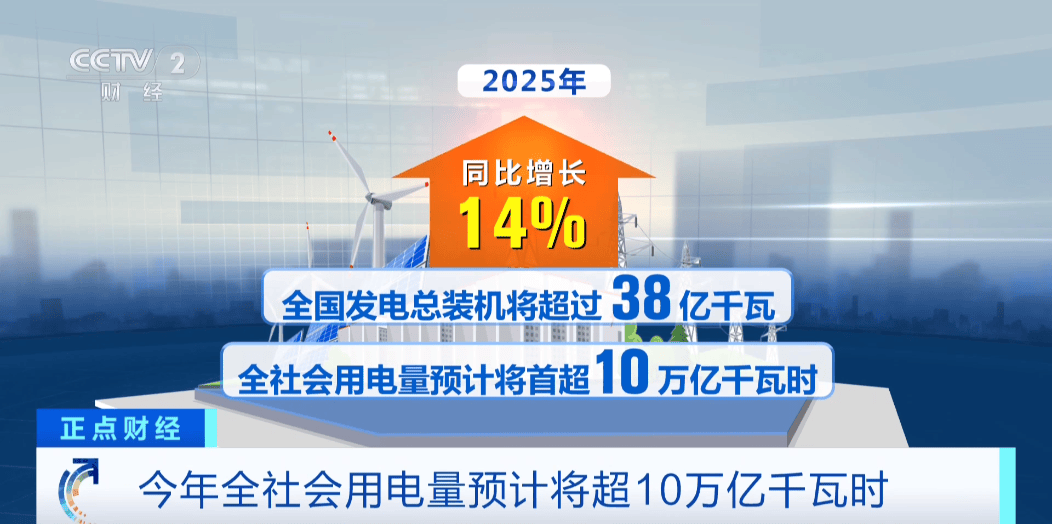
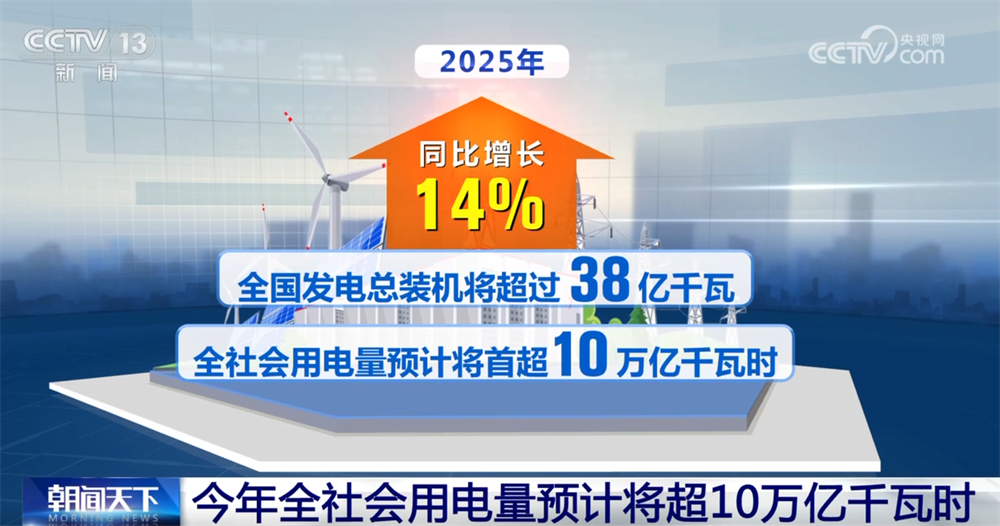
Core Insights - The national electricity supply in China remains safe and stable, with total electricity consumption expected to exceed 10 trillion kilowatt-hours this year [1][3] Group 1: Electricity Supply and Demand - The total installed power generation capacity in China is projected to exceed 3.8 billion kilowatts by 2025, representing a year-on-year growth of 14% [3] - The anticipated electricity consumption of over 10 trillion kilowatt-hours this year is approximately double the total electricity consumption in 2015 [3] Group 2: Sector Performance - High-tech and equipment manufacturing sectors are leading in electricity consumption growth, with predicted year-on-year increases of over 20% for new energy vehicle manufacturing and over 30% for wind energy equipment manufacturing from January to November [5] - The internet and related services sector is expected to see a year-on-year electricity consumption growth of over 30%, while the charging and swapping service sector is projected to grow nearly 50% [5]

从“10万亿千瓦时”透视中国经济澎湃活力 全国电力供应保持安全稳定
Yang Shi Wang· 2025-12-16 01:34
Core Insights - The national electricity supply in China remains safe and stable, with total electricity consumption expected to exceed 10 trillion kilowatt-hours this year [1][3] Group 1: Electricity Supply and Demand - The total installed power generation capacity in China is projected to exceed 3.8 billion kilowatts by 2025, representing a year-on-year growth of 14% [3] - The anticipated total electricity consumption of over 10 trillion kilowatt-hours will be approximately double the total consumption in 2015 [3] Group 2: Sector Performance - High-tech and equipment manufacturing sectors are leading in electricity consumption growth, with specific segments like new energy vehicle manufacturing and wind energy equipment manufacturing expected to see year-on-year growth rates exceeding 20% and 30%, respectively [6] - The internet and related services sector is also experiencing significant growth, with electricity consumption increasing by over 30% year-on-year, while the charging and swapping service sector is seeing nearly 50% growth [6]
固定资产投资增速持续下滑 国家统计局:重点领域投资仍保持增长
Sou Hu Cai Jing· 2025-12-15 03:46
Group 1 - The core viewpoint of the news is that despite a decline in fixed asset investment growth, key sectors continue to see investment growth, supported by policies aimed at expanding domestic demand and upgrading industries [1][2][3] Group 2 - Fixed asset investment (excluding rural households) decreased by 2.6% year-on-year in the first 11 months of the year, while project investment excluding real estate development increased by 0.8% [1] - Investment in emerging sectors showed strong growth, with general equipment manufacturing investment rising by 8.9% year-on-year, and investments in automotive manufacturing and transportation equipment manufacturing increasing by 15.3% and 22.4%, respectively [1] - Investment in renewable energy sources such as solar, wind, nuclear, and hydropower grew by 7.4%, while information service industry investment surged by 29.6% [1] Group 3 - Traditional industries also saw investment expansion, with petroleum, coal, and other fuel processing industries, as well as chemical fiber manufacturing, growing by 23.6% and 12.1%, respectively [2] - The rapid development of online retail has led to increased investments in related services, with accommodation and catering, as well as wholesale and retail industries, both growing by 7.1% [2] - Investment in public infrastructure increased, with power and heat production and supply, as well as water transportation, growing by 12.5% and 8.9%, respectively [2] Group 4 - The government is focusing on enhancing investment efficiency and stimulating private investment, with measures introduced to promote investment growth [3] - Future investment potential remains significant, with a need for continued investment in education, healthcare, housing, and public services to meet the needs of the population [3] - The government aims to optimize investment structure, improve the investment environment, and further stimulate private investment to promote high-quality economic development [3]
数览中国脉动丨中国大市场向上生长的力量不断积蓄
Xin Hua She· 2025-12-10 11:12
Group 1 - The consumer market in China is showing steady growth, with final consumption expenditure contributing 53.5% to economic growth in the first three quarters, an increase of 9 percentage points compared to the previous year [5] - The total retail sales of social consumer goods exceeded 40 trillion yuan in the first ten months, reflecting a year-on-year growth of 4.3%, which is 0.8 percentage points higher than both the same period last year and the entire previous year [5] - The offline consumption heat index increased by 17.3% year-on-year in October, indicating a robust recovery in consumer spending [8] Group 2 - Fixed asset investment reached 40.89 trillion yuan from January to October, with significant growth in key areas such as infrastructure and internet-related services, which saw a year-on-year increase of 20% [7] - The industrial park production heat index grew by 19.8%, and the wage index reflecting labor demand in industrial enterprises increased by 8.1% [8] - The automotive industry experienced a surge in trade-in subsidy applications, surpassing 10 million, highlighting the active engagement in the market [8] Group 3 - The logistics sector demonstrated remarkable performance during the "Double 11" shopping festival, with postal and express companies handling an average of 634 million packages daily, which is 117.8% of their regular business volume [8] - The railway sector also reported a record high of 3.95 billion passengers transported in the first ten months, showcasing the growing mobility and demand within the economy [8] - China's vast market potential is being activated, contributing to the resilience and growth of the economy amid challenges [10]

十四五”发展亮点丨中国“大市场”不一般!内需平均贡献率86.4%
Xin Hua Wang· 2025-12-01 05:40
Group 1 - The core viewpoint emphasizes that a strong domestic market is the strategic foundation for China's modernization, with a focus on expanding domestic demand as a key strategy [1] - The average contribution rate of domestic demand to economic growth from 2021 to 2024 is projected to be 86.4%, indicating a transition from a "large market" to a "strong market" [1] - China remains the second-largest consumer market globally, the largest in online retail, and the second-largest in imports [1] Group 2 - Over the past four years, final consumption has contributed an average of 56.2% to economic growth, an increase of 8.6 percentage points compared to the previous five-year period [3] - The integration of artificial intelligence into daily life has led to a surge in demand for smart products, with significant sales growth in items like smart homes and traditional cultural products [3] - The service consumption sector has diversified, with increased demand for cultural, tourism, and wellness services, highlighting trends in urban leisure and traditional tea culture [3] Group 3 - Investment has contributed an average of 30.2% to economic growth, with a focus on improving living standards, including the construction of approximately 7.8 million affordable housing units over the past four years [4] - The expansion of market consumption has driven investment in related sectors, with internet services and communication equipment manufacturing seeing annual investment growth rates of 21.9% and 11.2%, respectively [4] - The "14th Five-Year Plan" emphasizes the integration of consumer and investment strategies to stimulate demand and supply interactions, aiming to enhance the domestic market's internal driving force [4]

新华鲜报·“十四五”发展亮点丨中国“大市场”不一般!内需平均贡献率86.4%
Xin Hua Wang· 2025-12-01 02:19
Group 1 - The core viewpoint emphasizes the importance of a strong domestic market as a strategic foundation for China's modernization, with a focus on expanding domestic demand as a key strategy [1] - The average contribution rate of domestic demand to economic growth from 2021 to 2024 is projected to be 86.4%, indicating a steady transition from a "large market" to a "strong market" [1] - China remains the second-largest consumer market globally, the largest online retail market, and the second-largest import market [1] Group 2 - Over the past four years, final consumption has contributed an average of 56.2% to economic growth, an increase of 8.6 percentage points compared to the "13th Five-Year Plan" period [3] - The integration of artificial intelligence into daily life has led to a surge in demand for smart products, with significant sales growth in items like smart homes and traditional cultural products [3] - The service consumption sector has diversified, with increased demand for cultural, tourism, and wellness services, highlighting trends in urban leisure and traditional tea culture [3] Group 3 - The average contribution of investment accumulation to economic growth is 30.2%, with a focus on improving living standards through the construction of approximately 7.8 million affordable housing units over the past four years [5] - Investment in social welfare has seen rapid growth, enhancing basic public service levels and promoting a virtuous cycle between consumption and investment [5] - The expansion of market consumption has driven significant investment growth in related sectors, such as a 21.9% annual increase in internet and related services investment due to high demand for smartphones [5] Group 4 - The "14th Five-Year Plan" emphasizes the need to combine investments in both material and human resources, aiming to create new demand through new supply and promote a positive interaction between consumption and investment [5] - The strategy of expanding domestic demand is highlighted as a key focus, with plans to accelerate the development of a robust domestic market to invigorate internal demand [5]
天地在线:11月21日召开董事会会议
Mei Ri Jing Ji Xin Wen· 2025-11-21 13:16
Group 1 - The company Tian Di Online (SZ 002995) announced on November 21 that its fourth board meeting was held to discuss the termination of a share issuance and cash payment for asset acquisition, as well as the withdrawal of related application documents [1] - For the first half of 2025, the company's revenue composition shows that 99.16% comes from the internet and related services, while other sources account for 0.84% [1] - As of the report date, the market capitalization of Tian Di Online is 3.2 billion yuan [1] Group 2 - The article features an interview with Huang Qunhui, emphasizing the importance of AI in empowering various industries while also considering its impact on employment and income polarization [1]