宏观经济

Search documents
浙商早知道-20251128
ZHESHANG SECURITIES· 2025-11-27 23:30
Market Overview - On Thursday, the Shanghai Composite Index rose by 0.3%, while the CSI 300 fell by 0.1%, the STAR Market 50 decreased by 0.3%, the CSI 1000 increased by 0.1%, and the ChiNext Index dropped by 0.4%. The Hang Seng Index saw a slight increase of 0.1% [4] - The best-performing sectors on Thursday included light industry manufacturing (+1.1%), basic chemicals (+1.0%), oil and petrochemicals (+0.9%), coal (+0.8%), and beauty care (+0.7%). The worst-performing sectors were comprehensive (-2.3%), media (-1.4%), retail (-1.2%), computer (-0.8%), and building materials (-0.7%) [4] - The total trading volume in the Shanghai and Shenzhen markets on Thursday was 1,709.6 billion yuan, with a net inflow of 1.33 billion Hong Kong dollars from southbound funds [4] Key Insights Home Appliances Sector - The home appliance sector shows resilience, with opportunities in overseas markets due to improving external demand and enhanced overseas production efficiency. There is a focus on emerging growth areas [5] - Market concerns exist regarding the impact of domestic subsidy reductions on demand, but the report maintains a positive outlook on leading white goods companies like Midea Group and Haier Smart Home, which are less sensitive to these changes [5] - Key drivers include alleviated industry competition, improving overseas demand, and stable domestic demand [5] Macro Research - The macroeconomic report emphasizes that under the framework of a unified national market, "anti-involution" focuses more on high-quality supply optimization rather than merely clearing excess capacity [6] - The report maintains a consistent viewpoint regarding the significant efforts to combat "involution" [6] Social Services Sector - The social services sector is witnessing a warming in pricing, with service consumption outperforming goods consumption. Travel demand remains robust, and hotel RevPAR is showing signs of recovery [8] - The report highlights a shift in local retail from store closures to inventory adjustments, which is expected to release profits [8] - Key drivers include CPI, same-store sales, and social retail performance [8] Medical Devices Sector - The medical devices sector is viewed positively due to investment opportunities arising from payment policy optimization and growth driven by the Belt and Road Initiative [9] - The report emphasizes the potential for high-value consumables to accelerate growth following the completion of centralized procurement [9] - Key drivers include ongoing innovation in medical devices and the international expansion of the sector [9]
IMF预计政府"停摆"使美四季度经济增速放缓
Xin Hua Wang· 2025-11-14 00:29
Core Viewpoint - The U.S. federal government shutdown is expected to negatively impact the economy, with the IMF predicting a lower economic growth rate of less than 1.9% for Q4 of this year [1] Economic Impact - The U.S. economy has shown resilience in recent years but is currently facing increasing pressure due to weak domestic demand and slowing job growth [1] - Factors such as reduced immigration, tariffs, and broader policy uncertainty are collectively suppressing economic activity in the U.S. [1] Government Shutdown Consequences - The government shutdown has resulted in data gaps, affecting the IMF's ability to assess U.S. economic performance [1] - The Congressional Budget Office estimated that a six-week shutdown would lead to approximately $11 billion in economic losses for the U.S. [1]
德国权威机构下调2026年德国经济增长预期
Zhong Guo Xin Wen Wang· 2025-11-12 21:39
Core Insights - The German Economic Expert Committee has revised down its GDP growth forecast for 2026 to 0.9%, slightly lower than the previous estimate of 1.0% made in spring [1] - The federal government had previously projected a growth rate of 1.3% for the upcoming year [1] - The report attributes the ongoing economic weakness to external pressures from global changes, domestic economic and security adjustments, declining industrial competitiveness, and an aging population [1] Economic Challenges - The report highlights that despite the federal government's efforts to increase investment and defense spending, there is significant room for improvement in investment execution [1] - Poor implementation of these investments could weaken growth potential and jeopardize the sustainability of public finances [1] Recommendations - The committee urges the government to utilize the "Infrastructure and Climate Neutrality" special fund (SVIK) more efficiently [1] - If the total fund of €500 billion is effectively used as additional investment outside the regular budget, it could significantly boost economic development [1] - Most experts recommend reforms to inheritance and gift taxes, including higher tax rates on corporate assets, although one committee member cautions that discussing higher corporate inheritance taxes may be premature given the current weak private investment sentiment [1]
21评论丨中国经济成为世界经济抗冲击、稳增长的中流砥柱
2 1 Shi Ji Jing Ji Bao Dao· 2025-10-23 22:24
Core Viewpoint - The Fourth Plenary Session of the 20th Central Committee of the Communist Party of China highlighted significant achievements during the 14th Five-Year Plan period, emphasizing China's resilience in the face of global challenges, including the COVID-19 pandemic and rising trade protectionism [2][3][4]. Economic Performance - China's GDP surpassed 110 trillion, 120 trillion, and 130 trillion yuan during the 14th Five-Year Plan, with a projected GDP of approximately 140 trillion yuan in 2025, reflecting a 23.9% increase from 2020 and an average annual growth rate of 5.5% [3][4]. - In 2025, China's GDP growth is estimated to reach around 5%, with a total economic increment expected to exceed 35 trillion yuan during the 14th Five-Year Plan [4][5]. International Economic Context - The global economic uncertainty has increased significantly due to U.S. tariff policies and geopolitical conflicts, with the world instability index rising over threefold from the end of 2024 [4]. - The International Monetary Fund (IMF) revised its growth forecasts for China and the global economy, increasing China's growth rate prediction from 4.0% to 4.8% and the global growth rate from 2.8% to 3.2% [5]. Future Goals - The 15th Five-Year Plan aims for high-quality development, significant improvements in technological self-reliance, and enhanced social and economic reforms, with a target of achieving a per capita GDP at the level of moderately developed countries by 2035 [6]. - The plan emphasizes the importance of fostering new productive forces and promoting industrial upgrades to achieve high-quality economic growth [6].


【环球财经】国际货币基金组织下调俄罗斯2025年GDP增长预测至0.6%
Xin Hua Cai Jing· 2025-10-14 22:45
Group 1 - The International Monetary Fund (IMF) has revised Russia's GDP growth forecast for 2025 down to 0.6%, while maintaining a 1% growth forecast for 2026 [1] - Compared to the IMF's July forecast, the GDP growth prediction for Russia this year has been lowered by 0.3 percentage points [1] - Russia's economic growth was 4.3% last year, and the IMF had previously estimated a 4.1% growth rate for this year in April [1] Group 2 - The adjustment in the GDP growth forecast for this year is attributed to recent data indicating that Russian budget expenditures are concentrated in the fourth quarter of 2024, leading to an increase in the 2024 GDP growth forecast from 4.1% to 4.3% [1] - The IMF predicts that the inflation rate in Russia will reach 9% in 2025, decreasing to 5.2% by 2026 [1] - The unemployment rate in Russia was estimated at 2.5% last year, expected to decrease to 2.4% this year, and is projected to rise to 3.1% in the future [1] Group 3 - The Russian Ministry of Economic Development has also revised its GDP growth forecast for 2025 down from 2.5% to 1%, and for 2026 from 2.4% to 1.3% [2]
世界银行维持哥伦比亚2025年经济增长预期为2.4%
Shang Wu Bu Wang Zhan· 2025-10-12 03:37
Core Insights - The World Bank maintains its economic growth forecast for Colombia at 2.4% for 2025, attributing this to the primary drivers of growth being consumption and investment [1] Economic Outlook - Global high interest rates, weak investment, and limited fiscal space continue to constrain economic recovery in Latin America [1] - Colombia's economic performance is expected to improve compared to 2024, supported by a rebound in private consumption and investment [1] - The pace of monetary easing is slowing due to the sustained high interest rates in developed economies [1] Inflation Trends - Since 2023, inflation in Colombia has been on a downward trend [1] - The World Bank projects that by the end of 2025 or in 2026, inflation in most Latin American countries will return to the central bank's target range [1]
英国经济二季度增速放缓至0.3% 财政大臣里夫斯面临严峻预算抉择
智通财经网· 2025-09-30 12:13
Economic Performance - The UK economy showed strong performance at the beginning of 2025, but growth slowed in the second quarter, with GDP growth at 0.3% year-on-year compared to 0.7% in the first quarter [1] - The overall economic growth for 2024 remains unchanged at 1.1%, while the GDP growth for the year ending June 2025 was revised up from 1.2% to 1.4% [1] G7 Economic Ranking - In the first half of 2025, the UK had the fastest economic growth among G7 countries, driven partly by one-off factors such as a surge in exports before US tariffs took effect [2] - The Bank of England forecasts a moderate economic growth of 1.25% for the entire year of 2025 [2] Consumer and Business Sentiment - The economic outlook for the second half of the year is expected to be more challenging, with predicted growth of only 0.2% due to slowing wage growth and rising inflation [2] - Household savings rate increased slightly from 10.5% in Q1 to 10.7% in Q2, indicating consumer concerns about the future [2] Taxation Expectations - Economists anticipate that Chancellor Rachel Reeves will need to raise hundreds of billions of pounds in taxes in the upcoming budget to meet deficit reduction goals [3] - The Office for Budget Responsibility (OBR) may adopt a more pessimistic view on future productivity and economic growth [3] Current Account Deficit - The UK's current account deficit reached £28.939 billion (approximately $38.9 billion) in Q2 2025, the highest level in two years, with the deficit as a percentage of GDP rising from 2.8% in Q1 to 3.8% [5] - The increase in the deficit is primarily attributed to higher dividend payments to foreign investors [6]
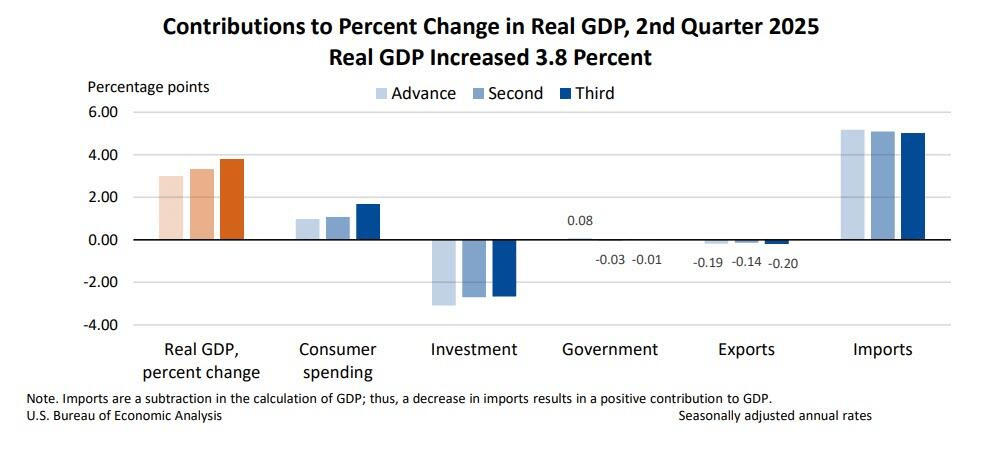
美国第二季度GDP增速上修至3.8%,创近两年新高,PCE物价指数2.6%
Sou Hu Cai Jing· 2025-09-25 13:05
Core Insights - The U.S. economy grew at its fastest pace in nearly two years in the second quarter, driven by a significant upward revision in consumer spending data [1][2]. Economic Growth - Consumer spending, a key engine of economic growth, was revised up from 1.6% to 2.5%, becoming the main driver of the data revision [4][9]. - The second quarter's actual GDP annualized quarter-on-quarter growth rate was 3.8%, exceeding expectations of 3.3% [8]. - Non-residential investment growth was revised up from 5.7% to 7.3%, indicating strong corporate investment sentiment [9]. - Residential investment saw a slight downward revision, with the contraction increasing from 4.7% to 5.1% [9]. - Gross Domestic Income (GDI) growth was revised down from 4.8% to 3.8%, aligning with GDP growth [9]. Inflation and Monetary Policy - The core Personal Consumption Expenditures (PCE) price index annualized quarter-on-quarter growth was revised up to 2.6% for the second quarter, with expectations of near 3% year-on-year growth in the upcoming August PCE data [14]. - Persistent inflation pressures may constrain the Federal Reserve's decision-making, potentially limiting the extent of future interest rate cuts [14]. Market Reactions - U.S. stock futures experienced a slight decline, with the Nasdaq 100 index dropping by 0.6% [15]. - The U.S. dollar index rose approximately 20 points, currently reported at 98.10 [16]. - Spot gold prices fell by about $8, currently at $3746.41 per ounce [19].
经合组织上调25年中国经济增长率预期至4.9%
3 6 Ke· 2025-09-24 04:09
Core Insights - The OECD has revised its global economic growth forecast for 2025 to 3.2%, an increase of 0.3 percentage points from the previous June estimate, driven by AI-related investments in the US and fiscal stimulus in China [2][4] - The US growth rate is projected at 1.8% for 2025, up by 0.2 percentage points, but down from 2.8% in 2024, with high tariffs and reduced immigration offsetting strong high-tech investments [4] Economic Growth Forecasts by Region - Global growth is expected to slow from 3.3% in 2024 to 3.2% in 2025, and further to 2.9% in 2026 [2][3] - The Eurozone's growth forecast has been raised to 1.2% for 2025, an increase of 0.2 percentage points, with current policy rates at 2%, half of the peak rates from 2023-2024 [4] - China's growth forecast for 2025 is now 4.9%, up by 0.2 percentage points, expected to remain stable compared to 2024's 5% [3][4] - Japan's growth forecast has been increased by 0.4 percentage points to 1.1%, supported by strong corporate earnings and investment growth [4] Risks and Concerns - The OECD highlights the potential risks from high tariffs, with the effective tariff rate in the US reaching 19.5%, the highest since 1933, which may negatively impact investment and trade [2][4] - Fiscal risks are a growing concern for the global economy, with increasing defense spending and aging population costs contributing to rising national debt yields [4]

经合组织上调25年中国经济增长率预期至4.9%
日经中文网· 2025-09-24 02:58
Core Viewpoint - The OECD has revised its global economic growth forecast for 2025 to 3.2%, an increase of 0.3 percentage points from the previous June forecast, driven by AI-related investments in the US and fiscal stimulus in China [2][4]. Economic Growth Forecasts - The OECD predicts a global economic growth rate of 3.3% for 2024, slowing to 3.2% in 2025 and further to 2.9% in 2026 [4]. - For the US, the growth forecast for 2025 is set at 1.8%, up by 0.2 percentage points, but down from 2.8% in 2024. High tariffs and reduced immigration are offsetting the effects of strong high-tech investments [6]. - The Eurozone's growth forecast has been raised by 0.2 percentage points to 1.2%, with current policy rates at 2%, half of the peak rates from 2023-2024 [6]. - China's growth forecast for 2025 is adjusted to 4.9%, an increase of 0.2 percentage points, expected to remain stable compared to 2024's 5% [6]. - Japan's growth forecast has been increased by 0.4 percentage points to 1.1%, supported by strong corporate earnings and investment growth [6]. Economic Risks - The OECD highlights that fiscal risks, including rising defense spending and aging population costs, are concerns for the global economy. Increased government bond yields are also seen as evidence of rising future risks for investors [6].