
家具

Search documents
敏华控股尾盘涨超4% 公司此前收购美国家居品牌 有望受益北美房地产复苏
Zhi Tong Cai Jing· 2026-02-25 07:55
Group 1 - The core viewpoint of the article highlights that Minhua Holdings (01999) experienced a significant stock price increase of 4.31%, reaching HKD 5.08, with a trading volume of HKD 49.0869 million [1] - Minhua Holdings announced the acquisition of GRIC Group for approximately USD 58.7 million, which primarily operates in the manufacturing and trading of soft furniture in the United States [1] - According to Yongxing Securities, the acquisition is expected to create synergies between Minhua Holdings and GRIC Group through cross-selling opportunities from GRIC's over 1,000 active customers and cost savings in raw material procurement and manufacturing efficiency [1] Group 2 - The report suggests that a potential interest rate cut may lead to signs of recovery in the U.S. real estate market, with the wealth effect from rising U.S. stock markets likely to gradually release housing demand [1] - Following the completion of the acquisition, Minhua Holdings is expected to leverage its brand and distribution channels to enhance its business development in North America [1]
港股异动 | 敏华控股(01999)尾盘涨超4% 公司此前收购美国家居品牌 有望受益北美房地产复苏
智通财经网· 2026-02-25 07:50
Core Viewpoint - Minhua Holdings (01999) experienced a significant increase in stock price, rising over 4% to HKD 5.08, with a trading volume of HKD 49.09 million [1] Group 1: Acquisition Details - In December of last year, Minhua Holdings announced the acquisition of GRIC Group for approximately USD 58.7 million, which primarily operates in the manufacturing and trading of soft furniture in the United States [1] - The acquisition is expected to create synergies between Minhua Holdings and GRIC Group through cross-selling opportunities via GRIC's network of over 1,000 active customers [1] Group 2: Market Outlook - Yongxing Securities noted that a potential interest rate cut could indicate signs of recovery in the U.S. real estate market, with a noticeable wealth effect from rising U.S. stock markets [1] - The demand for real estate is anticipated to gradually release, and following the acquisition, Minhua Holdings may leverage its brand and distribution channels to enhance its business development in North America [1]
特朗普政府正酝酿征收新关税
Xin Lang Cai Jing· 2026-02-24 19:18
Group 1 - The U.S. Supreme Court ruled that the large-scale tariffs imposed by the Trump administration under the International Emergency Economic Powers Act were illegal, leading to uncertainty in the economy [1] - The Trump administration is preparing to impose new tariffs on six categories of products based on other legal provisions related to national security, which differ from the newly introduced 15% tariffs [1][4] - The U.S. Department of Commerce is initiating new investigations under Section 232 of the Trade Expansion Act of 1962, targeting products such as large batteries, cast iron, plastic pipes, industrial chemicals, and telecommunications equipment [2] Group 2 - The Trump administration previously invoked Section 232 to investigate nine categories of products, including semiconductors and pharmaceuticals, with investigations potentially accelerating after the Supreme Court ruling [3] - The administration intends to modify the algorithm for steel and aluminum tariffs, which may lower nominal rates for some products but could result in higher overall tariffs based on total product value [3] - The Supreme Court's ruling has led to the cessation of tariffs under the International Emergency Economic Powers Act, but tariffs under Sections 232 and 301 remain effective [4] Group 3 - The new tariffs and trade policies introduced by the Trump administration are expected to increase complexity and uncertainty in the economic landscape, with experts noting a lack of clarity regarding future tariff changes [5] - The administration's use of multiple trade laws to impose tariffs may not allow for quick implementation, potentially taking months to take effect [4][5]
美媒:特朗普政府正酝酿征收新关税
Xin Lang Cai Jing· 2026-02-24 11:51
Core Viewpoint - The U.S. Supreme Court ruled that the large-scale tariffs imposed by the Trump administration under the International Emergency Economic Powers Act were illegal, leading to plans for new tariffs based on national security laws, which may increase economic uncertainty [1][6]. Group 1: New Tariff Investigations - The U.S. Department of Commerce is initiating new investigations under Section 232 of the Trade Expansion Act of 1962 for products in industries such as large batteries, cast iron and iron fittings, plastic pipes, industrial chemicals, and telecommunications equipment [1][6]. - The U.S. Trade Representative's office is also starting new trade investigations under Section 301 of the Trade Act of 1974, which may lead to tariffs on issues like drug pricing and discrimination against U.S. technology companies [2][6]. Group 2: Existing Tariffs and Changes - The Trump administration previously invoked Section 232 to investigate nine categories of products, including semiconductors and solar panels, with many investigations ongoing for nearly a year [2][7]. - There is an intention to modify the algorithm for steel and aluminum tariffs, potentially lowering nominal rates but taxing based on the total value of products rather than just their steel and aluminum content [7]. Group 3: Economic Uncertainty - Following the Supreme Court ruling, the Department of Homeland Security confirmed that tariffs under the International Emergency Economic Powers Act would cease, but tariffs under Sections 232 and 301 remain effective [9]. - The new tariffs announced under Section 122 of the Trade Act of 1974 will impose a 15% tariff on goods from all countries for a maximum of 150 days, requiring Congressional approval for extension [9]. - Experts predict that the complexity and unpredictability of trade policies will increase, leading to greater uncertainty regarding future tariffs [10].
拱火的来了,“美一众盟友惨了,中国巴西受益最大”
Sou Hu Cai Jing· 2026-02-23 18:15
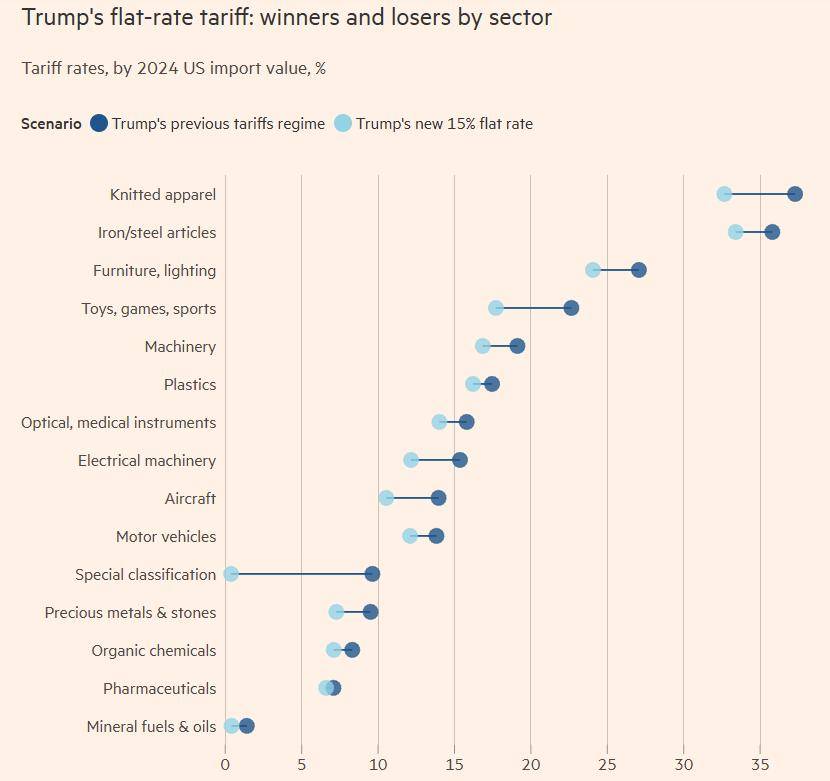
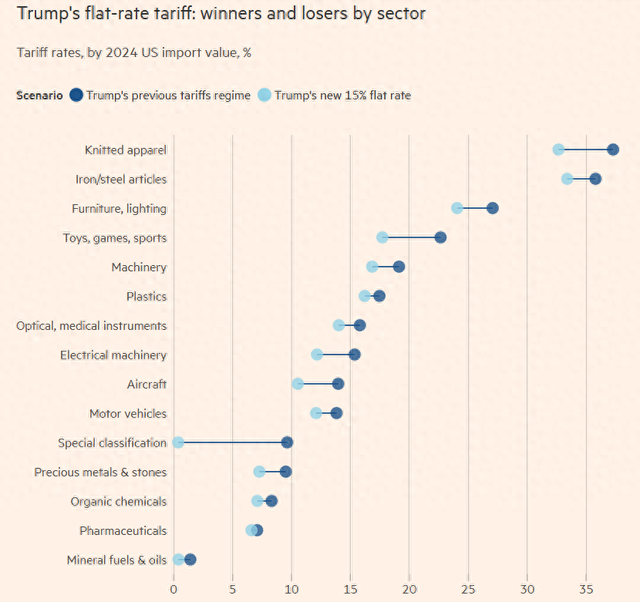
Core Viewpoint - The new 15% global uniform tariff introduced by Trump is expected to benefit countries like China and Brazil, while traditional allies such as the UK, EU, and Japan will face significant losses [1][6]. Group 1: Impact on Countries - Brazil will see the largest average tariff reduction of 13.6 percentage points, followed by China with a 7.1 percentage point decrease [1]. - The new tariff structure will particularly benefit countries previously criticized by the U.S., such as Mexico, Canada, Vietnam, Thailand, and Malaysia, in sectors like apparel, furniture, toys, and plastics [1]. - The UK is projected to be the most adversely affected, with an average tariff increase of 2.1 percentage points, disappointing around 40,000 exporting companies [6]. - The EU will experience an overall average tariff increase of 0.8 percentage points, with Italy and France being the most impacted [6]. Group 2: U.S. Trade Policy and Reactions - The U.S. government has indicated a willingness to utilize legal provisions to impose additional tariffs, signaling a new round of trade negotiations [2]. - U.S. Treasury Secretary and Trade Representative have defended the new tariffs, asserting that all trade partners wish to maintain existing agreements despite the changes [8][10]. - The U.S. Trade Representative plans to initiate investigations into unfair trade practices, particularly concerning overcapacity in Asian countries [10]. Group 3: Future Trade Dynamics - The uncertainty surrounding U.S. tariff policies remains high, with potential for further investigations and tariffs based on the 1974 Trade Act [1][10]. - Trump's upcoming visit to China is aimed at maintaining bilateral stability and encouraging China to fulfill agreements, including purchasing U.S. agricultural products and aircraft [11][12].

华尔街顶级分析师最新评级:谷歌、英伟达获上调
Xin Lang Cai Jing· 2026-02-23 16:35
Core Viewpoint - The article summarizes significant rating changes from Wall Street that could impact market trends, highlighting upgrades, downgrades, and new coverage by various financial institutions [1][5]. Upgrades - Wells Fargo upgraded Alphabet (GOOGL) from Hold to Buy, raising the target price from $354 to $387, citing Google's leading position in key AI traits such as user data, channels, and computing power [7]. - Aletheia upgraded NVIDIA (NVDA) from Hold to Buy with a target price of $250, stating the stock is "too cheap to ignore" ahead of its quarterly earnings report [7]. - Lake Street upgraded Tandem Diabetes (TNDM) from Hold to Buy, increasing the target price from $14 to $50, believing the shift to a pharmacy model will yield stable growth and higher profit margins [7]. - UBS upgraded BlackRock (BLK) from Neutral to Buy, setting a target price of $1,280, based on strong Q4 performance and positive outlook from the UBS Financial Conference [7]. - Baird upgraded Henry Schein (HSIC) from Neutral to Outperform, raising the target price from $78 to $100, citing growth potential in its dental-related business [7]. Downgrades - Jefferies downgraded Workday (WDAY) from Buy to Hold, lowering the target price from $325 to $150, noting that application software stocks have underperformed the overall software sector [8]. - Bank of America downgraded General Mills (GIS) from Buy to Neutral, reducing the target price from $55 to $48, stating that previous growth expectations for the pet business and North American retail have failed [8]. - Baird downgraded Arcellx (ACLX) from Outperform to Neutral, with a target price adjustment from $106 to $115, following Gilead's acquisition announcement at $115 per share [8]. - JPMorgan downgraded VF Corporation (VFC) from Neutral to Underweight, lowering the target price from $19 to $18, and reducing earnings forecasts for 2027 and 2028 below market consensus [8]. - Jefferies downgraded Deere (DE) from Hold to Underperform, raising the target price from $475 to $550, indicating that the agricultural cycle is expected to bottom out this year [8]. New Coverage - Citigroup initiated coverage on York Space Systems (YSS) with a Buy rating and a target price of $37, describing it as a high-risk, high-reward opportunity in the space trend [9]. - Oppenheimer initiated coverage on Public Policy Holding Co (PPHC) with an Outperform rating and a target price of $16, noting its expansion into state and international lobbying [9]. - Citigroup initiated coverage on PicPay (PICS) with a Buy rating and a target price of $28, projecting an 85% potential upside due to its credit-related business growth [9]. - JPMorgan initiated coverage on Ethos (LIFE) with a Buy rating and a target price of $13, believing there is still growth potential through agency channels [9]. - DA Davidson initiated coverage on Bob's Discount Furniture (BOBS) with a Buy rating and a target price of $26, citing a large and fragmented industry poised for recovery [9].


外媒炒作:美国一众盟友惨了,中国和巴西受益最大
Guan Cha Zhe Wang· 2026-02-23 05:19
Core Viewpoint - The new 15% global uniform tariff introduced by Trump is expected to benefit countries like China and Brazil while adversely affecting traditional allies such as the UK, EU, and Japan [1][4]. Group 1: Tariff Impact on Countries - Brazil will see the largest average tariff reduction of 13.6 percentage points, followed by China with a 7.1 percentage point reduction [1]. - The new tariff structure significantly benefits countries previously criticized by the U.S., including Mexico and Canada, as well as Asian manufacturing economies like Vietnam, Thailand, and Malaysia [1]. - The UK is projected to be the most affected, with an average tariff increase of 2.1 percentage points, disappointing around 40,000 exporting companies [4]. Group 2: Reactions from Allies - The EU's average tariff is expected to rise by 0.8 percentage points, with Italy and France facing the most significant impacts [4]. - The EU has demanded clarification from the U.S. regarding the tariff increases, emphasizing that they will not accept any rise in tariffs, asserting that "a deal is a deal" [4]. - European Central Bank President Christine Lagarde echoed the EU's call for clear policy rules from the U.S. [5]. Group 3: U.S. Government's Position - U.S. Treasury Secretary and Trade Representative defended the new tariffs, claiming that all trade partners wish to maintain existing agreements despite the changes [6][8]. - The U.S. plans to continue trade investigations and may impose additional tariffs based on findings related to overcapacity in various countries [8]. - Trump's upcoming visit to China is aimed at maintaining bilateral stability and encouraging China to fulfill agreements, including purchasing U.S. agricultural products [9][10].
博埃家具2026财年Q1营收微降,净利润同比下滑超30%
Xin Lang Cai Jing· 2026-02-19 18:12
Core Insights - La-Z-Boy Incorporated reported its Q1 FY2026 earnings, showing a slight decline in revenue and a significant drop in net profit compared to the previous year [1][2] Financial Performance - The company achieved a revenue of $492 million for the quarter, with a net profit of $18.2 million, resulting in a net profit margin of 3.70% [1] - Gross margin stood at 42.50%, and operating margin was 4.47% [1] - Cash flow from operating activities was $35.51 million, while free cash flow amounted to $17.05 million [1] - Year-over-year, revenue decreased by 0.67%, and net profit fell by 30.41% [1] Business Composition - The core business segments are wholesale and retail, with wholesale accounting for 50.11% of revenue and retail for 42.59% as of April 30, 2025 [2] - The company's asset turnover ratio is 1.10 times [2]

立足商贸与制造优势 构建“广货行天下”新格局
Xin Lang Cai Jing· 2026-02-19 00:29
Core Insights - The central economic work meeting in December 2025 emphasized the importance of "domestic demand as the main driver" for economic work in 2026, with Guangdong launching the "Guangdong Goods Going Global" spring initiative to enhance the visibility and influence of local products [1] Group 1: Current Status of "Guangdong Goods" - The concept of "Guangdong Goods" has evolved from traditional products to include modern innovations such as drones, electric vehicles, and 5G smartphones, while traditional products like clothing and furniture have undergone brand rejuvenation [1] - Guangdong's foreign trade reached a record high of 9.49 trillion RMB in 2025, accounting for 20.9% of the national total and contributing 24.1% to national foreign trade growth [2] Group 2: Competitive Advantages of "Guangdong Goods" - The national open policy has provided a fundamental guarantee for the international expansion of "Guangdong Goods," aligning with central government initiatives to boost consumption and supply quality products [3] - Guangdong's manufacturing system has shown resilience amid global economic adjustments, with over 530 local enterprises participating in international trade exhibitions, highlighting their significant role in the global supply chain [3] Group 3: Strategies for Advancement - Improving product quality is essential, focusing on establishing a comprehensive quality control system and fostering "champion" enterprises in niche markets to create differentiated competitive advantages [4] - Reducing product costs through supply chain collaboration, digital transformation, and leveraging economies of scale is crucial for enhancing competitiveness [5] - Enhancing after-sales service systems to provide comprehensive support and improve brand loyalty in global markets is a priority [5] Group 4: Environmental and Market Expansion Strategies - Emphasizing green transformation to align with international environmental standards and promote sustainable development in manufacturing is vital [7] - Expanding international markets by integrating Lingnan culture into product design and marketing strategies can enhance global competitiveness [8]
顾家家居股东股份冻结,定增计划获通过,业绩稳健增长
Jing Ji Guan Cha Wang· 2026-02-13 04:39
Core Viewpoint - The company has recently faced a shareholder equity freeze while its nearly 2 billion yuan private placement plan has been approved, and its performance in the first three quarters remains strong [1] Group 1: Stock Performance - On February 3, 2026, the company announced that approximately 15.43 million shares held by major shareholder TB Home Limited, accounting for 1.88% of the total share capital, were subject to judicial freeze due to pending legal matters [2] - Another shareholder, Hangzhou Deyejiajun Enterprise Management Co., Ltd., also had all its shares frozen, but these shareholders are not controlling shareholders, and the incident does not affect the company's control or daily operations [2] Group 2: Private Placement - In early December 2025, the company's nearly 2 billion yuan private placement application was approved by the Shanghai Stock Exchange and has entered the "registration submission" phase, with the controlling shareholder, Yingfeng Group, fully subscribing [3] - Upon completion, Yingfeng Group's shareholding will increase from 29.42% to 37.37%, further consolidating its control [3] - The funds raised will be used for projects related to production line automation, marking the first large-scale capital action since Yingfeng Group took over [3] Group 3: Performance and Operations - In the first three quarters of 2025, the company reported revenue of 15.012 billion yuan and a net profit attributable to shareholders of 1.539 billion yuan, representing year-on-year growth of 8.77% and 13.24%, respectively [4] - During the Q3 2025 earnings call, management emphasized a focus on functional and intelligent innovation, as well as advancing the transformation of domestic retail and the globalization of foreign trade strategies [4] - The company expects positive growth in revenue and profit for 2026 [4]
