
对外贸易

Search documents
央广财评|韧性十足!中国外贸规模连续第9年保持增长
Yang Guang Wang· 2026-01-15 02:06
Core Insights - China's foreign trade reached a record high of 45.47 trillion yuan in 2025, marking a 3.8% growth and the ninth consecutive year of increase despite significant global economic challenges [1] Group 1: Trade Expansion - China's trade network has expanded, engaging with over 240 countries and regions, with exports to emerging markets in Latin America, the Middle East, Central Asia, and Africa growing faster than the overall rate [1] - The diversification of export markets indicates China's role as a crucial part of the global industrial and supply chains, providing high-quality and reliable products [1] Group 2: High-Quality and Green Products - Exports of high-tech products increased by 13.2%, contributing 2.4 percentage points to overall export growth, with specialized equipment, high-end machine tools, and industrial robots seeing significant increases of 20.6%, 21.5%, and 48.7% respectively [1] - The export of green products, including "new three items" and wind turbine generators, grew by 27.1% and 48.7%, respectively, showcasing China's commitment to providing solutions for global green transformation [1] Group 3: Business Vitality - Private enterprises have become the main force in stabilizing foreign trade, with their share of total foreign trade value rising by 1.8 percentage points to 57.3% in 2025 [2] - The success is attributed to effective policies that support foreign trade and development, boosting business confidence and stabilizing market expectations [2] Group 4: Future Outlook - The 20th National Congress emphasized expanding high-level opening-up and creating win-win cooperation, with 2026 marking the start of the 14th Five-Year Plan [2] - Strategies will include developing service trade, innovating in digital and green trade, and aligning with international high-standard economic and trade rules to enhance foreign trade quality and efficiency [2]
贸易强国建设稳步推进——解码“十四五”收官年的外贸答卷
Xin Hua She· 2026-01-15 00:07
Core Insights - In 2025, China's total goods trade import and export value exceeded 45 trillion yuan, marking a historical high with a year-on-year growth of 3.8%, maintaining growth for nine consecutive years since 2017 [1][4] - The "14th Five-Year Plan" period saw China's cumulative import and export scale surpass 200 trillion yuan, a 40% increase compared to the previous five-year period, with a stable international market share for imports and exports [2] - The growth in high-tech product exports averaged 7.9% annually over five years, with new products like electric vehicles and solar products seeing a significant increase in export scale [2][5] Trade Performance - In 2025, the total import and export value reached 45.47 trillion yuan, a 41.1% increase from 2020, with an average annual growth rate of 7.1% [2] - December 2025 saw a record monthly import and export value of 4.26 trillion yuan, a year-on-year increase of 4.9% [4] - The number of trading entities exceeded 780,000, and China maintained trade relations with nearly 250 countries and regions [1] Challenges and Resilience - The external environment remains challenging, with global economic slowdown, geopolitical tensions, and rising trade costs [3] - Despite these challenges, China's imports have shown a steady increase, with a 4.4% growth in December 2025, marking seven consecutive months of year-on-year growth [7] - The government's timely policy responses have helped stabilize trade and boost market confidence [4][7] Innovation and Market Expansion - The export of self-owned brand products increased by 12.9%, with significant sales of smart devices in over 170 countries [5][6] - Private enterprises accounted for 57.3% of China's total foreign trade value, with a notable increase in exports through market procurement methods [6] - China has actively expanded its trade footprint in emerging markets, achieving growth in trade with over 60% of countries and regions across five continents [6] Future Outlook - The establishment of the Hainan Free Trade Port has led to a rapid increase in foreign trade enterprises, with a 19.6% year-on-year growth in trade volume since its closure [9] - The focus for 2026 includes enhancing trade and investment integration, promoting digital and green trade, and expanding the "Export China" brand [9][10] - China's commitment to high-level opening-up and cooperation is expected to inject stability and positive energy into global economic development [10]
(经济观察)2025年中国外贸在压力下“突围”
Zhong Guo Xin Wen Wang· 2026-01-14 06:05
Core Viewpoint - In 2025, China's foreign trade is expected to achieve a total import and export value of 45.47 trillion yuan, marking a year-on-year growth of 3.8%, with exports reaching 26.99 trillion yuan, a 6.1% increase, despite facing complex global challenges [1][2]. Group 1: Trade Performance - China's import and export value in 2025 is projected to reach 45.47 trillion yuan, a record high, with exports contributing 26.99 trillion yuan [1]. - This marks the ninth consecutive year of growth in China's foreign trade, the longest period since joining the WTO [1]. - High-tech product exports reached 5.25 trillion yuan, growing by 13.2%, contributing 2.4 percentage points to overall export growth [1]. Group 2: Market Diversification - By 2025, China is expected to engage in trade with 249 countries and regions, with growth in trade with over 190 of them [1]. - China has become the main export destination for 79 countries and regions, an increase of three from the previous year [2]. - Trade diversification is identified as a long-term strategy for China to adapt to external environmental changes [2]. Group 3: Future Challenges and Strategies - The external environment for China's foreign trade is anticipated to remain "severe and complex," with increased uncertainties expected in 2026 [2][3]. - The Chinese government plans to strengthen trade stability efforts, promote innovative trade development, and optimize goods trade while encouraging service exports and digital trade [3]. - A new Foreign Trade Law will take effect on March 1, 2026, enhancing the legal framework for cross-border service trade and showcasing a commitment to high-level opening up [3]. Group 4: Competitive Advantages - China's advantages in institutional, market, industrial systems, and talent resources are becoming more pronounced, enhancing its resilience against risks [4]. - The combination of robust policies, a large market potential, and a complete industrial system is expected to support stable growth in foreign trade [3][4].
将改革举措上升为法律制度 新修订的《对外贸易法》含“新”量十足
Yang Shi Wang· 2026-01-09 07:53
Group 1 - The newly revised Foreign Trade Law of the People's Republic of China will officially take effect on March 1 this year, elevating several innovative systems and mature practices in China's foreign trade sector to legal status [1] - The new law explicitly supports new business models such as cross-border e-commerce and comprehensive foreign trade services, marking the first inclusion of digital trade and green trade in legislation [3] - The law promotes the use of electronic bills of lading and electronic invoices, and aims to advance international mutual recognition of digital certificates and electronic signatures, thereby fostering innovation in digital trade and accelerating the establishment of a green trade system [3] Group 2 - The inclusion of the negative list system for cross-border service trade in the law is particularly noteworthy, as it enhances the transparency of service trade opening rules [5] - Experts believe that the legal elevation of the trade policy compliance mechanism will create a fairer, more open, and transparent business environment for foreign enterprises, boosting their confidence and expectations for investment in China [7] - The new law is expected to play a more active and profound role in enhancing the level of trade liberalization and facilitation, as well as strengthening the resilience of foreign trade development as supporting policy measures are gradually implemented [7]


2025年:过渡之年
Shang Wu Bu Wang Zhan· 2026-01-08 05:53
Core Viewpoint - Mauritius continues to face significant structural pressures in foreign trade in 2025, with a high trade deficit and fluctuating export performance impacting overall trade balance [1] Trade Performance - The import scale remains high, primarily in food, fuel, and machinery sectors, while exports show volatility, constraining trade balance [1] - Monthly trade deficit has shown fluctuations but overall has expanded, with October 2025 trade deficit reaching 22.1 billion rupees, the highest in nearly ten months due to increased imports [1] - In June 2025, the trade deficit was 19.1 billion rupees, with imports at 28.4 billion rupees and exports at 9.3 billion rupees, indicating a significant imbalance [1] - July 2025 saw a reduction in trade deficit to 14.5 billion rupees compared to June, although June exports experienced a year-on-year decline [1] Economic Outlook - The GDP growth rate for 2025 is projected at approximately 3.2%, indicating moderate growth [1] - Tax revenue from products is expected to increase, reaching 105.7 billion rupees for the year, a year-on-year growth of 12.1%, providing fiscal support to the government [1] - Private investment has declined, and public debt remains high, approximately 89.3% of GDP as of the end of September 2025, highlighting ongoing risks [1] Overall Assessment - 2025 is characterized as a transitional phase for Mauritius's foreign trade and economic operations, with tax revenue growth and moderate economic expansion offering some policy adjustment space [1] - Continuous reforms are necessary in export structure, competitiveness enhancement, and deficit financing management to alleviate long-term pressures from trade imbalances [1]
维护公平公正国际经贸秩序
Xin Lang Cai Jing· 2026-01-08 03:31
Core Viewpoint - The revision of the Foreign Trade Law marks a significant institutional update in China's foreign trade sector, effective from March this year, aiming to align with international high-standard economic and trade rules and enhance the competitiveness of Chinese enterprises in global markets [1][2]. Group 1: Legal Framework and Regulatory Changes - The revised Foreign Trade Law encompasses comprehensive aspects such as foreign trade operations, import and export of goods and technology, international service trade, intellectual property protection, trade order, trade investigations and remedies, trade promotion, and legal responsibilities [1]. - The law establishes a unified foreign trade system, encourages the development of foreign trade, and aims to adapt to the needs of a high-level opening-up [2]. Group 2: Support for Enterprises and Market Environment - The law specifies the entry qualifications and conduct standards for enterprises engaged in foreign trade, providing a regulatory framework for foreign trade activities [2]. - It introduces a diversified dispute resolution mechanism to encourage efficient resolution of trade disputes through mediation and arbitration [2]. - The law emphasizes the government's role in providing information services to foreign trade operators and the public, fostering a market-oriented, rule-of-law, and international business environment [2]. Group 3: Risk Prevention and Compliance - The law highlights the establishment of an overseas intellectual property warning and protection assistance information platform to enhance compliance and risk response capabilities for foreign trade operators [3]. - It allows the government to create trade adjustment assistance systems in line with WTO rules to stabilize supply chains and respond to trade risks [3]. - The law encourages professional service institutions to improve their service networks to assist foreign trade operators in exploring international markets and managing risks [3]. Group 4: Promotion of New Trade Models - The revised law supports the development of cross-border e-commerce, digital trade, and green trade, responding to the growing demand for these new business models [4]. - It promotes the use of information technology in foreign trade activities, including electronic bills and invoices, and encourages the establishment of a digital trade governance system [4]. - The law aims to accelerate the establishment of a green trade system, promoting the import and export of green low-carbon products and enhancing international cooperation in green trade [4]. Group 5: Implications for Enterprises - The revision of the Foreign Trade Law is seen as a crucial institutional improvement that aligns with the development needs of emerging sectors, providing a legal basis for enterprises to enjoy policy support and explore innovative models [5]. - Companies are advised to accurately assess the law's regulatory requirements and support directions for emerging trade fields and to enhance their internal compliance management systems to mitigate legal risks in cross-border trade [5].
以绿色竞争力赢得外贸新优势
Jing Ji Ri Bao· 2026-01-02 22:10
Core Insights - China's foreign trade has successfully met its annual targets, showcasing resilience and vitality despite complex international economic conditions [1] - The strong performance is attributed to a complete manufacturing system, dynamic business entities, and increasingly diversified market strategies, rather than a single industry advantage or policy reliance [1] Group 1: Trade Performance - In the first 11 months of 2025, China's total goods trade value exceeded 41 trillion yuan, marking a year-on-year growth of 3.6% [1] - Private enterprises accounted for over 50% of the total trade, with imports and exports to Belt and Road Initiative countries making up 51.8% [1] - High-tech, high-value-added, and competitive products have replaced traditional labor-intensive products, with electromechanical product exports exceeding 60% [1] Group 2: Challenges and Shortcomings - The EU's carbon tariff has expanded from steel and aluminum to batteries, potentially impacting over 100 billion euros worth of Chinese exports [2] - High-end chips and precision instruments remain vulnerable to supply chain constraints, particularly affecting small and medium-sized enterprises that constitute over 90% of foreign trade companies [2] - The transition from "scale expansion" to "quality improvement" in foreign trade presents significant challenges that go beyond mere technical or cost issues [2] Group 3: Future Directions - The implementation of the EU Carbon Border Adjustment Mechanism (CBAM) in 2026 presents both challenges and opportunities for China's foreign trade, necessitating a shift towards green transformation [2] - Enhancing carbon management capabilities is crucial for responding to carbon tariffs and achieving carbon neutrality goals, which are integral to building a strong trade nation [2] - The future of foreign trade competition will focus on understanding regulations, sustainability, and intelligence rather than just volume and scale [3]
3月1日起施行!中方修订《对外贸易法》,这招兵不血刃看懂的都说好
Sou Hu Cai Jing· 2025-12-31 09:09
Core Viewpoint - The recent revision of China's Foreign Trade Law, effective from March 1, 2026, signals a strategic shift in response to global economic uncertainties and trade tensions, positioning China to redefine rules and advance its trade power [1][3]. Group 1: Legislative Changes - The revised law emphasizes the protection of national sovereignty, security, and development interests, reflecting China's commitment to safeguarding its economic sovereignty and promoting high-quality development [3][5]. - The law introduces a dual strategy of expanding high-level openness while establishing robust countermeasures against external pressures, enhancing China's legal framework for international trade [5]. Group 2: Strategic Implications - The law enriches China's legal toolkit for external negotiations, including measures for trade retaliation and market access restrictions, providing clear legal grounds for responding to unreasonable trade restrictions [5][7]. - It aligns with global trade trends by focusing on digital trade, green trade, and intellectual property, indicating China's intent to meet international standards and attract foreign investment [5][7]. Group 3: Economic Resilience - Despite ongoing external challenges, including U.S. technology bans and rising global protectionism, China is adopting a proactive approach through institutional reforms to seize rule-making power [7]. - The implementation of the new law is expected to bolster China's economic resilience and competitive edge in high-tech sectors, reinforcing its central role in global supply chains [7].
2024年长三角区域发展指数稳步提升 区域高质量发展行稳致远 - 国家统计局
Guo Jia Tong Ji Ju· 2025-12-29 09:36
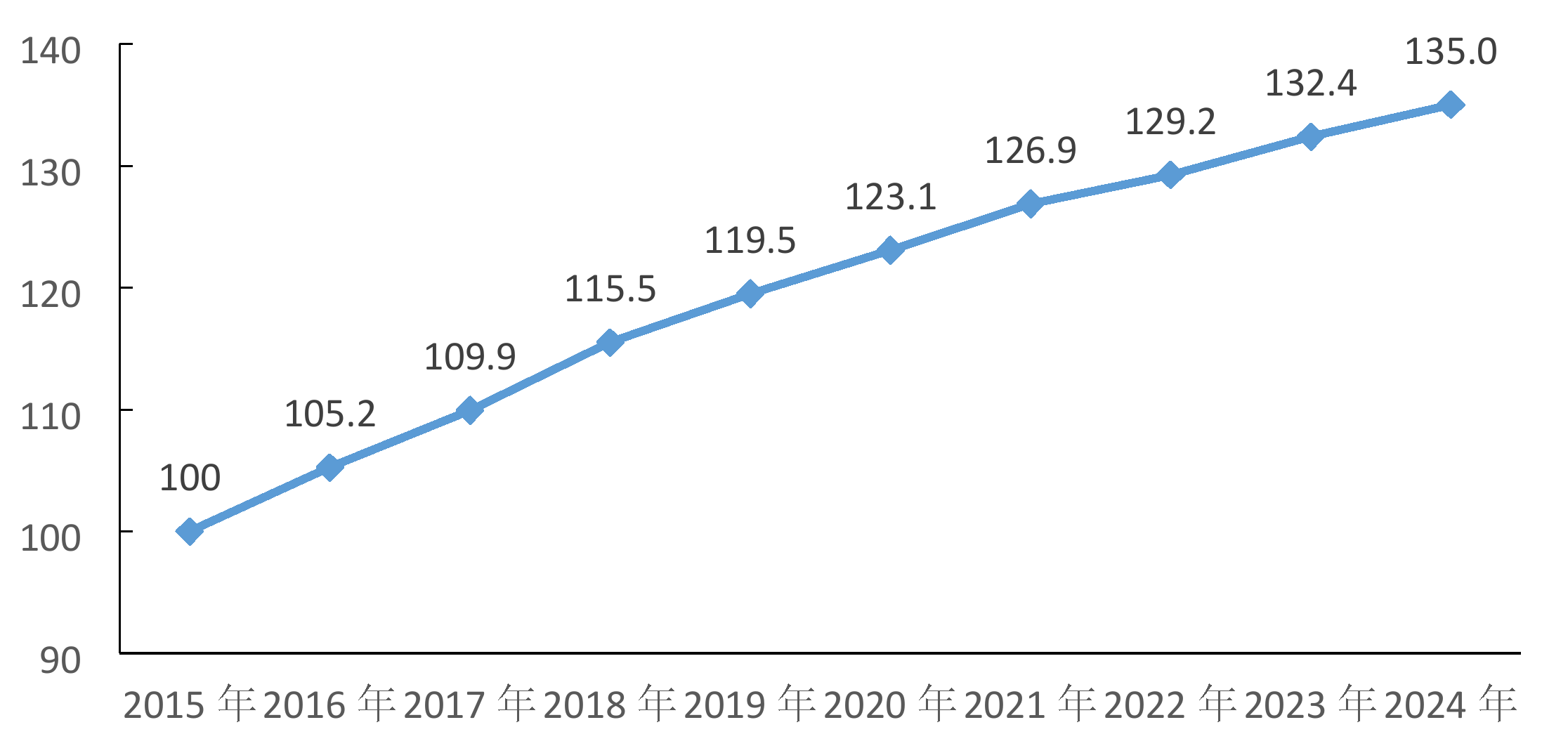
Core Insights - The Yangtze River Delta (YRD) region is solidifying its role as a strong growth engine and a model for high-quality development, with significant advancements in technological and industrial innovation, high-level openness, ecological protection, and improved public welfare in 2024 [1] Economic Development - The YRD's demonstration index for high-quality economic development reached 129.8 in 2024, a 2.4 increase from 2023, and an average annual increase of 2.3 since 2018 [2] - The region's GDP reached 33.17 trillion yuan, 1.5 times that of 2018, accounting for 24.7% of the national total, a slight increase of 0.1 percentage points from 2023 [2] - The digital economy is thriving, with the value added by the information transmission, software, and IT services sector reaching 1.88 trillion yuan, 2.3 times that of 2018, and nearly 30% of the national total [2] Innovation and R&D - The innovation co-construction index rose to 160.6 in 2024, an increase of 8.2 from 2023, with an average annual growth of 6.4 since 2018 [3] - R&D investment in the region reached 1.12 trillion yuan, a 10.5% increase from 2023, representing 30.9% of the national total [3] - The region saw nearly 300,000 new invention patents, with a per capita rate exceeding 12 patents per 10,000 people, 1.6 times that of 2018 [3] Infrastructure and Connectivity - The coordination index for the YRD remained stable at 131.0 in 2024, with an average annual increase of 4.4 since 2018 [4] - The region's railway network expanded to over 15,000 kilometers, a 43.6% increase since 2018, with high-speed rail accounting for over half of the total [4] - The income disparity among residents across provinces narrowed from 2.68:1 in 2018 to 2.40:1 in 2024 [4] Environmental Protection - The green co-protection index reached 163.8 in 2024, a 6.3 increase from 2023, with an average annual growth of 5.6 since 2018 [5] - The air quality improved, with an average of 84.5% of days classified as good air quality across 41 cities, a 0.8 percentage point increase from 2023 [5] - The proportion of good quality surface water reached 94.3%, an increase of 0.9 percentage points year-on-year, marking a historical high [6] Trade and Economic Openness - The openness index for the YRD was 106.6 in 2024, reflecting a resilient outward-oriented economy [7] - The region's total import and export volume exceeded 16 trillion yuan, accounting for 36.5% of the national total, with exports nearing 10 trillion yuan, representing 39.1% of the national total [7] - The seventh China International Import Expo attracted 3,496 exhibitors from 129 countries, with intended transactions exceeding 80 billion USD, of which the YRD accounted for 34% [7] Public Welfare and Services - The public welfare index increased to 130.4 in 2024, a 0.9 increase from 2023, with an average annual rise of 3.1 since 2018 [8] - The average disposable income per capita reached 57,137 yuan, a nominal increase of 5.2% year-on-year [8] - The number of hospital beds in the region increased to 1.6525 million, a rise of 361,800 since 2018, with nearly 7 beds per 1,000 people [8]
滨州市外贸实绩企业突破1500家!连续多年入选全国外贸百强市
Qi Lu Wan Bao· 2025-12-26 15:27
Core Viewpoint - The "14th Five-Year Plan" period is crucial for Binzhou's foreign trade and investment, focusing on creating a new high ground for opening up, enhancing cooperation, and achieving mutual benefits [1][2]. Group 1: Strengthening Open Support - The number of foreign trade enterprises in Binzhou has exceeded 1,500, with AEO-certified enterprises reaching 15. By 2024, the city's foreign trade import and export is projected to reach 129.66 billion yuan, a 58.6% increase from the end of the "13th Five-Year Plan" [1]. - The actual utilization of foreign capital in Binzhou is expected to reach 733 million USD in 2024, a 70.5% increase from 430 million USD at the end of the "13th Five-Year Plan" [1]. - Since the beginning of the "14th Five-Year Plan," the total actual use of foreign capital has reached 3 billion USD [1]. Group 2: Expanding International Markets - Binzhou has established trade relations with 218 countries or regions, including 152 countries along the "Belt and Road" initiative. By October this year, the import and export volume with these countries reached 354.196 billion yuan, a 72.5% increase from the "13th Five-Year Plan" period [2]. - The city has set up 101 overseas investment enterprises, with actual foreign investment reaching 1.12 billion USD [2]. - The cross-border e-commerce trade volume has surged from 2.42 billion yuan in 2021 to 26.65 billion yuan in 2024, an increase of 11 times [2]. Group 3: Enhancing Open Channels - Binzhou has made significant progress in transportation infrastructure, with 19 railways completed and a total railway mileage of 426.7 kilometers [3]. - The total length of highways in Binzhou has surpassed 18,000 kilometers, with a highway density of 186.8 kilometers per 100 square kilometers [3]. - The city has established a comprehensive transportation pattern integrating sea, river, land, and air ports [3]. Group 4: Promoting Open Brands - The "Binzhou Enterprises Create the World" initiative has been launched to strengthen the city's international brand presence [4]. - Over 300 activities have been conducted to promote policies and provide training, covering more than 4,000 enterprises [4]. - Binzhou has established international cultural exchange activities, increasing the number of international friendship cities from 10 to 19, covering 15 countries [5]. Group 5: Future Outlook - Binzhou aims to anchor a new starting point for high-level opening up, promoting reform and development through openness, and striving for new achievements in quality development [5].