
算力设施

Search documents
利好来了,五部门联合发布
Zhong Guo Ji Jin Bao· 2026-01-19 06:34
Core Viewpoint - The release of the "Guiding Opinions on the Construction of Zero Carbon Factories" aims to enhance energy conservation and carbon reduction in the industrial sector, promoting green and low-carbon transformation while fostering new productive forces [1][6]. Group 1: Principles of Zero Carbon Factory Construction - The construction of zero carbon factories follows four principles: tailored strategies based on industry needs, systematic advancement, innovation-driven and technology-enabled approaches, and a commitment to transparency and standardization [4][10]. Group 2: Goals and Phased Implementation - The initiative will prioritize industries with urgent decarbonization needs and lower decarbonization difficulties, with a phased approach starting in 2026 to select benchmark zero carbon factories [4][11]. - By 2027, a batch of zero carbon factories will be established in sectors such as automotive, lithium batteries, photovoltaics, electronics, light industry, machinery, and computing facilities [4][11]. - By 2030, the initiative aims to expand to high carbon intensity industries like steel, non-ferrous metals, petrochemicals, building materials, and textiles, exploring new decarbonization pathways [4][11]. Group 3: Construction Pathways - Key pathways for construction include establishing a carbon emission accounting management system, accelerating the transition to a green and low-carbon energy structure, and enhancing energy efficiency through technological upgrades [5][12][13]. - The initiative emphasizes the importance of carbon footprint analysis for key products to drive collaborative carbon reduction across the entire supply chain [5][14]. - Digitalization and intelligent management will be leveraged to achieve precise measurement and control of energy consumption and carbon emissions [5][15]. Group 4: Implementation Requirements - Local industrial and information authorities are encouraged to develop specific implementation plans for zero carbon factory construction, promoting collaboration among government, enterprises, and markets [16][17]. - A comprehensive standard system will be established to support the management and evaluation of zero carbon factories, ensuring alignment with international standards [16][17].

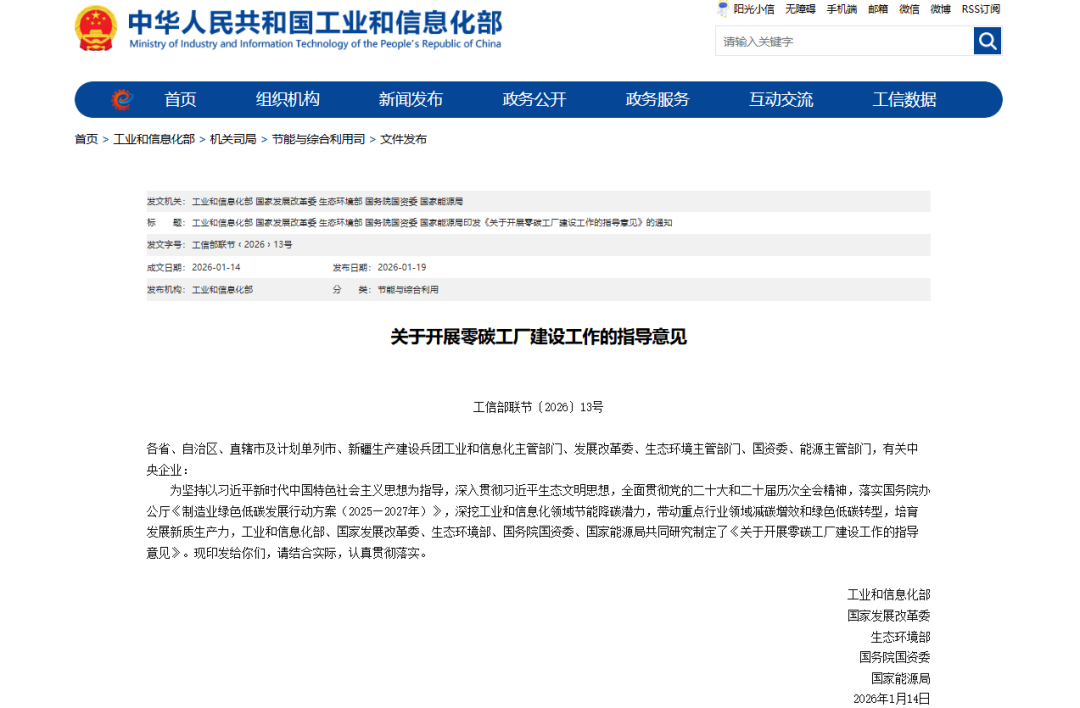
五部门发文:2027年前在汽车等重点领域培育零碳工厂
2 1 Shi Ji Jing Ji Bao Dao· 2026-01-19 06:32
Core Viewpoint - The ongoing trend towards zero-carbon initiatives is being reinforced by the implementation of policies for zero-carbon factories, which are expected to significantly contribute to the green transformation of industries in China [1][4]. Group 1: Policy and Guidelines - The Ministry of Industry and Information Technology, along with four other departments, issued the "Guiding Opinions on the Construction of Zero-Carbon Factories," which outlines the selection of zero-carbon factories starting in 2026 and aims to establish benchmarks for various industries [1][4]. - By 2027, the plan includes the cultivation of zero-carbon factories in sectors such as automotive, lithium batteries, photovoltaics, electronics, light industry, machinery, and computing facilities [1][4]. - The expansion of zero-carbon factory initiatives to traditional high-energy industries like steel, non-ferrous metals, petrochemicals, building materials, and textiles is targeted by 2030 [1][4]. Group 2: Objectives and Implementation - The guiding opinions emphasize a phased approach to nurturing zero-carbon factories, focusing on quality improvement and green transformation across the entire industrial chain [4][5]. - Key objectives include the establishment of a carbon emission accounting management system, enhancing energy efficiency, and promoting digitalization to achieve intelligent carbon control [4][5]. Group 3: Challenges and Support - The construction of zero-carbon factories faces challenges such as inconsistent evaluation standards, unverified key technologies, and weak foundations for carbon emission statistics [6]. - The Ministry of Industry and Information Technology plans to enhance coordination and policy support to facilitate the high-quality advancement of zero-carbon factory construction [6].
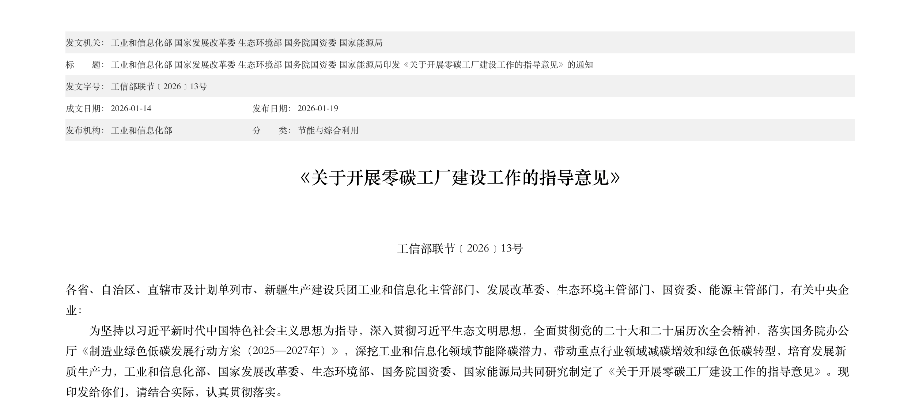
利好来了,五部门联合发布
中国基金报· 2026-01-19 06:23
Core Viewpoint - The article discusses the release of the "Guiding Opinions on the Construction of Zero Carbon Factories" by five Chinese government departments, emphasizing the importance of reducing carbon emissions in industrial sectors and promoting green transformation through zero carbon factory initiatives [2][3]. Group 1: Overall Requirements - The initiative is guided by Xi Jinping's thoughts on ecological civilization and aims to enhance industrial efficiency and promote green transformation across the entire industrial chain [7]. - The construction of zero carbon factories will follow principles such as tailored strategies for different industries, innovation-driven approaches, continuous improvement, and transparency in carbon emissions reporting [8][9]. Group 2: Main Goals - The plan includes a phased approach, starting with industries that have urgent decarbonization needs and are primarily electricity consumers, with a goal to select a batch of zero carbon factories by 2026 [10]. - By 2027, the initiative aims to establish zero carbon factories in sectors like automotive, lithium batteries, photovoltaics, electronics, light industry, machinery, and computing facilities, with further expansion to high carbon intensity industries by 2030 [10]. Group 3: Construction Pathways - Establishing a carbon emission accounting management system is crucial for accurate data support in zero carbon factory construction [11]. - Transitioning to a green and low-carbon energy structure is essential, encouraging the use of renewable energy sources and technologies such as distributed solar and wind power [12]. - Improving energy efficiency through systematic optimization of production processes and adopting advanced technologies is a key focus [13]. - Promoting zero carbon supply chain management and conducting carbon footprint analysis for key products will drive collaborative decarbonization across the industry [14]. - Enhancing digital and intelligent management capabilities will facilitate precise measurement and control of energy consumption and carbon emissions [14]. - Carbon offsetting and information disclosure are necessary to achieve and maintain near-zero carbon emissions [14]. Group 4: Work Requirements - Local industrial and information departments are encouraged to develop specific implementation plans for zero carbon factory construction, promoting collaboration among government, enterprises, and markets [15]. - A comprehensive standard system for zero carbon factories is to be established, providing scientific and practical guidelines for management and evaluation [16]. - The promotion of comprehensive services for energy saving and carbon reduction is essential, including technology transfer and international cooperation [17].

重磅!工信部、国家发改委、国家能源局等5部门发布
中国能源报· 2026-01-19 04:27
Core Viewpoint - The article discusses the guidance issued by the Ministry of Industry and Information Technology and other departments in China regarding the construction of zero-carbon factories, aiming to enhance low-carbon competitiveness and adapt to international trade rules by 2030 [1][3]. Group 1: Overall Requirements - The initiative is guided by Xi Jinping's thoughts on ecological civilization and aims to promote green and low-carbon transformation in key industries, enhancing productivity and achieving carbon peak and neutrality goals [4][5]. - The construction of zero-carbon factories will follow principles such as tailored strategies, innovation-driven approaches, and systematic promotion to ensure effective low-carbon transitions [6][7]. Group 2: Main Goals - From 2026, a selection of zero-carbon factories will be established as benchmarks, with a focus on industries like automotive, lithium batteries, photovoltaics, electronics, light industry, machinery, and computing facilities by 2027 [8][9]. - By 2030, the initiative will expand to include industries such as steel, non-ferrous metals, petrochemicals, building materials, and textiles, exploring new decarbonization pathways [9][10]. Group 3: Construction Pathways - A carbon emission accounting management system will be established to provide accurate data for zero-carbon factory construction, including direct and indirect emissions [11]. - The initiative encourages the transition to green and low-carbon energy structures, promoting the use of renewable energy sources and technologies [12]. - Energy efficiency will be significantly improved through systematic optimization of production processes and the adoption of advanced technologies [13]. - The analysis of carbon footprints for key products will be promoted to drive collaborative decarbonization across the supply chain [14]. - Digitalization and smart technologies will be leveraged to enhance carbon management and operational efficiency [15]. - Carbon offsetting and information disclosure will be implemented to maintain near-zero emissions and improve sustainability reporting [16]. Group 4: Work Requirements - Local authorities are encouraged to develop specific implementation plans for zero-carbon factory construction, promoting collaboration among government, enterprises, and markets [16][18]. - A standard system will be established to support zero-carbon factory management and evaluation, ensuring alignment with international standards [18]. - The promotion of comprehensive services for energy saving and carbon reduction will be encouraged, facilitating technology transfer and market services [18].

五部门:到2027年在汽车、锂电池、光伏、算力设施等行业领域培育建设一批零碳工厂
Jin Rong Jie· 2026-01-19 04:07
Core Viewpoint - The Ministry of Industry and Information Technology, along with other governmental bodies, has issued guidelines for the construction of zero-carbon factories, aiming to enhance energy efficiency and promote green transformation in key industries, thereby supporting carbon peak and carbon neutrality goals [1][4]. Group 1: Guidelines and Principles - The construction of zero-carbon factories will follow four principles: tailored strategies for different industries, systematic advancement, innovation-driven and technology-enabled approaches, and a commitment to transparency and standardization [2]. - A phased approach will be implemented, prioritizing industries with urgent decarbonization needs and lower decarbonization difficulties, with a gradual expansion to more challenging sectors [2][9]. Group 2: Goals and Timeline - By 2026, a selection of zero-carbon factories will be identified to serve as benchmarks, with a target to establish a number of such factories in sectors like automotive, lithium batteries, photovoltaics, electronics, light industry, machinery, and computing facilities by 2027 [2][9]. - By 2030, the initiative aims to extend to high-energy-consuming industries such as steel, non-ferrous metals, petrochemicals, building materials, and textiles, exploring new decarbonization pathways [2][9]. Group 3: Construction Pathways - Key pathways for zero-carbon factory construction include establishing a carbon emission accounting management system, enhancing the green and low-carbon transformation of energy structures, improving energy efficiency, conducting carbon footprint analyses, advancing digitalization, and implementing carbon offsetting and information disclosure [3][9]. Group 4: Implementation and Support - The Ministry of Industry and Information Technology will collaborate with other departments to ensure the effective implementation of the guidelines, encouraging local governments to develop specific plans for zero-carbon factory construction [11][12]. - There will be a focus on developing a standard system for zero-carbon factories and promoting comprehensive energy-saving and carbon-reduction services through collaboration with industry associations and research institutions [12].
五部门联合印发《关于开展零碳工厂建设工作的指导意见》
Zheng Quan Shi Bao Wang· 2026-01-19 03:04
Core Viewpoint - The joint guidance issued by multiple Chinese government agencies aims to promote the construction of zero-carbon factories, emphasizing a phased and systematic approach to decarbonization across various industries [1] Group 1: Principles of Zero-Carbon Factory Construction - The construction of zero-carbon factories will follow four main principles: tailored strategies based on industry needs, systematic advancement, innovation-driven and technology-enabled approaches, and a commitment to transparency and standardization [1] Group 2: Implementation Phases - The initiative will implement a phased approach, prioritizing industries with urgent decarbonization needs, primarily those relying on electricity, and where decarbonization is relatively easier [1] - Starting in 2026, a selection of zero-carbon factories will be identified to serve as benchmarks [1] Group 3: Target Industries and Timeline - By 2027, the focus will be on cultivating zero-carbon factories in sectors such as automotive, lithium batteries, photovoltaics, electronics, light industry, machinery, and computing facilities [1] - By 2030, the initiative aims to expand to traditional high-energy-consuming industries like steel, non-ferrous metals, petrochemicals, building materials, and textiles, exploring new pathways for decarbonization [1]
在法治轨道更高质量做好节能降碳工作
Ren Min Ri Bao· 2025-12-29 05:22
Group 1 - The core viewpoint emphasizes the importance of energy conservation as a key aspect of carbon reduction, highlighting the need for a unified approach to enhance economic development and ensure energy security while achieving carbon reduction goals [1][2] - The next steps include reducing existing energy consumption in key sectors such as industry, construction, transportation, and computing facilities, implementing strict energy review and carbon emission evaluation systems, and integrating energy consumption and carbon emission metrics into carbon reduction assessments [1][2] Group 2 - There are challenges in enforcement, including weakened enforcement power and inconsistent standards, which affect the implementation of the Energy Conservation Law. Future reforms will focus on strengthening institutional supply, enhancing energy supervision in key industries, and improving enforcement capabilities [2] - The need to update energy conservation standards, particularly for emerging industries like AI, is highlighted. Plans include accelerating the revision of mandatory energy standards for traditional industries and developing new standards for emerging sectors [2][3] Group 3 - The rapid growth of energy consumption in computing facilities is identified as a new challenge. Strategies to manage energy efficiency in this area include ensuring strict oversight of new projects, enhancing the renovation of existing facilities, and promoting the recovery and utilization of waste heat [3] - Support from the finance and state-owned enterprise systems is crucial for promoting energy conservation and the development of renewable energy. Measures include incorporating energy conservation into performance assessments and encouraging state-owned enterprises to lead in energy-saving initiatives [3] Group 4 - The inquiry session lasted over two hours, addressing key issues and proposing solutions, reflecting a commitment to enhancing energy conservation and carbon reduction efforts within a legal framework to support the construction of a beautiful China [4]
人大常委会|强化节约优先战略 持续提升能源利用效率——来自全国人大常委会专题询问现场的声音
Xin Hua She· 2025-12-26 13:07
Core Viewpoint - The National People's Congress (NPC) emphasizes the importance of energy conservation and efficiency improvement in China, highlighting significant achievements and future strategies in energy saving and carbon reduction efforts [1][2]. Group 1: Achievements in Energy Conservation - China's energy conservation efforts have been significant, with an average energy consumption growth rate of 3.3% supporting an average economic growth rate of 6.1% [2]. - The country has improved the benchmark capacity for energy efficiency in key industries such as steel, cement, refining, and ethylene by an average of 6 percentage points since the start of the 14th Five-Year Plan [2]. - A total of 317 national energy-saving standards have been issued, and various policies have been implemented to enhance the energy-saving system [2]. Group 2: Focus on Key Areas - The electricity consumption of computing facilities has been growing nearly 20% annually, exceeding 2,500 billion kilowatt-hours, necessitating targeted energy-saving measures [3]. - The government plans to strengthen energy-saving evaluations for new projects and enhance the renovation of existing computing facilities to optimize their structure and improve energy efficiency [3]. - In the transportation sector, the government aims to promote the large-scale development of new energy heavy trucks and improve the charging infrastructure for electric vehicles [3]. Group 3: Enhancing Public Awareness - There is a growing need to enhance residents' participation in energy conservation, especially in urban construction, where energy-saving measures can be implemented in both household appliances and building insulation [5]. - The implementation of a tiered electricity pricing system has been effective in balancing basic electricity needs while promoting energy savings and reducing waste [6]. - The government plans to optimize the tiered pricing system further to encourage reasonable electricity use among residents [6].
国家能源局:推动新能源基地与算力设施协同规划,探索依托海上风电基地就近建设算力设施
Zheng Quan Shi Bao Wang· 2025-11-12 07:21
Core Viewpoint - The National Energy Administration has released guidelines to promote the integrated development of new energy and emerging industries, emphasizing the synergy between renewable energy and new technologies [1] Group 1: Policy Initiatives - The guidelines advocate for the active promotion of the integration of new energy with emerging industries [1] - The "East Data West Computing" project is highlighted as a framework for coordinating green electricity demand with computing power facilities and renewable energy resources [1] Group 2: Infrastructure Development - There is a focus on the collaborative planning of renewable energy bases and computing power facilities, particularly near offshore wind power bases [1] - The potential for adjustable computing load in terms of time and space is to be explored, facilitating the dual network operation of electricity and computing power [1] Group 3: Industry Growth - The initiative aims to accelerate the development of new materials, high-end equipment manufacturing, and energy-saving environmental protection industries in regions rich in renewable resources and with a solid manufacturing base [1] - The goal is to create a new industrial ecosystem that promotes innovation through the integration of new energy and emerging industries [1]