
餐饮外卖

Search documents
申万宏源证券晨会报告-20251201
Shenwan Hongyuan Securities· 2025-12-01 01:13
Group 1: Real Estate Industry - The China Securities Regulatory Commission (CSRC) has initiated a pilot program for commercial real estate REITs, indicating significant development potential for this sector. The market for public REITs in China is estimated to exceed 10 trillion yuan, with the current market size at 219.9 billion yuan, of which commercial real estate accounts for 130.9 billion yuan [12][27]. - The planned commercial real estate REITs will create a multi-tiered market for asset securitization, which will help to broaden financing channels for enterprises, optimize capital structures, and facilitate strategic transformations from developers to asset managers [12][27]. - The commercial real estate REITs are seen as a key practice for constructing a new development model in the real estate sector, focusing on quality and sustainability rather than mere quantity [12][27]. Group 2: Internet and Media Industry - Core consumer brands in the internet and media sector, such as gaming companies and lifestyle brands, are currently trading at a PE ratio below 20x for 2026, indicating a high margin of safety for investors. The structural consumption trend among young users in China remains a significant growth driver [11][12]. - The gaming sector is experiencing a demographic shift, with Generation Z users making up 65% of the market, and there is untapped potential in female-oriented gaming content. Companies like Giant Network are expected to benefit from this trend [11][12]. - The music industry is also highlighted as a growth area, with stable demand for subscription services among young users, and companies are expected to enhance their bargaining power in the face of a fragmented rights market [15]. Group 3: Energy Sector - Guangzhou Development (600098.SH) is positioned as a comprehensive energy service provider, with a diversified business model covering electricity, energy logistics, gas, and renewable energy. The company reported a net profit of 2.159 billion yuan for the first nine months of 2025, a year-on-year increase of 36.1% [14][19]. - The company has a strong dividend history, with a payout ratio consistently above 50% over the past three years, and plans to increase dividends further in 2025 [14][19]. - The energy sector is expected to benefit from stable pricing in coal and gas power generation, with ongoing projects set to enhance profitability [19][20].
美团-W发布第三季度业绩 收入约955亿元 同比增长约2% 闪购与全球化布局亮点突出
Zhi Tong Cai Jing· 2025-11-28 08:54
Core Insights - The company reported a revenue increase of 2.0% year-on-year for Q3 2025, reaching RMB 955 billion, despite facing significant losses in its core local business segment due to intensified competition in the food delivery industry [1] - The company continues to enhance operational efficiency and consumer experience, focusing on service quality and market adaptability, which has led to record high daily active users and monthly transaction users in the food delivery sector [2] - The new business segment, including "Meituan Flash Purchase," is experiencing rapid growth, with increased user acquisition and transaction frequency, while expanding its supply capabilities and partnerships with leading brands [3] - The grocery retail business, including "Little Elephant Supermarket" and "Fast Donkey," is showing strong growth, and the company is exploring offline models to enhance supply chain capabilities [4] Financial Performance - For Q3 2025, the company's adjusted EBITDA and adjusted net profit both declined to negative RMB 148 billion and negative RMB 160 billion, respectively [1] - The core local business segment reported an operating loss of RMB 141 billion, while the new business segment's operating loss widened to RMB 13 billion [1] - As of September 30, 2025, the company held cash and cash equivalents of RMB 992 billion and short-term investments of RMB 421 billion [1] Business Strategy - The company is accelerating supply-side innovation and improving service quality to maintain its competitive edge in the food delivery market [2] - New supply models such as "Pin Hao Fan," "Shen Qiang Shou," and "Brand Satellite Stores" are being implemented to enhance collaboration with quality merchants and expand high-quality product coverage [2] - The launch of "Brand Officer Flag Flash Warehouse" aims to provide comprehensive instant retail infrastructure for retail brands, enhancing user growth and sales [3] Market Expansion - The company is expanding its global footprint with Keeta, which is seeing steady growth in markets like Hong Kong, Saudi Arabia, Qatar, Kuwait, UAE, and Brazil [4] - The company is focusing on improving consumer and delivery experiences in various regions through its product, technology, and operational advantages [4]

在数千家企业中,寻找穿越周期的商业力量
Jing Ji Guan Cha Wang· 2025-11-26 14:45
Core Insights - The conference highlighted the importance of respected enterprises in driving China's economic growth and social progress, emphasizing innovation and long-term value creation [1][2][8] Group 1: Respected Enterprises - The "2024-2025 Respected Enterprises" and "Respected Leading Enterprises" were recognized based on extensive research across thousands of companies and key industries, focusing on operational quality, innovation, public trust, social contribution, and annual impact [1] - Notable companies recognized include Anta, BYD, Huawei, JD.com, Meituan, Qingdao Beer, Ping An, and China Feihe, among others [1] - The event underscored that respected enterprises must address social pain points and create social value while maintaining economic contributions [2] Group 2: Innovation and Quality - High-quality products and services are fundamental to the reputation of respected enterprises, reflecting the innovation management capabilities and ethical standards of their leaders [3] - The need for a supportive environment that encourages innovation and tolerates failure was emphasized, alongside the importance of strategic investments and a stable macro policy [3] - The role of AI in transforming the financial industry was discussed, with a focus on integrating AI technologies to enhance customer service and operational efficiency [4] Group 3: Market Dynamics and Compliance - Antitrust compliance is seen as a catalyst for improving product quality and advancing industries towards higher standards, countering low-quality competition [5][6] - The implementation of antitrust laws has effectively curtailed monopolistic practices, promoting fair competition and encouraging companies to focus on quality [6] Group 4: Future Outlook - The development of new productive forces through technological self-reliance and innovation is crucial for enterprise growth, with China's computing infrastructure being a key asset [7] - The emergence of AI and related technologies is expected to disrupt various industries, leading to new growth opportunities [7]




京东:三季度,京东外卖保持健康发展
Ge Long Hui A P P· 2025-11-13 09:51
Core Insights - JD's food delivery service has shown healthy growth in Q3 2025, with steady increases in both GMV and order volume while reducing overall investment [1] - The improvement in profitability per order is attributed to enhanced operational efficiency and rational competition within the industry [1] - The synergy between JD's food delivery and core retail business has been beneficial, particularly in user growth, frequency of purchases, and cross-category shopping [1] - The launch of "Seven Fresh Kitchen" has received widespread consumer recognition, maintaining high daily order volumes, representing a significant innovation in the supply chain model for the food delivery industry [1]

湖北公布一批外卖食品安全典型案例
Yang Shi Xin Wen· 2025-11-01 04:57
Core Viewpoint - Hubei province has intensified inspections of food safety responsibilities among platforms and food delivery operators, leading to the crackdown on illegal activities and the enforcement of penalties for violations [1] Summary by Sections Case 1: Food Business License Update Violation - A restaurant in Jia Yu County failed to update its food business license information on the delivery platform after it was canceled, violating regulations [2] Case 2: Unauthorized Sale of Cold Dishes - A restaurant in Xiaogan City was found selling cold dishes without the necessary food business license, leading to penalties including confiscation of illegal gains and fines [3] Case 3: Use of Expired Food Products - A restaurant in Xiantao City was penalized for using expired food products, violating food safety laws, resulting in warnings and fines [4] Case 4: Non-compliance with Food Safety Standards - A bakery in Jingmen City was found using food-related products that did not meet safety standards, leading to corrective orders and fines [5] Case 5: Sale of Contaminated Food - A restaurant in Ezhou City was penalized for selling food that contained foreign objects, violating food safety laws, resulting in fines [6]
后外卖大战时代:创伤、修复与重建
远川研究所· 2025-10-27 13:04
Core Insights - The recent food delivery war has led to a significant decline in the restaurant industry's profitability, with 75% of new orders priced below 15 yuan, primarily in beverages, and in-store dining prices dropping to levels seen a decade ago [1][6] - The intense competition has resulted in a false sense of prosperity, with platforms heavily subsidizing orders, ultimately harming the industry and leading to a stagnation in revenue growth [1][5] Group 1: Industry Impact - The food delivery platforms collectively spent at least 300 billion yuan in the second quarter of this year, which is a conservative estimate, as the actual figure may be higher [6] - Major platforms like JD and Meituan reported significant profit declines, with JD's net profit down 50.8% and Meituan's down 89%, while marketing expenses surged [6][10] - The market has seen a split where delivery orders surged by four times, but in-store dining has drastically declined, indicating a shift in consumer behavior [7][10] Group 2: Market Dynamics - The food delivery market is characterized by limited growth potential, as consumer demand is primarily driven by necessity rather than financial incentives, leading to resource wastage [9] - The intense price competition has forced restaurants into a dilemma of choosing between maintaining order volume or preserving profit margins, with many small businesses unable to cope [9][10] - The oversaturation of the market has led to a significant increase in the closure rate of restaurants, with a projected 40% turnover in 2024 [21][24] Group 3: Future Outlook - The industry is now at a critical juncture where it must find a path back to sustainable growth, moving away from price wars and focusing on quality and service innovation [14][19] - Platforms are beginning to adjust their strategies, with a shift towards supporting quality merchants and reducing unnecessary competition [19][22] - The recent announcement of additional subsidies by Meituan aims to help quality merchants stabilize their operations and recover from the impacts of the price war [24][26]



无堂食要明确标识 保障外卖消费者知情权
Nan Fang Du Shi Bao· 2025-10-18 00:35
Core Viewpoint - The National Market Supervision Administration has drafted regulations to clarify the responsibilities of third-party platforms and food service providers in ensuring food safety, aiming to prevent issues like "ghost takeout" [1][2] Group 1: Responsibilities of Platforms and Providers - The regulations emphasize the need for platforms to conduct on-site inspections of new food service providers and maintain records of these inspections [1] - Platforms must ensure that food service providers implement "Internet + Bright Kitchen" practices before they can engage in transactions on the platform [1] - The regulations require platforms to label providers that do not offer dine-in services, which addresses consumer confusion and promotes transparency [2][3] Group 2: Consumer Behavior and Market Dynamics - Consumers often rely on the presence of dine-in customers as an indicator of food quality, influencing their decision to order takeout [2][3] - The prevalence of false advertising by some providers, who misrepresent their dine-in status, manipulates consumer perceptions and can lead to dissatisfaction [3] - The regulations aim to address these deceptive practices and reinforce the responsibilities of both platforms and providers to maintain consumer trust [3] Group 3: Regulatory Impact and Industry Development - The introduction of these regulations is seen as a targeted response to the growing issues within the online food service industry, promoting a healthier development environment [3] - Clear penalties for non-compliance are outlined, reinforcing the importance of adherence to these new standards [3]
美团王莆中:堂食客单价跌至十年前
Di Yi Cai Jing· 2025-10-16 11:12
Group 1 - The core local business CEO of Meituan, Wang Puzhong, stated that the average dining-in customer spending in the restaurant industry has approached levels seen in 2015 [1] - According to the conference data, the overall average customer spending has dropped to a phase low, forcing merchants to rely on low prices to maintain orders [1] Group 2 - At the 8th Restaurant Industry Conference, it was reported that 75% of the new takeaway orders this year came from the low-price range of under 15 yuan [3] - Following the takeaway battle in May, nearly half of the incremental orders generated through subsidies were for beverages, leading to a surge in sales for many milk tea and coffee shops [3]
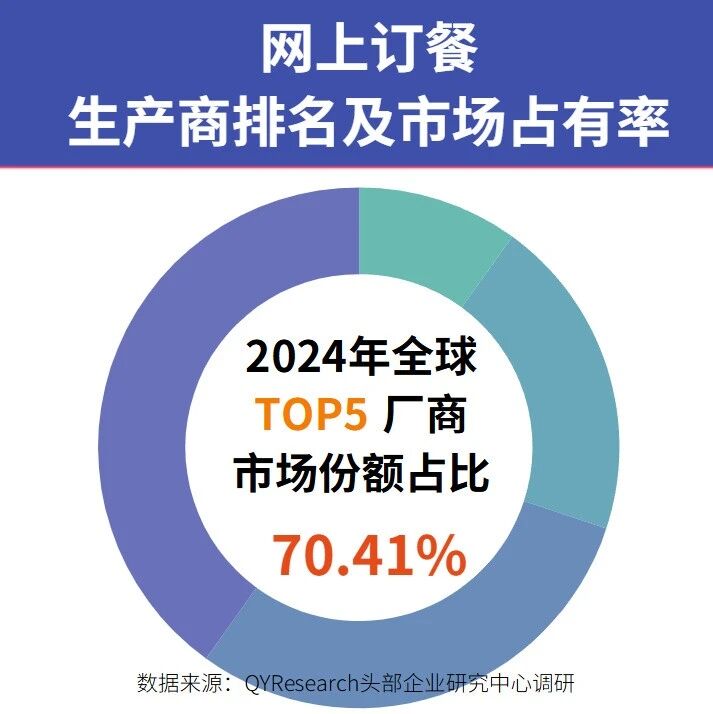
网上订餐行业洞察:2024年TOP5 企业占据全球70.41%的市场份额
QYResearch· 2025-10-14 02:16
Overview of Online Food Ordering - Online food ordering refers to the process of ordering food through a restaurant's own website or mobile application, or through multi-restaurant chains' websites or applications. Customers can choose between delivery or pickup. The ordering process includes selecting a restaurant, scanning the menu, choosing dishes, and finally selecting pickup or delivery. Payment methods include credit or debit card payments through the app or website, or cash payments at the restaurant [1]. Market Size and Growth - The global online food ordering market is expected to reach $13.47 billion by 2031, with a compound annual growth rate (CAGR) of 9.5%, compared to $7.086 billion in 2024 [2]. - The online food ordering market is becoming increasingly concentrated, with major players including McDonald's, KFC, Subway, Pizza Hut, Starbucks, Burger King, Domino's Pizza, Dunkin Donuts, Dairy Queen, Papa John's, Wendy's, Just Eat, Takeaway, Alibaba (Ele.me & Flash Delivery), GrubHub, OLO, Swiggy, Meituan Waimai, JD Waimai, Uber Eats, DoorDash, and Caviar. By 2024, the top five manufacturers are expected to account for approximately 70.41% of total revenue [2][9]. Market Segmentation - The online food ordering market is divided into independent ordering and restaurant self-operated ordering. As of 2024, delivery platforms dominate the market, accounting for 96.1% of the total market share. The online food ordering market primarily includes B2B and B2C models, with B2C holding the largest market share of approximately 91.3%, reaching $6.46 billion, while B2B is showing a declining trend globally [2][3]. Regional Insights - According to QYResearch, due to rising living standards and market maturity, the Asia-Pacific region is expected to hold the largest market share by 2025. Suppliers recognize the importance of this region, particularly in China and India, and are working to penetrate the market by strengthening their sales and distribution networks [3]. Competitive Landscape - Despite the intense competition in the global online food ordering market, many companies are able to achieve substantial profits from online food ordering production and marketing, which is believed to attract more entrants into the market. An increasing number of consumers are choosing online food ordering with higher frequency, leading to fierce competition between in-house delivery service providers and third-party delivery service providers. The potential introduction of artificial intelligence solutions and drone delivery is also anticipated [3].
黄仁勋减持英伟达;美团试点外卖骑手屏蔽顾客功能丨新鲜早科技
2 1 Shi Ji Jing Ji Bao Dao· 2025-10-13 02:13
Group 1: Executive Actions and Corporate Developments - Jensen Huang, CEO of NVIDIA, sold 225,000 shares for over $42.8 million in October, totaling over $113 million in stock sales this month [2] - Apple is in the final stages of negotiations to acquire Prompt AI, a startup focused on home security systems, enhancing its smart home ecosystem [3] - ByteDance initiated its second stock buyback of the year, with prices set at $200.41 for current employees and $180.37 for former employees [7] Group 2: Industry Innovations and Projects - China Mobile plans to explore the construction of large-scale intelligent computing centers and enhance its AI capabilities [4] - BYD won a bid for Singapore's first L4 autonomous bus pilot project, set to test electric buses by mid-2026 [5] - Didi Autonomous Driving secured 2 billion yuan in Series D funding to boost AI research and L4 autonomous driving applications [16] Group 3: Market and Regulatory Updates - The Chinese market regulator is investigating Qualcomm for potential antitrust violations related to its acquisition of Autotalks [11] - Wen Tai Technology condemned the Dutch government's actions against Nexperia as politically motivated interference [12][13] - Zhongxin Jingyuan is preparing for an IPO on the Beijing Stock Exchange, focusing on semiconductor silicon wafer production [14] Group 4: Product Launches and Technological Advancements - The world's first four-channel low-noise semiconductor single-photon detector has been mass-produced in Hefei, marking a significant advancement in quantum technology [10] - Samsung launched the W26 foldable flagship smartphone featuring a 200-megapixel camera and upgraded AI capabilities [17]


