
互联网科技

Search documents
港股收评:午后拉升!恒指反弹0.92%,科技股、金融股集体回暖
Ge Long Hui· 2025-12-17 08:23
另一方面,军工股、燃气股、水务股全天低迷,此外,全市场超20只个股跌超10%以上,其中广联科技 控股尾盘一度大跌超37%。(格隆汇) 盘面上,连续走低拖累大市下跌的大型科技股普遍拉升回暖,其中,美团、快手、百度涨近2%,腾 讯、京东、阿里巴巴均涨超1%;机构指中长期行业景气改善有望传导至票价提升,航空股全天强势领 涨,中国南方航空盘中曾涨超8%;国寿集团指出,要发挥保险资金长期资本优势,保险股午后发力明 显,中资券商股、内银股等权重集体拉升助力大市止跌回暖;半导体股、苹果概念股、纸业股、影视 股、铝业股、黄金股表现活跃。 港股午后三大指数快速拉升回暖,结束2连跌行情。恒生科技指数尾盘一度涨至1.4%,最终收涨 1.03%,恒生指数、国企指数分别上涨0.92%及0.98%。 ...
港股收评:恒指涨0.92%、科指涨1.03%,航空股、有色金属及芯片股走高,金融股午后活跃
Jin Rong Jie· 2025-12-17 08:21
Market Performance - The Hong Kong stock market experienced a narrow fluctuation in the morning and a strong rally in the afternoon, with the Hang Seng Index rising by 0.92% to 25,468.78 points, the Hang Seng Tech Index increasing by 1.03% to 5,457.95 points, and the National Enterprises Index up by 0.98% to 8,843.57 points [1] - Major technology stocks mostly rose, with Alibaba up 1.25%, Tencent Holdings up 1.42%, JD Group up 1.26%, and Meituan up 1.81% [1] - The aviation sector showed strong performance, with China Southern Airlines rising over 5%, while financial stocks also saw gains, with China Life Insurance increasing over 4% [1] - The metals sector led the gains, with Tianqi Lithium up nearly 6%, Ganfeng Lithium up over 5%, and Luoyang Molybdenum up over 2% [1] - Semiconductor stocks also rose, with Shanghai Fudan up 4%, Huahong Semiconductor up nearly 3%, and SMIC up over 2% [1] Corporate News - China Energy Construction (03996.HK) announced the official operation of the first phase of the Zhongnengjian Songyuan Hydrogen Energy Industrial Park project [2] - China Pacific Insurance (02601.HK) reported that its cumulative original insurance premium income for the first 11 months reached RMB 250.32 billion, a year-on-year increase of 9.4%, while its property insurance premium income was RMB 187.68 billion, up 0.3% [2] - Hansoh Pharmaceutical (03692.HK) entered into a licensing agreement with Glenmark for Amivantamab, which includes an upfront payment and potential milestone payments exceeding USD 1 billion [2] Financing Activities - Yuexiu Property (00123.HK) secured a term loan financing of HKD 500 million [3] - China Railway Construction (01186.HK) plans to issue company bonds with a total amount not exceeding RMB 4 billion [4] - Genscript Biotech (01672.HK) increased its share buyback fund from a maximum of HKD 300 million to HKD 500 million [5] - Tencent Holdings (00700.HK) repurchased 1.067 million shares for approximately HKD 636 million at prices ranging from HKD 592.5 to HKD 602.5 [6] - Xiaomi Group (01810.HK) repurchased 7.2 million shares for HKD 294 million at prices between HKD 40.36 and HKD 41.00 [7] - Kuaishou Technology (01024.HK) repurchased 1.8231 million shares for HKD 116 million at prices from HKD 63.05 to HKD 64.4 [8] - Geely Automobile (00175.HK) repurchased 299,900 shares for approximately HKD 50.54 million at prices between HKD 16.72 and HKD 17.2 [9] Institutional Insights - According to China Merchants Securities, the recent weakness in the Hong Kong stock market is attributed to southbound capital returning to A-shares due to new public fund benchmark regulations, concerns over IPO financing, and the upcoming peak of stock unlocks [10] - Huatai Securities noted that while the market's downside is manageable, the upside potential has not yet opened up, with market sentiment indicators remaining in a pessimistic range [10] - China Merchants Securities also highlighted that the Hong Kong market has not stabilized after overseas interest rate cuts, primarily due to internal liquidity issues [10]

AI算力“逃离地球”?谷歌宣布“追日者”计划,2027年拟在太空部署AI数据中心
Hua Er Jie Jian Wen· 2025-12-17 08:02
Core Insights - Google is attempting a groundbreaking infrastructure experiment called "Project Suncatcher," which aims to relocate high-energy AI data centers to space to address ground power shortages and planning bottlenecks [1][3] - The project involves a cluster of 81 satellites equipped with AI chips, which will operate in a coordinated manner in space, with the first two prototype satellites expected to be launched by 2027 in collaboration with Planet [1][3] - The initiative seeks to leverage the unique environmental advantages of space, particularly the near-constant solar energy available in sun-synchronous orbit, to provide power for high-energy AI workloads [3] Group 1: Project Overview - Project Suncatcher envisions operating in a sun-synchronous orbit approximately 650 kilometers from Earth, ensuring nearly uninterrupted power supply through solar panels [3] - This architecture relies on the collaborative functioning of satellites, which must handle computational tasks while maintaining communication during high-speed travel [3] - The project aims to circumvent challenges faced by ground data centers, such as complex planning approvals, local community opposition, and the inability of existing power grids to meet the energy demands of rapidly expanding AI [3] Group 2: Technical and Economic Challenges - The ambitious plan faces significant questions regarding technical feasibility and economic viability, especially after Microsoft's previous underwater data center project (Project Natick) was terminated due to maintenance difficulties and cost-effectiveness concerns [2][5] - The costs associated with launching and maintaining satellites in space are high, and the risks posed by radiation, debris collisions, and increasing orbital traffic cast doubt on the project's future [2][4] - The proximity of satellites in the proposed orbit (100 to 200 meters apart) raises concerns about collision risks, which could lead to catastrophic chain reactions and exacerbate the existing problem of space debris [4] Group 3: Industry Implications - The project raises governance concerns regarding space, as astronomers worry that more satellite constellations will interfere with scientific observations [7] - The current space environment is becoming a competitive arena for tech giants like Jeff Bezos and Elon Musk, with Google's plan potentially increasing light pollution and radio interference, highlighting the lack of effective governance mechanisms for this public resource [7] - This initiative represents both a gamble to showcase the limitless potential of AI and a metaphor for the industry's "overexpansion" amid energy anxieties [7]

短期港股市场情绪或将进入震荡修复期,聚焦恒生ETF(159920)、恒生国企ETF(159850)一键布局
Sou Hu Cai Jing· 2025-12-17 05:52
Group 1 - The Hong Kong stock market indices collectively rose, with the Hang Seng Index increasing by 0.22%, the Hang Seng Tech Index by 0.02%, and the Hang Seng China Enterprises Index by 0.27% as of midday close [1] - The technology sector is expected to maintain relative resilience amid declining liquidity risks, supported by policy emphasis on innovation and the focus on cutting-edge technology related to "new productive forces" [1] - The Hang Seng Index's forward P/E ratio is currently at 12.7 times, having corrected by 5% from its highest point this year, indicating a potential period of market sentiment stabilization [2] Group 2 - Notable investment targets include the Hang Seng ETF (159920), the Hang Seng Tech Index ETF (513180), and the Hang Seng China Enterprises ETF (159850) [3] - The "tech + dividend" barbell strategy remains effective, with traditional dividend sectors such as banking, insurance, telecom, utilities, and energy being defensive options, while the consumer sector also warrants attention [2]
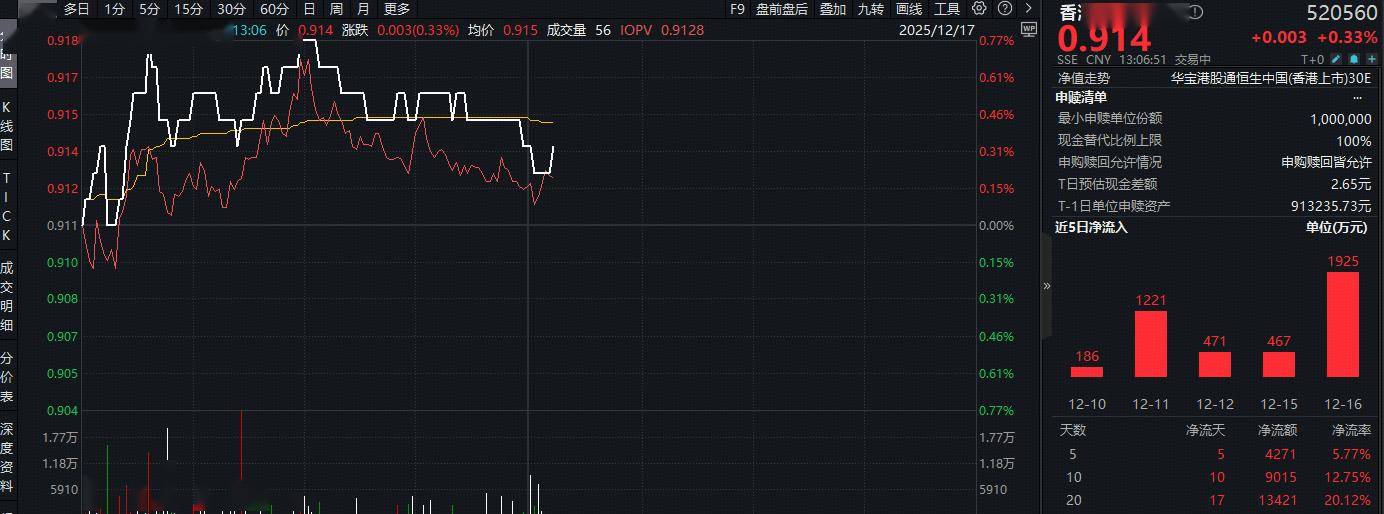
ETF盘中资讯 | 港股低吸窗口期?自带“科技+红利”哑铃策略的——香港大盘30ETF(520560)近10日连续吸金9015万元!
Sou Hu Cai Jing· 2025-12-17 05:26
Group 1 - The Hong Kong Large Cap 30 ETF (520560) has shown a positive market performance with an intraday increase of 0.77% and a current rise of 0.33%, indicating strong buying interest from investors [1] - Over the past 10 days, the ETF has experienced a net inflow of funds totaling 90.15 million, reflecting investor confidence in the future performance of Hong Kong stocks [1] - In the consumer sector, stocks like Pop Mart and Nongfu Spring have risen over 2% and 1% respectively, while in the technology sector, Meituan and Tencent have also shown positive movement [1] Group 2 - The U.S. labor market is showing signs of weakness with November's non-farm payrolls adding only 64,000 jobs and an unexpected rise in the unemployment rate to 4.6%, the highest in four years [3] - The expectation of continued interest rate cuts by the Federal Reserve is likely to weaken the U.S. dollar and improve liquidity in the Hong Kong stock market, potentially attracting foreign capital [3] - Analysts suggest that the current Hong Kong stock market is in a favorable position characterized by a "valuation bottom, liquidity bottom, and sentiment bottom," creating a strategic investment window [3] Group 3 - The Hong Kong Large Cap 30 ETF (520560) is designed with a "technology + dividend" strategy, combining high-growth tech stocks like Alibaba and Tencent with stable dividend-paying stocks such as China Construction Bank and Ping An [4] - The ETF offers a flexible "T+0" trading mechanism, making it an ideal long-term investment tool for those looking to balance risk and return in the Hong Kong market [4] - The recommendation is to adopt a "barbell strategy" for investment, focusing on stable value assets for long-term holdings while also considering growth-oriented assets that show strong industry fundamentals [3]

前11个月快递业务量达1807亿件,阿里发布电影级视频模型万相2.6系列|未来商业早参
Mei Ri Jing Ji Xin Wen· 2025-12-16 23:15
Group 1: Express Delivery Industry - In the first eleven months, the express delivery business volume reached 180.74 billion pieces, a year-on-year increase of 14.9% [1] - In November alone, the express delivery business volume was 18.06 billion pieces, with a year-on-year growth of 5.0%, while the revenue decreased by 3.7% to 137.65 billion yuan [1] - The growth in express delivery volume indicates a continuous increase in online shopping penetration, highlighting the importance of the express delivery industry as the infrastructure for e-commerce [1] Group 2: Alibaba's AI Technology - Alibaba launched the new generation of the Wanxiang 2.6 series model, which is fully upgraded for professional film production and image creation, supporting features like character role-playing and multi-camera generation [2] - The upgrade of the Wanxiang 2.6 model is expected to enhance Alibaba's competitiveness in the film production and image creation sectors, reflecting its ongoing investment in AI technology and content ecosystem development [2] Group 3: Cainiao's Collaboration with Mixue Group - Cainiao announced a technology partnership with Mixue Group to develop a supply chain management system focused on sales forecasting, transitioning from experience-driven to AI-driven supply chain management [3] - This collaboration aims to optimize Mixue's supply chain management through AI replenishment algorithms and shared distribution networks, potentially reducing logistics costs and improving operational efficiency [3] - The partnership demonstrates Cainiao's strategic positioning in logistics supply chain technology by collaborating with leading brands to validate its technology models and predictive capabilities [3]

创纪录,南向资金爆买
Zheng Quan Shi Bao· 2025-12-16 14:23
今年以来,港股在全球主要股市中表现突出,恒生指数等年内涨幅超过20%。不过,自10月中旬以来, 港股市场进入调整阶段,波动有所加大,11月整体呈现震荡走势,12月以来的调整幅度有所加大。 港股作为典型的离岸市场,其流动性受海外环境影响显著,而基本面则与内地经济紧密相连。相比基本 面,流动性对港股行情的影响更为直接和迅速,其中科技类资产对利率变化更为敏感。 除了流动性,估值优势、资产质量提升与市场生态重塑多重因素,也将促使港股估值修复。多家券商机 构展望2026年港股行情时指出,随着港股基本面触底反弹,叠加其依旧显著的估值折价,港股市场在 2026年将迎来第二轮估值修复以及业绩进一步复苏的行情。 南向资金创纪录流入 中信证券也表示,考虑到理财和货基等产品收益率持续下滑,而今年以来中国资产的"赚钱效应"愈发显 著,居民"存款搬家"现象或将持续。特别考虑到港股的低配情况,预计南向资金将持续增配港股,尤其 散户资金有较大的增配空间。 回购热情升温 与南向资金涌入相呼应的是,港股市场回购热情出现升温。 Wind数据显示,截至2025年12月15日,港股上市公司今年以来的回购金额为1693.45亿港元,相比2024 年2 ...
港股开盘|恒指低开0.32% 阿里巴巴跌逾1%
Di Yi Cai Jing· 2025-12-16 14:18
恒生指数低开0.32%,恒生科技指数跌0.56%。紫金矿业、百度集团、阿里巴巴跌逾1%;蔚来涨近2%, 在上海建成500座充换电站。 ...
特斯拉(TSLA.US)董事获逾30亿美元股票奖励 远超其他科技巨头
智通财经网· 2025-12-16 11:55
Core Insights - Tesla's board members have earned over $3 billion from stock awards, significantly exceeding compensation levels of peers [1] - From 2018 to 2020, Tesla board members received an average total cash and stock compensation of approximately $12 million per year [1] - Tesla's board compensation is about eight times higher than that of Alphabet and surpasses that of Nvidia, Meta, Apple, Microsoft, and Amazon [1] Compensation Details - The total compensation of over $3 billion was granted to five out of eight current non-executive directors [1] - Three directors joined after the suspension of compensation grants, which are Jeffrey Straubel, Jack Hartung, and Joe Gebbia [1] - Despite no new awards being granted since the 2020 shareholder lawsuit settlement, the value of these stock awards has significantly increased due to Tesla's soaring stock price [1]

道达尔能源斩获21年长约 为谷歌马来西亚数据中心供电
Xin Lang Cai Jing· 2025-12-16 09:49
法国能源巨头道达尔能源于本周二宣布,已与字母表公司旗下的谷歌签署一份为期 21 年的供电协议, 承诺为谷歌在马来西亚的数据中心提供 1 太瓦时的可再生能源。 这家法国能源企业表示,相关电力将由马来西亚新建的西特拉能源太阳能电站供应,该电站计划于 2026 年初动工建设。 这份供电合同预计将于明年第一季度正式生效。 此外,道达尔能源已于 11 月达成另一项独立协议,同意为谷歌位于美国俄亥俄州的数据中心供电。 随着科技企业竞相满足人工智能的研发需求,以科技巨头为主导建设的数据中心对能源的需求量正持续 攀升,其能耗规模往往超出当地公用电力公司的供应能力。 法国能源巨头道达尔能源于本周二宣布,已与字母表公司旗下的谷歌签署一份为期 21 年的供电协议, 承诺为谷歌在马来西亚的数据中心提供 1 太瓦时的可再生能源。 这家法国能源企业表示,相关电力将由马来西亚新建的西特拉能源太阳能电站供应,该电站计划于 2026 年初动工建设。 这份供电合同预计将于明年第一季度正式生效。 此外,道达尔能源已于 11 月达成另一项独立协议,同意为谷歌位于美国俄亥俄州的数据中心供电。 随着科技企业竞相满足人工智能的研发需求,以科技巨头为主导建 ...

