
家政

Search documents
名校毕业生,「疯抢」保洁饭碗?
3 6 Ke· 2025-07-14 01:18
Group 1 - The core viewpoint of the article highlights the shift in employment trends among university graduates, with a significant number now entering blue-collar jobs, reflecting a change in societal perceptions and job market dynamics [4][5][54] - In 2023, over half of the summer graduates have joined manufacturing positions, indicating a growing acceptance of blue-collar work among educated youth [4][17] - The average monthly income for blue-collar workers in 2023 is reported to be 6,043 yuan, which is higher than the average monthly income of 5,695 yuan for urban private sector employees [23][27] Group 2 - The article discusses the increasing number of university graduates pursuing blue-collar jobs, with a 165% increase in job applications for blue-collar positions among those under 25 since 2019 [17][18] - The narrative around blue-collar work is evolving, with many graduates finding satisfaction and higher earnings in these roles, challenging traditional views of job prestige [18][54] - The demand for skilled blue-collar workers is rising, particularly in sectors like manufacturing, where there is a projected talent gap of nearly 30 million by 2025 [46][50] Group 3 - The article emphasizes that the definition of blue-collar work is changing, with many positions now requiring advanced skills and knowledge, such as in high-tech manufacturing and modern service industries [50][52] - The trend of university graduates entering blue-collar jobs is seen as a response to the oversaturation of the job market for white-collar positions, leading to a reevaluation of career paths [46][54] - The discussion around the perceived devaluation of degrees is framed as a reflection of changing labor market needs rather than a failure of higher education [40][54]


14项任务促家政服务业提质扩容
Bei Jing Shang Bao· 2025-07-08 10:30
Group 1 - The Ministry of Commerce and other nine departments have issued a "2025 Home Service and Agriculture Action Work Plan" to enhance home service supply and promote consumption, contributing to rural revitalization [1] - The plan includes 14 tasks focusing on supporting rural labor in home service employment, improving skills, and integrating vocational education with the home service industry [1] - It emphasizes the need for better employment security for rural labor in home services, including housing support and social security, to facilitate their integration into urban areas [1] Group 2 - The home service industry is seeing an increase in the proportion of young workers, with significant interest from entrepreneurial enterprises [2] - The industry is expected to exceed 2 trillion yuan by 2025, driven by strong demand in segments like elderly care and maternal and infant services [2] - Digital platforms are empowering home service entrepreneurs, enhancing market access and service quality, with 58 Daojia reporting a 60% reduction in average order distance and improved service efficiency [2] - 58 Daojia offers comprehensive vocational training with 78 courses across five major job categories, achieving over 90% employment success for trainees, and 74% of participants report salary increases post-training [2] - The Ministry of Commerce plans to implement policies to further leverage the home service industry for improving livelihoods, stabilizing employment, and promoting consumption [2]
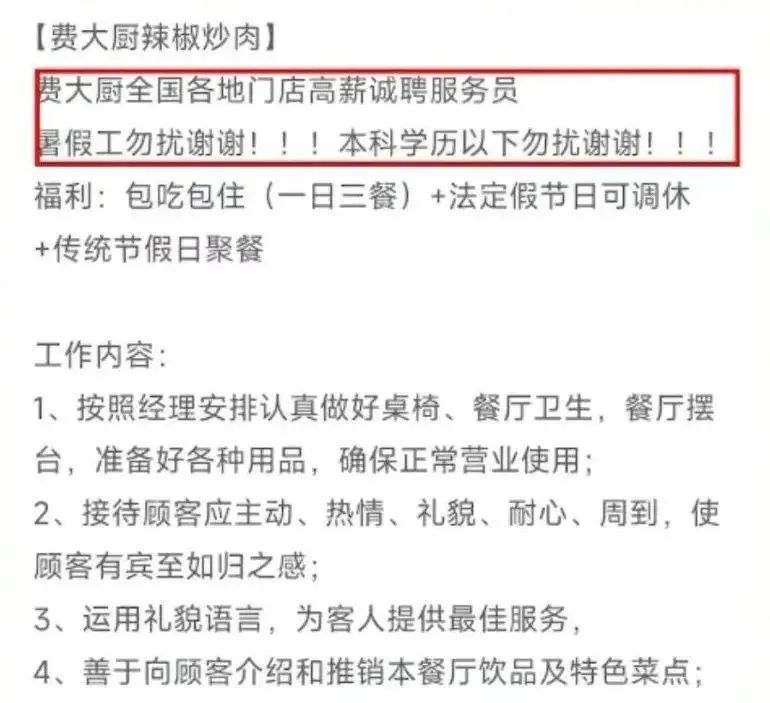
服务员要本科?学历大贬值,上学还真的有用吗?
3 6 Ke· 2025-07-07 12:16
Group 1 - The article discusses the phenomenon of educational inflation in China, highlighting how job requirements have escalated to demand higher educational qualifications even for low-skilled positions [1][2][4] - It notes that the number of college graduates has dramatically increased from 450,000 in 1982 to 12.22 million in 2023, a 27-fold increase, while job opportunities have not kept pace [4][10] - The article emphasizes that this educational inflation is not limited to white-collar jobs but has also permeated blue-collar positions, with many employers now requiring higher degrees for roles traditionally filled by lower-educated workers [6][10] Group 2 - The article identifies three main reasons for educational inflation: the rapid expansion of higher education outpacing job growth, economic transitions leading to a demand for higher qualifications, and companies using educational requirements as a shortcut in the hiring process [10][12][13] - It provides historical context, comparing China's situation to that of the United States and Japan, where similar trends occurred during economic shifts [12][13] - The article highlights the psychological impact of educational inflation, where the belief that higher education guarantees better job prospects is increasingly challenged, leading to disillusionment among graduates [14][16] Group 3 - The article suggests that educational inflation does not equate to the uselessness of degrees but rather indicates a shift in how educational qualifications are valued, emphasizing the need for skills alongside degrees [19][20] - It offers practical advice for students and job seekers, recommending the selection of niche majors, the conversion of educational advantages into skill advantages, and the exploration of flexible employment opportunities [19][21][24] - The conclusion stresses that while the value of degrees may have diminished, the potential for individuals to leverage their skills and education remains significant, allowing for diverse career paths [25][26]
马斯克成立“美国党” ,特朗普回应;财政部:在政府采购活动中对自欧盟进口的医疗器械采取相关措施;也门荷台达市遭以色列密集空袭丨早报
Di Yi Cai Jing· 2025-07-07 00:38
Group 1 - The establishment of the "American Party" by Elon Musk is seen as a response to the current political landscape, with Musk claiming the country is in a state of a single-party system due to waste and corruption [2][33] - Musk's political ambitions may face significant challenges, as he is unlikely to secure any electoral votes in upcoming elections [33] Group 2 - The Chinese government has implemented measures targeting medical devices imported from the EU, effective from July 6, 2025, which will affect procurement processes for medical equipment [3][5] - The measures specifically exclude products produced by European-funded enterprises in China, indicating a focus on imported goods rather than domestic production [5] Group 3 - The Chinese government has launched a plan to enhance the home service industry, with 14 specific tasks aimed at improving quality and expanding capacity, contributing to rural revitalization [6] - The plan includes measures to ensure employment security for rural laborers in the home service sector and improve their access to public services [6] Group 4 - The State-owned Assets Supervision and Administration Commission (SASAC) has issued guidelines to promote brand building among central enterprises, aiming for significant improvements in brand value by 2030 and 2035 [8] - The initiative emphasizes the importance of brand influence and competitiveness in the global market [8] Group 5 - The Hong Kong stock market has seen a significant increase in IPO fundraising, with over HKD 107 billion raised in the first half of the year, marking a 22% increase compared to the previous year [14] - The surge in IPO activity is primarily driven by investor interest in technology stocks [14] Group 6 - The domestic weight loss drug market is experiencing a shift with the introduction of the domestic GLP-1 weight loss drug, which may lead to increased competition for global giants like Novo Nordisk and Eli Lilly [34] - The pricing of weight loss drugs in China is currently high, but the entry of more products could lead to price reductions and potential inclusion in health insurance [34]


★融合场景亮点纷呈 服务消费创新升级添动能
Zhong Guo Zheng Quan Bao· 2025-07-03 01:56
Group 1: Service Consumption Trends - The summer season has seen an increase in service consumption, particularly in tourism and home services, contributing significantly to economic growth and employment [1][3] - The Ministry of Commerce launched the "Service Consumption Season" initiative for 2025, aiming to promote the integration of various service sectors such as tourism, food, sports, and digital services [1][2] - Live streaming has become a popular platform for purchasing travel products, with significant sales growth reported during the "618" shopping festival, particularly for theme park and cruise products [1][2] Group 2: Innovations in Tourism and Entertainment - The integration of different tourism experiences, such as the collaboration between Haichang Ocean Park and Xiangyuan Holdings, aims to create a comprehensive consumption experience [2] - The upcoming opening of Shanghai Lego Land has generated high search interest on travel platforms, indicating strong demand for IP-driven entertainment [2] - The film industry is preparing for a robust summer season, with over 60 films scheduled for release, and initiatives to boost movie consumption [2] Group 3: Home Service Sector Developments - The demand for home services is increasing, particularly for flexible labor options like hourly workers, as families seek assistance during the summer [3][4] - Digital technologies are being leveraged to enhance service delivery and improve matching efficiency between service providers and clients [3][4] - The government is promoting the expansion and quality improvement of home services, recognizing it as a new growth point for service consumption [3][4] Group 4: Sports and Events Impact - The inaugural Jiangsu City Football League has become a popular sports IP, driving local tourism and consumption through innovative ticketing and promotional packages [5][6] - The sports sector is expected to benefit from increased investment and development of various sports events, with significant economic returns projected from sports spending [5][6] - The government is encouraging the organization of more sports events and enhancing the infrastructure for outdoor and recreational activities [6]
深度专题 | 新“三万亿”投资会在哪?(申万宏观·赵伟团队)
申万宏源宏观· 2025-06-25 14:54
Core Viewpoint - The article emphasizes the significant investment opportunities in the service industry, highlighting a potential investment gap of approximately 3.3 trillion yuan due to the disparity between actual and potential service consumption [2][10]. Group 1: Demand Increment "Blue Ocean" - The current service industry investment has a potential gap of 3.3 trillion yuan, with a projected shortfall in per capita service consumption of 2,093 yuan in 2024, translating to nearly 30 trillion yuan nationwide [2][10]. - The decline in consumer time due to "involution" is a short-term constraint on service consumption recovery, but policies encouraging paid leave and flexible work arrangements are expected to mitigate this trend [2][3][33]. Group 2: International Experience in Demand-Driven Supply - Global experiences indicate that as consumer preferences shift from goods to services, a positive feedback loop is created, driving supply and investment growth [4][68]. - In Japan, service industry investment surged after entering an aging society, with service investment as a percentage of total investment rising to 11.6% when GDP reached 20,000 USD [4][90]. Group 3: Investment Opportunities in Specific Areas - The demand for household services, particularly in the domestic service sector, is on the rise, with significant investment potential in areas like housekeeping and elderly care [5][96]. - The service industry in China is currently more focused on corporate services, with a low proportion of value added from lifestyle services, indicating a need for greater attention to consumer demand [7][128]. - The effective supply of services in sectors like health and entertainment has been insufficient, leading to a significant gap between supply and demand [8][141]. Group 4: Future Investment Trends - The service industry is expected to see accelerated investment growth as private investment shifts from manufacturing to services, with notable increases in sectors like health and entertainment [8][158]. - The article suggests that the aging population will drive demand for "age-friendly" services, creating further investment opportunities in related sectors [6][113].

深圳:建立健全服务消费标准体系
news flash· 2025-06-25 11:25
Core Viewpoint - Shenzhen has issued measures to promote high-quality development of service consumption, emphasizing the establishment and improvement of a standardized service consumption system [1] Group 1: Service Industry Standards - The measures include strengthening the standardization of the service industry by revising and formulating standards related to various service sectors such as catering, housekeeping, elderly care, cultural tourism, and decoration [1] - There is encouragement for enterprises and institutions to participate in the formulation, promotion, and implementation of national, industry, local, group, and enterprise standards related to the service industry [1]
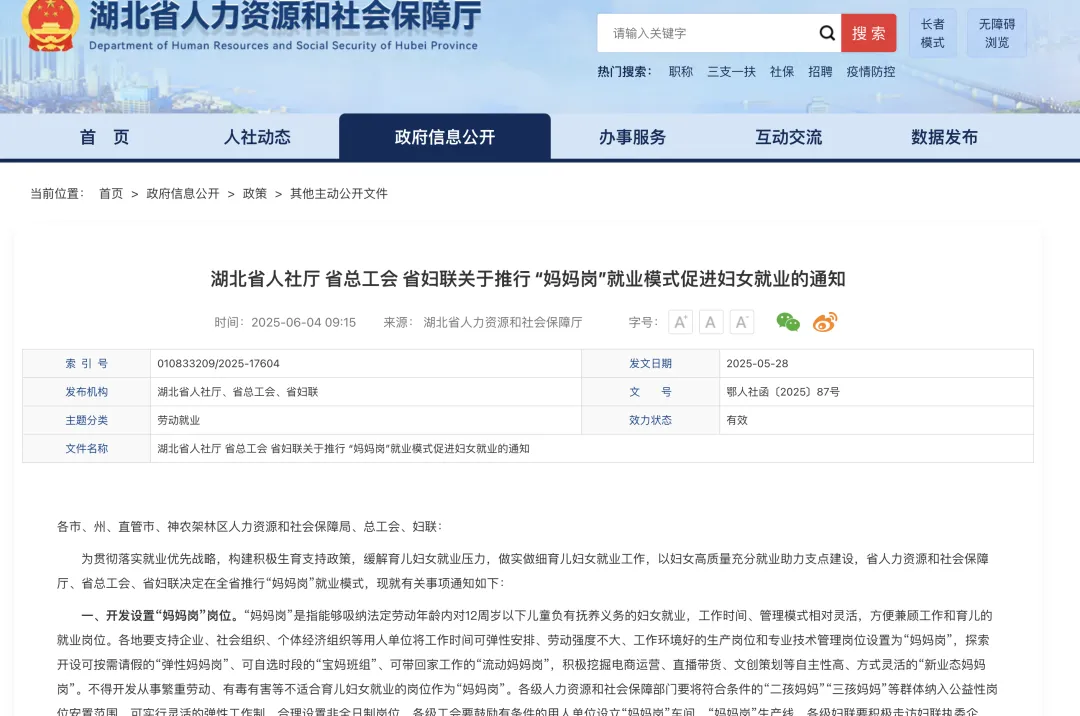
“妈妈岗”火了,已婚已育的职场女性更难了
Hu Xiu· 2025-06-24 01:37
Core Viewpoint - The emergence of "Mom Jobs" in China is a response to the increasing unemployment among women, particularly those with childcare responsibilities, but it raises concerns about gender discrimination and the quality of these job opportunities [3][42][52]. Group 1: Overview of "Mom Jobs" - "Mom Jobs" are designed for women with childcare responsibilities, offering flexible working hours to balance work and family [5][49]. - The concept gained attention after Hubei Province announced a policy to promote this employment model [3][4]. - The jobs are primarily found in labor-intensive sectors like home services, packaging, and customer service, often with low pay and limited benefits [47][49]. Group 2: Public Reaction and Criticism - Public opinion on "Mom Jobs" is polarized, with some viewing them as a necessary option for working mothers, while others criticize them as a form of disguised gender discrimination [6][7][52]. - Critics argue that these jobs exploit women's emotional needs and reinforce negative stereotypes about female workers [52][53]. Group 3: Challenges Faced by Women - Many women report difficulties in securing jobs due to biases against mothers, with employers often favoring candidates without childcare responsibilities [10][13][14]. - The pay for "Mom Jobs" is generally low, with many positions offering salaries that barely meet local minimum wage standards [23][27][31]. - Women often face additional challenges, such as lack of job security, inadequate training, and no opportunities for advancement [32][47]. Group 4: Societal Implications - The rise of "Mom Jobs" reflects broader societal issues, including inadequate childcare support and the pressures of modern parenting [39][40][42]. - Experts suggest that the focus should shift from creating low-quality jobs for mothers to implementing systemic changes that provide equitable employment opportunities for all caregivers [54][55].
国务院规范平台企业涉税报送,各类“小哥”家政人员不受影响
Di Yi Cai Jing· 2025-06-23 10:31
Core Viewpoint - The introduction of the "Regulations on Tax Information Reporting by Internet Platform Enterprises" aims to enhance tax fairness and optimize market order in China's platform economy, ensuring high-quality development [1]. Group 1: Tax Information Reporting Regulations - The regulations specify that the obligation to report tax information lies with internet platform enterprises, relieving individual operators and workers from any reporting duties [1]. - Certain scenarios are outlined where tax information does not need to be reported, including pre-regulation information, income of workers enjoying tax exemptions, and information already submitted for tax withholding [1]. - The regulations are designed to have no adverse impact on the daily work, income, and tax burden of various service workers, such as delivery personnel and domestic workers [1]. Group 2: Workforce and Income Tax Implications - Currently, there are nearly 100 million workers in China's platform economy, primarily engaged in delivery, transportation, and domestic services [2]. - According to existing personal income tax policies, platform workers with an annual income not exceeding 120,000 yuan are generally exempt from personal income tax, with most workers not liable for tax after deductions [2].
杭州市“商贸大师(名匠)”大讲堂第三期开讲
Hang Zhou Ri Bao· 2025-06-19 02:31
屋里咖啡以"产品+模式"双创新开辟办公室咖啡新场景,打造竞争优势;京东聚焦体验创新,以极 致物流体验构建护城河;AI技术创新,让服务业实现运营效能跃升……创新,是企业在竞争中脱颖而 出的有力手段。 6月18日,2025杭州市"商贸大师(名匠)"大讲堂第三期在杭州交投科创中心开讲。浙大管理学院 创新创业与战略学系副主任郑刚作为主讲嘉宾,以"创新者的逆袭——变革时代的创新思维与创新战 略"为题,向现场百余位商贸服务行业的人才及行业代表分享AI+时代下的创新思维。 杭州市"商贸大师(名匠)"大讲堂是杭州市培养商贸服务业技能人才、促进服务质量提升的重要途 径。学员们来自全市商贸服务领域,覆盖餐饮、零售、家政等多业态,授课教师则来自企业、高校、技 能大师工作室等,在提升学员单一技能的同时,全面锻炼和提升技能人才的综合素养。 市商务局相关负责人表示,大讲堂旨在弘扬工匠精神,传承大师技艺,同时帮助年轻技能人才开阔 视野、提升知识水平。类似活动会持续开展,为推动行业服务品质提升提供坚实的人才支撑。 郑刚结合具体案例,深入讲解了创新管理体系中的创新战略、创新流程、创新组织及创新制度与文 化。他表示,"当下环境中打造创新矩阵,需 ...