先进制造业

Search documents
镇江:多维发力落实国家重大战略 书写高质量发展答卷
Yang Zi Wan Bao Wang· 2025-11-11 09:30
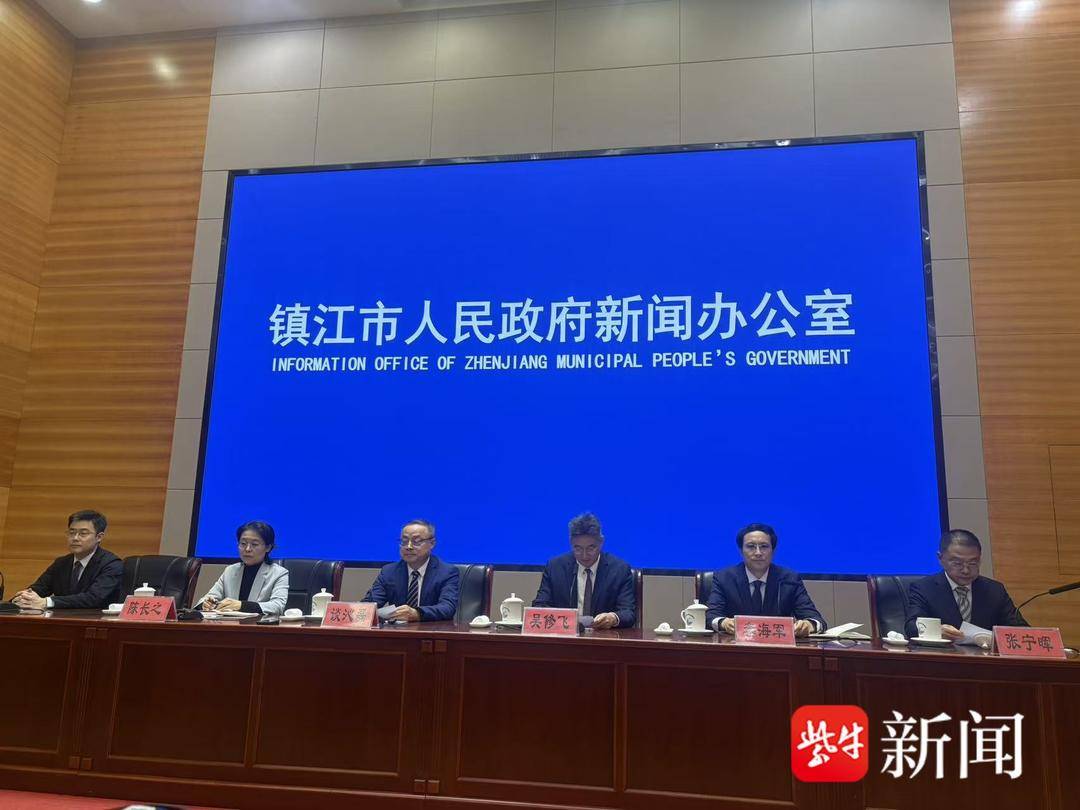
Core Viewpoint - Zhenjiang is actively integrating into national major development strategies, focusing on high-quality completion of the 14th Five-Year Plan through collaborative development, ecological protection, and open cooperation [1][3]. Group 1: Regional Coordination and Integration - Zhenjiang is advancing the integration of the Ning-Zhen-Yang area, focusing on the G312 industrial innovation corridor, enhancing transportation connectivity, and fostering industrial collaboration [4]. - The city has improved public services through shared educational and healthcare resources, achieving significant results in industrial cooperation with over 50% of new projects during the 14th Five-Year Plan period being linked to Ning-Zhen enterprises [4]. Group 2: Ecological Development - Zhenjiang has prioritized ecological civilization, achieving a PM2.5 annual average concentration of 35 micrograms per cubic meter by 2024, the best level recorded [5]. - The city has maintained a 100% rate of good water quality in surface water monitoring points for three consecutive years and has established a comprehensive ecological protection system [5]. Group 3: Transportation Infrastructure - The transportation sector in Zhenjiang is enhancing its modern comprehensive transportation system, with the port expected to handle 295 million tons of cargo by 2024, ranking among the top 20 ports in China [6][7]. - Significant improvements in road and rail networks have been made, including the completion of major highways and the development of rural transportation [7]. Group 4: Innovation and Economic Development - Zhenjiang ranks 100th globally in the 2025 Global Innovation Index, with a strong focus on cultivating specialized and innovative enterprises [8]. - The city has seen a trade volume of 42.37 billion yuan with Belt and Road countries from January to September, accounting for 51.7% of its total imports and exports [8]. Group 5: Support and Collaboration - Zhenjiang has invested 1.833 billion yuan in 353 support projects, fostering collaboration with regions like Tibet and Xinjiang, and creating significant employment opportunities [9]. - The city is leveraging its planning period to enhance regional collaboration, innovation, and public welfare, aiming to contribute more significantly to provincial development [9].

我省出台二十五条措施深化就业改革 事业单位招聘将放宽年龄限制
Si Chuan Ri Bao· 2025-11-09 01:12
Group 1 - The provincial government of Sichuan has introduced the "Implementation Opinions on Further Deepening Employment Reform to Promote High-Quality and Full Employment," outlining 25 specific measures across five key areas [1][2] - The focus is on establishing a "big employment" framework, enhancing employment support policies, and creating a modern human resources system [1][2] - Local government leaders will be held accountable for employment outcomes, with urban job creation and unemployment rates as key macroeconomic indicators [1][2] Group 2 - Sichuan aims to leverage market-oriented employment channels to create more job opportunities and promote coordinated economic and employment growth [2][3] - The government plans to support key industries such as artificial intelligence, healthcare, and advanced manufacturing to expand employment capacity [2][3] - Policies will be implemented to provide financial support, tax incentives, and subsidies to businesses that hire unemployed individuals, particularly targeting grassroots and private enterprises [2][3] Group 3 - Employment support for specific groups, including recent graduates and veterans, will be enhanced through simplified processes and incentives [3][4] - The government encourages flexible hiring practices and aims to create diverse job opportunities for older individuals [3][4] - A comprehensive labor service system will be established to support migrant workers and promote high-quality employment initiatives [4]
大河安澜 绿色蝶变——内蒙古彰显担当推动黄河流域高质量发展
Zhong Guo Fa Zhan Wang· 2025-11-07 07:35
Core Points - The article emphasizes the importance of protecting and managing the Yellow River for the high-quality development of the region, as highlighted by President Xi Jinping in 2019 [1] - Since the 14th Five-Year Plan, Inner Mongolia has implemented various policies for ecological protection and high-quality development in the Yellow River basin, establishing a closed-loop work mechanism to ensure accountability [1] - Significant progress has been made in ecological system protection, with 45% of the land in the Yellow River basin designated as ecological protection red lines and 25.35 million acres of desertification control completed [1] - Systematic governance of environmental pollution in the Yellow River basin has been strengthened, resulting in stable water quality at Class II level for five consecutive years, with 77.1% of national monitoring sections achieving Class I to III water quality by 2024 [1][2] Water Resource Management - A comprehensive water resource management system is being established, with a focus on deep water conservation actions and increasing the reuse of reclaimed water [2] - By 2024, water usage per unit of GDP and industrial added value in the Yellow River basin is expected to decrease by 37% and 42% respectively compared to 2020 [2] Flood Control and Economic Development - Key projects for flood control and soil erosion management have been implemented, with 3.16 million acres of soil erosion control completed and 2,426 kilometers of levees constructed [2] - The Yellow River basin has seen the development of renewable energy, with a total installed capacity of 87.3 million kilowatts, and the establishment of advanced manufacturing clusters in various cities [2] Cultural Heritage - Efforts are being made to protect, inherit, and promote Yellow River culture, including the establishment of the Yellow River National Cultural Park and the successful creation of a 5A scenic area at the Old Niuwan Yellow River Grand Canyon [2] Future Plans - Inner Mongolia plans to continue deepening reforms and implementing key tasks for ecological protection and high-quality development in the Yellow River basin during the 15th Five-Year Plan [3]
前三季度山东16市经济解读:“头号”压舱,凸显消费主引擎
Feng Huang Wang Cai Jing· 2025-11-06 08:23
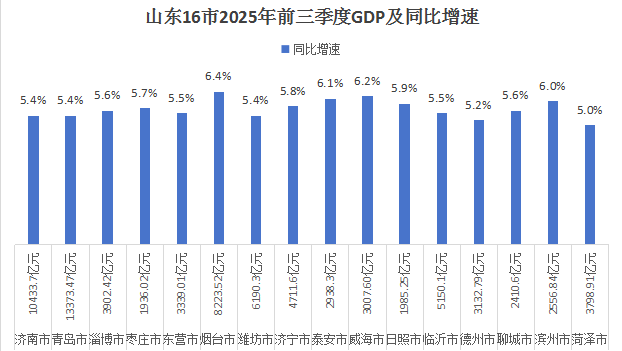
Economic Overview - Shandong's 16 cities reported stable economic performance in the first three quarters, with a provincial GDP growth rate of 5.6% [3] - Seven cities, including Yantai and Weihai, exceeded the provincial average growth rate, while two cities maintained parity with it [3] - Yantai leads the province in economic growth, with a GDP of 8223.52 billion yuan, growing by 6.4% year-on-year [4] Industrial Development - Shandong's industrial sector is a key driver, with industrial added value increasing by 7.8% year-on-year in the first three quarters, surpassing GDP growth [4] - Yantai's industrial added value grew by 13.9%, while Linyi aims for an industrial output exceeding 1 trillion yuan [4] - Zaozhuang has seen consistent economic growth since Q1 2022, attributed to the implementation of significant development plans [5][6] Consumption and Tourism - Cities like Binzhou and Rizhao have shown GDP growth rates exceeding the provincial average, driven by strong retail sales growth [9][10] - The retail sales in Rizhao reached 631.01 billion yuan, with significant increases in categories like home appliances and new energy vehicles [10] - The tourism sector is being developed as a pillar industry, with plans to attract 900 million tourists and generate over 1 trillion yuan in tourism revenue by 2024 [12] Private Economy - The private sector is increasingly significant, with Jinan's import and export volume surpassing 200 billion yuan, a 28% increase year-on-year [13] - In Zaozhuang, fixed asset investment grew by 5.4%, with private investment accounting for 58.8% of total investment [13] - Local governments are focusing on enhancing the business environment and supporting private enterprises to drive economic growth [14][15]
十五五”规划的产业体系建设之“变
Zheng Quan Shi Bao Wang· 2025-11-06 07:02
Core Viewpoint - The "15th Five-Year Plan" marks a strategic shift in China's industrial development, emphasizing the construction of a modern industrial system as a primary task, reflecting a transition from focusing on localized breakthroughs to establishing a resilient and open industrial ecosystem [1][2]. Strategic Positioning Changes - The "15th Five-Year Plan" elevates the construction of a modern industrial system to the top of its 12 strategic tasks, indicating a significant shift in national strategic focus [2]. - The plan aims to transition from being a participant in the global value chain to becoming a leader driving global industrial transformation [2]. Structural Design Changes - The plan establishes a modern industrial system centered on advanced manufacturing, moving beyond the previous principle-oriented approach to a more systematic framework [3]. - It emphasizes a gradient development mechanism that includes traditional, emerging, and future industries, ensuring a balanced industrial upgrade [3]. Dynamic Mechanism Changes - The economic development model shifts to "demand-led, consumption-driven, and endogenous growth," focusing on the interaction between supply and demand [4]. - The plan sets quantitative goals such as significantly increasing the resident consumption rate and aims to eliminate barriers to a unified national market [4]. Open Dimension Changes - The "15th Five-Year Plan" upgrades its approach to openness from merely aligning with international standards to actively leading institutional openness [6]. - It emphasizes the importance of participating in global governance and setting international standards in emerging fields like artificial intelligence and quantum technology [6]. Future Outlook - The plan aims to drive China's industrial transformation towards becoming a "strong manufacturing" and "strong creation" nation, focusing on intelligent, green, and integrated development [7].
合肥经开区全链条招才引智,推动人才生态提质增效
Zhong Guo Fa Zhan Wang· 2025-11-05 09:38
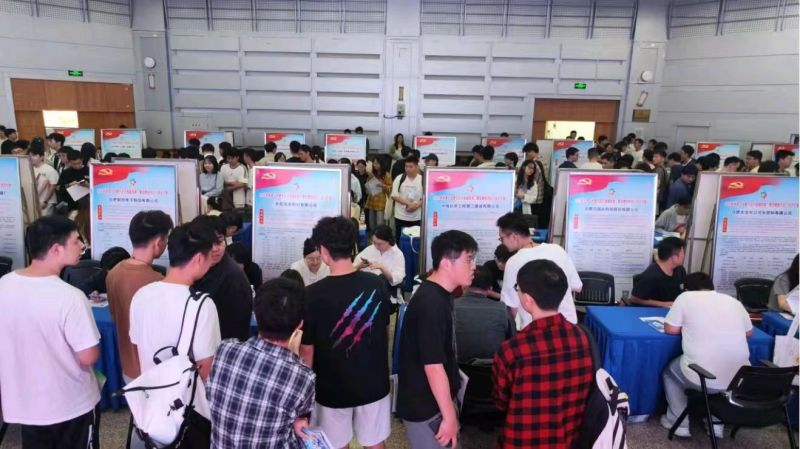
Group 1 - The core idea of the news is that Hefei Economic Development Zone is actively enhancing its talent acquisition strategies through various initiatives, including campus recruitment and international talent engagement [1][3][5][7][9] - The Hefei Economic Development Zone has organized 532 enterprises to connect with 27 universities across 10 cities, resulting in nearly 5,000 employment intentions, marking a successful start to the new academic year [1] - The zone has implemented a "3+6" industry system to create a multi-level talent recruitment framework, focusing on skilled, young, and overseas talents [1][9] Group 2 - The autumn campus recruitment event has strengthened the connection between local enterprises and universities, with tailored recruitment plans based on specific needs and academic strengths [1][5] - A total of 15 "Recruit and Train" events have been conducted this year, establishing stable partnerships between 11 key enterprises and 19 vocational schools, resulting in 1,348 skilled talents entering local companies [5] - The first Global Talent Cloud Recruitment Fair attracted nearly 1,000 participants, with 78% holding master's degrees or higher, focusing on high-level talent in cutting-edge fields such as AI and biomedicine [3] Group 3 - The Hefei Economic Development Zone has set up a "Talent Service Zone" during recruitment events to provide one-stop services for graduates, enhancing the overall talent experience [7] - The zone has organized seven brand activities this year to enrich talent services, fostering a comprehensive support system that enhances the sense of belonging for talents [7] - Future plans include further expanding talent acquisition channels and optimizing the talent service ecosystem to attract more domestic and international talents [9]
最新公开!GDP30强城市更新:成都不敌苏州,合肥退至18,唐山29
Sou Hu Cai Jing· 2025-11-04 18:55
Core Insights - China's economic landscape is undergoing a new round of urban momentum transformation, with the latest GDP rankings revealing significant shifts among cities [1] - The competition among cities reflects accelerated economic layouts and the restructuring of industrial competitiveness [1] Group 1: GDP Rankings and Growth - Shanghai, Beijing, and Shenzhen occupy the top three positions in the GDP rankings, with growth increments of 633.19 billion and 495.39 billion respectively [9] - Suzhou ranks sixth with a GDP of 19,930.21 billion, driven by a leading advanced manufacturing cluster [3] - Chengdu's GDP reached 18,226.90 billion, showing a growth increment of 1,492.72 billion, highlighting its robust economic potential [3][9] Group 2: Industrial Strengths - Suzhou's core advantage lies in its advanced manufacturing sectors, including electronics and high-end equipment, with output exceeding 1 trillion [3] - Chengdu's retail sector, particularly the "first store economy," is thriving, with daily foot traffic in the Taikoo Li shopping district surpassing 300,000 [3] - Hefei's investment in R&D has reached 3.85%, focusing on cutting-edge technologies like quantum information and fusion energy [5] Group 3: Emerging Cities and Innovations - Hefei has seen significant advancements in new energy vehicles, with its urban cluster producing over 2,000 billion in output [5] - Tangshan, ranked 29th with a GDP of 6,707.20 billion, is transitioning from traditional steel production to high-value specialty steel [7][10] - The city of Tangshan is also enhancing its logistics capabilities, with its port ranking second globally in cargo throughput [8] Group 4: Economic Connectivity - The "Belt and Road" initiative is being leveraged by cities like Hefei to enhance technological trade corridors, with a 30% annual growth in the operation of China-Europe freight trains [5] - The Beijing-Tianjin-Tangshan area is developing into a new economic growth hub, supported by over 400 industrial transfer projects [8]
“十五五”国资改革重点明确:加强战略重组,推动科技创新
Di Yi Cai Jing· 2025-11-04 13:27
Core Insights - The Chinese government emphasizes the importance of nurturing emerging industries and optimizing the structure of state-owned enterprises (SOEs) to drive economic growth during the 14th Five-Year Plan period [1][4][6] Group 1: Economic Strategy and Development - The State-owned Assets Supervision and Administration Commission (SASAC) aims to enhance the vitality of various business entities as a key task for the next five years [1] - The focus will be on optimizing the layout and structure of state-owned economies, with an emphasis on strategic and professional restructuring to avoid redundant construction and disorderly competition [1][6] - The "14th Five-Year Plan" period saw a significant investment growth in strategic emerging industries, with an annual increase of over 20% in investments from central enterprises [4][5] Group 2: Innovation and Technology - The government encourages SOEs to strengthen their role as innovation entities, promoting the integration of innovation resources and enhancing the overall innovation capability [4][5][8] - There is a push for the development of high-tech industries such as new information technology, new energy, and high-end equipment, which are expected to drive significant economic impact [4][5][9] Group 3: Structural Reform and Optimization - The "15th Five-Year Plan" outlines the need for deeper reforms in SOEs, focusing on enhancing core functions and competitiveness [6][7] - The restructuring efforts include merging similar enterprises to improve efficiency and reduce competition, while also enhancing the resilience and competitiveness of industrial chains [8][9] - The SASAC reported that over 70% of the revenue from central enterprises is generated in sectors critical to national security and the economy [7]
浙江5城霸榜长三角增速榜,江苏失落
21世纪经济报道· 2025-11-04 05:59
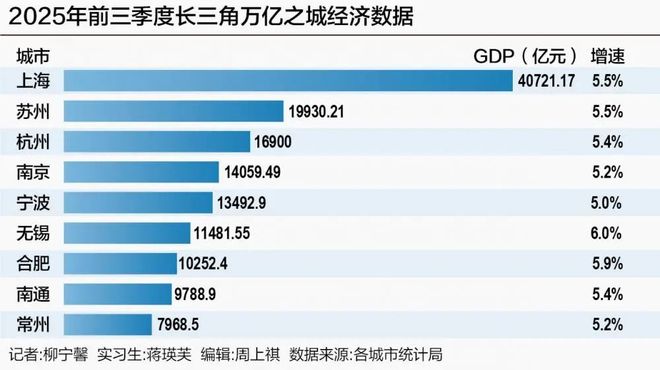
Core Viewpoint - The economic performance of the Yangtze River Delta (YRD) region is strong, with a GDP contribution of approximately 25% to the national total, driven by advanced manufacturing and a recovering consumer market [1][3]. Economic Growth - In the first three quarters, the total GDP of Jiangsu, Zhejiang, Shanghai, and Anhui reached 251,797.17 billion yuan, with 30 out of 41 cities in the YRD outpacing the national average growth rate of 5.2% [1][3]. - Zhejiang led the growth with a GDP increase of 5.7%, followed by Shanghai (5.5%), Jiangsu (5.4%), and Anhui (5.4%) [3][4]. - Jiangsu's GDP totaled 102,811 billion yuan, making it the largest in the YRD, while Zhejiang and Shanghai followed with 68,495 billion yuan and 40,721.17 billion yuan, respectively [3][4]. Advanced Manufacturing - Advanced manufacturing is a key driver of Jiangsu's economic stability, with significant contributions to GDP growth and risk resilience [3][4]. - In Shanghai, the AI and integrated circuit sectors saw double-digit growth, while Jiangsu's high-tech manufacturing also maintained strong growth rates [1][8]. - Anhui's high-tech manufacturing value added increased by 27.8%, showcasing its emerging advantages [1][8]. Consumer Market Recovery - The consumer market in the YRD is steadily recovering, with policies like "old-for-new" driving sales in appliances, automobiles, and electronics [1][10]. - Jiangsu's retail sales growth was supported by local sports events, with a 13% increase in sports service revenue [10][12]. - Zhejiang's retail sales growth of 5.2% was bolstered by events like the Wuzhen Theatre Festival and other local activities [9][11]. Structural Changes in Consumption - The integration of digital economy and consumer scenarios in Zhejiang has enhanced consumption, with innovations in e-commerce and payment systems [11]. - The "Su Chao effect" has strengthened regional consumption collaboration, encouraging cities to leverage their unique characteristics for enhanced consumer engagement [12].
浙江5城霸榜长三角增速榜,江苏失落
2 1 Shi Ji Jing Ji Bao Dao· 2025-11-04 05:47
Core Insights - The Yangtze River Delta (YRD) region accounts for approximately 25% of China's GDP, with significant new industrial momentum and consumer potential emerging [1] - In the first three quarters of this year, 31 out of 41 cities in the YRD outpaced the national average GDP growth rate of 5.2%, with 14 cities exceeding 6% [1][5] - The economic structure of the YRD continues to optimize, with advanced manufacturing playing a crucial role in supporting growth [1][12] Economic Performance - The total GDP of Jiangsu, Zhejiang, Shanghai, and Anhui reached 251,797.17 billion yuan, with Jiangsu leading at 102,811 billion yuan, followed by Zhejiang at 68,495 billion yuan, and Shanghai at 40,721.17 billion yuan [5][9] - The cities with GDP exceeding 1 trillion yuan include Shanghai, Suzhou, Hangzhou, Nanjing, Ningbo, Wuxi, and Hefei [9] Manufacturing and Innovation - Advanced manufacturing is a key driver of economic growth in the YRD, with Shanghai's AI and integrated circuit sectors showing double-digit growth [1][12] - Jiangsu's high-tech manufacturing and digital core product manufacturing also maintained double-digit growth, with a notable 27.8% increase in Anhui's high-tech manufacturing value added [1][12] Consumer Market Dynamics - The consumer market in the YRD is steadily recovering, with policies like "old-for-new" driving consumption in sectors such as home appliances and automobiles [13][14] - Jiangsu's local sports events, such as "Su Chao," have significantly boosted sports and cultural tourism consumption, with a 13.0% increase in sports service revenue [13][15] Regional Economic Strategies - Zhejiang is leveraging its strong manufacturing base and innovative capabilities to transform traditional industries, focusing on digital empowerment and new business models [6][8] - The integration of manufacturing and service sectors in Jiangsu is creating a dual-driven growth model, enhancing both product supply and service innovation [13][15]