智能汽车

Search documents
小鹏汽车获L3级自动驾驶道路测试牌照,有望下季度全量上车
Xin Lang Cai Jing· 2025-12-16 09:26
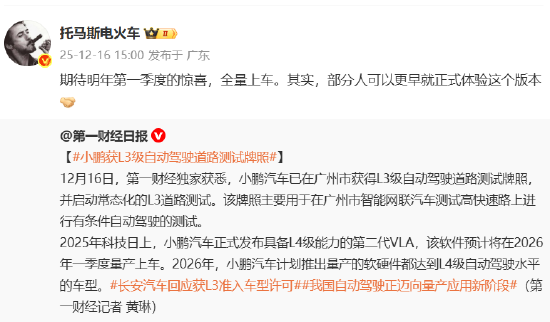
12月16日,据报道,小鹏汽车已在广州市获得 L3 级自动驾驶道路测试牌照,并启动常态化的 L3 道路 测试。 小鹏汽车副总裁 @托马斯电火车 今日发文透露:"期待明年第一季度的惊喜,全量上车。其实,部分人 可以更早就正式体验这个版本。" 责任编辑:李昂 12月16日,据报道,小鹏汽车已在广州市获得 L3 级自动驾驶道路测试牌照,并启动常态化的 L3 道路 测试。 小鹏汽车副总裁 @托马斯电火车 今日发文透露:"期待明年第一季度的惊喜,全量上车。其实,部分人 可以更早就正式体验这个版本。" 责任编辑:李昂 ...

大和:升地平线机器人-W目标价至11.8港元 重申“买入”评级
Zhi Tong Cai Jing· 2025-12-16 07:33
大和发布研报称,地平线机器人-W(09660)计划自明年起为大众市场车款配备城市领航辅助驾驶 (NOA),并发布第四代BPU架构;且业务拓展至人形机器人。该行重申予该股"买入"评级,目标价由原先 10.5港元上调至11.8港元;又相信公司已建立良好的产品组合,能进一步拓展中国城市NOA市场。 大和表示,地平线致力于推动智能汽车技术普及化,使城市NOA功能惠及大众市场车辆;预计到2025年 底,中国乘用车L2+、L2++级ADAS渗透率将达到20%,2026年进一步提升至28%,而L3级自动驾驶预 计将从2026年起主要于高端车型中出现。 ...

大和:升地平线机器人-W(09660)目标价至11.8港元 重申“买入”评级
Zhi Tong Cai Jing· 2025-12-16 07:32
Core Viewpoint - Daiwa has released a report indicating that Horizon Robotics (09660) plans to equip mass-market vehicles with City Navigation Assistance (NOA) starting next year and has launched its fourth-generation BPU architecture, while also expanding into humanoid robots. The firm maintains a "Buy" rating on the stock, raising the target price from HKD 10.5 to HKD 11.8, believing the company has established a strong product portfolio to further penetrate the Chinese urban NOA market [1] Group 1 - Horizon Robotics is committed to promoting the popularization of smart automotive technology, making urban NOA features accessible to mass-market vehicles [1] - It is expected that by the end of 2025, the penetration rate of L2+ and L2++ level ADAS in China's passenger cars will reach 20%, increasing to 28% in 2026 [1] - L3 level autonomous driving is anticipated to primarily appear in high-end models starting from 2026 [1]
这次L3放行,比想象中更克制
阿尔法工场研究院· 2025-12-16 05:23
Core Viewpoint - The issuance of conditional permits for L3 autonomous driving vehicles marks a significant milestone, transitioning the technology from testing phases to formal product approval, benefiting the entire automotive and related industries [2][5][14]. Industry Impact - The approval of L3 autonomous driving not only affects the automotive sector but also positively impacts the chip and perception hardware supply chains, indicating a new watershed moment for the smart vehicle industry [3][14]. - The L3 autonomous driving vehicles from Changan and Arcfox are subject to strict operational conditions, including specific road types, urban areas, and speed limits, reflecting a cautious regulatory approach [5][6]. Policy Development - The path to L3 autonomous driving's "licensed operation" has been a gradual process over three years, beginning with the Ministry of Industry and Information Technology's (MIIT) 2022 notice on smart connected vehicle access management [8][9]. - The MIIT's recent guidelines emphasize the need for a joint application from automotive manufacturers and operational entities, ensuring safety monitoring and data management capabilities [8][9]. Corporate Strategies - Major automotive companies have accelerated their timelines for L3 autonomous driving, with Changan aiming for full-scene L3 by 2026 and GAC planning to launch its first L3 vehicle by late 2025 [10]. - Different companies are exploring various technological paths, with some focusing on sensor fusion and others on algorithmic advancements, highlighting the ongoing exploration in L3 technology [11]. Technical Requirements - L3 autonomous driving systems require advanced hardware capabilities, including multi-sensor integration and high-reliability computing systems, which are driving demand for specific components in the supply chain [13]. - Key players in the sensor and chip markets, such as OmniVision and Hesai Technology, are expected to see increased order stability as L3 technology scales [13]. Regulatory and Legal Considerations - The main challenges to L3 deployment are not technological but rather legal responsibilities and infrastructure readiness, necessitating adjustments in regulations and insurance frameworks [12]. - The cautious approach to L3 implementation aims to gather real-world operational data to inform future regulatory developments [12].


L3级自动驾驶来了,智能车ETF(159888)逆市上涨,索菱股份等多股涨停
Mei Ri Jing Ji Xin Wen· 2025-12-16 03:27
Core Viewpoint - The A-share market experienced a collective decline, while sectors related to intelligent driving and connected vehicles saw gains, indicating a potential shift towards the commercialization of L3 autonomous driving technology in China [1]. Group 1: Market Performance - On December 6, the three major A-share indices fell collectively, but sectors such as vehicle-road collaboration, intelligent driving, intelligent transportation, and vehicle networking rose against the trend [1]. - The Intelligent Vehicle ETF (159888) increased by 0.91%, with stocks like Wanjie Technology, Zhejiang Sebao, and Suoling Co. hitting the daily limit [1]. - Haon Electric surged over 12%, and Guangting Information rose more than 8% [1]. Group 2: Regulatory Developments - The Ministry of Industry and Information Technology announced the first batch of L3 conditional autonomous driving vehicle permits on December 15, marking a significant step from testing to commercial application in China [1]. - The approval of L3 vehicles indicates progress in both technology and policy, laying a foundation for future commercialization of intelligent driving [1]. Group 3: Future Outlook - According to Ping An Securities, the transition to mass production of autonomous driving technology is underway, although the current operational conditions for approved L3 models have many restrictions [1]. - The commercialization process for intelligent driving is expected to accelerate by 2026, with the potential for a complete commercial loop to be established [1].

2026年汽车智能化投资策略
2025-12-16 03:26
Summary of Conference Call Records Industry Overview - The conference call discusses the **smart automotive industry**, focusing on the evolution of autonomous driving technologies and investment strategies from 2026 to 2030 [1][2][4][7]. Key Points and Arguments Industry Development Stages - The smart automotive industry has undergone several key phases: - **2014-2017**: Initial phase focusing on L1 to early L2 technologies, primarily using low-cost monocular cameras for features like AEB, ACC, and LCC. Companies like Mobike were prominent during this period [2]. - **2018-2019**: A downturn where many companies exited the market due to supply chain and demand changes [2]. - **2020-2023**: Peak phase focusing on L2++ technologies, driven by the electric vehicle (EV) boom, with Tesla leading the innovation [2]. - **2023-2025**: Shift towards software and algorithm innovations, moving away from hardware-centric approaches [2][7]. Future Predictions (2026-2030) - The industry is expected to experience three distinct phases: - **2025-2026**: A "dark period" before dawn, where the electric vehicle boom fades, but significant investments are needed [1][11]. - **2026-2028**: Optimal investment period where L4 technology will validate B2B business models, leading to the emergence of new autonomous vehicle companies [1][11]. - **2028-2030**: A resurgence in the C-end market as early EV adopters seek replacements, driving demand and technological innovation [1][11]. Investment Strategy - Future investment strategies should pivot from electric vehicle frameworks to focus on AI applications, emphasizing software over hardware as the market matures [1][8][10]. Key Technologies and Trends - The importance of software algorithms is surpassing that of hardware, with advancements in large language models significantly impacting the automotive sector [1][12]. - The cost of both hardware and software is expected to decline rapidly, aligning with Moore's Law, which will further drive industry growth [5]. Market Dynamics - The **Robotaxi** segment is highlighted as having the highest potential, with expected penetration rates of 10% by 2028 and 50% by 2035 [3][24]. - The autonomous vehicle market is projected to see significant growth in commercial applications, with estimates of 500,000 autonomous commercial vehicles by 2028, increasing to 1.5 million by 2030 [23][26]. Policy and Technology Interaction - While policy has historically driven the electric vehicle market, the focus is shifting to technological advancements as the primary growth driver for autonomous vehicles [10][12][16]. Other Important Insights - The acceptance of autonomous vehicles by consumers is crucial for market growth, with companies like Xiaoma Zhixing and Waymo focusing on L4 development while others like Tesla and XPeng validate algorithms through consumer experiences [20]. - The upcoming year (2026) is expected to be pivotal for L4 technology, with significant market impacts anticipated as consumers begin to understand and accept the concept of not driving themselves [4][6]. - The differences between the US and Chinese markets in terms of labor costs and consumer acceptance are noted, with China potentially adapting to and promoting autonomous technology more rapidly [25]. This summary encapsulates the key insights and projections regarding the smart automotive industry and its trajectory over the next several years, emphasizing the shift towards software and AI applications in autonomous driving technologies.
2026促消费,从“增收”发力 | 聚焦中央经济工作会
Sou Hu Cai Jing· 2025-12-16 01:17
Core Insights - The 2025 Central Economic Work Conference emphasizes "domestic demand as the main driver" and "prioritizing people's livelihoods" as key tasks for the upcoming year, aligning with the long-term goals of enhancing consumer capacity and improving the social security system outlined in the 15th Five-Year Plan [2] Income Growth - The conference introduces a plan to increase income for urban and rural residents, marking a shift from short-term consumption stimulation to long-term income structure improvement, with a focus on synchronizing income growth with economic growth and labor remuneration with productivity [3] - The income growth plan targets various groups, including college graduates and migrant workers, aiming to stabilize employment and income through job retention and quality enhancement actions [3] - Policies will also address the income of flexible workers like delivery personnel by improving their social security mechanisms, thereby alleviating their concerns about spending [3] Supply Expansion - The conference prioritizes domestic demand and proposes actions to boost consumption by expanding the supply of quality goods and services [6] - There is a focus on upgrading consumer goods from basic to high-quality products, with policies aimed at promoting the iteration of popular items like smartphones and smart home devices [8] - The initiative includes expanding the scope of trade-in policies to cover various categories, enhancing the adaptability of supply to meet consumer needs [8] Investment Promotion - Investment is highlighted as a crucial lever for expanding domestic demand, with the conference calling for measures to stabilize and invigorate private investment [11] - The conference acknowledges a 1.7% year-on-year decline in fixed asset investment in the first ten months of the year, while emphasizing the need for structural optimization in investment, particularly in high-tech sectors [11] - The government aims to create a stable and predictable environment for private investment by addressing barriers and expanding access [13] Consumption Environment Improvement - The conference outlines measures to eliminate unreasonable restrictions in the consumption sector, aligning with the goal of building a unified national market [14] - Policies will encourage the development of new consumption formats such as digital and green consumption, enhancing the management of emerging consumption models [16] - The initiative includes the establishment of a national unified market construction regulation to improve market order and protect consumer rights, fostering a more favorable consumption environment [16]

华为靳玉志:L2 级辅助驾驶渗透率提升至 50% 仅用五年时间,智能驾驶正快速迭代
Xin Lang Cai Jing· 2025-12-15 13:44
靳玉志在接受采访时谈及了汽车智能化发展的态势,他表示汽车智能化正在加速,数据显示,新能源的渗透率做到 50% 花了十年的时间(2014 年-2024 年);新能源汽车的 L2 辅助驾驶系统渗透率做到 50%,其实只用了五年时间,智能驾驶(辅助驾驶)的智能化正快速迭代。 靳玉志还透露,华为乾崑智驾从 ADS 1 到 ADS 4,每一代用户量都在快速增长。截至 10 月底,累计辅助驾驶里程突破 58 亿公里,"车位到车位"智驾使用 次数也超 2000 万次,泊车辅助功能次数更达 3.5 亿次。值得一提的是,华为乾崑智驾月活跃用户比例超 95%,意味着几乎所有车主都在使用。 据IT之家此前报道,本月初,华为乾崑智能汽车解决方案公布数据:华为乾崑伙伴品牌 11 月总销量超 18 万台,环比增长 80%。而在 11 月 20 日晚的华为乾 崑生态大会上,华为智能汽车解决方案 BU CEO 靳玉志宣布:华为乾崑智驾 ADS 的 33 款合作车型月销量破 10 万,创历史新高。 IT之家 12 月 15 日消息,华为乾崑智能汽车解决方案今日发布了华为智能汽车解决方案 BU CEO 靳玉志接受新华网采访的视频。 靳玉志在接受 ...

程实:每一代人都有自己的Labubu︱实话世经
Di Yi Cai Jing· 2025-12-15 12:46
Core Insights - The rise of Labubu is not coincidental but a result of generational aesthetics, emotional symbols, and identity expression [1][2] - The "Implementation Plan" provides a systematic framework for the new demand and supply dynamics, emphasizing the importance of capturing emotional trends and creating a sustainable supply chain [1][2][10] Generational Symbols - Each generation has its own Labubu, representing the spirit of the times, from Transformers for the 70s to digital IPs for Gen Z [2] - The changing emotional structures reflect new consumer demands in China, with the "Implementation Plan" targeting three trillion-level and ten hundred-billion-level consumption hotspots [2][4] New Consumption Trends - Future consumption is shifting from purchasing goods to subscribing to lifestyles, driven by demographic segmentation and interest-oriented consumption [3] - Changes in consumption dimensions include spatial (from traditional malls to immersive experiences), temporal (from one-time purchases to long-term relationships), and relational (from buyers to co-creators) [3] New Demand Dynamics - The demand for new products is shaped by collective choices across generations, with emotional needs such as identity recognition, emotional healing, and self-narrative being crucial [4][5] - The children's market is evolving towards cognitive development and emotional growth, while the elderly market is shifting from passive care to active quality of life improvements [6][5] New Supply Strategies - New supply-side structural reforms focus on leveraging technology and new models for precise supply-demand matching [7] - Flexible production and rapid iteration are becoming standard, with the ability to quickly respond to new consumer trends [7][8] Investment Opportunities - The investment landscape is becoming clearer with three trillion-level sectors (elderly products, smart vehicles, consumer electronics) and ten hundred-billion-level sectors (trendy toys, outdoor products, etc.) identified [9] - Key investment criteria include addressing unique emotional needs, having a sustainable supply system, and aligning with national strategic directions [9][10]
陈伟GTC2024讲MindGPT压缩版/视频版/图文版
理想TOP2· 2025-12-15 12:02
Core Viewpoint - The article discusses the advancements in the development of MindGPT, a multimodal cognitive model designed to enhance human-machine interaction in smart vehicles, emphasizing its capabilities in perception, understanding, and interaction [2][20][39]. Group 1: Technology and Model Architecture - MindGPT is built on a self-developed TaskFormer structure, which has been recognized for its performance in industry evaluations [2][35]. - The model incorporates multimodal perception capabilities, allowing it to process audio and visual data simultaneously, enhancing user interaction through features like voice recognition and gesture control [29][30]. - The architecture supports a complete agent capability, integrating perception, planning, memory, tools, and action [35][36]. Group 2: Training and Performance - The training strategy focuses on 15 key areas relevant to in-car scenarios, utilizing self-supervised learning and reinforcement learning from human feedback (RLHF) to cover over 110 domains and 1,000 specialized capabilities [3][35]. - The training platform, Li-PTM, achieves training speeds that are significantly faster than industry standards, with SFT phase speeds over three times better than the best open-source capabilities [46][47]. - The model's inference engine, LisaRT-LLM, has been optimized for performance, achieving a throughput increase of over 1.3 times compared to previous models under high concurrency [5][53]. Group 3: User Interaction and Experience - MindGPT aims to create a natural interaction experience by allowing users to communicate with the vehicle using simple commands and gestures, reducing the complexity of user input [10][32]. - The system is designed to understand and remember user preferences, providing personalized interactions based on historical conversations [36][39]. - The integration of advanced AI technologies aims to enhance emotional connections between users and their vehicles, creating a more immersive experience [14][18].