
造船

Search documents
紧扣合理增速区间 多措并举释放发展潜能
Zheng Quan Shi Bao· 2025-10-29 18:39
Group 1 - The "15th Five-Year Plan" outlines seven major development goals for China's economic and social development, including high-quality development and technological self-reliance [2][3] - The average annual GDP growth rate is projected to be around 4.8% in real terms and at least 5% in nominal terms during the "15th Five-Year Plan" period [1][4] - The plan emphasizes the need to maintain economic growth within a reasonable range to ensure progress towards modernization and improve living standards [2][5] Group 2 - The plan aims to achieve significant improvements in high-quality development, with a focus on enhancing the level of technological self-reliance and deepening reforms [2][6] - The potential GDP growth rate is estimated to be between 4.5% and 5.3%, with optimistic scenarios suggesting it could rise to between 5.1% and 5.8% [3][4] - The plan highlights the importance of fostering new productive forces and transitioning to an innovation-driven growth model, particularly in digital and green industries [5][6] Group 3 - The plan anticipates the creation of approximately 10 trillion yuan in new market space over the next five years, driven by advancements in various sectors such as quantum technology and advanced manufacturing [6] - The emphasis on consumer spending is expected to lead to quantifiable targets for consumption promotion [6] - The plan aims to leverage China's institutional advantages, large market size, complete industrial system, and rich talent resources to achieve high-quality development [6]
2025金融街论坛|黄奇帆:生产性服务业是民营企业发展新赛道
Bei Jing Shang Bao· 2025-10-29 15:41
Core Insights - China's manufacturing industry has achieved "five leading and five parallel" sectors, with automotive, shipbuilding, power equipment, high-speed rail equipment, and new energy equipment leading globally, while new materials, biomedicine, high-end equipment, aerospace, and artificial intelligence are on par with developed countries [1] Group 1: Manufacturing Sector - The global share of China's manufacturing industry has reached 32% [1] - The leading sectors are automotive, shipbuilding, power equipment, high-speed rail equipment, and new energy equipment [1] - The parallel sectors include new materials, biomedicine, high-end equipment, aerospace, and artificial intelligence [1] Group 2: Service Industry - The productive service industry encompasses ten categories: R&D, logistics, inspection and testing, finance, green low-carbon, digitalization, trade, intellectual property, professional consulting, and human resources [1] - This sector is identified as a growth driver for GDP, unicorn cultivation, service trade enhancement, and total factor productivity [1] - There is a call for private enterprises to expand into the productive service industry to alleviate manufacturing competition, create job opportunities for graduates, and revitalize office resources [1]

“十五五”产业趋势三大关键定调:巩固传统优势,决胜新兴未来
2 1 Shi Ji Jing Ji Bao Dao· 2025-10-29 14:08
Core Insights - The article discusses the key directives outlined in the "15th Five-Year Plan" for China's economic and social development, emphasizing the importance of modernizing the industrial system and strengthening the real economy as a strategic priority [1][4]. Group 1: Traditional Industries - The plan prioritizes the optimization and enhancement of traditional industries such as mining, metallurgy, chemicals, light industry, textiles, machinery, shipbuilding, and construction, aiming to improve their global competitiveness and position in the international division of labor [1][5]. - Traditional industries account for approximately 80% of the added value in China's manufacturing sector, highlighting their foundational role in economic stability and growth [4]. - The focus on upgrading traditional industries is seen as a response to the ongoing global industrial restructuring, with an emphasis on transitioning from cost advantages to systemic advantages in the global market [5][6]. Group 2: Emerging and Future Industries - The plan aims to cultivate new pillar industries with global competitiveness, particularly in sectors like new energy, new materials, aerospace, and the newly introduced low-altitude economy [8][9]. - The low-altitude economy is expected to unlock a trillion-yuan market, driven by advancements in technology and significant demand across various applications [9][10]. - Future industries such as quantum technology, biomanufacturing, hydrogen energy, and brain-computer interfaces are identified as new economic growth points, with projections indicating substantial market potential in the coming years [10][11]. Group 3: Service Industry Development - The plan emphasizes the need for high-quality development in the service sector, particularly in productive services, which currently account for about 30% of GDP, indicating room for growth compared to developed economies [12][13]. - Initiatives to enhance the integration of modern services with advanced manufacturing and agriculture are expected to create new market opportunities and improve overall economic efficiency [13][14]. - The construction of a modern infrastructure system is also highlighted, with a focus on new types of infrastructure that support the digital economy and enhance connectivity across regions [14].
韩美就关税具体内容达成协议 汽车关税将降至15%
Zhong Guo Ji Jin Bao· 2025-10-29 12:30
Core Points - The US and South Korea have reached an agreement on tariffs, with auto tariffs set to decrease to 15% from the previous 25% [2][5] - South Korea will invest $350 billion in the US, with $200 billion paid in installments and $150 billion allocated for shipbuilding [2][3] - A special purpose company will be established for US investment projects, focusing on commercially viable initiatives [2][6] Tariff Agreement - The US will maintain a 15% tariff on South Korean goods, while auto tariffs will be reduced to 15% [2] - The agreement aims to improve the trade environment for South Korean companies [2] Investment Details - South Korea's investment will be phased, rather than a one-time payment, with profits shared 50:50 before recovering initial investments [2][3] - The maximum annual funding provided to the US by South Korea is set at $20 billion [2] Bilateral Cooperation - The leaders of both countries expressed a commitment to expand economic cooperation centered around the shipbuilding industry [6] - South Korea aims to support US manufacturing revitalization through increased investments and imports [6] Defense and Security - Discussions included the importance of defense industrial cooperation, with South Korea requesting nuclear submarine fuel supplies [6] - The agreement is expected to alleviate some defense responsibilities for the US military in the region [6] Diplomatic Relations - South Korean President Lee Jae-myung awarded US President Trump the highest honor, the Order of Mugunghwa, highlighting the close relationship between the two leaders [7]

突发!关税大消息!
中国基金报· 2025-10-29 11:51
Core Points - The core agreement between South Korea and the United States involves a reduction of automobile tariffs to 15% and a commitment from South Korea to invest $350 billion in the U.S. over time [3][5][6]. Group 1: Tariff Agreement - South Korea and the U.S. have reached an agreement where the automobile tariff will be reduced to 15%, down from the previous 25% [5][6]. - The U.S. will continue to impose a 15% tariff on South Korean goods overall [5]. Group 2: Investment Commitments - South Korea will invest $350 billion in the U.S., with $200 billion to be paid in installments and $150 billion allocated for shipbuilding [5][6]. - The investment will be phased rather than a one-time payment, and profits will be shared equally (50:50) before the initial investment is recouped [5][6]. Group 3: Bilateral Cooperation - The leaders of South Korea and the U.S. expressed a commitment to expand economic cooperation centered around the shipbuilding industry [11]. - Discussions included the importance of national security and the potential for the U.S. to supply nuclear submarine fuel to South Korea, which would allow South Korea to build conventional submarines [12]. Group 4: Diplomatic Relations - The meeting between South Korean President Lee Jae-myung and U.S. President Trump was described as very successful, with both leaders emphasizing the strengthening of the U.S.-South Korea alliance [9][11]. - President Trump was awarded South Korea's highest honor, the Order of Mugunghwa, highlighting the close relationship between the two leaders [12].

韩美敲定贸易协议:韩国承诺3500亿美元对美投资,换取汽车15%关税、半导体产业关税优待
Hua Er Jie Jian Wen· 2025-10-29 11:19
Core Points - The US and South Korea have reached an agreement on specific terms of a trade deal, including a commitment from South Korea to invest $350 billion in the US [1][2] - The investment plan consists of $200 billion in cash investments, with an annual cap of $20 billion, and an additional $150 billion allocated for shipbuilding projects [2] - The agreement maintains a 15% tariff on automotive parts and ensures that semiconductor tariffs will not disadvantage South Korea [1][2][3] Investment Commitments - South Korea's $350 billion investment will be executed in two phases, with $200 billion as cash investments and $150 billion for shipbuilding [2] - The investment commitments are expected to be finalized by January 2029 [2] - This investment strategy mirrors a previous agreement between the US and Japan, indicating a consistent approach by the Trump administration towards major Asian economies [2] Tariff Arrangements - The US will maintain a 15% overall tariff level, with both countries agreeing on the same tariff rate for automotive parts [1][3] - South Korea has secured the most-favored-nation status for pharmaceutical tariffs, which is a significant advantage [3] - In the agricultural sector, South Korea successfully resisted demands for further market opening, particularly concerning rice and beef [2]
韩股今年来飙升70%冠绝全球,小摩上调目标:未来一年再涨至少20%
Feng Huang Wang· 2025-10-29 06:24
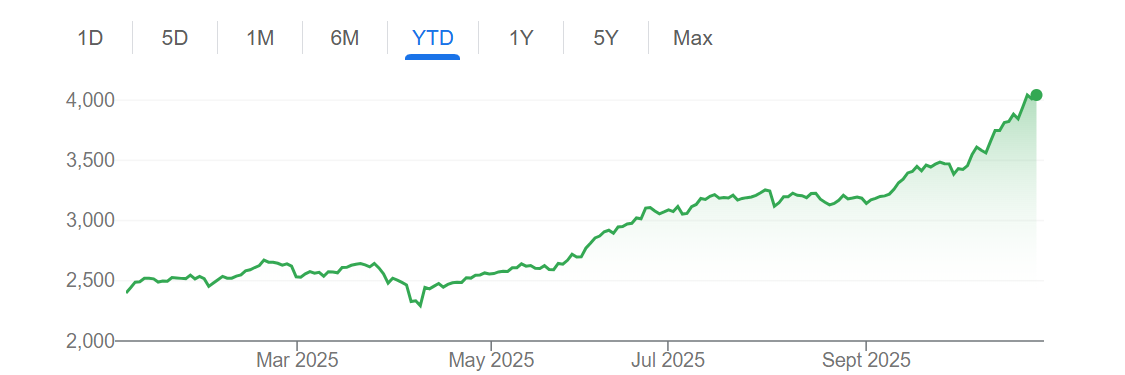
Group 1 - The South Korean KOSPI index has seen a remarkable increase of nearly 70% year-to-date, making it one of the best-performing markets globally [1] - Morgan Stanley has raised its 12-month target for the KOSPI index to 5,000 points, with an optimistic scenario suggesting it could reach 6,000 points [2] - Morgan Stanley anticipates at least a 20% upside for the KOSPI index in the next 12 months, viewing short-term pullbacks as buying opportunities [4] Group 2 - The primary drivers of the KOSPI index's rise are the strong performances of major tech companies, Samsung Electronics and SK Hynix, which have benefited from surging demand for memory chips amid the AI boom [4] - SK Hynix's stock has surged by 218.63% and Samsung's stock has increased by 86.52% year-to-date, significantly contributing to the KOSPI index's overall performance [4] - Optimizations in shareholder return policies, including stock buybacks, are also enhancing the overall valuation of the South Korean stock market [4] Group 3 - Morgan Stanley has identified key companies for investment, including Samsung Electronics, SK Hynix, Hanwha Aerospace, Hyundai Motor, Naver, Shinhan Financial Group, Samsung C&T, Samsung Life Insurance, and Korea Shipbuilding & Offshore Engineering [4] - The investment strategy focuses on increasing exposure to the KOSPI market, particularly in semiconductors, finance, and select industrial stocks [4]
《建议》未提经济增速具体目标,怎么看?
第一财经· 2025-10-29 03:57
Core Viewpoint - The article discusses the key objectives and strategies outlined in the "15th Five-Year Plan" for China's economic and social development, emphasizing high-quality growth, technological self-reliance, and comprehensive reforms to enhance living standards and national security [3][4]. Economic Growth - The "15th Five-Year Plan" does not set a specific economic growth target but emphasizes maintaining growth within a reasonable range, with a focus on increasing consumer spending and enhancing domestic demand as the main driver of economic growth [5][6]. - Analysts predict that China's GDP growth during the "15th Five-Year Plan" will average between 4.5% and 5.0%, ensuring a stable medium-to-high growth level while balancing growth, structural adjustments, and risk prevention [6][8]. Long-term Goals - By 2035, the plan aims for China's per capita GDP to reach the level of middle-income countries, which is generally considered to be around $20,000. Current projections indicate that China's per capita GDP will be approximately $13,445 in 2024, highlighting the significant gap that remains [7][8]. - Achieving this long-term goal will require maintaining a suitable economic growth rate during the "15th Five-Year Plan" period [7]. Economic Potential Release - The plan emphasizes the need to fully unleash economic growth potential by leveraging China's institutional advantages, large market size, complete industrial system, and rich talent resources [10]. - The focus on reform and innovation is seen as crucial for overcoming systemic barriers and enhancing overall productivity, which is essential for achieving both qualitative and quantitative growth [10][11]. Industry Development - The plan outlines initiatives to upgrade key industries such as chemicals, machinery, and shipbuilding, aiming to enhance their global competitiveness and create an estimated market space of around 10 trillion yuan over the next five years [11]. - It also highlights the importance of developing strategic emerging industries like new energy and new materials, which are expected to generate significant market opportunities and contribute to high-quality economic growth [11].

四中全会将这项任务摆在首位 传递哪些信号?
Yang Guang Wang· 2025-10-29 01:11
Core Insights - The Fourth Plenary Session of the 20th Central Committee of the Communist Party of China emphasized the importance of building a modern industrial system and strengthening the foundation of the real economy as a top priority for national development [1][2] Group 1: Industrial Development - The proposal aims to optimize and upgrade traditional industries, focusing on enhancing the global competitiveness of sectors such as chemicals, machinery, and shipbuilding, which account for approximately 80% of the manufacturing value added [2] - The National Development and Reform Commission (NDRC) estimates that there will be an additional market space of around 10 trillion yuan in the next five years [2] - The development of emerging pillar industries, including new energy, new materials, aerospace, and low-altitude economy, is expected to create several trillion-yuan market opportunities [2] Group 2: Market Strategy - The strategy emphasizes the importance of a strong domestic market as a key component of China's modernization, with a focus on expanding domestic demand [2] - Specific pathways include increasing market volume, enhancing efficiency, and ensuring smooth circulation of goods and services [2] Group 3: Investment and Efficiency - The annual scale of fixed asset investment in China has reached 50 trillion yuan, with a need to optimize government investment structures to better address public welfare and developmental needs [3] - The proposal includes measures to improve the proportion of government investment in public welfare, manage investments throughout their lifecycle, and enhance the overall effectiveness of investments [3] - The synergy between upgrading traditional industries and the growth of emerging industries is crucial for achieving stable and dynamic economic growth [3]
《建议》未提经济增速具体目标,怎么看 | 解读“十五五”
Di Yi Cai Jing· 2025-10-29 01:01
Economic Growth and Development Goals - The "15th Five-Year Plan" emphasizes high-quality development, technological self-reliance, and comprehensive reforms without setting explicit economic growth targets, focusing instead on maintaining growth within a reasonable range [2][3] - The average GDP growth rate during the "15th Five-Year Plan" is projected to be around 4.5% to 5.0%, ensuring a balance between steady growth, structural adjustments, and risk prevention [3][4] - By 2035, the goal is for China's per capita GDP to reach the level of middle-developed countries, which is generally considered to be around $20,000, indicating a significant increase from the current level of approximately $13,445 [3][4] Reform and Innovation - The plan identifies reform and innovation as fundamental drivers for overcoming systemic barriers and enhancing total factor productivity, which are crucial for achieving both qualitative and quantitative growth [6] - Key industries such as chemicals, machinery, and shipbuilding are targeted for quality upgrades to enhance their global competitiveness, with an estimated market space increase of around 10 trillion yuan over the next five years [6][7] Emerging Industries and Investment Opportunities - The plan aims to accelerate the development of strategic emerging industries like new energy and new materials, potentially creating several trillion-yuan market opportunities [7] - Investment in infrastructure, particularly in underground pipeline networks, is expected to exceed 5 trillion yuan, highlighting significant investment needs in the coming years [7]