
养殖业

Search documents
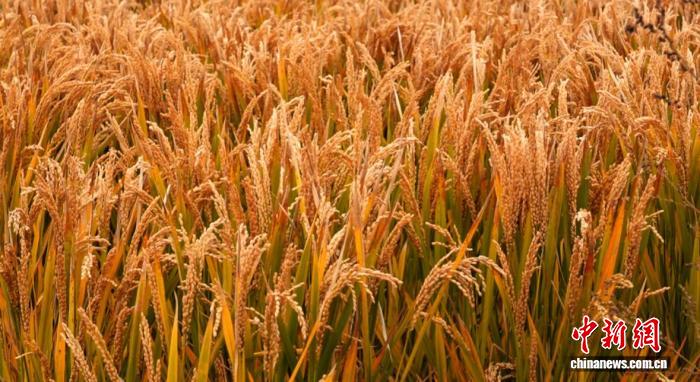
(走进中国乡村)辽宁盘锦稻香蟹肥迎丰收
Zhong Guo Xin Wen Wang· 2025-10-22 09:07
Core Insights - The article highlights the successful harvest season in Panjin, Liaoning, focusing on the increased rice yield and the thriving river crab farming industry, which utilizes a unique ecological farming model [1][3][5] Group 1: Rice Production - The rice harvest in Panjin is expected to yield significantly higher per acre compared to previous years, with mechanized operations fully implemented [1][3] - The total rice planting area in Panjin remains stable at over 1.6 million acres, and the local rice has been recognized as a national geographical indication product [3][4] - The "Honghaitan No. 1" rice has been awarded as one of the first "Liaoning Quality Products," indicating its high quality and market acceptance [3][4] Group 2: River Crab Farming - Panjin is recognized as the birthplace of the rice-crab farming technique, which allows crabs to feed on pests and weeds in rice fields, enhancing both rice and crab quality [3][4] - Local crab farmers report high quality and yield this year, with some achieving a production of 30 pounds of crabs per acre after an initial investment of 10 pounds of juvenile crabs [4][5] - The "Panjin Model" of integrated rice and crab farming has created a sustainable and profitable farming approach, benefiting local farmers [4][5] Group 3: Economic Impact and Tourism - The dual harvest of rice and crabs has not only improved economic benefits for farmers but also boosted confidence in promoting this farming model [5] - The Red Beach National Rice Park attracted many tourists during the National Day and Mid-Autumn Festival, showcasing the economic potential of agritourism alongside agricultural production [5] - The integration of rice planting, technology demonstration, and nostalgic experiences at the "1955 State Farm" has enhanced both product sales and tourism experiences [5]

养殖业板块10月22日跌1.22%,圣农发展领跌,主力资金净流出3.88亿元
Zheng Xing Xing Ye Ri Bao· 2025-10-22 08:19
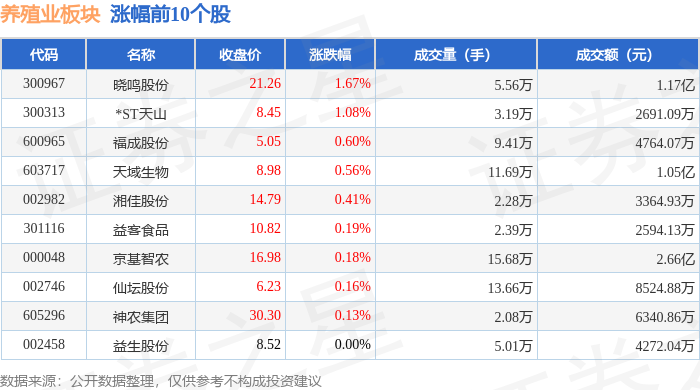
Core Insights - The aquaculture sector experienced a decline of 1.22% on October 22, with Shengnong Development leading the drop [1][2] - The Shanghai Composite Index closed at 3913.76, down 0.07%, while the Shenzhen Component Index closed at 12996.61, down 0.62% [1] Aquaculture Sector Performance - The following companies showed notable performance: - Pangming Co., Ltd. (300967) closed at 21.26, up 1.67% with a trading volume of 55,600 shares and a transaction value of 117 million [1] - Shengnong Development (002299) closed at 16.16, down 4.15% with a trading volume of 276,600 shares and a transaction value of 449 million [2] - Wens Foodstuff Group (300498) closed at 18.09, down 1.15% with a trading volume of 410,500 shares and a transaction value of 750 million [2] Capital Flow Analysis - The aquaculture sector saw a net outflow of 388 million from institutional investors, while retail investors contributed a net inflow of 211 million [2] - Notable capital flows included: - Pangming Co., Ltd. had a net inflow of 6.53 million from institutional investors, while retail investors had a net outflow of 7.21 million [3] - Wens Foodstuff Group experienced a net outflow of 2.93 million from institutional investors, with a significant net inflow of 20.58 million from retail investors [3]





养殖业板块10月21日涨0.28%,天邦食品领涨,主力资金净流出4444.89万元
Zheng Xing Xing Ye Ri Bao· 2025-10-21 08:22
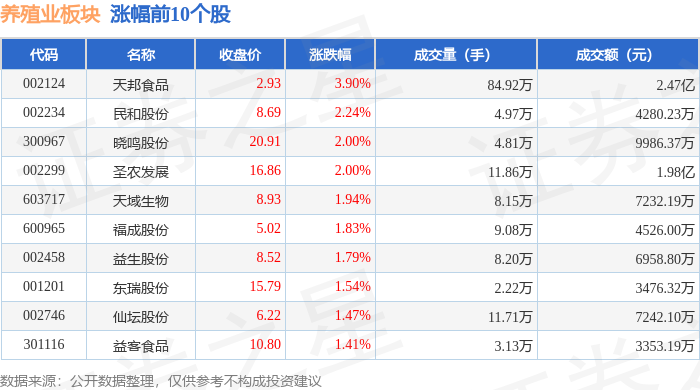
Market Overview - The aquaculture sector increased by 0.28% on October 21, with Tianbang Food leading the gains [1] - The Shanghai Composite Index closed at 3916.33, up 1.36%, while the Shenzhen Component Index closed at 13077.32, up 2.06% [1] Stock Performance - Tianbang Food (002124) closed at 2.93, up 3.90% with a trading volume of 849,200 shares and a transaction value of 247 million [1] - Minhe Livestock (002234) closed at 69.8, up 2.24% with a trading volume of 49,700 shares and a transaction value of 42.8 million [1] - Xiaoming Co. (300967) closed at 20.91, up 2.00% with a trading volume of 48,100 shares and a transaction value of 99.9 million [1] - Shengnong Development (002299) closed at 16.86, up 2.00% with a trading volume of 118,600 shares and a transaction value of 28.67 million [1] - Tianyu Bio (603717) closed at 8.93, up 1.94% with a trading volume of 81,500 shares and a transaction value of 72.32 million [1] Capital Flow - The aquaculture sector experienced a net outflow of 44.44 million from institutional investors and 35.77 million from retail investors, while retail investors saw a net inflow of 80.22 million [2] - The capital flow for individual stocks shows Shengnong Development (002299) with a net inflow of 22.98 million from institutional investors [3] - Institutional investors also showed a net inflow of 18.73 million for Zhengbang Technology (002157) [3] - Tianbang Food (002124) had a net inflow of 16.94 million from institutional investors [3]



世界猪业博览会开幕!农牧渔ETF(159275)上涨0.7%!机构:养殖业产能出清或推动景气反转
Xin Lang Ji Jin· 2025-10-21 05:18
Group 1 - The agricultural and livestock ETF (159275) showed a stable performance with a price increase of 0.81% and a trading volume of 3.45 million yuan, bringing the fund's total size to 206 million yuan [1] - Among the constituent stocks, Zhongxing Junye reached the daily limit, while Chenguang Biotech and Zhuangzidao followed with increases of 3.07% and 2.89% respectively [1] - The 14th World Pig Industry Expo opened in Changsha, covering an area of 100,000 square meters and attracting over 800 global enterprises, focusing on technology exchange and innovation in the pig farming industry [1] Group 2 - Guohai Securities indicated that the pig farming industry is entering a regulatory phase, with measures to reduce production capacity affecting pig prices, which are under downward pressure in the short term [2] - The poultry sector is expected to improve, with the import ratio of white feather chicken breeding stock decreasing to 41%, despite low prices [2] - The pet economy is rapidly developing, with domestic brands rising and improving industry profitability [2]
晨会纪要:2025年第177期-20251021
Guohai Securities· 2025-10-21 02:07
Group 1: Pig Industry - The pig industry is undergoing a period of regulatory control, with measures aimed at reducing production capacity to stabilize prices. Short-term pressures on prices are expected due to increased market supply, but the overall regulatory approach is likely to be moderate, focusing on sustainable price recovery [3][4] - The recommendation is to focus on leading companies such as Muyuan Foods and Wens Foodstuffs, while also considering opportunities in lower-cost producers like Dekang Agriculture and Shennong Group [3] Group 2: Poultry Industry - The poultry sector is expected to see improvements in its fundamentals, with significant updates in breeding stock. In September 2025, 136,800 sets of grandparent stock were updated, contributing to a total of 803,300 sets for the year [4] - The recommendation includes companies like San Nong Development and Lihua Stock, as the market dynamics are anticipated to shift positively [4] Group 3: Animal Health - The competitive landscape in the animal health sector is expected to improve, supported by government initiatives to optimize the veterinary drug industry and encourage innovation among leading firms [5] - The clinical trials for African swine fever vaccines are progressing, with companies like BioFeng and Zhongmu Bio receiving clinical approval, which could enhance market prospects for these vaccines [5] Group 4: Planting Industry - The pig-to-grain price ratio is continuing to decline, which may benefit companies that have invested early in genetically modified seed development. Companies like Suqian Agricultural Development and Longping High-Tech are recommended [6] Group 5: Feed Industry - The feed industry is experiencing price fluctuations, but there is an expectation of increased market concentration. Hai Da Group is recommended, with a focus on He Feng Stock as a potential opportunity [7] Group 6: Pet Industry - The pet economy is thriving, with domestic brands gaining significant market share. The profitability of the industry is improving, and companies like Guibao Pet and Zhongchong Stock are recommended for investment [8] Group 7: Automotive Industry - In September 2025, wholesale automotive sales increased by 14.9% year-on-year, with significant growth in new energy vehicles, which accounted for 46.1% of total new car sales [9][10] - The launch of new models like the Leap D19 and Wei Brand's Gaoshan 7 is expected to enhance market competitiveness, with the latter achieving a sales price of 285,800 yuan [10][11] - The automotive sector is recommended for investment, particularly in companies that are positioned for high-end and intelligent vehicle development, such as Li Auto and BYD [12] Group 8: Beauty and Healthcare - Meili Tianyuan's acquisition of Siyuanli for 1.25 billion yuan is set to strengthen its position in the high-end beauty market, with the deal structured as 67% cash and 33% stock [14][15] - The acquisition is expected to enhance revenue and profit scales, with projected revenues of 3 billion yuan in 2025, growing to 5.2 billion yuan by 2027 [16]
回望“十四五”| 数说“十四五” ESG笔墨绘就企业发展新底色
Zhong Guo Zheng Quan Bao· 2025-10-21 00:27
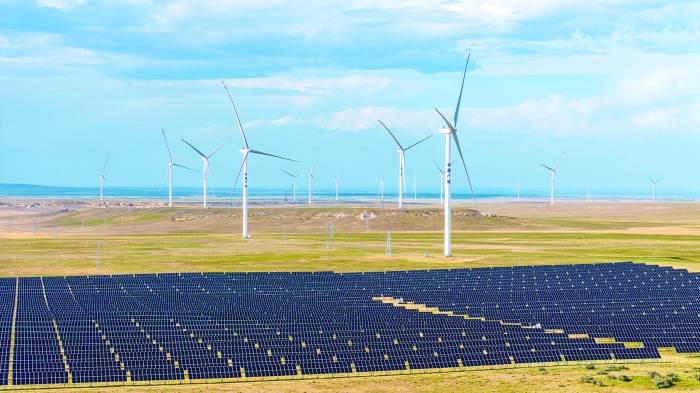
Group 1: ESG Reporting and Development - The disclosure rate of ESG reports among A-share listed companies has increased significantly, with 2,521 companies publishing reports for the 2024 fiscal year, representing 46.83% of all listed companies, marking a 71% increase from 2021 [2] - The quality of ESG development has improved, with 342 companies in the Shanghai Stock Exchange included in MSCI ESG ratings, and 100 companies receiving upgrades in their ratings [2] - ESG has evolved from a conceptual framework to a key dimension for measuring corporate competitiveness, aligning with national development goals for green growth and harmony with nature [2][4] Group 2: Green Energy and Low-Carbon Initiatives - The share of renewable energy in power generation capacity has risen from 40% to approximately 60% during the "14th Five-Year Plan" period, with nearly 60% of new power generation coming from non-fossil energy sources [6] - A zero-carbon intelligent manufacturing base in Jiangsu has been established, generating over 600 million kWh of clean electricity annually and achieving net-zero emissions [5] - Significant reductions in energy consumption per unit of GDP have been achieved, with an 11.6% decrease over four years, equating to a reduction of 1.1 billion tons of CO2 emissions [6] Group 3: Corporate Social Responsibility and Community Engagement - A majority of listed companies are actively engaging in community services and educational support, with 67.16% involved in community service and 66.67% providing educational assistance [8] - The third industry has seen an increase in employment capacity, with 35.866 million people employed by the end of 2024, marking a 1.1 percentage point increase in its share of total employment [8] - Significant progress has been made in housing projects, with over 240,000 urban old residential areas renovated, benefiting over 40 million households [9] Group 4: Agricultural and Rural Development - Companies are integrating ESG practices with rural revitalization strategies, with over 6,000 enterprises supporting poverty alleviation efforts [12] - The contribution rate of agricultural technology has reached 63.2%, with over 75% of crop farming being mechanized by the end of 2024 [12] - Initiatives like the "MAP modern agricultural assistance model" have helped increase agricultural output and income for farmers [12]
数说“十四五” ESG笔墨绘就企业发展新底色
Zhong Guo Zheng Quan Bao· 2025-10-20 20:17
Core Insights - The disclosure rate of ESG reports among A-share listed companies has steadily increased, with a 71% year-on-year growth in the number of reports published for the 2024 fiscal year compared to 2021 [2] - ESG has evolved from a conceptual framework to a critical dimension for measuring corporate competitiveness, aligning with national development goals [2][3] - Companies are increasingly integrating sustainable development principles into their corporate culture and operations, demonstrating a commitment to ESG practices [2][3] ESG Disclosure and Performance - As of September 2025, 2,521 A-share listed companies have published ESG reports, representing 46.83% of all listed companies [2] - The quality of ESG disclosures has significantly improved, with 342 companies included in MSCI ESG ratings, and 100 companies receiving upgrades in their ratings [2] - The shift towards actionable ESG practices is evident across various industries, with companies adopting international ESG standards to enhance report quality [2] Green Development Initiatives - The share of renewable energy in China's power generation capacity has increased from 40% to approximately 60% during the "14th Five-Year Plan" period [4] - Significant reductions in carbon emissions have been achieved, with a reported decrease of 11.6% in energy consumption per unit of GDP, equating to a reduction of 1.1 billion tons of CO2 emissions [5] - Companies are increasingly adopting green technologies and practices, contributing to a sustainable business model and enhancing their competitive edge [3][4] Social Responsibility and Community Engagement - A growing number of companies are embedding social responsibility into their operations, with 67.16% engaging in community services and 66.67% supporting educational resources [6] - The third sector's employment capacity has strengthened, with 35.87 million people employed in this sector by the end of 2024, marking a 1.1 percentage point increase from 2020 [6] - Companies are actively participating in housing and elderly care initiatives, significantly improving living conditions and support networks for communities [6][7] Agricultural and Rural Development - Companies are integrating ESG practices with rural revitalization strategies, exemplified by successful projects like the silk industry in Guangxi, which is expected to generate over 8 million yuan in output by 2025 [8] - Digital solutions are being implemented to enhance agricultural productivity, with platforms connecting over 1,000 agricultural regions and benefiting millions of farmers [8] - The contribution of agricultural technology to productivity has reached 63.2%, with mechanization rates exceeding 75%, showcasing the role of innovation in modern agriculture [8]
数说“十四五”ESG笔墨绘就企业发展新底色
Shang Hai Zheng Quan Bao· 2025-10-20 18:13
Group 1: ESG Reporting Growth - As of September 2025, 2,521 A-share listed companies have published their 2024 ESG reports, representing a 71% increase compared to 2021 [2][4] - Among 389 mandatory disclosure entities that have released sustainability reports, 97.94% (381 companies) have initiated carbon reduction actions [2][9] - The disclosure rate of ESG reports has steadily increased over the past five years, with 46.83% of all A-share companies disclosing ESG reports for 2024 [4] Group 2: Corporate Social Responsibility - 67.16% of listed companies are engaged in community service, and 66.67% provide assistance to educational resources [2][10] - The third industry has seen an increase in employment capacity, with 35.866 million employed by the end of 2024, an increase of 600,000 since 2020 [10] - Over 24,000 urban old residential communities have been renovated, benefiting over 40 million households [10][11] Group 3: Green Energy and Low-Carbon Initiatives - The share of renewable energy generation capacity has increased from 40% to approximately 60% during the "14th Five-Year Plan" period [8] - The carbon emissions intensity and energy consumption per unit of GDP have decreased by 11.6% cumulatively over four years, equivalent to a reduction of 1.1 billion tons of CO2 emissions [8][9] - A zero-carbon intelligent manufacturing base in Jiangsu has achieved 100% green electricity supply and net-zero emissions, reducing CO2 emissions by over 400,000 tons annually [8] Group 4: Rural Revitalization and Economic Development - Over 6,000 enterprises have supported the consolidation and expansion of poverty alleviation efforts since the "14th Five-Year Plan" [14][15] - The income from leisure agriculture reached 900 billion yuan last year, showcasing the economic impact of rural revitalization [15] - Agricultural technology contribution rates have reached 63.2%, with over 75% mechanization in crop farming [15][16]
养殖业板块10月20日跌1.22%,巨星农牧领跌,主力资金净流出2.43亿元
Zheng Xing Xing Ye Ri Bao· 2025-10-20 08:21
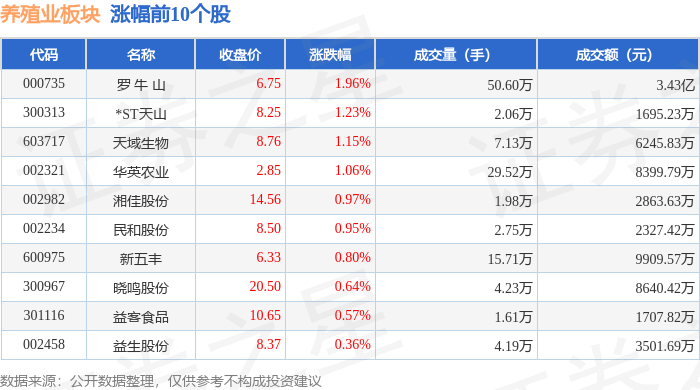
Core Viewpoint - The livestock sector experienced a decline of 1.22% on October 20, with Juxing Agriculture leading the drop, while the Shanghai Composite Index rose by 0.63% and the Shenzhen Component Index increased by 0.98% [1][2]. Livestock Sector Performance - Juxing Agriculture's stock closed at 18.47, down 4.15%, with a trading volume of 189,500 shares and a transaction value of 350 million yuan [2]. - Other notable declines included Muyuan Foods, down 2.25% to 49.48, and Shengnong Development, down 1.31% to 16.53 [2]. - In contrast, stocks like Luoniushan and *ST Tianshan saw slight increases of 1.96% and 1.23%, respectively [1]. Capital Flow Analysis - The livestock sector saw a net outflow of 243 million yuan from main funds, while retail investors contributed a net inflow of 209 million yuan [2][3]. - Notable net inflows from retail investors were observed in stocks like Zhengbang Technology and Huaying Agriculture, while main funds showed outflows in several stocks including Shengnong Development and *ST Tianshan [3].


美国大豆滞销之后,东南亚接盘却出了乱子?
Hu Xiu· 2025-10-20 04:07
Core Insights - The U.S. is attempting to shift the soybean crisis to Southeast Asia, pressuring Indonesia and Vietnam to take over the supply [1] - Vietnam's livestock industry is suffering due to excessive impurities and pesticide residues in soybeans [1] - Indonesia faces economic losses due to heavy metal contamination in soybean oil cake [1] - Drought conditions in the U.S. Midwest are exacerbating delivery delays, putting Southeast Asian livestock industries in a difficult position [1]