云计算

Search documents
全球人工智能领域的投入持续加大,资金抢筹布局光模块,通信ETF(515880)近20日资金净流入超28亿元
Mei Ri Jing Ji Xin Wen· 2026-02-11 02:01
Group 1 - The demand for AI data centers is driving an increase in both the quantity and price of optical fibers and cables, with applications in Scale Out scenarios and potential growth in Scale Across and Scale Up markets [1] - The industry is experiencing improved supply-demand dynamics, leading to rising prices for data center optical fibers such as G.657.A1 and multimode fibers, alongside increased demand for high-value products like small-diameter, ultra-low-loss, and hollow-core fibers [1] - Meta has reached an agreement with Corning to invest $6 billion in AI data center optical cables from 2026 to 2030, indicating a positive industry outlook [1] Group 2 - Alphabet and Amazon reported strong financial results for FY25, with Alphabet's annual revenue surpassing $400 billion and Amazon's net sales increasing by 12% to $716.9 billion [2] - Both companies announced significant capital expenditure plans for FY26, with Alphabet expecting $175-185 billion and Amazon around $200 billion, reflecting ongoing investment in AI infrastructure [2] - The performance of leading cloud providers like Google and Amazon, along with their increased capital expenditures, suggests a sustained high demand in the global AI industry, benefiting sectors like optical modules and servers in the A-share market [2]


优刻得股价涨5.26%,博时基金旗下1只基金位居十大流通股东,持有426.2万股浮盈赚取801.25万元
Xin Lang Ji Jin· 2026-02-11 01:56
Group 1 - UCloud's stock price increased by 5.26% to 37.59 CNY per share, with a trading volume of 600 million CNY and a turnover rate of 4.04%, resulting in a total market capitalization of 17.153 billion CNY [1] - UCloud has experienced a continuous stock price increase for three days, with a cumulative increase of 4.17% during this period [1] - UCloud, established on March 16, 2012, and listed on January 20, 2020, operates as a neutral third-party cloud computing service provider, offering a secure and reliable cloud computing service platform [1] Group 2 - UCloud's main business revenue composition includes: public cloud (50.63%), hybrid cloud (35.41%), cloud communication (8.26%), private cloud (2.75%), solutions and others (1.90%), and edge cloud (1.05%) [1] - Among UCloud's top ten circulating shareholders, Bosera Fund's AI ETF has increased its holdings by 601,400 shares, totaling 4.262 million shares, which represents 1.05% of the circulating shares [2] - The Bosera AI ETF has achieved a year-to-date return of 13.92% and a cumulative return of 34.95% since its inception [2]

Alphabet募资320亿美元加码AI军备竞赛,红包大战千问日活暴增!
Mei Ri Jing Ji Xin Wen· 2026-02-11 01:27
Market Review - The A-share market for artificial intelligence and robotics continues to show strong performance, with both thematic ETFs rising and a sustained bullish sentiment [1] - The Huaxia Sci-Tech AI ETF (589010) opened higher and maintained a stable high-level consolidation, closing at 1.587 yuan, up 2.255% from the opening price, with 23 out of 30 constituent stocks rising, led by Chip Original Co. with an 8.54% increase [1] - The Robot ETF (562500) showed resilience, closing at 1.079 yuan, up 0.841% from the opening price, with 45 out of 66 constituent stocks rising, and a notable net inflow of 5.27 billion yuan, indicating strong institutional interest [1] Hot News - Alphabet, Google's parent company, raised approximately $32 billion through the issuance of bonds in multiple currencies, including a rare 100-year bond, highlighting the intensifying global AI arms race [2] - QuestMobile reported a significant increase in daily active users for the Qianwen App, which grew by 727.7% to 58.48 million, surpassing the Yuanbao App's user growth [2] - The Beijing Humanoid Robot Innovation Center launched the next-generation general-purpose robot platform, TGC 3.0, which enhances stability and motion control, marking a significant advancement in the industry [2] Institutional Viewpoints - Guohai Securities reports that AI is becoming the core engine driving growth in the cloud computing industry, with the demand for massive computing power for large model training and inference significantly raising the market ceiling [3] Popular ETFs - The Robot ETF (562500) is the only ETF in the market with a scale exceeding 20 billion, offering the best liquidity and comprehensive coverage of the Chinese robotics industry [4] - The Huaxia Sci-Tech AI ETF (589010) is positioned as the brain of robotics, capturing the "singularity moment" in the AI industry with a 20% fluctuation range and small to mid-cap elasticity [4]
“AI之战”输不得!如果美股Mag 7今年就把现金流“烧成负数”,这对市场意味着什么?
Hua Er Jie Jian Wen· 2026-02-11 01:21
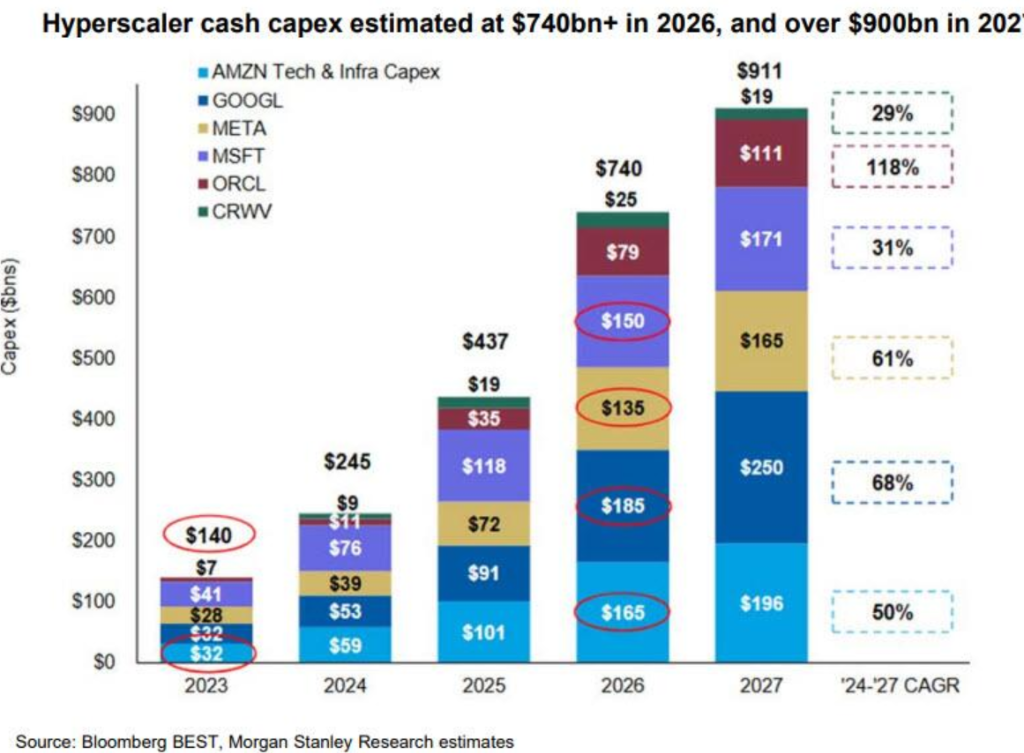
Group 1: Capital Expenditure Insights - Major cloud providers including Google, Amazon, Microsoft, and Meta are projected to have a combined capital expenditure guidance of approximately $650 billion for 2026, which increases to $740 billion when including Oracle and CoreWeave [1][3] - The $740 billion figure represents a 70% year-over-year increase compared to 2025 and is double the market consensus expectation of 35% growth for that year [3][4] - This level of capital expenditure is nearing the total annual operating cash flow of the entire large-scale cloud provider ecosystem, raising concerns about sustainability [3][5] Group 2: Financial Implications - Goldman Sachs analysts warn that if capital expenditures reach $700 billion by 2026, it would be comparable to the peak internet bubble's spending intensity, which was 1.4% of GDP [3][5] - Cash flows are being significantly impacted, with predictions that many companies will exhaust their free cash flow, leading to increased reliance on debt financing [5][9] - The AI investment boom is causing a shift in the debt market, with AI-related investment-grade debt accounting for about 14% of the U.S. investment-grade market, surpassing the banking sector [8][13] Group 3: Debt Market Dynamics - Major tech companies are increasingly turning to the debt market to fund their AI-related expenditures, with Oracle issuing a record $25 billion in bonds and Google following with a $20 billion issuance [14][16] - Despite strong initial demand for these bonds, signs of strain are emerging in the debt market, with widening spreads and underperformance of newly issued bonds [16][18] - The software industry is facing valuation challenges as AI tools disrupt traditional software demand, posing risks to private credit markets heavily invested in software companies [19][22] Group 4: Strategic Considerations - Companies are caught in a "prisoner's dilemma," where failing to invest in AI could result in losing market share, while over-investing could lead to financial strain [23][26] - The potential outcomes hinge on the return on investment (ROI) from these massive capital expenditures, with a significant gap between projected profits and required returns [28][29] - Two scenarios are outlined: a bullish scenario where AI adoption mirrors cloud computing's trajectory, and a bearish scenario reminiscent of past tech failures, indicating that not all companies may achieve sufficient long-term profitability [31]




影响市场重大事件:依托“天关”卫星,黑洞研究又有新发现;深蓝航天“星云二号”大型可回收火箭第二批次发动机首台产品热试车考核成功
Mei Ri Jing Ji Xin Wen· 2026-02-10 23:29
Group 1 - The "Tian Guan" satellite has captured an unprecedented high-energy cosmic explosion, suggesting it may be the process of a medium-mass black hole tearing apart a white dwarf star [1] - Deep Blue Aerospace's "Star Cloud No. 2" large reusable rocket has successfully completed key tests of its core propulsion system, marking a significant advancement in China's largest thrust liquid oxygen-kerosene engine [2] - The Ministry of Industry and Information Technology and other departments have issued guidelines to enhance network coverage in low-altitude airspace, utilizing existing 5G infrastructure and satellite communication [3][4] Group 2 - The State Council has mandated a comprehensive safety risk assessment for elderly care institutions by the end of 2026, aiming to eliminate safety hazards and enhance management mechanisms [5] - The National Copyright Administration and other departments have launched a special initiative to protect the copyrights of theatrical films, focusing on combating piracy and illegal distribution [6] - Zhejiang Province aims for its core artificial intelligence industry to achieve a revenue of 1.2 trillion yuan by 2030, promoting innovation and collaboration between tech and manufacturing sectors [7] - The same province is exploring the construction of a comprehensive computing power system and planning for advanced digital infrastructure, including 5G-A networks and future communication technologies [8] Group 3 - Over 60% of private equity firms are heavily invested going into the holiday, with nearly 70% optimistic about the market's performance post-holiday, indicating a potential upward trend in A-shares [9] - Alibaba Cloud has become the first Chinese cloud provider to pass comprehensive technical tests by ICANN, enabling it to offer end-to-end services for top-level domain management [10]
云巨头天价资本支出
2 1 Shi Ji Jing Ji Bao Dao· 2026-02-10 23:09
Core Insights - The financial reports from major tech companies like Microsoft, Google, and Amazon reveal a strong growth in AI-related cloud services, but also raise concerns about their massive capital expenditures [1][2][3][4]. Group 1: Cloud Business Performance - Microsoft Azure experienced a 39% year-over-year growth, while Google Cloud surged by 48%, and AWS recorded a 24% growth, marking its fastest rate in thirteen quarters [1][3][4]. - Google Cloud's revenue reached $17.664 billion in the fourth quarter, exceeding analyst expectations by over 9%, and is projected to surpass $70 billion in annual revenue by the end of 2025 [3]. - AWS generated $35.6 billion in sales for the fourth quarter, reflecting a 24% year-over-year increase, which is the highest growth since the end of 2022 [4]. Group 2: Capital Expenditures - Microsoft reported a record capital expenditure of $37.5 billion for the quarter, a 66% increase year-over-year, while Google plans to spend between $175 billion and $185 billion in 2026, nearly doubling its 2025 budget [1][8]. - Amazon's capital expenditure for 2026 is expected to reach approximately $200 billion, representing a more than 50% increase from 2025 [8]. - The significant capital investments are primarily directed towards advanced AI chips, global data centers, and sustainable energy sources [8]. Group 3: Future Orders and Revenue Visibility - Google Cloud's unfulfilled orders reached $240 billion by the end of 2025, more than doubling year-over-year, while AWS's backlog surged by 40% to $244 billion [5][7]. - Microsoft's remaining performance obligations soared to $625 billion, a 110% increase, with 45% dependent on a single client, OpenAI [6][7]. Group 4: Market Dynamics and Investor Sentiment - Investors are increasingly concerned about the sustainability of returns given the high capital expenditures, with stock prices for Microsoft, Google, and Amazon dropping significantly post-earnings reports [1][8]. - The market is shifting focus from revenue growth to the sustainability of capital returns, as companies face pressure to demonstrate how their investments will translate into profits [11].
以现代科技助力深刻重塑奥运会运行方式——中国元素闪耀米兰冬奥会
Ren Min Ri Bao· 2026-02-10 22:35
Group 1: Event Overview - The Milan-Cortina Winter Olympics commenced on February 6, showcasing a blend of Chinese elements and global participation in sports [1] - The event is characterized by its decentralized nature, with 18 venues spread over 22,000 square kilometers in Northern Italy, presenting significant logistical challenges [3] Group 2: Technological Innovations - Alibaba Cloud's upgraded technology, initially used in the Beijing Winter Olympics, is now applied in Milan-Cortina, featuring a 360-degree real-time replay system that enhances athlete performance analysis [2] - The integration of AI models into the Olympics' core operations marks a significant advancement, facilitating event management, resource coordination, and global broadcasting [2][3] Group 3: Sustainability Efforts - The "Energy Consumption Treasure" system developed by Alibaba Cloud monitors energy usage across venues, aiming for precise tracking of the event's carbon footprint [4] - The International Olympic Committee (IOC) emphasizes that the cloud computing and AI technologies provided by Chinese companies significantly enhance operational efficiency and sustainability [4] Group 4: Media and Broadcasting - The International Broadcast Center in Milan is equipped to serve nearly 3 billion viewers globally, ensuring high-quality and continuous coverage of the events [4] - TCL, as a global Olympic partner, supplies advanced display technologies for various venues, enhancing the viewing experience for both athletes and audiences [5][6] Group 5: Chinese Brand Participation - Chinese sports brands like Anta and Berghaus are actively involved, providing specialized equipment for various national teams, showcasing China's advancements in winter sports technology [8] - TCL's presence at the Olympics serves as a platform for Chinese companies to integrate into global supply chains and showcase technological innovations [7] Group 6: Cultural Exchange - The "China House" at the Winter Olympics features cultural displays that blend traditional Chinese elements with the Olympic spirit, promoting cultural exchange among visitors [9] - Events such as the "Italy and China: Olympic Spirit and Artistic Heritage" cultural exchange highlight the role of sports in fostering international friendship and collaboration [10]
从黄金到GPU:一条让你多花钱的隐秘供应链
Sou Hu Cai Jing· 2026-02-10 21:39
Group 1 - The IT industry is experiencing a cost storm due to soaring prices of precious metals, which is impacting the semiconductor supply chain and leading to a "digital inflation" crisis [1][4][5] - Gold prices reached a historical peak of nearly $5600 per ounce before experiencing significant volatility, with a record single-day drop of 40 years on January 30, followed by a rebound [2][4] - Silver has seen dramatic price fluctuations, with a single-day drop exceeding 35% on January 31, erasing all gains made since the beginning of the year, further contributing to cost pressures in the semiconductor industry [4][6] Group 2 - Silver's demand is increasing significantly in various industries, particularly in semiconductors, photovoltaics, and automotive sectors, due to its superior conductivity and thermal properties [8][10] - The photovoltaic industry now consumes nearly 30% of the global physical silver supply, as new technologies require almost double the amount of silver compared to older models [10][12] - The semiconductor packaging segment is highly sensitive to raw material price changes, with a 20% increase in gold costs potentially leading to a 5%-8% rise in packaging costs [12][14] Group 3 - The semiconductor industry is facing a supply-demand imbalance, with a projected 23% increase in global DRAM memory demand in 2026, particularly driven by data centers [14][15] - The AI boom is a significant factor driving the current price increase in the semiconductor sector, as the demand for computing power surges [14][15] - The limited capacity expansion in semiconductor manufacturing, with only a 5% increase expected in 2026, is insufficient to meet the explosive demand growth [14][15] Group 4 - Different players in the semiconductor ecosystem are experiencing varied impacts from the price increases, with domestic semiconductor equipment manufacturers benefiting from increased cash flow due to rising prices [15][17] - Chip design and hardware manufacturers are struggling to pass on rising costs to customers, risking customer loss while facing pressure from raw material price hikes [15][17] - The overall price increase across the semiconductor supply chain is likely to affect consumer electronics, leading to higher prices for end products [17][19] Group 5 - Major PC manufacturers have begun raising prices across their product lines, with increases ranging from 10% to 30% due to rising component costs [21][22] - The smartphone industry is also feeling the impact, with companies like Xiaomi and OPPO announcing price hikes for new models, driven by increased memory costs [22][24] - Cloud computing giants like AWS and Google Cloud have announced price increases for their services, marking a significant shift in the pricing paradigm of the industry [25][28] Group 6 - The rise in cloud service prices is expected to affect consumers directly, as software and application subscription costs are also increasing due to higher underlying computing costs [29][31] - The trend of charging for AI services is shifting from aggressive subsidies to more sustainable pricing models, with many companies adjusting their API prices upwards [31][34] - A significant portion of consumers is now willing to pay for AI functionalities that enhance productivity, indicating a shift in consumer attitudes towards software pricing [34][35]
马云“跑了”,套现300亿!背后藏着什么秘密?
Sou Hu Cai Jing· 2026-02-10 16:00
Core Viewpoint - Alibaba is undergoing a strategic retreat by selling off non-core assets to focus on its primary business areas, particularly in instant retail and AI/cloud computing, rather than facing financial distress or "running away" [1][11]. Group 1: Asset Sales - Alibaba has sold various assets, including a portion of its stake in Sanjiang Shopping, realizing 2.52 billion yuan. Overall, it has recouped over 30 billion yuan through divestments from Intime Retail, a complete exit from RT-Mart, and other sales [1][3]. - The sold assets are characterized as heavy, slow-growing, and increasingly unprofitable traditional retail businesses, which are no longer aligned with Alibaba's core focus [3][5]. - Alibaba's Chairman, Cai Chongxin, stated that exiting these non-core businesses is a reasonable decision, indicating a shift from a "big and complete" empire to a "focused core" entity [3][5]. Group 2: Strategic Focus Areas - The 30 billion yuan raised from asset sales will be directed towards two main battles: instant retail and AI/cloud computing [5][10]. - In instant retail, Alibaba is investing heavily in delivery services, with initiatives like "one-hour delivery" and significant subsidies to compete against rivals like Meituan and JD.com. Instant retail revenue has shown rapid growth, with increases between 37% and 60% [5][10]. - For AI and cloud computing, Alibaba plans to invest 380 billion yuan over the next three years, which exceeds its total investment in these areas over the past decade. This investment aims to establish a foundational infrastructure for AI, positioning Alibaba as a key player in the future tech landscape [6][10]. Group 3: Leadership and Organizational Changes - The leadership structure at Alibaba has shifted, with power concentrated among three key figures: Cai Chongxin, Wu Yongming, and Jiang Fan, indicating a strong leadership drive for the new strategic direction [8][10]. - The partner committee has been streamlined from 26 to 17 members, reflecting a transition from a diverse expansion phase to a focused core strategy [8][10]. - Jiang Fan's return to a central role in overseeing e-commerce signifies a commitment to tackling the challenges in instant retail with experienced leadership [8][10]. Group 4: Lessons and Implications - The strategic shift at Alibaba serves as a lesson for businesses, emphasizing the need to adapt and evolve core competencies in response to changing market conditions [10][11]. - Focusing resources on high-value areas is crucial in the current economic landscape, where efficiency and technological advancement are paramount [10][11]. - Observing the capital flows of major companies like Alibaba, Tencent, and JD.com can provide insights into future economic trends, particularly in instant consumption and AI technology [10][11].

为什么海外科技巨头烧钱停不下来?
Hua Er Jie Jian Wen· 2026-02-10 12:28
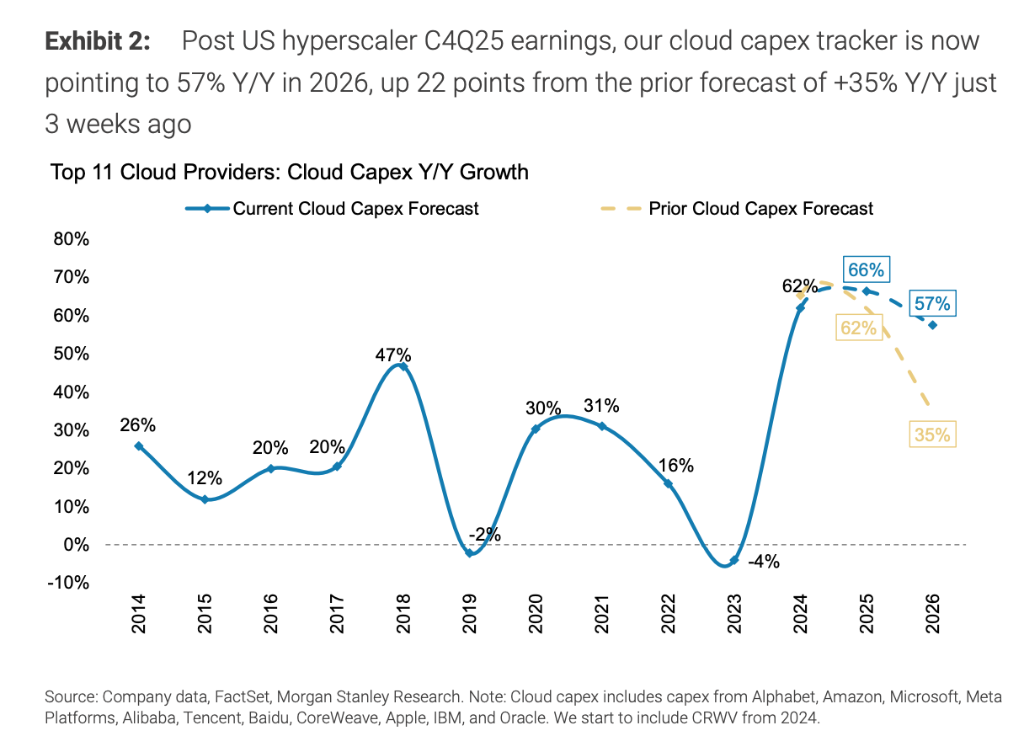
据追风交易台,摩根士丹利最新研究指出,2026年全球云计算资本支出预计将飙升至约7350亿美元,同比增长约60%,连续第三年增长率超过 60%。这一预测较三周前大幅上调22个百分点,新增规模约1200亿美元。 驱动此次上调的核心因素,是美国四大超大规模云服务商在最新财报季释放的强劲资本支出指引。Alphabet、亚马逊、微软及Meta均显著提高了 2026年投资计划。尽管增速较2025年有所放缓,但全球前11大云服务商连续三年维持如此高强度的资本支出增长,在行业追踪史上尚属首次。 研究认为,在人工智能驱动的算力需求持续超越供给的背景下,云基础设施的高强度投资周期仍将延续。这一趋势对云计算产业链中资本支出敞 口较大的供应商构成明确利好。 资本开支强度创历史新高 全球前11大云服务商的资本支出密集度已攀升至总收入26%以上的历史高位,达到2014-2023年平均水平的三倍。仅在一年前,市场对2025-2026 年全球云资本支出的预测约为7100亿美元,而当前这一预期已大幅跃升至1.2万亿美元,意味着预测值累计上调近5000亿美元。 摩根士丹利对2026年全球云资本支出的预测已达7950亿美元,较当前市场共识高出约 ...