汽车

Search documents
欧洲越来越难买芯片了
半导体芯闻· 2026-03-19 10:19
Core Insights - The ongoing conflict in Iran has disrupted air freight routes through the Middle East, leading European companies to seek alternative warehouses and incur higher shipping costs for semiconductor imports from Asia [1][4] - Global air freight capacity has decreased by approximately 9% compared to pre-war levels, causing increased costs and delivery delays for European companies importing semiconductors [1][4] - Despite the challenges, many buyers are willing to pay a premium to ensure continued delivery of high-value products like semiconductors [1][4] Group 1: Impact on Semiconductor Supply Chain - European semiconductor companies are experiencing delivery delays due to rising air freight costs, with some unable to predict future price trends [2] - The conflict has led to a shift in logistics strategies, with airlines opting for direct flights, which reduces cargo capacity due to the need for additional fuel [4] - Companies are actively testing their semiconductor supply chains due to disruptions in key shipping routes, resulting in increased logistics costs and reduced buffer inventories [6] Group 2: Industry Responses and Adjustments - Many companies have adjusted their supply chains post-COVID-19 to maintain higher inventory levels and are diversifying their semiconductor suppliers [5][6] - Automotive manufacturers, such as ZF and Volkswagen, are continuing to use air freight for semiconductor transportation but are facing increased costs [4][6] - The semiconductor supply chain is under pressure, but some companies report no immediate impact on production, indicating a level of preparedness and inventory management [5][6]

中国官方:加快补齐汽车芯片短板
半导体芯闻· 2026-03-19 10:19
Group 1 - The Chinese government held a meeting on March 17 to accelerate the improvement of automotive chips and basic software in the new energy vehicle (NEV) industry [1] - The Ministry of Industry and Information Technology (MIIT) emphasized the need to enhance the competitive order of the NEV industry, boost innovation capabilities, expand automotive consumption, and optimize industry management [1][2] - Key actions include strengthening price monitoring, conducting cost investigations, and ensuring compliance with a 60-day payment commitment by enterprises [1] Group 2 - The meeting proposed to implement special actions to stimulate consumption, promote vehicle trade-in programs, and support the large-scale application of new energy heavy trucks [2] - It aims to improve financial credit services, enhance international logistics support, and facilitate automotive export trade and overseas development [2] - The MIIT is working on legislative processes for the Motor Vehicle Production Access Management Regulations to establish a more open and efficient governance system for the automotive industry [2]
马斯克建晶圆厂,将豪掷450亿美元
半导体芯闻· 2026-03-19 10:19
如果您希望可以时常见面,欢迎标星收藏哦~ 特斯拉(Tesla Inc.)首席执行官马斯克(Elon Musk、见图)再度抛出震撼弹,上周末预告7天内将启 动名为「Terafab」的晶圆厂兴建计划。业界传出,为确保自驾计程车与人型机器人「Optimus」 的芯片供应无虞,马斯克有意打破业界与晶圆代工厂合作的惯例,挑战「自行建置」晶圆厂。分析 师警告,这项艰巨的任务恐耗资最多450亿美元。 Barron`s 、 Sherwood News 报 导 , 摩 根 士 丹 利 (Morgan Stanley 、 通 称 大 摩 ) 分 析 师 Andrew Percoco 16 日 发 布 报 告 指 出 , 根 据 团 队 最 近 跟 公 司 的 对 话 , Terafab 计 划 的 核 心 跟 地 缘 政 治 与 Optimus有关。随着特斯拉冲刺Optimus机器人(长期目标年产逾1亿台),对芯片的需求将从目前的 水平喷涨50倍以上,每年需要超过2亿颗芯片。 Percoco指出,马斯克倾向「内部自行制造」而非委外代工,主要是因为地缘政治风险及对AI算力 瓶颈的担忧。管理层预期,AI运算能力可能在未来3~4年内面 ...

吉利汽车2025年全年营收3452亿元
Cai Jing Wang· 2026-03-19 09:17
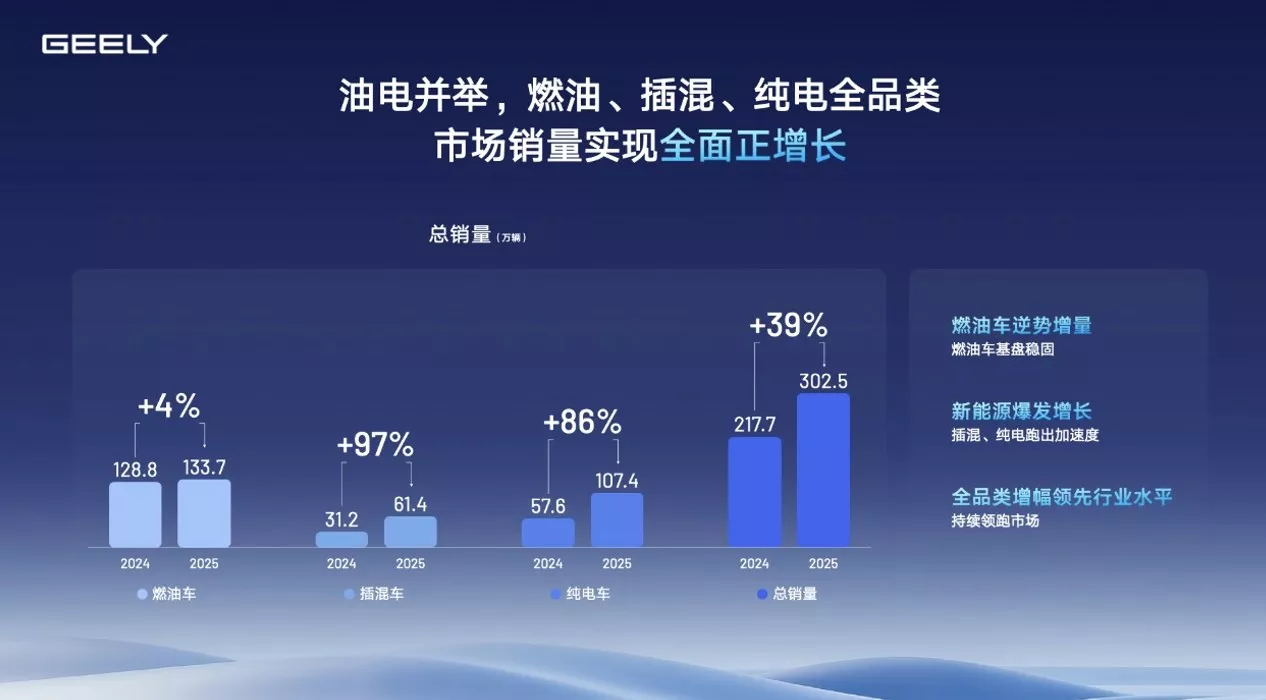
Core Insights - Geely Automobile Holdings Limited reported a record total revenue of 345.2 billion yuan for the year 2025, representing a 25% year-on-year increase [1] - The core net profit attributable to shareholders reached 14.41 billion yuan, up 36% year-on-year, after excluding foreign exchange and other non-core items [1] Financial Performance - Gross profit increased to 57.3 billion yuan, a 25% year-on-year rise [3] - Total cash level rose by 46% to 68.2 billion yuan by the end of 2025 [3] Sales Performance - Total sales volume for Geely reached 3.025 million units, a 39% increase year-on-year, exceeding annual targets [3] - New energy vehicle sales surpassed 1.68 million units, marking a 90% year-on-year growth [3] - In the first two months of 2026, Geely's sales reached 476,000 units [3] Strategic Developments - Geely deepened its "One Geely" strategy, integrating Zeekr and forming a brand layout covering mainstream, high-end, and luxury markets [3] - Zeekr brand sales exceeded 224,000 units, with December sales surpassing 30,000 units for the first time [3] - Lynk & Co. achieved annual sales of 350,000 units, a 23% increase, with Lynk 900 delivering over 50,000 units in six months [3] - Geely Galaxy brand saw a 150% year-on-year increase in sales, totaling 1.24 million units [3] Technological Advancements - Geely launched the industry's first comprehensive AI technology system, with a 2.0 version iteration planned for CES 2026 [3] - In the assisted driving sector, Geely's G-ASD technology is among the industry leaders, with L4 RoboTaxi 2.0 demonstration operations initiated in Hangzhou [4] - The new generation AI cockpit operating system, Flyme Auto 2, has been released, with 2.26 million units equipped with the previous version [4] International Expansion - Geely's overseas sales reached 420,000 units, with over 120,000 new energy vehicles exported [6] - The brand entered 13 new markets, including the UK and Italy, expanding its network to over 1,200 locations in 88 countries and regions by the end of 2025 [6] - Zeekr brand is now present in over 50 countries and regions, while Lynk & Co. operates over 860 stores globally, including more than 200 overseas [6] Future Outlook - Geely aims to launch multiple new models in 2026, with a sales target of 3.45 million units for the year [6]

数据简报 | 2026年2月汽车出口情况简析
中汽协会数据· 2026-03-19 09:15
Core Viewpoint - The automotive export sector in China is experiencing significant growth, with exports projected to increase by over 50% year-on-year by February 2026, indicating a robust upward trend in the industry [1]. Group 1: Overall Export Performance - In January-February 2026, automotive exports reached 1.352 million units, marking a year-on-year increase of 48.4% [2]. - In February 2026, total automotive exports were 672,000 units, showing a month-on-month decline of 1.4% but a year-on-year growth of 52.4% [4]. Group 2: Passenger Vehicle Exports - In February 2026, passenger vehicle exports totaled 586,000 units, reflecting a slight month-on-month decrease of 0.6% but a substantial year-on-year increase of 58% [3]. - For January-February 2026, passenger vehicle exports amounted to 1.174 million units, with a year-on-year growth of 53.3% [3]. Group 3: Commercial Vehicle Exports - In February 2026, commercial vehicle exports were 87,000 units, which is a month-on-month decline of 6.3% but a year-on-year increase of 23.1% [6]. - In January-February 2026, commercial vehicle exports reached 178,000 units, showing a year-on-year growth of 22.4% [7]. Group 4: Traditional Fuel Vehicle Exports - In February 2026, traditional fuel vehicle exports were 391,000 units, with a month-on-month increase of 2.8% and a year-on-year growth of 26.2% [7]. - For January-February 2026, traditional fuel vehicle exports totaled 769,000 units, reflecting a year-on-year increase of 22.2% [7]. Group 5: New Energy Vehicle Exports - In February 2026, new energy vehicle exports reached 282,000 units, showing a month-on-month decline of 6.6% but a year-on-year increase of 110% [9]. - In January-February 2026, new energy vehicle exports were 583,000 units, also reflecting a year-on-year growth of 110% [10].
腾讯、快手、阿里、百度,集体大跌
Di Yi Cai Jing· 2026-03-19 08:37
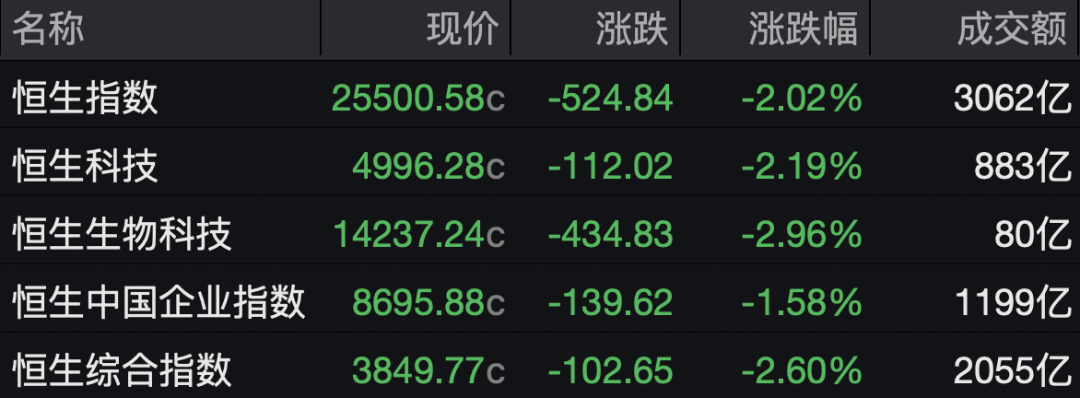
Market Overview - The Hong Kong stock market experienced a significant decline on March 19, with the Hang Seng Index dropping by 2.02% and the Hang Seng Tech Index falling by 2.19% [1][7] - Southbound capital recorded a net inflow of over 26 billion HKD [1] Index Performance - Hang Seng Index closed at 25,500.58, down 524.84 points, with a trading volume of 306.2 billion HKD [2][7] - Hang Seng Tech Index ended at 4,996.28, down 112.02 points, with a trading volume of 88.3 billion HKD [2][7] - Hang Seng Biotech Index fell by 2.96%, closing at 14,237.24 with a trading volume of 8 billion HKD [2][7] - Hang Seng China Enterprises Index decreased by 1.58%, closing at 8,695.88 with a trading volume of 119.9 billion HKD [2][7] - Hang Seng Composite Index dropped by 2.60%, closing at 3,849.77 with a trading volume of 205.5 billion HKD [2][7] Major Stock Movements - Major tech stocks saw significant declines, with Tencent Holdings and Kuaishou both dropping over 6%, and Alibaba falling over 4% [2][7] - Other notable declines included Huahong Semiconductor and Bilibili, both down over 5%, and Baidu and SMIC, both down over 3% [2][7] Specific Stock Performance - Tencent Music fell by 8.05% to 41.12 HKD [3][8] - Tencent Holdings decreased by 6.81% to 513.00 HKD [3][8] - Kuaishou dropped by 6.19% to 55.35 HKD [3][8] - Alibaba fell by 4.14% to 132.00 HKD [3][8] - MiniMax saw a significant drop of 13.89% to 1,066.00 HKD, while Zhiyuan fell by 11.25% to 659.00 HKD [4][9] Sector Performance - The large model concept stocks experienced a pullback, with MiniMax and Zhiyuan leading the declines [4][9] - The non-ferrous metal sector also faced substantial losses, with the WanGuo Gold Group dropping over 19% [5][10] - Other companies in the non-ferrous metal sector, such as Lingbao Gold and Long Resources, also saw declines exceeding 10% [5][10] New Listings - Lantu Automotive's stock fell by 13.2% on its first trading day, closing at 6.51 HKD per share [6][11]

腾讯、快手、阿里、百度,集体大跌
第一财经· 2026-03-19 08:28
Market Overview - The Hong Kong stock market experienced a significant decline on March 19, with the Hang Seng Index dropping by 2.02% to close at 25,500.58 points, and the Hang Seng Tech Index falling by 2.19% to 4,996.28 points [1] - The total trading volume reached approximately 3,062 billion HKD, indicating a high level of market activity despite the downturn [1] Major Stock Movements - Major tech stocks saw substantial declines, with Tencent Holdings down by 6.81% to 513.00 HKD, Kuaishou down by 6.19% to 55.35 HKD, and Alibaba down by 4.14% to 132.00 HKD [2] - Other notable declines included Bilibili down by 5.68% and Baidu down by 3.28% [2] Sector Performance - The large model concept stocks faced a pullback, with MiniMax dropping nearly 14% and Zhiyu falling over 11% [3] - The non-ferrous metal sector also suffered, with WanGuo Gold Group plummeting by 19.61% and several other companies like LingBao Gold and Long Resources experiencing declines exceeding 10% [5] New Listings - Lantu Automotive saw a decline of 13.2% on its first trading day, closing at 6.51 HKD per share [6]

霍尔木兹封锁波及日本汽车行业
日经中文网· 2026-03-19 08:00
Group 1 - The Japanese automotive industry is facing production cuts due to the blockade of the Strait of Hormuz, affecting logistics and supply chains [2][4] - Nissan plans to reduce production by 1,200 vehicles in Japan within March, while Toyota is also implementing production cuts [2][4] - Nissan's subsidiary in Kyushu will cut production of the small MPV "Serena" and SUV "X-Trail" to ensure storage space, while continuing normal production of the profitable "Patrol" model [4] Group 2 - Toyota is expected to reduce production of popular models like the "Land Cruiser" by approximately 20,000 vehicles by the end of March, with an overall reduction of about 40,000 vehicles in the two months leading to April [4] - Japanese automakers are heavily reliant on exports to the Middle East, with S&P Global Mobility reporting that Japanese manufacturers sold over 870,000 new vehicles in ten Middle Eastern countries in 2025, accounting for 30% of the region's total [4] - The logistics disruption is also impacting the supply of automotive parts, with Mitsubishi Chemical Group announcing price increases for certain products due to difficulties in importing naphtha from the Middle East [5][6] Group 3 - The shipping companies have suspended operations in the Strait of Hormuz, which typically sees 10-15 car transport ships from Japan to the Middle East each month, each capable of carrying up to 5,000 vehicles [5] - The situation is exacerbated by attacks on commercial ships in the Red Sea, leading to further shipping route disruptions [5] - If the geopolitical tensions persist, there may be a potential increase in tire prices due to raw material shortages, as companies like Bridgestone and Yokohama Rubber are closely monitoring the situation [6]


20260318申万期货品种策略日报-双焦(JM&J)-20260319
Shen Yin Wan Guo Qi Huo· 2026-03-19 06:35
1. Report Industry Investment Rating - No relevant information provided 2. Core View of the Report - The main contracts of coking coal and coke rose slightly in the night session yesterday, and the total open interest of coking coal was basically flat compared with the previous period. Last week, the coking coal production continued to increase, and the customs clearance volume of Mongolian coal also increased significantly, indicating pressure on the supply side of coking coal. Due to the impact of environmental protection restrictions, the hot metal production continued to decline, but with the end of environmental protection restrictions and the promotion of resumption of work and production, it is expected that the hot metal production will significantly rebound in the future. The increase in the listing volume and trading volume of coking coal last week also proves the current rigid demand resilience, so there is no need to be overly pessimistic about the future trend. The future focus should be on the trend of hot metal production, mine operation, and geopolitical situation [2] 3. Summary by Relevant Catalogs Futures Price and Trading Volume - **Price Changes**: The closing prices of coking coal futures contracts on different delivery dates changed compared to the previous two days. For example, the 1 - month contract decreased by 6.5 to 1475.5, with a decline of -0.44%; the 5 - month contract decreased by 5.0 to 1176.0, with a decline of -0.42%; the 9 - month contract increased by 1.5 to 1282.0, with an increase of 0.12% [2] - **Trading Volume and Open Interest**: The trading volume of the 5 - month contract was 673152, and the open interest was 391077. The open interest of the 1 - month contract decreased by 49, while that of the 9 - month contract increased by 1386 [2] - **Price Spreads**: The price spreads between different contracts also changed. For example, the 1 - 5 month spread increased by 306 to 240, and the 5 - 9 month spread increased by 2.5 to -79.5 [2] Spot Price - **Coal Types and Prices**: The current prices of low - sulfur main coking coal in Linfen (ex - factory price) is 3711, the port pick - up price of Mongolian No. 5 main coking coal is 1210, and the prices of other coal types in different regions are also provided, such as the Tangshan first - grade coke price is 1800 [2] - **Price Changes**: The price of low - sulfur main coking coal in Taiyuan (railway siding price) increased by 44, while the prices of other coal types remained unchanged [2] Policy Information - The National Development and Reform Commission has launched a new batch of 13 landmark major foreign - funded projects with a planned investment of 13.4 billion US dollars. The projects are mainly concentrated in manufacturing fields such as electronics, chemicals, automobiles, and machinery, and for the first time, logistics projects are included in the list, while continuing to support R & D center projects in fields such as biomedicine [2]
马斯克:对黄仁勋深感钦佩 SpaceX AI与特斯拉(TSLA.US)将持续大规模采购英伟达(NVDA.US)芯片
智通财经网· 2026-03-19 06:23
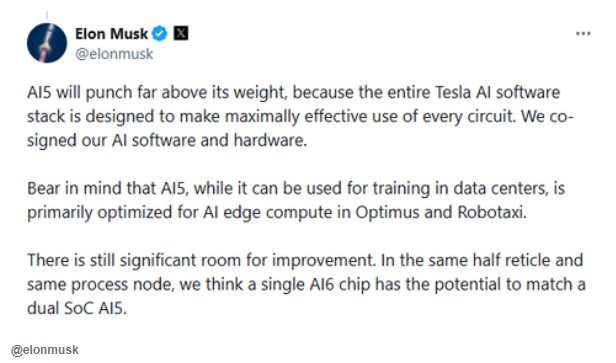
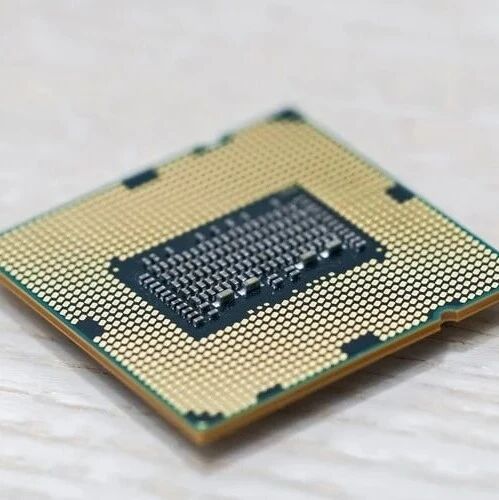
Group 1 - Elon Musk announced that SpaceX AI and Tesla (TSLA.US) will continue to make large-scale purchases of NVIDIA (NVDA.US) chips [1] - Tesla is developing its fifth-generation AI chip aimed at achieving full autonomous driving, which will power its autonomous driving system [1] - The AI5 chip is primarily optimized for AI edge computing support for the Optimus humanoid robot and Robotaxi autonomous vehicles, despite its capability for data center model training [1] Group 2 - Musk indicated that there is significant optimization potential for the AI5 chip, with expectations that the performance of a single AI6 chip could reach the level of a dual-core AI5 system under the same design and manufacturing process [1] - Tesla plans to widely roll out an updated version of its full self-driving (supervised version) software in the coming weeks [1] - SpaceX acquired xAI through an all-stock transaction, occurring ahead of a potential large-scale IPO later this year, marking the first time Musk referred to the merged entity as "SpaceX AI" [2]