
芯片设计

Search documents
上海高端模拟芯片“小巨人”被家具厂收购!
是说芯语· 2025-11-07 01:51
Core Viewpoint - The company MengTian Home is pursuing a significant strategic shift by planning to acquire control of ChuanTu Microelectronics, a high-end analog chip manufacturer, while also considering a change in its actual controller. This move is seen as a critical step towards transforming into the high-tech industry amid challenges in its core furniture business [1][9]. Group 1: Acquisition and Strategic Shift - MengTian Home intends to acquire ChuanTu Microelectronics through a combination of share issuance and cash payment, which is expected to constitute a major asset restructuring [1]. - The acquisition is part of MengTian Home's broader strategy to diversify into the technology sector, following a previous investment in Chongqing Lingxin Microelectronics [9]. Group 2: ChuanTu Microelectronics Overview - ChuanTu Microelectronics, established in May 2016, specializes in the research, design, and sales of high-end analog chips and has been recognized as a national-level "Little Giant" enterprise [3]. - The company offers a range of core products across three main series, including isolation and interface, driver and power, and high-performance analog series, serving over 5,000 clients, including notable companies like BYD and GoodWe [4]. Group 3: Technical Strength and Market Position - ChuanTu Microelectronics has a strong focus on technology R&D, holding 123 patents, and has established significant technical barriers, particularly in automotive-grade products with certifications such as AEC-Q100 and ISO 26262:2018 [5]. - The company has achieved an annual shipment of over 10 million automotive chips, covering all scenarios in new energy vehicles, and is recognized as a top 10 player in the analog chip sector in China [6]. Group 4: Future Development Plans - ChuanTu Microelectronics has a clear development trajectory, having launched its first isolator product in 2018 and secured strategic investments from BYD and SAIC Group in 2023 [8]. - The company aims to increase R&D investment in automotive chips and deepen collaboration with industrial capital, focusing on core areas such as industrial automation and new energy, with a vision of "Creating Excellent Chinese Chips" [8].



中国芯片设计,已经超越韩国
半导体行业观察· 2025-11-07 01:00
Core Viewpoint - The necessity for South Korean companies to invest more actively in semiconductor production to maintain global competitiveness in the AI sector is emphasized [3][4]. Group 1: Importance of In-House Semiconductor Production - Companies must predict and design future chip specifications to succeed in the AI semiconductor market [3]. - The speed of chip manufacturing and integration into products is crucial for success [3]. - Relying on external chip suppliers will result in a secondary position in the market; self-production is essential for leading the industry [3][4]. Group 2: Competitive Landscape - China's semiconductor industry has rapidly grown, with the number of fabless companies increasing from 1,780 in 2019 to 3,626 by 2024 [3]. - South Korea currently has around 150 fabless companies, a number that is declining [3]. - China has transitioned from a fast follower to a design leader in the semiconductor field, establishing a self-sufficient ecosystem [4]. Group 3: Recommendations for South Korea - A triangular cooperation structure between system demand companies, fabless companies, and foundries is necessary for maintaining competitiveness [4]. - Establishing a complete AI platform that integrates hardware design and system software is vital for product differentiation [3].
超威半导体:业绩超预期但难以满足市场高涨情绪
HTSC· 2025-11-06 14:31
Investment Rating - The investment rating for Advanced Micro Devices (AMD) is maintained as "Buy" with a target price of $280.00 [2][9][13] Core Views - AMD's Q3 performance exceeded expectations, with revenue of $9.246 billion, a year-on-year increase of 36%, and non-GAAP EPS of $1.20, up 30% year-on-year. However, the stock fell 4% post-earnings due to concerns over margin guidance and market sentiment [6][10] - The data center business led revenue growth, with Q3 data center revenue at $4.341 billion, a 22% year-on-year increase, driven by increased market share in EPYC server CPUs [7][10] - AMD's management anticipates significant AI-related revenue, projecting hundreds of billions in AI orders for 2026 and beyond, supported by partnerships with major companies like OpenAI and Oracle [8][9] Financial Performance - AMD's revenue projections for 2024 to 2027 are as follows: - 2024: $25.785 billion - 2025E: $34.961 billion - 2026E: $53.434 billion - 2027E: $69.343 billion - Non-GAAP net profit is expected to grow significantly, with projections of $1.641 billion in 2024, $3.758 billion in 2025, and $8.695 billion in 2026 [5][34] Market Position - AMD's x86 server CPU market share increased to 27.3% in Q2 2025, with sales revenue market share rising to 41.0%. The desktop CPU market share also improved to 32.2% [7][10] - The gaming segment saw a remarkable revenue increase of 181% year-on-year, driven by strong demand for the Radeon RX 9000 series [7][10] Valuation Metrics - The adjusted PE ratio for AMD is projected to decrease from 75.52 in 2025 to 26.27 in 2027, indicating a potential for improved valuation as earnings grow [5][34] - The target price of $280 corresponds to an 8.5x price-to-sales ratio for 2026 estimates, suggesting a favorable valuation compared to competitors [9][13]

向“新”而行 知识产权激发深圳创新源动力(人民网)
Ren Min Wang· 2025-11-06 09:12
Core Insights - The Guangdong-Hong Kong-Macao Greater Bay Area is recognized as a leading innovation hub in China, with a strong focus on technology enterprises contributing to the development of new productive forces [1] - The Shenzhen-Hong Kong-Guangzhou cluster has ranked first globally in the World Intellectual Property Organization's 2025 Global Innovation Cluster Ranking, while the Macao-Zhuhai cluster has maintained its position in the top 100 for two consecutive years [1] Company Highlights - Chipsea Technology (Shenzhen) Co., Ltd. has invested heavily in R&D, with over 70% of its workforce dedicated to this area and R&D expenditures exceeding 30% of revenue for the past three years [2] - As of June this year, Chipsea Technology has applied for over 1,300 patents, with more than 500 patents granted, including U.S. patents, ranking among the top in the Sci-Tech Innovation Board for chip design companies [2] - SUTENG Technology Co., Ltd. is the global leader in laser radar market share, focusing on embodied intelligence and has applied for nearly 1,900 patents, with over 70% being invention patents [4] - SUTENG's global patent strategy includes significant deployments in key markets, benefiting from China's patent pre-examination system that accelerates patent authorization and enhances quality [4] - Karrku Technology Co., Ltd., a leader in automotive emergency power supply, has successfully navigated three U.S. "337 investigations" while exporting products to over 100 countries [4][5] Intellectual Property Role - Intellectual property is viewed as a critical asset for companies venturing abroad, with Karrku's chairman emphasizing the importance of timely patent applications and professional legal support during litigation [5] - The role of intellectual property in driving innovation is underscored by the experiences of these companies, highlighting its necessity in technology development and market expansion [5]


芯原股份(688521):单季度营收创新高,在手订单持续转化
CAITONG SECURITIES· 2025-11-05 10:58
Investment Rating - The investment rating for the company is "Accumulate" (maintained) [2] Core Views - The company reported a revenue of 2.255 billion yuan for the first three quarters of 2025, representing a year-on-year increase of 36.64%, with a net profit attributable to shareholders of -347 million yuan. The single-quarter revenue reached a record high of 1.281 billion yuan, showing a year-on-year increase of 78.38% and a quarter-on-quarter increase of 119.26% [7] - The rapid growth in performance is driven by the chip design and mass production businesses, with chip design revenue reaching 428 million yuan, a quarter-on-quarter increase of 290.82% and a year-on-year increase of 80.23% [7] - The company signed new orders worth 1.593 billion yuan in the third quarter of 2025, a significant year-on-year increase of 145.80%, with AI-related orders accounting for approximately 65% [7] - The company expects to achieve revenues of 3.535 billion, 4.802 billion, and 6.393 billion yuan for 2025, 2026, and 2027 respectively, with corresponding price-to-sales ratios of 22.8, 16.8, and 12.6 times [7] Financial Performance Summary - Revenue for 2023 is projected at 2.338 billion yuan, with a revenue growth rate of -12.7%. The net profit attributable to shareholders is expected to be -296 million yuan, with a net profit growth rate of -501.6% [6] - For 2024, revenue is expected to be 2.322 billion yuan, with a slight decline in growth rate to -0.7%. The net profit is projected at -601 million yuan, reflecting a continued decline [6] - The company anticipates a significant recovery in 2025, with revenue expected to rise to 3.535 billion yuan, a growth rate of 52.3%, and a net profit of -192 million yuan, indicating a turnaround in profitability [6] - By 2026, revenue is projected to reach 4.802 billion yuan, with a growth rate of 35.8%, and a net profit of 48 million yuan, marking a positive shift towards profitability [6]

中颖电子:公司主要从事芯片设计及销售
Zheng Quan Ri Bao· 2025-11-05 08:36
Group 1 - The company primarily engages in chip design and sales, focusing on various sectors including smart home appliances, motor control, battery management, OLED display drivers, and automotive electronics [2]

北京君正拟赴港上市,五大核心问题待补充说明,大模型业务成焦点
Zhong Guo Zheng Quan Bao· 2025-11-04 08:48
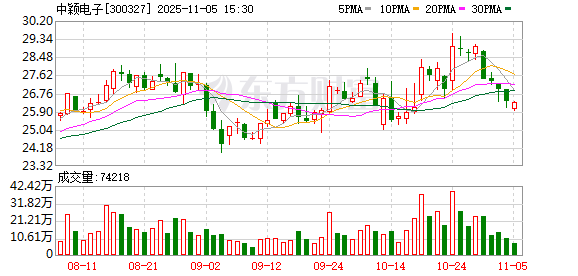
Core Viewpoint - The China Securities Regulatory Commission (CSRC) has requested supplementary materials from Beijing Junzheng regarding its application for listing on the Hong Kong Stock Exchange, focusing on five key issues related to control stability, shareholder qualifications, and business operations [2][3]. Group 1: Control Stability and Shareholder Qualifications - The CSRC emphasizes the need for Beijing Junzheng to clarify the stability of its control, particularly concerning the actual controller's debt repayment ability and whether share pledges could lead to a change in control [3]. - The qualifications of the shareholder Wuyuefeng Investment are under scrutiny, with the CSRC requiring details on whether the underlying domestic entity has any legal restrictions on shareholding [3]. - Recent share reductions by major shareholders, including Wuyuefeng Investment and Beijing Yitang Shengxin Semiconductor Industry Investment Center, have raised concerns about the stability of the company's shareholder structure [3][6]. Group 2: Business Operations and Compliance - The CSRC has requested detailed disclosures regarding the business model and compliance of Beijing Junzheng's large model business, including whether relevant filings have been completed [4]. - The company must clarify the operational status of subsidiaries involved in asset management and investment consulting, and whether they have obtained necessary qualifications for financial operations [4]. - The CSRC also requires information on the fundraising methods, specific uses of raised funds, and the company's data security measures, including user information collection and protection [4]. Group 3: Financial Performance and Risks - Beijing Junzheng has experienced a decline in revenue, with figures dropping from 5.412 billion yuan in 2022 to 4.213 billion yuan in 2024, and net profit decreasing from 779 million yuan to 364 million yuan during the same period [6]. - The company's revenue for the first three quarters of 2025 was 3.437 billion yuan, reflecting a year-on-year growth of 7.35%, while net profit fell by 19.75% to 244 million yuan [6]. - High customer and supplier concentration poses significant operational risks, with over 50% of sales attributed to the top five customers and over 65% of purchases from the top five suppliers in recent years [6].

智能视觉芯片龙头,富瀚微港股上市能否破“盈利局”?
Zhi Tong Cai Jing· 2025-11-04 07:02
Core Insights - Shanghai Fuhangwei Electronics is set to complete its "A+H" dual listing on the Hong Kong Stock Exchange, positioning itself as a leader in the global smart vision processing chip market, with a projected first-place revenue ranking in 2024 [1][3] - Despite its market leadership, the company's financial data reveals a concerning trend of declining revenue and sharply reduced net profits, with a nearly 98% drop in net profit in the first half of 2025 compared to the previous year [1][5] - The company operates under a "fabless" model, focusing on integrated circuit design and sales while outsourcing manufacturing, which allows for concentrated resources on technological innovation [1][2] Business Overview - Fuhangwei's product architecture covers the complete visual processing chain, from image signal acquisition to video storage and management, providing a robust full-stack solution [2] - The company's core product lines include smart video, contributing 67.3% of total revenue in 2024, smart IoT, and smart mobility, with products used in various applications such as security cameras and automotive systems [2] Market Opportunities - The AI wave presents significant transformation opportunities for the visual chip industry, with the global AI SoC market expected to grow from $43.8 billion in 2025 to $109 billion by 2029, at a CAGR of 25.6% [3] - Fuhangwei's "AI for All" strategy aims to leverage technological innovation to provide high-performance, cost-effective AI visual ICs, with plans to expand its R&D team and AI product offerings [3] Financial Challenges - The company's financial performance has shown a downward trend, with total revenue declining from 2.11 billion RMB in 2022 to 1.79 billion RMB in 2024, and a further 14.1% decrease in the first half of 2025 [4] - Net profit has also significantly decreased from 378 million RMB in 2022 to 23.2 million RMB in 2024, with a drastic drop to 1.8 million RMB in the first half of 2025, attributed to reduced procurement from its largest customer and intense price competition [5] Customer and Supply Chain Risks - Fuhangwei's business model is highly exposed to customer concentration risks, with the top five customers contributing 88.4% of revenue in 2024, and the largest customer accounting for 66.7% of total sales [6] - The supply chain is similarly concentrated, with the top five suppliers representing 80.6% of total procurement, making the company vulnerable to disruptions from key suppliers [6] Conclusion - Fuhangwei's strong market position and technological capabilities are its core strengths, but it faces significant challenges including declining profitability, customer concentration, and escalating market competition [7] - The upcoming IPO is seen as a critical opportunity for the company to secure funding for strategic transformation, balancing the potential of AI-driven market growth against its internal operational challenges [7]

新股前瞻 | 智能视觉芯片龙头,富瀚微港股上市能否破“盈利局”?
Zhi Tong Cai Jing· 2025-11-04 02:12
Core Viewpoint - Shanghai Fuhang Microelectronics is set to complete its "A+H" dual listing on the Hong Kong Stock Exchange, despite revealing alarming financial data in its prospectus, indicating a significant decline in revenue and net profit [1][4][5] Group 1: Market Position and Product Lines - Fuhang Microelectronics ranks first in global smart vision processing chip revenue and leads in shipments of edge smart vision processing chips and automotive-grade ISP chips [1] - The company operates under a "fabless" model, focusing on IC design and sales while outsourcing manufacturing, which allows for concentrated resources on technological innovation [1][2] - Its product architecture covers the entire visual processing chain, with three core product lines: smart video, smart IoT, and smart mobility, contributing 67.3% of total revenue in 2024 [2][3] Group 2: Financial Performance and Challenges - The company's total revenue declined from 2.11 billion RMB in 2022 to 1.79 billion RMB in 2024, with a further 14.1% drop in the first half of 2025 [4][5] - Net profit plummeted from 378 million RMB in 2022 to 23.2 million RMB in 2024, and further down to 1.8 million RMB in the first half of 2025, a decline of over 97% [5] - The average selling price (ASP) of products has significantly decreased, with the ASP for smart video dropping from 15.4 RMB in 2022 to 11.1 RMB in the first half of 2025, and for smart IoT from 15.5 RMB to 8.6 RMB [5] Group 3: Customer and Supply Chain Risks - The company faces structural vulnerabilities due to high customer concentration, with the top five customers contributing 88.4% of revenue in 2024, and the largest customer accounting for 66.7% [5][6] - The supply chain is also highly concentrated, with the top five suppliers making up 80.6% of total procurement, exposing the company to risks from potential disruptions [6] Group 4: Strategic Outlook - Fuhang Microelectronics aims to leverage the AI wave with its "AI for All" strategy, focusing on high-performance, cost-effective AI visual ICs to capitalize on market opportunities [3][7] - The upcoming IPO is seen as a critical opportunity for the company to secure funding for strategic transformation and to address its profitability challenges [7]
新股前瞻 | 智能视觉芯片龙头,富瀚微(300613.SZ)港股上市能否破“盈利局”?
智通财经网· 2025-11-04 02:08
Core Insights - Shanghai Fuhuan Microelectronics is set to complete its "A+H" dual listing on the Hong Kong Stock Exchange, positioning itself as a leader in the Chinese visual IC industry [1] - Despite its leading position in the global smart visual processing chip market, the company's financial data reveals a concerning trend of declining revenue and sharply reduced net profit, with a nearly 98% drop in net profit in the first half of 2025 [1][5] - The company has a robust market position and a clear strategy to leverage AI for growth, but faces significant challenges related to profitability and customer concentration [3][7] Company Overview - Fuhuan Microelectronics has over 20 years of experience in the industry, utilizing a "fabless" business model that focuses on IC design and sales while outsourcing manufacturing and testing [1] - The company's product architecture covers a complete visual processing chain, including smart video, smart IoT, and smart mobility, with smart video contributing 67.3% of total revenue in 2024 [2] Market Opportunities - The global AI SoC market is projected to grow from $43.8 billion in 2025 to $109 billion by 2029, with a compound annual growth rate of 25.6% [3] - Fuhuan Microelectronics aims to capitalize on this opportunity through its "AI for All" strategy, focusing on high-performance, cost-effective AI visual ICs [3] Financial Performance - The company's total revenue declined from 2.11 billion RMB in 2022 to 1.79 billion RMB in 2024, with a further 14.1% decrease in the first half of 2025 [4] - Net profit fell from 378 million RMB in 2022 to 232 million RMB in 2024, with a drastic drop to 1.8 million RMB in the first half of 2025, attributed to reduced procurement from its largest customer and intense price competition [5] Risks and Challenges - The company faces structural vulnerabilities due to high customer concentration, with the top five customers accounting for 88.4% of revenue in 2024, and the largest customer contributing 66.7% [6] - The supply chain is also highly concentrated, with the top five suppliers representing 80.6% of total procurement, exposing the company to risks from potential disruptions [6] Strategic Outlook - Fuhuan Microelectronics is at a critical juncture, with the potential for significant market opportunities in AI and IoT, but must address its profitability challenges and customer dependency to ensure sustainable growth [7]