
消费电子

Search documents
存储价格急升 分析师:电子产业下游承压才刚开始
Jing Ji Ri Bao· 2026-02-10 23:02
富达国际基金经理人白芳苹指出,当前市场估值多半预期供应吃紧,能在未来一到两季内缓解,但她认 为,产业紧俏态势可能延续至今年底。这意味着下游企业面临的利润压力或许只是刚开始,远未到结束 之时。 分析师指出,存储价格急升,已在全球股市掀起连锁冲击,且影响时间可能比市场预期更久,电子产业 下游企业面临的利润遭挤压的压力或许只是刚开始。 过去几个月来,从游戏主机、PC品牌到苹果供应链等多数消费电子企业,都因成本暴增导致获利承 压,股价纷纷受挫;反观三星、SK海力士等存储制造商股价则屡创新高。彭博资讯的统计显示出这种 分歧走势:全球消费电子制造商指数去年9月底以来跌约12%,同期存储晶片制造商指数却大涨逾 160%。 ...
内存芯片短缺,全球多行业承压
Huan Qiu Shi Bao· 2026-02-10 22:47
富达国际基金经理维维安·柏表示,目前市场尚未充分意识到短缺持续时间可能带来的风险,当前估值 很大程度上是基于内存芯片供应扰动将在一至两个季度内恢复正常的假设,"我们认为行业供应紧张局 面很可能会持续,甚至可能延续至今年年底"。 路透社称,随着全球内存芯片短缺冲击智能手机市场,诸如苹果公司这样的头部企业也面临两难选择: 是提高价格还是牺牲利润来争取新客户。苹果的决定将对整个行业产生重要影响。 彭博社提到,内存芯片短缺及价格上涨已成为企业财报和电话会议中的高频话题,投资者已明确收到警 报。上周四,智能手机处理器制造商美国高通公司暗示内存限制将影响手机产量后,其股价下跌逾 8%;任天堂在东京市场也因警告短缺导致利润率承压,股价在上周三创下18个月来最大跌幅。此外, 因芯片涨价打压个人电脑需求前景,瑞士电脑外设制造商罗技的股价自去年11月高点已回落约30%。 目前,对需求与盈利的双重担忧正笼罩企业界,而美国超大规模云服务商在人工智能基础设施上的巨额 投入,更引发市场对内存芯片短缺可能进一步恶化的担忧。 总部位于苏黎世的独立投资管理公司GAM Investments基金经理科特西表示,内存芯片的周期通常持续3 至4年。 ...
从黄金到GPU:一条让你多花钱的隐秘供应链
Sou Hu Cai Jing· 2026-02-10 21:39
Group 1 - The IT industry is experiencing a cost storm due to soaring prices of precious metals, which is impacting the semiconductor supply chain and leading to a "digital inflation" crisis [1][4][5] - Gold prices reached a historical peak of nearly $5600 per ounce before experiencing significant volatility, with a record single-day drop of 40 years on January 30, followed by a rebound [2][4] - Silver has seen dramatic price fluctuations, with a single-day drop exceeding 35% on January 31, erasing all gains made since the beginning of the year, further contributing to cost pressures in the semiconductor industry [4][6] Group 2 - Silver's demand is increasing significantly in various industries, particularly in semiconductors, photovoltaics, and automotive sectors, due to its superior conductivity and thermal properties [8][10] - The photovoltaic industry now consumes nearly 30% of the global physical silver supply, as new technologies require almost double the amount of silver compared to older models [10][12] - The semiconductor packaging segment is highly sensitive to raw material price changes, with a 20% increase in gold costs potentially leading to a 5%-8% rise in packaging costs [12][14] Group 3 - The semiconductor industry is facing a supply-demand imbalance, with a projected 23% increase in global DRAM memory demand in 2026, particularly driven by data centers [14][15] - The AI boom is a significant factor driving the current price increase in the semiconductor sector, as the demand for computing power surges [14][15] - The limited capacity expansion in semiconductor manufacturing, with only a 5% increase expected in 2026, is insufficient to meet the explosive demand growth [14][15] Group 4 - Different players in the semiconductor ecosystem are experiencing varied impacts from the price increases, with domestic semiconductor equipment manufacturers benefiting from increased cash flow due to rising prices [15][17] - Chip design and hardware manufacturers are struggling to pass on rising costs to customers, risking customer loss while facing pressure from raw material price hikes [15][17] - The overall price increase across the semiconductor supply chain is likely to affect consumer electronics, leading to higher prices for end products [17][19] Group 5 - Major PC manufacturers have begun raising prices across their product lines, with increases ranging from 10% to 30% due to rising component costs [21][22] - The smartphone industry is also feeling the impact, with companies like Xiaomi and OPPO announcing price hikes for new models, driven by increased memory costs [22][24] - Cloud computing giants like AWS and Google Cloud have announced price increases for their services, marking a significant shift in the pricing paradigm of the industry [25][28] Group 6 - The rise in cloud service prices is expected to affect consumers directly, as software and application subscription costs are also increasing due to higher underlying computing costs [29][31] - The trend of charging for AI services is shifting from aggressive subsidies to more sustainable pricing models, with many companies adjusting their API prices upwards [31][34] - A significant portion of consumers is now willing to pay for AI functionalities that enhance productivity, indicating a shift in consumer attitudes towards software pricing [34][35]


年货越来越“聪明” 工厂实验室里藏着中国智造的密码
Yang Shi Wang· 2026-02-10 21:28
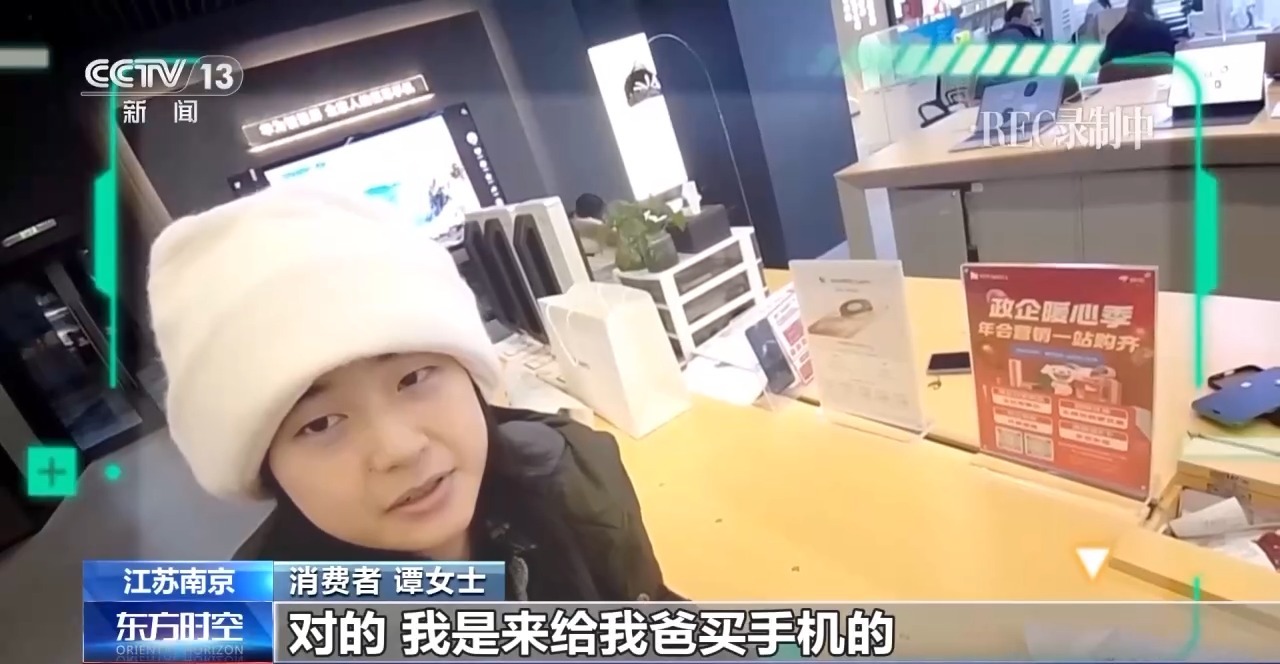
Core Insights - The upcoming Spring Festival is driving a surge in consumer spending on electronic products, particularly in home appliances, 3C products, and automobiles, with a notable increase in sales due to the "old-for-new" policy initiated in 2026 [1][3] - Smart home appliances are gaining popularity, with products like sweeping robots, refrigerators, and washing machines being highly sought after by consumers [9][11] - The rapid advancement in smart technology is evident, with significant improvements in product features and functionalities occurring within short timeframes [11][14] Consumer Behavior - Consumers are actively utilizing the "old-for-new" policy, with discounts of 500 yuan from national subsidies and 200 yuan from store promotions being reported [3] - There is a growing trend of consumers purchasing electronic gifts for family members, such as smartphones and AI hearing aids, reflecting a shift in purchasing dynamics within families [5][7] - The demand for smart kitchen appliances, like cooking machines, is increasing among working professionals [11] Industry Trends - The production of smart appliances is experiencing a significant uptick, with some companies reporting a doubling of production capacity compared to the previous year to meet the demand for the Spring Festival [14] - Young professionals are playing a crucial role in the research and development sectors of technology companies, contributing to innovation and product upgrades [14] - The integration of smart technology into daily life is transforming consumer experiences, with advancements in human-computer interaction making products more user-friendly [8][15] Technological Advancements - The development of smart products is characterized by rapid iterations, with companies implementing "small iterations" every six months and "large iterations" annually to enhance user experience [14] - Innovations in robotics and AI are being showcased, with robots now capable of performing complex tasks and enhancing efficiency in various sectors [17][19] - The emergence of smart city technologies is evident, with applications such as contactless public transport and drone deliveries becoming commonplace [15][19]
魔幻!卖到1000 多的蓝牙耳机,竟然有几万人反馈:物超所值,太好用了……
Xin Lang Cai Jing· 2026-02-10 13:53
Core Insights - The article highlights the popularity and innovative design of the ear-clip headphones, which have received thousands of positive reviews and significant sales since their launch [1][5][24] - The ear-clip headphones are praised for their comfort, allowing users to wear them for extended periods without discomfort, and their open acoustic design enhances situational awareness [9][13] - The company Padmate is set to release a new model, the S80, which features advanced technology such as Bluetooth 6.0 and a competitive price point, making it accessible to a broader audience [36][72] Group 1: Product Features and Design - The ear-clip design is user-friendly, accommodating various hairstyles and eyewear, and is suitable for activities like running and working while remaining aware of the surroundings [11][13] - The S80 model boasts a custom acoustic design that improves sound quality and reduces sound leakage, with a focus on ergonomic fit and comfort [45][49] - The headphones are lightweight, weighing approximately 5 grams each, and feature a stylish design with a premium finish [81][83] Group 2: Technological Advancements - The S80 headphones are equipped with Bluetooth 6.0, which significantly enhances connectivity stability, reduces latency, and improves audio quality compared to previous Bluetooth versions [57][64] - The headphones offer an impressive battery life, with up to 7 hours of continuous playback and a total of 24 hours with the charging case [70][93] - The product incorporates advanced features such as IPX4 water resistance, making it suitable for sports and outdoor activities [85] Group 3: Market Position and Pricing - The S80 headphones are priced at 299 yuan, with a promotional launch price of 149 yuan, positioning them as a competitive option in the market [72][76] - The company aims to differentiate itself by focusing on quality and innovation, releasing only one product per year to maintain high standards [31][33] - The headphones have already gained traction on crowdfunding platforms, breaking records in the audio category and receiving endorsements from notable figures [24][26]

一条不存在的AI耳机广告,为什么惊动OpenAI总裁?
36氪· 2026-02-10 13:30
以下文章来源于爱范儿 ,作者发现明日产品的 爱范儿 . 关注明日产品的数字潮牌 广告是假的,硬件是真的。 来源| 爱范儿(ID:ifanr) 封面来源 | unsplash 每年的美国「春晚」超级碗广告时间,都是科技公司的兵家必争之地,即使只能露面个30秒,也足以成为全球网友的谈资,不用担心没热度。 但对于当下的当红炸子鸡OpenAI来说,不管做不做广告,热度也会自己找上门:前脚刚被对家Claude用广告嘲讽,后脚又传出消息,称OpenAI其实做了 一条广告,最后却紧急撤档。 一条早有预谋的假广告 Reddit上一位自称是OpenAI员工的用户发帖,称自己参与的广告没能播出,还直接「泄露」了相关视频。 视频中出现了OpenAI的首个硬件产品——一个闪亮的扁状球体装置,以及一个佩戴着开放式耳机的男子。 这条「广告」一出,立刻在各大社交媒体引发了大量转发,很快也引发了OpenAI警觉。 OpenAI总裁GregBrockman转发了相关的推文,直接评论「假新闻」;公司的发言人也表示「这完全是假的」。 不过也有一些网友并不买账,认为这个视频质感实在太好,不像AI生成。 官方下场辟谣后,这个Reddit帖子也被火速删 ...

小米集团-W:存储涨价影响短期盈利,汽车业务规模效应渐显-20260211
HTSC· 2026-02-10 13:30
Investment Rating - The investment rating for the company is maintained as "Buy" with a target price of HKD 47.00, down from the previous HKD 53.8 [1][2][5]. Core Insights - The report highlights that the rising prices of DRAM and NAND storage are expected to negatively impact the global demand for consumer electronics and brand gross margins. Despite this, the company is projected to achieve a revenue growth of 10% year-on-year in 4Q25, driven by the delivery of 140,000 vehicles [1][2]. - The automotive business is showing significant growth, with expected revenue of RMB 37.2 billion in 4Q25, representing a 123% year-on-year increase. However, the gross margin for the automotive segment is anticipated to fluctuate due to the changing delivery mix [3][4]. - The smartphone segment is facing challenges, with a projected decline in shipments to 37.8 million units in 4Q25, a decrease of 11.5% year-on-year, and a gross margin expected to drop to approximately 8.5% [1][4]. - The Internet of Things (IoT) segment is expected to see a revenue decline of 19% year-on-year to RMB 25.2 billion, while maintaining a high gross margin of 22.2% [1][4]. - The Internet services revenue is projected to grow by 2% year-on-year to RMB 9.5 billion, with a stable gross margin of 76.9% [1][4]. Summary by Sections Automotive and New Business - The company is expected to deliver approximately 140,000 vehicles in 4Q25, generating revenue of RMB 37.2 billion, a quarter-on-quarter increase of 28.2%. The gross margin for the automotive segment is projected to be around 21.6% [3][4]. - For 2026, the company aims to deliver 650,000 vehicles, exceeding its initial target of 550,000 units, supported by new model launches [2][3]. Smartphone/IoT/Internet - The global smartphone market is projected to see a decline in shipments, with the company's smartphone shipments expected to decrease by 10% year-on-year to 148 million units in 2026. The average selling price (ASP) is anticipated to increase by approximately 5% due to product mix improvements [4][5]. - The IoT business is expected to grow by 5% year-on-year to RMB 130.5 billion, driven primarily by overseas demand [4][5]. Profit Forecast and Valuation - The revenue forecasts for 2025-2027 have been revised downwards by 3.1%, 9.5%, and 11.5%, respectively. The Non-GAAP net profit estimates for the same period have also been reduced by 9.1%, 21.4%, and 19.4% [5][10]. - The target price of HKD 47 corresponds to a 29x PE ratio based on the 2026 earnings forecast [5][20].
光盘录制时代落幕,索尼宣布全面停产蓝光录像机
3 6 Ke· 2026-02-10 13:16
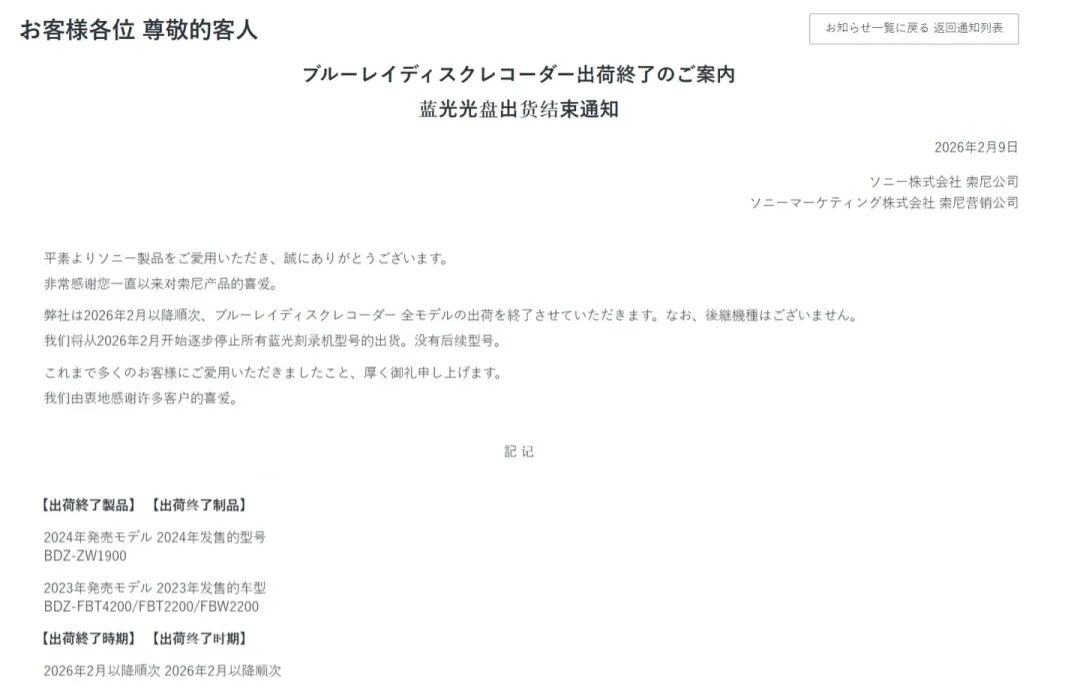
Core Viewpoint - Sony has announced the gradual cessation of all Blu-ray recorder product shipments starting February, marking its complete exit from the home Blu-ray recorder hardware market, with no future models planned [1][3]. Group 1: Product and Market Overview - The cessation includes major models such as the BDZ-ZW1900 and BDZ-FBT4200, ending nearly two decades of Blu-ray recording technology [1][3]. - The exit primarily affects Blu-ray recorders with built-in playback functionality, while Sony has not announced the discontinuation of standard Blu-ray players or UHD Blu-ray players [3]. Group 2: Historical Context and Industry Trends - Blu-ray technology was introduced in 2002 by Sony in collaboration with Philips and Panasonic, addressing the need for high-definition storage with a capacity of 25GB per disc [3][4]. - The peak of Blu-ray recorder sales occurred in 2011, with 6.39 million units shipped in Japan, which has since plummeted to 620,000 units last year [3][4]. Group 3: Competitive Landscape and Industry Decline - Sony held a significant market share in the Blu-ray recorder segment, competing with brands like Panasonic, JVC, LG, Samsung, and Pioneer [4]. - The industry is experiencing a decline due to the rise of streaming services and advancements in storage technology, leading to the exit of several key players from the market [4][5]. Group 4: Broader Implications for Sony - Sony recently announced a divestiture of its television business, planning to establish a joint venture with TCL Electronics to manage its home entertainment operations [4]. - The market share of Sony's television products in China has significantly decreased, with the combined market share of major foreign brands dropping below 5% in 2024 [4].
赛伍技术:公司致力于成为平台化的多元应用领域企业
Zheng Quan Ri Bao Wang· 2026-02-10 12:42
Core Viewpoint - The company aims to become a platform-based enterprise across multiple application fields, with a focus on integrating upstream material research and downstream brand and channel operations through the acquisition of Jinlan Nano [1] Group 1: Business Strategy - The company has expanded its business segments to include photovoltaic materials, lithium battery and new energy vehicle materials, consumer electronics, and semiconductor materials [1] - The acquisition of Jinlan Nano represents a strategic extension from the B2B market to the B2C end-consumer sector [1] - The integration of Jinlan Nano's automotive aftermarket brand and channels is intended to achieve full-chain value coverage from material development to terminal brand and channel operations [1]

标普500冲高后按下暂停键,市场屏息等待关键数据周
Hua Er Jie Jian Wen· 2026-02-10 12:28
Core Viewpoint - The U.S. stock market is experiencing a cautious pause after a strong rebound, with the S&P 500 index slightly retreating from its historical high as investors await key economic data [1] Group 1: Market Dynamics - The market is facing a tug-of-war between recalibrated corporate earnings expectations and an escalating memory chip supply crisis, which is reshaping the landscape of winners and losers in the tech sector [1] - The ongoing earnings season has highlighted supply chain tensions, particularly the surge in memory chip prices, which is threatening profit margins across various industries from consumer electronics to automotive manufacturing [1][4] - Investors are trying to assess the duration of this supply bottleneck and its long-term impacts on inflation and corporate earnings, leading to a pause in trading activity ahead of significant economic data releases [1] Group 2: Performance Disparities - The recent relentless rise in memory chip prices has created a clear divide in the stock market, with a 10% decline in the Bloomberg index tracking global consumer electronics manufacturers since late September, while memory manufacturers, including Samsung, have surged approximately 160% [3] - Companies that can secure supply, raise product prices, or redesign products to reduce memory usage are being evaluated by fund managers and analysts for their ability to navigate this pressure [3] Group 3: Corporate Warnings - Frequent warnings from companies regarding memory shortages and pricing issues are becoming common in earnings reports and conference calls, with Honda and Qualcomm highlighting supply risks that could hinder production [4] - PC manufacturers are facing the most significant impact, with Lenovo and Dell seeing stock declines of over 25% from their peak last October, as concerns about rising chip prices dampen PC demand [4] Group 4: AI-Driven Supercycle - The memory price surge has become a headline issue this earnings season, with concerns about the timeline of supply tightness being questioned, particularly due to massive investments in AI infrastructure by major U.S. companies [6] - The shift in capacity from traditional DRAM to high-bandwidth memory driven by AI has led to a "supercycle," breaking the typical boom-and-bust pattern of memory supply and demand [6] - Despite weak demand for end products like smartphones and cars, DRAM spot prices have skyrocketed over 600% in recent months, with memory manufacturers emerging as winners in the tech sector [6][7]