制造业

Search documents
Inside the US-India Trade Deal
Youtube· 2026-02-03 14:20
Economic Growth and Trade - The trade deal is expected to provide a significant boost to India's growth estimates, potentially raising them from 6.8% to 7.4% or higher [3][4][18] - India has commitments to make purchases of approximately $500 billion over the next five years, which could enhance its economic position [5] - The trade deal is seen as a way to reinvigorate the "China plus one" strategy, positioning India as a key player in global value chains [2][8] Currency and Capital Flows - The Indian rupee has been underperforming, but the trade deal is anticipated to improve investor sentiment and capital flows, which are critical for the economy [6][7][8] - The current account deficit is relatively low compared to historical trends, which may help stabilize capital flows despite recent challenges [8] Budget and Fiscal Policy - The budget includes a fiscal deficit target of around 4.3% of GDP, with a focus on maintaining fiscal discipline while boosting growth through infrastructure investments exceeding $12 billion [11][12] - Customs duty reductions on various sectors, including electronics and pharmaceuticals, are expected to lower input costs and enhance competitiveness [15][17] Job Creation and Employment - The budget aims to create jobs through initiatives targeting micro, small, and medium enterprises, as well as investments in health and tourism sectors [20][21] - Labor code notifications are designed to reduce uncertainty for employers and employees, facilitating job creation [19] Foreign Investment and Market Sentiment - The trade deal is viewed as a catalyst for reversing the trend of foreign investors exiting the Indian market, with expectations of renewed interest in India's macro fundamentals [23][24] - The removal of uncertainties surrounding the trade agreement is likely to signal a more favorable environment for international investors [24]


尼泊尔证券交易所指数微幅上涨
Shang Wu Bu Wang Zhan· 2026-02-03 13:24
Market Overview - The Nepalese stock market experienced fluctuations but closed slightly higher on February 2, 2026, with the NEPSE index rising by 1.53 points to 2695.73 points [1] - The total trading volume for the day was 8.22 billion Nepalese Rupees [1] Sector Performance - Contributing sectors to the index increase included development banks, hotels and tourism, and manufacturing, with the hotel and tourism sector leading with a rise of 1.77% [1] - A total of 114 companies saw their stock prices increase, while 134 companies experienced declines [1] Notable Stocks - SY Panel Nepal and two other companies hit the upper price limit during the trading session [1] - The company with the highest trading volume for the day was Akukola Hydropower Company, with a trading volume of 413.9 million Nepalese Rupees [1]
大叶股份:公司产品以外销为主
Zheng Quan Ri Bao Wang· 2026-02-03 12:13
Group 1 - The core viewpoint of the article is that Daye Co., Ltd. (300879) primarily focuses on export sales and is taking measures to mitigate the impact of foreign exchange rate fluctuations on its financial results [1] - The company adheres to principles of legality, prudence, safety, and effectiveness in conducting foreign exchange derivative hedging activities [1] - The foreign exchange derivative instruments utilized by the company have resulted in certain losses [1]

Modine Manufacturing (NYSE: MOD) Earnings Preview: A Look at the Upcoming Q3 2026 Results
Financial Modeling Prep· 2026-02-03 12:00
Core Viewpoint - Modine Manufacturing is positioned strongly in the manufacturing sector, with upcoming earnings expectations indicating continued growth and solid financial health [1][5][6] Earnings Expectations - Analysts expect Modine to report earnings per share (EPS) of $1.02 and revenue of approximately $763.5 million for the third quarter of 2026, reflecting a strong market position [1][6] - A projected 7.6% increase in quarterly earnings compared to the previous year, with revenues expected to rise by 23.8% [5] Financial Health - Modine maintains a solid financial standing with a debt-to-equity ratio of 0.50, a current ratio of 2.00, and a quick ratio of 1.16, indicating effective debt management and ability to meet short-term obligations [2][6] Stock Performance and Valuation - The stock opened at $185.31, showing investor confidence, with a market capitalization of $9.76 billion [2][3] - Modine's stock has a price-to-earnings (P/E) ratio of 53.56 and a price-to-earnings-growth (PEG) ratio of 1.17, indicating a growth-oriented valuation [3][6] - Over the past year, the stock has ranged from a low of $64.79 to a high of $190.22, with a 50-day simple moving average of $144.10 and a 200-day simple moving average of $141.74 [3] Previous Earnings Performance - In the previous earnings release on October 28th, Modine reported EPS of $1.06, exceeding expectations of $0.97, and achieved revenue of $738.9 million, surpassing the anticipated $699.9 million, representing a 12.3% increase in revenue year-over-year [4]

美国1月制造业PMI进入扩张区间, 美债收益率走高
Qi Huo Ri Bao· 2026-02-03 11:50
Core Viewpoint - The ISM reported that the US manufacturing PMI rose from 47.9 to 52.6 in January, marking the first expansion in nearly a year and the highest level since February 2022 [1] Group 1: Manufacturing Sector Performance - The US manufacturing sector has been in a state of low activity for the past three years, with very few instances of PMI exceeding 50 [1] - The January PMI data is seen as a positive signal for the economy, but caution is advised due to seasonal factors and ongoing tariff issues [1] Group 2: Market Reactions - Following the release of the manufacturing index, US Treasury yields reached a daily high, and the dollar index accelerated to a one-week high [1] Group 3: Expert Commentary - Susan Spence, chair of the ISM manufacturing business survey committee, emphasized the need for caution despite the positive indicators, noting that January is typically a month for inventory replenishment [1] - The report included numerous complaints from executives about tariff and policy uncertainties affecting various industries [1]
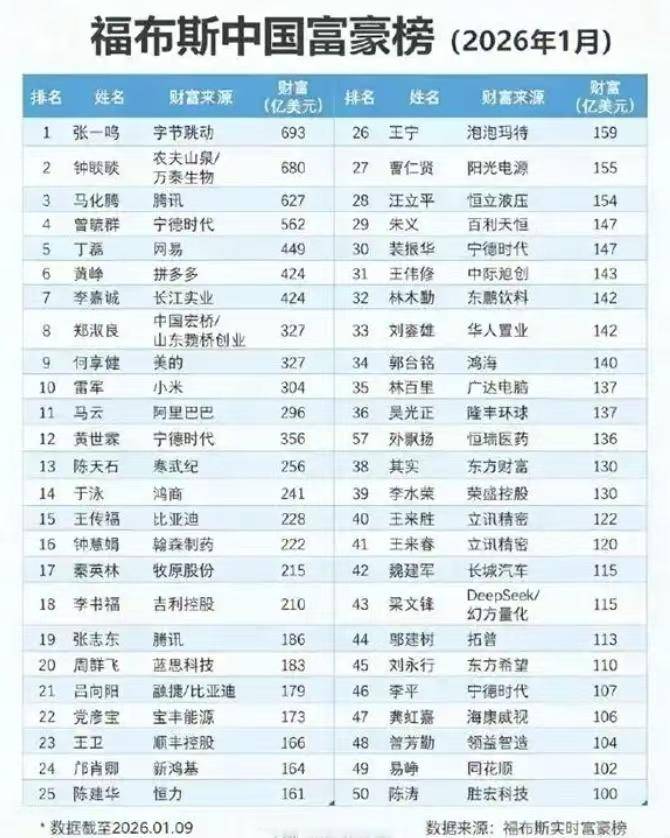
【科技早报】2月2日 星期一1、#中国富豪榜# 最新榜单出炉!张一鸣、钟睒睒、马化腾稳居前三,马云身价缩水跌至第十一位。雷军位列第十,量化基金与DeepSeek创始人梁文锋身价达115亿美元,成长迅速。2、#人形机器人挑战极寒# 宇树G1人形机器人在-47.4℃极寒环境中自主行走了...
Sou Hu Cai Jing· 2026-02-03 11:15
Group 1 - The article presents a ranking of wealthy individuals in the technology and business sectors, highlighting their net worth in billions of dollars [1] - Zhang Yiming, founder of ByteDance, tops the list with a net worth of $85.079 billion, followed by Zhong Guoguo from Nongfu Spring with $58 billion [1] - Other notable figures include Ma Huateng from Tencent with $62.7 billion and Ding Xue from Newe with $50 billion [1] Group 2 - The list includes various industries such as technology, beverage, and automotive, showcasing the diversity of wealth sources among the top individuals [1] - The rankings also reflect the competitive landscape in sectors like electric vehicles, with figures like Wang Chuanfu from BYD at $22.8 billion [1] - The data indicates a significant presence of technology entrepreneurs, with multiple representatives from companies like Tencent and ByteDance [1]

短期压力显化,稳需求政策预期上升
金融街证券· 2026-02-03 11:12
Economic Indicators - The January 2026 PMI index is at 49.3%, down 0.8 percentage points from the end of 2025, indicating a shift from expansion to contraction in manufacturing[3] - The new orders index is at 49.2%, a decrease of 1.6 percentage points, reflecting insufficient total market demand[3] - The new export orders index stands at 47.8%, down 1.2 percentage points, signaling a further slowdown in external demand[3] Supply and Production Dynamics - The production index is at 48.7%, a decline of 2.4 percentage points, while the business activity expectation index is at 52.6%, down 2.9 percentage points[3] - The "production index - new orders index" spread increased by 0.5 percentage points, indicating an expanding supply-demand gap[3] - Finished goods inventory rose from 48.2% to 48.6%, suggesting passive inventory accumulation by firms[3] Price Pressures - The raw material purchase price index is at 56.1%, up 3.0 percentage points, indicating significant cost pressure on businesses[4] - The factory price index is at 50.6%, an increase of 1.7 percentage points, but it lags behind the rise in raw material costs, compressing profit margins[4] Non-Manufacturing Sector - The non-manufacturing PMI for the construction sector is at 48.8%, down 4 percentage points, indicating contraction and nearing historical lower limits[4] - The service sector PMI is at 49.5%, a slight decrease of 0.2 percentage points, reflecting ongoing economic pressures[7] Macro Economic Outlook - There is a risk of evolving into a "stagflation-like" structure due to inflation being driven more by upstream costs rather than demand[5] - The urgency for demand stabilization policies is highlighted to alleviate structural pressures and improve economic expectations[5]
邦达亚洲:澳洲联储如期加息25个基点 澳元早盘上行
Xin Lang Cai Jing· 2026-02-03 11:07
Group 1: US Manufacturing Sector - The US manufacturing Purchasing Managers' Index (PMI) unexpectedly rose from 47.9 to 52.6 in January, marking the first entry into the expansion zone in nearly a year and the highest value since February 2022 [1][6] - The PMI has been below 50 for most of the past three years, indicating a prolonged period of economic weakness in the manufacturing sector [1][6] - ISM's chair, Susan Spence, cautioned that January's data should be viewed with caution, as it is typically a month for inventory replenishment post-holidays, and some purchasing may be preemptive against potential price increases due to ongoing tariff issues [1][6] Group 2: Australian Monetary Policy - The Reserve Bank of Australia raised the cash rate target by 25 basis points to 3.85% to address significant inflationary pressures expected to rise in the second half of 2025 and demand-driven capacity constraints [2][7] - Despite a notable decline in inflation since its peak in 2022, recent increases indicate stronger capacity pressures, leading to the assessment that inflation may remain above target for some time [2][7] - The statement highlighted that private demand growth is significantly stronger than expected, driven by household consumption and investment, with ongoing activity and price increases in the housing market [2][7] Group 3: Gold Market - Gold prices experienced a significant drop, nearing the 4400 mark and reaching a four-week low, with current trading around 4820 [3][8] - The nomination of Kevin Walsh as Fed Chair has cooled expectations for interest rate cuts, supporting the rise of the US dollar index and putting downward pressure on gold prices [3][8] - The forced liquidation of some long positions after the sharp decline further exacerbated the drop in gold prices [3][8] Group 4: Currency Markets - The Australian dollar (AUD) saw a slight decline due to a strengthening US dollar index, which reached a six-day high, although expectations for further rate hikes by the Reserve Bank of Australia limited the downside [4][9] - The USD/CAD pair rose, hitting a four-day high around 1.3700, supported by strong economic data and a cooling of Fed rate cut expectations, while oil prices fell due to easing geopolitical tensions [5][10]
【宏观经济】一周要闻回顾(2026年1月28日-2月3日)
乘联分会· 2026-02-03 10:48
Fiscal Expenditure - In 2025, the national general public budget expenditure is projected to be 28.74 trillion yuan, representing a year-on-year increase of 1% [5] - Key areas of expenditure include social security and employment (up 6.7%), education (up 3.2%), health (up 5.7%), science and technology (up 4.8%), and energy conservation and environmental protection (up 6.1%) [5] Cultural Industry Revenue - In 2025, the revenue of large-scale cultural and related industry enterprises is expected to grow by 7.4%, reaching 1521.35 billion yuan, an increase of 104.51 billion yuan from the previous year [6][8] - The cultural core sector's revenue is projected to be 1031.81 billion yuan, up 11.5%, while related sectors are expected to see a slight decline of 0.4% [9] Investment and Economic Cooperation - In 2025, China's non-financial direct investment abroad is expected to reach 145.66 billion USD, a growth of 1.3% year-on-year [22] - The scale of foreign contracting projects is anticipated to increase, with a completed turnover of 178.82 billion USD, up 7.7%, and new contract amounts reaching 289.22 billion USD, up 8.2% [22] - Labor exports are projected to grow, with 428,000 workers sent abroad, an increase of 4.6% [22] Purchasing Managers' Index (PMI) - In January 2026, the manufacturing PMI is reported at 49.3%, indicating a decline of 0.8 percentage points from the previous month, suggesting a slight contraction in manufacturing activity [12] - The non-manufacturing business activity index is at 49.4%, also down by 0.8 percentage points, reflecting a decrease in market demand [16] - The comprehensive PMI output index stands at 49.8%, down 0.9 percentage points, indicating a general slowdown in production and business activities [18]

【1月策略简评】流动性宽松,债券市场有望保持平稳运行
Sou Hu Cai Jing· 2026-02-03 10:32
Economic Growth and Investment - The GDP growth for the year 2025 is projected at 5.0%, achieving the annual economic growth target, characterized by a "high first, low second" structure and stronger external demand compared to internal demand [2] - In December 2025, industrial production accelerated, particularly in new momentum sectors such as pharmaceuticals, specialized equipment, and computer communications [2] - Fixed asset investment continued to decline throughout 2025, recording negative growth, but is expected to rebound in 2026 due to new policy financial tools and increased special bond investments [2] Consumer and Price Trends - In December, the Consumer Price Index (CPI) rose by 0.8%, reaching the highest level since March 2023, primarily driven by increased food prices [3] - The Producer Price Index (PPI) also turned positive, supported by improved supply-demand order from "anti-involution" policies and rising commodity prices [3] - Retail sales growth slowed to a new low for 2023, but service consumption showed improvement, indicating a potential bottoming out of certain consumer goods [2][3] Fiscal and Monetary Policy - Fiscal revenue saw a significant decline at year-end, with major tax categories dropping, while fiscal expenditure decreased at a slower rate [3] - The fiscal deficit rate for 2026 is expected to remain at a high level of 4.0%, ensuring that expenditure efforts will not diminish [3] - The central bank announced a reduction in the interest rates of structural monetary policy tools and expanded their scope, indicating ongoing targeted support for key sectors [3] External Environment and Market Trends - The Federal Reserve maintained its benchmark interest rate at 3.5%-3.75% in January, aligning with expectations, while continuing its asset purchase program [4] - Global stock markets experienced a broad rally in January, with emerging markets performing particularly well, and A-share indices all rising [4] - The bond market is expected to remain stable under conditions of liquidity easing and policy support, with certain bonds still holding investment value [5]