
棕榈油

Search documents
路透:马来西亚11月份原棕榈油产量估计为198万吨
Xin Hua Cai Jing· 2025-12-03 05:04
Core Viewpoint - The Malaysian palm oil market is experiencing fluctuations in production, export, and inventory levels, indicating potential shifts in supply and demand dynamics [1] Production - Malaysia's crude palm oil production for November is estimated at 1.98 million tons, a decrease of 3% compared to October [1] Export - The export of palm oil is projected to be 1.44 million tons in November, reflecting a significant decline of 14.9% from October [1] Inventory - The ending inventory for November is expected to rise to 2.66 million tons, marking an increase of 7.78% compared to October [1]
GAPKI:印尼9月棕榈油出口量达到220万吨
Xin Hua Cai Jing· 2025-11-27 05:51
Core Insights - Indonesia's palm oil exports in September amounted to 2.2 million tons, a decrease from 2.26 million tons in the same month last year and also lower than the 3.48 million tons exported in August this year [1] Group 1: Export Data - In September, Indonesia exported 2.2 million tons of palm oil, which includes refined palm oil products [1] - The export volume in September 2023 is lower than both the same month last year and the previous month [1] Group 2: Production Data - Indonesia produced 3.93 million tons of crude palm oil in September [1]
国投期货综合晨报-20251125
Guo Tou Qi Huo· 2025-11-25 05:17
Group 1: Energy and Metals Crude Oil - Overnight international oil prices rebounded, with the Brent 01 contract rising 1.41%. The Russia-Ukraine geopolitical risk is entangled between sanctions and peace talks. Supply and demand face greater inventory accumulation expectations in Q4 and Q1 next year, and the downward drive for oil prices remains. Focus on the progress of the Russia-Ukraine peace plan negotiation and the Venezuelan geopolitical risk [1] Precious Metals - Overnight precious metals rose. As several Fed officials advocated a December rate cut, the implied rate cut probability in the interest rate market rose to 80%. The market is uncertain, and precious metals are oscillating at high levels waiting for a directional breakthrough [2] Copper - Overnight copper prices oscillated. LME copper rose with precious metals at the end of the session. The domestic spot market has a certain bullish sentiment, and the SMM social inventory decreased by 1.39 million tons to 18.06 million tons [3] Aluminum - Overnight SHFE aluminum fluctuated narrowly. The social inventory of aluminum ingots and bars decreased by 0.8 million tons on Monday. The aluminum price may continue to adjust, with support around 21,100 yuan [4] Alumina - Alumina's operating capacity is at a historical high, and the supply surplus pattern remains unchanged. It will operate weakly before large-scale production cuts [5] Cast Aluminum Alloy - The spot price of Baotai ADC12 remained at 20,700 yuan. The supply of scrap aluminum is tight, and it will continue to follow the aluminum price, with the possibility of a narrowing spread with AL [6] Zinc - Domestic and overseas mine TC continued to decline. SHFE zinc oscillated in the range of 22,200 - 23,000 yuan/ton. The external demand supports zinc consumption, but the domestic demand is expected to weaken [7] Lead - SHFE lead oscillated in the range of 17,000 - 17,500 yuan/ton. The export of lead-acid batteries is expected to remain under pressure [8] Nickel and Stainless Steel - SHFE nickel rebounded, and stainless steel inventory decreased. However, the short-term contradiction lies in the macro level, and it is advisable to short on rebounds [9] Tin - LME tin closed higher, and SHFE tin oscillated at high levels. It is still advisable to short, and at the same time, match with out-of-the-money call options to hedge risks [10] Lithium Carbonate - The futures price of lithium carbonate opened low and moved lower. The market is highly divergent, and risk control should be prioritized [11] Polysilicon - The fundamentals of polysilicon are weak. The futures price will maintain an oscillating pattern [12] Industrial Silicon - The industrial silicon futures closed slightly lower. It will maintain an oscillating pattern in the short term [13] Iron Ore - The iron ore futures oscillated strongly overnight. The fundamentals are marginally looser, and the price is expected to oscillate [15] Coke - The coke price oscillated. It may oscillate weakly [16] Coking Coal - The coking coal price oscillated weakly. It may oscillate weakly [17] Manganese Silicon - The manganese silicon price oscillated. The bottom support is expected to move down [18] Silicon Ferrosilicon - The silicon ferrosilicon price oscillated. The bottom support will be tested [19] Fuel Oil and Low-Sulfur Fuel Oil - Both high-sulfur and low-sulfur fuel oils face pressure from abundant supply and weak demand [21] Asphalt - The asphalt price is expected to oscillate weakly under pressure [22] Group 2: Chemicals Urea - Urea supply remains sufficient. The market may return to a stalemate [23] Methanol - The methanol futures rose sharply. It is advisable to try to go long on the 5 - 9 spread at low prices [24] Pure Benzene - It is advisable to continue the idea of shorting on rebounds and consider option allocation [25] Styrene - The supply and demand of styrene are in a tight balance, but the support from the cost and demand sides is questionable [26] Polypropylene, Plastic, and Propylene - The market lacks guidance. Polyethylene supply pressure increases, and polypropylene supply is expected to increase slightly [27] PVC and Caustic Soda - PVC may follow the cost. Caustic soda will operate weakly [28] PX and PTA - PX is still strong before new capacity is put into production. PTA is driven by cost [29] Ethylene Glycol - The ethylene glycol price has a short-term rebound expectation, but the rebound space is limited [30] Short Fiber and Bottle Chip - Short fiber prices fluctuate with raw materials. Bottle chip is cost-driven [31] Group 3: Agricultural Products Soybean and Soybean Meal - The soybean meal futures rebounded. Pay attention to the impact of La Niña on South American soybean production [35] Soybean Oil and Palm Oil - Soybean oil and palm oil will oscillate in the short term. Palm oil is weaker [36] Rapeseed Meal and Rapeseed Oil - The rapeseed market focuses on Australian seeds. It is advisable to wait and see in the short term [37] Domestic Soybeans - Domestic soybeans rebounded strongly. Pay attention to the spot market and policy guidance [38] Corn - The corn futures oscillated at a high level. Pay attention to the sales progress of new corn in the Northeast [39] Live Hogs - The far-month hog futures rose, and the near-month is weak. The price may form a double bottom [40] Eggs - The number of newly laid hens is expected to decrease in December. Pay attention to the spot price [41] Cotton - The cotton futures may oscillate in the short term. It is advisable to wait and see [42] Sugar - The international sugar supply is sufficient. Pay attention to the production in India, Thailand, and Guangxi [43] Apples - The apple futures oscillated at a high level. Pay attention to the inventory removal [44] Wood - The wood futures oscillated. It is advisable to wait and see [45] Pulp - The pulp futures fell slightly. It is advisable to wait and see [46] Group 4: Financial Futures Stock Index Futures - A-shares rose in a shrinking volume. The short-term macro liquidity is uncertain. It is advisable to wait and see [47] Treasury Bond Futures - The treasury bond futures oscillated upward. The yield curve may flatten slightly [48] Group 5: Shipping Container Freight Index (European Line) - The SCFIS European route index rose sharply. The 02 contract may maintain a discount [20]
期货交易中如何做到:空仓不急、持仓不慌、开仓无畏,平仓不悔
对冲研投· 2025-11-22 05:02
Group 1: Lithium Carbonate Market - Lithium carbonate has hit a trading limit down, indicating a significant market correction driven by policy intervention and fundamental market dynamics [3][4]. - Regulatory measures by the Guangxi Futures Exchange aim to prevent excessive speculation that could harm the real economy, suggesting that the market is being cooled rather than ending [3][4]. - The volatility in the lithium carbonate market reflects a disconnect between bullish price expectations and current market realities, highlighting the speculative nature of recent trading [4][5]. Group 2: Methanol Market Outlook - The 05 contract for methanol is highlighted as a potential opportunity due to expected improvements in the fundamental market conditions [7]. - Key factors influencing the methanol market include potential gas supply restrictions from Iran, domestic supply reductions, and a possible demand recovery from MTO (Methanol-to-Olefin) operations [8][9][10]. - The market sentiment is expected to shift towards a de-stocking phase starting mid-December, which could positively impact prices [12][20]. Group 3: Industrial Silicon Market - A recent conference involving major players in the organic silicon industry has led to a coordinated reduction in production, effective from December 1, which is expected to alleviate supply pressures on upstream industrial silicon [21][23]. - The price of DMC (Dimethylcyclosiloxane) has increased significantly, reflecting the industry's efforts to stabilize prices amid long-term losses and supply-demand imbalances [23]. - The market's quick response to the news indicates a strong sentiment towards self-regulation within the industry, which could bolster confidence moving forward [23]. Group 4: Nickel Market Dynamics - Nickel prices have been on a downward trend, breaking through key support levels, driven by persistent supply-demand imbalances and high inventory levels [29][30]. - The anticipated tightening of nickel supply has not materialized, leading to a bearish outlook as demand growth remains insufficient to absorb the excess supply [32][33]. - The market is expected to remain under pressure due to high inventories and a lack of significant demand recovery in the near term [33]. Group 5: Futures Market Overview - The futures market shows a clear divergence between bullish opportunities in certain commodities like iron ore and bearish trends in others like coal and agricultural products [46][49][55]. - The core logic driving these trends revolves around supply-demand dynamics, macroeconomic policies, and seasonal factors affecting various commodities [48][54][57]. - Investors are advised to adopt a diversified approach while closely monitoring market conditions and adjusting strategies accordingly [58].


IIGF新闻 | 中财大绿金院专家受邀出席RT2025平行论坛
Xin Lang Cai Jing· 2025-11-12 16:04
Group 1 - The global roundtable conference RT2025 on sustainable palm oil trade was held in Kuala Lumpur, Malaysia, focusing on producer-consumer partnerships [1] - Professor Sun Jin highlighted the growth of sustainable trade, with China's eco-friendly product exports exceeding 10% of total exports and the value of sustainable trade products increasing from $100 billion in 2010 to $200 billion in 2024 [3] - Malaysia ranks as the second developing country in sustainable trade, but has been surpassed by India and Thailand since 2022 [3] Group 2 - The discussion included various stakeholders, such as producers, traders, and consumers, addressing challenges like the EU Deforestation Regulation (EUDR) and palm oil price declines [5] - The need for enhanced supply chain transparency and the use of digital technology was emphasized by consumer representatives [5] - All participants agreed on the necessity of building communication platforms and utilizing innovative financial tools to enhance the resilience and sustainability of palm oil trade [5] Group 3 - The Roundtable on Sustainable Palm Oil (RSPO) was established in 2004 to promote global partnerships for sustainable palm oil industry development [6] - RSPO's annual global conference serves as a significant multi-stakeholder platform for advancing sustainable development in the palm oil sector [6]

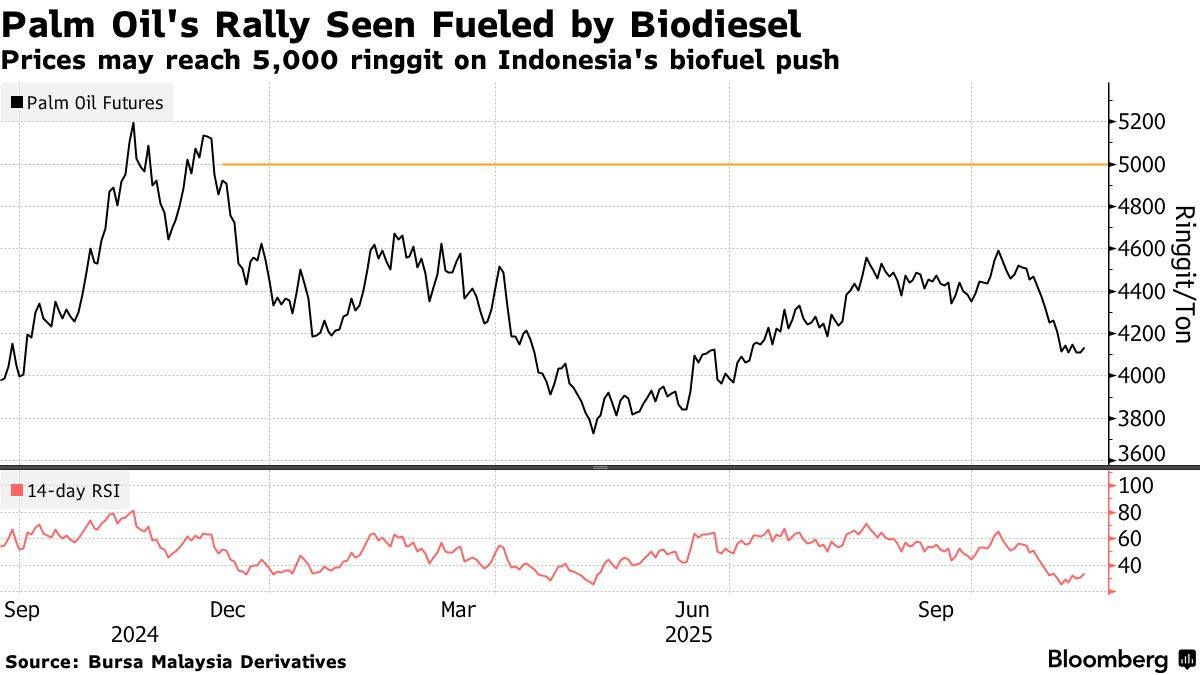
印尼加快推进生物燃料计划 供应紧张有望支撑棕榈油牛市前景
智通财经网· 2025-11-12 03:21
Core Viewpoint - Indonesia's accelerated biofuel plan is expected to lead to a bull market for palm oil, as it will reduce export supplies from the world's largest producer and exacerbate global palm oil supply tightness [1][4]. Group 1: Indonesia's Biofuel Plan - Indonesia plans to increase the biodiesel blending rate from 40% to 50% (B50 plan) by the second half of next year, aiming to lower fuel import costs and greenhouse gas emissions [1][4]. - The implementation of the B50 plan may lead to an increase in domestic palm oil consumption for biodiesel by approximately 25% [4][5]. - The B50 plan could result in a decrease in Indonesia's palm oil exports from an expected 31 million tons this year to 26 million tons by 2026 [4]. Group 2: Market Impact and Price Projections - The palm oil price is projected to rise to 5,000 Indonesian Rupiah per ton between January and June next year if the B50 plan is pursued [1][4]. - Analysts predict that the B50 plan could push palm oil prices to a three-year high of 5,500 Indonesian Rupiah per ton by the first quarter of 2026 [4]. - The current price of palm oil has fluctuated, with a year-to-date decline of 6%, currently at 4,145 Indonesian Rupiah (approximately $999.61) per ton [1]. Group 3: Supply Risks and External Factors - Weather factors, such as the La Niña phenomenon, may disrupt palm oil harvesting and production from November to February due to above-average rainfall [5]. - Other market-driving factors include U.S.-China agricultural trade agreements and U.S. biofuel policies that may restrict soybean oil exports [5]. - Concerns have arisen regarding the Indonesian government's recent seizure of plantation land, which could negatively impact next year's palm oil production if not managed properly [5].
冠通期货早盘速递-20251111
Guan Tong Qi Huo· 2025-11-11 01:29
Hot News - In October, the wholesale sales of new energy passenger vehicles reached 1.621 million, a year-on-year increase of 18.5% and a month-on-month increase of 8.5%. From January to October, the cumulative wholesale was 12.058 million, a growth of 29.9% [4]. - Since 13:01 on November 10, 2025, China has suspended the implementation of countermeasures against the US Section 301 investigation on the maritime, logistics, and shipbuilding industries for one year [4]. - In October, Malaysia's palm oil inventory was 2,464,452 tons, a month-on-month increase of 4.44%, and the palm oil production was 2,043,886 tons, a month-on-month increase of 11.02% [4]. - In the first three quarters of 2025, the net inflow of domestic gold ETFs was 79.015 tons, a year-on-year increase of 164.03%. The gold consumption was 682.730 tons, a year-on-year decrease of 7.95%. Among them, gold jewelry consumption was 270.036 tons, a year-on-year decrease of 32.50%; gold bars and coins consumption was 352.116 tons, a year-on-year increase of 24.55%; industrial and other gold consumption was 60.578 tons, a year-on-year increase of 2.72% [4]. - As of November 10, 2025, the total inventory of domestic soda ash manufacturers was 1.7062 million tons, a decrease of 0.008 million tons from last Thursday, a decline of 0.47%. Among them, the inventory of light soda ash was 0.7977 million tons, a month-on-month decrease of 0.0169 million tons, and the inventory of heavy soda ash was 0.9085 million tons, a month-on-month increase of 0.0089 million tons [4]. Plate Performance - Key focus: Soda ash, glass, coking coal, SHFE copper, SHFE gold [5]. - Night session performance: Non-metallic building materials rose 3.25%, precious metals rose 29.09%, oilseeds rose 9.52%, non-ferrous metals rose 23.21%, soft commodities rose 2.72%, coal, coke, steel and minerals rose 13.02%, energy rose 2.90%, chemicals rose 11.18%, grains rose 1.20%, and agricultural and sideline products rose 3.90% [5]. Large - Class Asset Performance | Category | Name | Daily Return (%) | Monthly Return (%) | Year - to - Date Return (%) | | --- | --- | --- | --- | --- | | Equity | Shanghai Composite Index | 0.53 | Fetching... | 19.90 | | | SSE 50 | 0.51 | -0.12 | 13.75 | | | CSI 300 | 0.35 | -0.29 | 19.32 | | | CSI 500 | 0.22 | -1.39 | 28.26 | | | S&P 500 | 1.54 | -0.64 | 16.17 | | | Hang Seng Index | 1.55 | 0.11 | 32.85 | | | German DAX | 1.65 | 0.38 | 20.35 | | | Nikkei 225 | 1.26 | -4.20 | 27.62 | | | FTSE 100 | 1.08 | 0.62 | 19.75 | | Fixed - Income | 10 - year Treasury Bond Futures | 0.01 | -0.18 | -0.40 | | | 5 - year Treasury Bond Futures | 0.02 | -0.12 | -0.56 | | | 2 - year Treasury Bond Futures | -0.00 | -0.07 | -0.49 | | Commodity | CRB Commodity Index | 1.38 | -0.09 | 2.81 | | | WTI Crude Oil | 0.47 | -2.09 | -16.53 | | | London Spot Gold | 2.88 | -0.57 | 56.84 | | | LME Copper | 1.47 | -1.46 | 23.83 | | | Wind Commodity Index | 1.61 | -2.67 | 30.21 | | Other | US Dollar Index | 0.07 | 0.43 | -8.17 | | | CBOE Volatility Index | 0.00 | 3.27 | 9.97 | [7]
马来西亚10月棕榈油产量为2043886吨 环比增长11.02%
Xin Hua Cai Jing· 2025-11-10 05:18
Core Insights - Malaysia's palm oil production in October reached 2,043,886 tons, reflecting a month-on-month increase of 11.02% [1] - Palm oil exports from Malaysia amounted to 1,692,895 tons in October, showing a month-on-month growth of 18.58% [1] - As of the end of October, Malaysia's palm oil inventory stood at 2,464,452 tons, which is a month-on-month increase of 4.44% [1]
化工:棕榈油行业26年展望
2025-11-10 03:34
Summary of Palm Oil Industry Conference Call Industry Overview - **Industry**: Palm Oil - **Key Countries**: Indonesia, Malaysia Core Insights and Arguments 1. **Indonesia's Palm Oil Production Forecast**: JAPKI predicts a 10% increase in Indonesia's palm oil production by 2025, but actual production may decrease by 2%-3% due to government land reclamation of illegally occupied areas, affecting 4.5 million hectares, or 1/6 of total planting area [1][2][7] 2. **Malaysia's Market Analysis**: Malaysia's production is only 1/5 of Indonesia's, limited by labor shortages and rising fertilizer costs. Monthly inventory fluctuates around 500,000 tons, insufficient to impact the market significantly [1][3][7] 3. **Biodiesel Policy Driving Demand**: Indonesia's B40 and B50 biodiesel initiatives are expected to significantly boost palm oil demand. Rising soybean oil prices in the US and Argentina are leading countries like India and China to switch to palm oil, resulting in a slight increase in recent inventories [1][4][7] 4. **Aging Palm Trees Increasing Supply Pressure**: Malaysia faces challenges with aging palm trees, which require frequent replacement to maintain stable supply. The slow replacement rate exacerbates supply issues [1][6][7] 5. **Global Biodiesel Development Trends**: While US biodiesel policies are cooling, there remains potential for demand growth. China is actively developing Sustainable Aviation Fuel (SAF), with a target to increase SAF blending to 5% within three years, supporting oil prices [1][12][14] Additional Important Insights 1. **Supply Changes in Indonesia and Malaysia**: Indonesia's palm oil production is crucial, with official figures indicating an annual output of 18-20 million tons. However, the transparency of these figures is low, and the government's land reclamation efforts are expected to significantly impact production [2][8] 2. **B50 Policy Status**: The B50 policy in Indonesia has completed testing but may face delays due to funding and technical issues. The new president is optimistic about advancing this policy [9][10] 3. **US Biodiesel Policy Impact**: Recent cooling in US biodiesel policies has created uncertainty, but demand is still expected to grow, with a projected 23% increase in soybean oil usage for biodiesel this summer [11] 4. **China's SAF Developments**: China is increasing its SAF production capacity, which will require more raw materials, thereby supporting overall oil prices [12][17] 5. **Malaysia's Export Adjustments**: Malaysia is reducing palm oil exports to meet domestic aviation fuel needs, tightening supply further [13][27] 6. **Global Biodiesel Trends**: Countries worldwide are pushing biodiesel projects, which will support palm oil demand. Chinese companies are pre-purchasing supplies to mitigate future shortages [27] Conclusion - The palm oil market is expected to tighten by 2025 due to supply constraints in Indonesia and Malaysia, while demand remains strong driven by biodiesel policies. Investment opportunities exist, but close monitoring of policy changes and execution is essential [7][22]
日度策略参考-20251107
Guo Mao Qi Huo· 2025-11-07 06:35
Report Industry Investment Rating No relevant content provided. Core Viewpoints of the Report - The current macro - level is in a relatively vacuum period, A - shares lack a clear upward main line, market trading volume remains low, and the stock index continues to fluctuate, accumulating momentum for the next round of upward movement. Meanwhile, with policy support and abundant macro - liquidity, there is still strong support below the stock index [1]. Summary by Related Catalogs Macro Finance - **Treasury Bonds**: Asset shortage and weak economy are beneficial to bond futures, but the central bank has recently warned of interest - rate risks, suppressing the upward space, showing an oscillating trend [1]. - **Copper**: The tight pattern of US dollar liquidity has eased, market risk appetite has recovered, and copper prices have stopped falling [1]. - **Aluminum**: Recently, the industrial - side driving force is limited, and the macro - level benefits have been digested, so aluminum prices are oscillating [1]. - **Alumina**: With still a small profit in production, domestic alumina production capacity is continuously released, and both production and inventory are increasing, putting pressure on the spot price. Recently, attention should be paid to the cost support [1]. - **Zinc**: The US government shutdown has reached the longest historical record, and market risk - aversion sentiment has increased. The LME zinc inventory has been continuously decreasing, and the short - squeeze movement has driven zinc prices higher. However, considering the domestic oversupply, caution is needed when chasing high prices [1]. Non - ferrous Metals - **Nickel**: The better - than - expected US ADP data has alleviated concerns about the US economic recession, but the expectation of the Fed's interest - rate cut has been suppressed, and market risk appetite has fluctuated. Indonesia has recently restricted the approval of nickel - related smelting projects again, but the approved projects are not affected. In the fourth quarter, attention should be paid to the approval of nickel - ore quotas in 2026. Nickel prices may oscillate in the short term, and high inventory pressure should be watched out for. It is recommended to trade within a short - term range, and the long - term surplus pattern of primary nickel will continue [1]. - **Stainless Steel**: The better - than - expected US ADP data has alleviated concerns about the US economic recession, but the expectation of the Fed's interest - rate cut has been suppressed, and market risk appetite has fluctuated. Indonesia has restricted the approval of nickel - related smelting projects again, but the approved projects are not affected. In the fourth quarter, attention should be paid to the progress of the approval of Indonesian nickel - ore quotas, and the premium at the ore end is currently stable. The price of raw - material ferronickel has weakened slightly, the social inventory of stainless steel has decreased slightly, and the steel mills' production plan for October is stable. Macro - sentiment is fluctuating, steel mills have recently lifted price limits, and stainless - steel futures are oscillating at the bottom. It is recommended to trade short - term and look for opportunities to sell on rallies [1]. - **Tin**: Recently, the positive macro - sentiment has been digested. Considering that the raw - material end of tin has not recovered and the new - quality demand is expected to be good, it is still recommended to pay attention to the opportunity of going long on dips in the long - term [1]. Precious Metals and New Energy - **Precious Metals (Gold and Silver)**: Judges of the high - court generally question the legitimacy of tariffs, increasing market uncertainty and supporting precious - metal prices. However, the resilience of US economic data has disrupted the interest - rate cut expectation. Precious metals are expected to oscillate within a range in the short term [1]. - **Industrial Silicon**: The production capacity in the northwest is continuously resuming, the start - up in the southwest is weaker than in previous years, and the impact of the dry season is weakened [1]. - **Polysilicon**: In the long - term, there is an expectation of production - capacity reduction. In the fourth quarter, the terminal installation will increase marginally. The anti - involution policy has not been implemented for a long time, and market sentiment has faded [1]. - **Lithium Carbonate**: The traditional peak season for new - energy vehicles is approaching, the energy - storage demand is strong, but the hedging pressure is large [1]. Ferrous Metals - **Rebar**: There are concerns about the potential weakening of industrial demand in the off - season. After the macro - sentiment is realized, attention should be paid to the upward pressure. It is advisable to participate in the out - of - the - money accumulative put option strategy [1]. - **Hot - Rolled Coil**: The off - season effect of the industry is not obvious, but the industrial structure is still loose. Similarly, attention should be paid to the upward pressure on prices after the macro - sentiment is realized [1]. - **Iron Ore**: Near - month production is restricted, but the commodity sentiment is good, and there is still an upward opportunity for far - month contracts [1]. - **Sulfur**: The direct demand is good, and there is cost support, but the supply is high, inventory is accumulating, and the sector is under pressure, with limited price rebound space [1]. - **Coke and Coking Coal**: Coking coal is struggling near the previous high, repeatedly testing the support. The high point of the coke futures price has included the expectation of five rounds of price increases, but the actual three - round price increase has been delayed, and the game is intense. Based on the tight supply, coke and coking coal are relatively strong, but considering the weakening of steel prices and the potential weakening of steel demand in November, the futures prices of coke and coking coal are likely to return to the oscillating range after a false breakout. In the short - term, it is advisable to wait and see, and in the long - term, it is still advisable to go long at low prices. Industrial customers can consider selling hedging [1]. Agricultural Products - **Palm Oil**: In the short term, palm oil still faces the dual pressures of seasonal production increase and weak exports. However, starting from November, Malaysia enters the traditional production - reduction cycle. If export data improve significantly, it may trigger a staged rebound [1]. - **Soybean Oil**: According to the China - US negotiation agreement, China will purchase 12 million tons of US soybeans in the next two months, which may bring a loose expectation for soybean oil in the fourth quarter, and the rebound momentum is insufficient. The actual impact needs to be observed [1]. - **Rapeseed Oil**: The meeting between Chinese and Canadian leaders has brought the expectation of Sino - Canadian relaxation, and the bumper harvest of Canadian rapeseed has put pressure on the futures price [1]. - **Cotton**: Although the production capacity in Xinjiang is expanding, the production capacity in the inland may decrease marginally. At the same time, due to the thinning of spinning profits in Xinjiang, the operating rate may also be affected. The contradiction between the expansion of Xinjiang's production capacity and the reduction of spinning profits makes the cotton demand in the new year highly uncertain. The current futures price has fully priced in the selling pressure of new crops, and the downward space is limited, but under the background of a record - high production of new crops, the basis and futures price may continue to be under pressure [1]. - **Sugar**: Typhoons before and after the National Day have had an adverse impact on the sugar - cane harvest and production in South China. There is a seasonal upward impetus for sugar prices in the short term. In the medium - term, considering the good growth of sugar cane this year, the rebound space after the new - sugar listing is expected to be limited [1]. - **Soybeans and Soybean Meal**: The domestic soybean purchase and crushing profit is poor, and the domestic futures price is undervalued. With the expectation of China's purchase of US soybeans, the import cost of US soybeans is expected to rise, and the domestic futures price is expected to rebound in the short term to repair the crushing profit. However, the current loose supply of domestic soybean - meal spot and the expected loose global soybean supply in the long - term limit the rebound height [1]. - **Paper Pulp**: The current trading logic of paper pulp is related to the trading of old warehouse receipts for the November contract. With weak downstream demand, the futures price is under great pressure. It is recommended to conduct a reverse spread between the November and January contracts [1]. - **Log**: The fundamentals of logs have declined, but the spot price is firm. After a sharp decline in the futures price, the risk - return ratio of short - selling is low. It is recommended to wait and see [1]. - **Live Pigs**: In the past half - month, the spot price has risen alternately in the north and south due to secondary fattening, frozen - product storage, and reluctance to sell, which has postponed the production capacity. There is still pressure on the November slaughter. In the short term, the futures price is at the same level as the spot price, and the futures price will follow the spot price to stabilize and then weaken [1]. Energy and Chemicals - **Crude Oil**: OPEC+ plans to continue a small - scale production increase in December, the short - term geopolitical speculation has cooled down, and the suspension of some China - US trade - tariff policies has eased market sentiment [1]. - **Fuel Oil**: Similar to crude oil, the short - term supply - demand contradiction is not prominent, and it follows the trend of crude oil. The demand for the 14th Five - Year Plan construction rush is likely to be falsified, and the supply of Venezuelan crude oil is sufficient. The profit of asphalt is high [1]. - **Natural Rubber**: There is strong support from raw - material costs, the mid - stream inventory is continuously decreasing, and the commodity - market atmosphere is positive [1]. - **BR Rubber**: The decline of crude - oil prices has reduced the cost support of butadiene, and the supply of synthetic rubber is loose. High - production and high - inventory have not suppressed the price, and the mainstream supply price has been continuously reduced [1]. - **PTA**: Gasoline profit and low benzene price support PX. The gasoline cracking price has risen above $15, prompting refineries to increase gasoline production and reduce the feed of aromatic - hydrocarbon units. Overseas device failures and the decline of the operating load of some domestic reforming units, as well as the rotation inspection of large domestic PTA devices, have led to a decline in domestic PTA production [1]. - **Ethylene Glycol**: The decline of crude - oil prices has led to a decline in ethylene - glycol prices, while the rise of coal prices has slightly strengthened the cost support of domestic ethylene glycol. The "Golden September and Silver October" of the polyester industry is coming to an end, and the domestic demand has not significantly declined [1]. - **Short - Fiber**: Gasoline profit and low benzene price support PX. The rebound of PTA prices has strengthened the basis of short - fiber. Short - fiber prices continue to fluctuate closely with costs [1]. - **Styrene**: The Asian benzene price is still weak, the operating rates of STDP and reforming units have declined, the arbitrage window from Northeast Asia to the US is still closed, the profit of domestic styrene has decreased, the number of styrene - device overhauls has gradually increased, and crude - oil prices have continued to fall [1]. - **Urea**: The export sentiment has eased slightly, and the limited domestic demand restricts the upward space. There is support from anti - involution and cost - end factors [1]. - **PE**: Under high - supply, the inventory pressure is large, the intensity of overhauls has weakened, and the downstream demand is slowly increasing, but the peak season is not prosperous [1]. - **PP**: The support from overhauls is limited, and the new - device production has increased the supply pressure. The downstream improvement is less than expected, and the futures price has returned to the fundamentals, showing a weak - oscillating trend [1]. - **PVC**: The overhauls have decreased compared with the previous period, and the new production capacity has been released, increasing the supply pressure. The rise of coal prices has strengthened the cost support of PVC [1]. - **Caustic Soda**: Many alumina projects in Guangxi are planned to be put into production, the subsequent concentration of overhauls will decrease, the high - concentration caustic soda is at a negative premium, the absolute price is low, and the near - month warehouse receipts are limited, so there is a risk of short - squeeze [1]. - **LPG**: The international oil - gas fundamentals are continuously loose, the CP/FEI prices have weakened, the valuation of the domestic LPG futures price has been repaired, and the domestic spot fundamentals are stable due to short - term cooling and chemical rigid demand [1]. Others - **Container Shipping (European Route)**: The positive macro - sentiment has been gradually digested, the expectation of price increases in the peak season has been priced in advance, and the shipping capacity supply in November is relatively loose [1].