
铁路船舶航空航天设备

Search documents
景气分化延续,动能有所减弱
Tebon Securities· 2025-10-31 12:03
Economic Overview - October PMI data indicates a renewed weakening of economic recovery momentum, with manufacturing PMI dropping to 49.0%, down 0.8 percentage points from the previous month and below the seasonal norm[3] - Non-manufacturing PMI slightly increased to 50.1%, up 0.1 percentage points, primarily driven by holiday consumption and seasonal service industry demand[3] - Overall, the composite PMI fell to 50.0%, a decrease of 0.6 percentage points, reflecting a continued divergence in economic conditions between sectors[3] Manufacturing Sector Insights - Manufacturing PMI at 49.0% indicates a return to low levels for the year, with large enterprises at 49.9%, medium enterprises at 48.7%, and small enterprises at 47.1%, showing increased operational pressure across all sizes[3] - Key sub-indices show production index at 49.7% (down 2.2 percentage points), new orders index at 48.8% (down 0.9 percentage points), and employment index at 48.3% (down 0.2 percentage points), indicating a significant decline in production and demand[3] - Industries such as food processing and automotive show stronger supply and demand, while textiles and chemicals remain below the prosperity line, indicating weak sector performance[3] Non-Manufacturing Sector Insights - Non-manufacturing PMI at 50.1% suggests moderate expansion, with construction PMI at 49.1% and service PMI at 50.2%, indicating a mixed performance across sectors[4] - New orders index for non-manufacturing remains weak at 46.0%, reflecting limited short-term demand recovery potential[4] - Employment index for non-manufacturing at 45.2% indicates ongoing labor market pressures, with business activity expectations index rising to 56.1%, suggesting optimism for future operations[4] Policy and Future Outlook - Short-term economic improvement is expected to require stronger policy support, with a focus on the effectiveness of financial tools and special bond allocations in Q4[3] - The upcoming "14th Five-Year Plan" is anticipated to influence medium to long-term policy direction, making 2026's economic performance critical for future strategies[3] - Risks include potential export weakness, real estate market downturns, and insufficient policy momentum[4]
10月PMI数据点评:“十四五”收官的两个月,关注宏观政策的逆周期调节和跨周期部署
Bank of China Securities· 2025-10-31 09:11
Manufacturing Sector - The October Manufacturing PMI index is at 49.0%, a decrease of 0.8 percentage points from September[2] - The production index for October is 49.7%, down 2.2 percentage points month-on-month[2] - The new orders index stands at 48.8%, reflecting a decline of 0.9 percentage points, with new export orders at 45.9%, down 1.9 percentage points[2] - The raw material inventory index is at 47.3%, a decrease of 1.2 percentage points[2] Non-Manufacturing Sector - The October Non-Manufacturing PMI index is at 50.1%, a slight increase of 0.1 percentage points, remaining above the threshold[10] - The new orders index for non-manufacturing is at 46.0%, unchanged from September, while the new export orders index is at 46.2%, down 3.6 percentage points[10] - The construction sector's PMI index is at 49.1%, a decrease of 0.2 percentage points, indicating continued contraction[13] Economic Outlook - The report emphasizes the importance of macroeconomic policies for counter-cyclical adjustment and cross-cycle deployment as the "14th Five-Year Plan" concludes[1] - A total of 500 billion yuan has been allocated for local government debt to support effective investment, indicating ongoing efforts to stabilize growth[1] - The business activity expectation index for the service sector is at 56.1%, indicating strong confidence among service enterprises[15]
宏观经济专题报告:10月制造业PMI环比下滑,服务业PMI小幅扩张
Ge Lin Qi Huo· 2025-10-31 08:29
Report Summary 1. Industry Investment Rating No industry investment rating is provided in the report. 2. Core Viewpoints - In October, the manufacturing PMI continued to be below the boom - bust line for the seventh consecutive month, with a larger - than - seasonal decline due to holiday disruptions and external factors. The new export order index was affected by trade frictions but is expected to rebound in November. The service industry's business activity index showed a mild expansion, and the new policy - based financial instruments are expected to promote economic development [2][3][10]. 3. Summary by Related Contents Manufacturing Industry - **Overall PMI**: In October, the manufacturing PMI was 49.0%, down from 49.8% in the previous month. The decline had some seasonal factors but was larger due to holiday and external impacts. Large - scale enterprises' PMI dropped below the boom - bust line after 5 - month expansion, medium - sized enterprises remained stable, and small - sized enterprises faced greater pressure [2][5]. - **Production and Demand**: The production index was 49.7% (previous 51.9%), and the new order index was 48.8% (previous 49.7%), indicating a slowdown in production and a decline in market demand. The new export order index was 45.9% (previous 47.8%), pulling down the overall new order index. It is expected to rebound in November due to Sino - US trade talks [2][5][6]. - **Industry Performance**: New - energy - related industries such as equipment manufacturing, high - tech manufacturing, and consumer goods manufacturing remained in the expansion range. The basic raw material industry's PMI continued to decline. Some industries like农副 food processing and automotive were active, while others like textile and chemical fiber had weak supply and demand [2][5]. - **Price and Inventory**: The main raw material purchase price index was 52.5% (previous 53.2%), and the ex - factory price index was 47.5% (previous 48.2%), squeezing corporate profits. The raw material inventory index was 47.3% (previous 48.5%), and the finished - product inventory index was 48.1% (previous 48.2%), showing cautious inventory increase [3][6][7]. - **Employment and Expectation**: The manufacturing employment index was 48.3% (previous 48.5%), with little change. The production and business activity expectation index was 52.8% (previous 54.1%), with a slight decline in expectations [8]. Non - manufacturing Industry - **Overall Non - manufacturing**: In October, the non - manufacturing business activity index was 50.1%, up slightly from 50.0% in the previous month [4][8]. - **Construction Industry**: The construction business activity index was 49.1% (previous 49.3%), with a slight decline. The new order index was 45.9% (previous 42.2%), and the employment index was 39.9% (previous 39.7%). The business activity expectation index was 56.0% (previous 52.4%). The real - estate market continued to drag down the construction industry [8]. - **Service Industry**: The service business activity index was 50.2% (previous 50.1%), showing a mild expansion. The new order index was 46.0% (previous 46.7%), the employment index was 46.1% (previous 45.9%), and the business activity expectation index was 56.1% (previous 56.3%). Some industries like railway and aviation were in a high - level boom range, while insurance and real - estate were weak [9]. Policy Impact As of the end of October, 500 billion yuan of new policy - based financial instruments were fully invested, and the supported projects are expected to be implemented intensively from October to December, driving over 7 trillion yuan in total project investment and promoting economic development [4][10].
【权威解读】10月份制造业采购经理指数有所回落 非制造业商务活动指数略有回升
中汽协会数据· 2025-10-31 07:53
Group 1: Manufacturing Purchasing Managers Index (PMI) - In October, the manufacturing PMI decreased to 49.0%, down by 0.8 percentage points from the previous month, indicating a slowdown in production activities [1][2] - Both production index and new orders index fell to 49.7% and 48.8%, respectively, reflecting a decline in production and market demand [2] - Large enterprises maintained a PMI above the critical point, with indices at 50.9% for production and 50.1% for new orders, indicating sustained expansion in this segment [2][3] Group 2: Non-Manufacturing Business Activity Index - The non-manufacturing business activity index rose to 50.1%, an increase of 0.1 percentage points, indicating slight expansion [4][5] - The service sector's business activity index reached 50.2%, showing improvement, particularly in sectors like transportation and hospitality, which benefited from holiday effects [5] - The construction sector's business activity index slightly declined to 49.1%, but the business activity expectation index improved to 56.0%, suggesting a more optimistic outlook [5] Group 3: Comprehensive PMI Output Index - The comprehensive PMI output index stood at 50.0%, indicating overall stability in production and business activities across sectors [6]


国家统计局:10月制造业PMI为49% 比上月下降0.8个百分点
Guo Jia Tong Ji Ju· 2025-10-31 07:16
Manufacturing PMI Overview - In October, the Manufacturing Purchasing Managers' Index (PMI) was 49.0%, a decrease of 0.8 percentage points from the previous month, indicating a decline in manufacturing activity [1][17] - The PMI for large, medium, and small enterprises was 49.9%, 48.7%, and 47.1%, respectively, all below the critical point [1][18] - The production index was 49.7%, down 2.2 percentage points, signaling a slowdown in manufacturing production [2][18] - The new orders index was 48.8%, a decrease of 0.9 percentage points, reflecting a drop in market demand [3][18] - The raw materials inventory index was 47.3%, down 1.2 percentage points, indicating a continued reduction in inventory levels [4][18] - The employment index was 48.3%, a slight decrease of 0.2 percentage points, suggesting a minor decline in employment levels within the manufacturing sector [5][18] Non-Manufacturing PMI Overview - The Non-Manufacturing Business Activity Index was 50.1%, an increase of 0.1 percentage points, indicating expansion in the non-manufacturing sector [6][17] - The service sector's business activity index was 50.2%, up 0.1 percentage points, showing a slight recovery in service sector activity [6][20] - The new orders index for non-manufacturing was 46.0%, unchanged from the previous month, indicating weak market demand [6][20] - The input prices index was 49.4%, an increase of 0.4 percentage points, suggesting a narrowing decline in input prices for non-manufacturing businesses [6][20] - The employment index for non-manufacturing was 45.2%, a slight increase of 0.2 percentage points, indicating a minor improvement in employment conditions [7][20] Composite PMI Overview - The Composite PMI Output Index was 50.0%, a decrease of 0.6 percentage points, indicating overall stability in production and business activities [8][21] - The manufacturing production index was 49.7%, while the non-manufacturing business activity index was 50.1%, contributing to the composite index's position at the critical point [21]
三大重点行业保持扩张!国家统计局发布重要数据
Zhong Guo Zheng Quan Bao· 2025-10-31 05:42
Group 1: Manufacturing Sector - The manufacturing Purchasing Managers' Index (PMI) for October is reported at 49.0%, a decrease of 0.8 percentage points from the previous month, indicating a slowdown in manufacturing activity [1][2] - The production index and new orders index for manufacturing are at 49.7% and 48.8%, respectively, reflecting declines of 2.2 and 0.9 percentage points compared to last month [5] - Large enterprises maintain a PMI of 49.9%, while medium and small enterprises are at 48.7% and 47.1%, respectively, showing varying degrees of decline in economic sentiment [5] Group 2: Key Industries - High-tech manufacturing, equipment manufacturing, and consumer goods industries have PMIs of 50.5%, 50.2%, and 50.1%, respectively, indicating continued expansion and support for the overall manufacturing sector [5] - High-energy-consuming industries have a PMI of 47.3%, down 0.2 percentage points, suggesting a decline in economic activity within this sector [5] Group 3: Non-Manufacturing Sector - The non-manufacturing business activity index is at 50.1%, an increase of 0.1 percentage points from the previous month, indicating a slight expansion in the non-manufacturing sector [1][6] - The service sector's business activity index is reported at 50.2%, reflecting a slight increase and improved economic conditions in service-related industries [9] - The construction sector's business activity index is at 49.1%, a decrease of 0.2 percentage points, indicating a slight contraction in construction activities [10] Group 4: Market Expectations - The production and business activity expectation index for manufacturing is at 52.8%, indicating a generally optimistic outlook among manufacturers [6] - The business activity expectation index for the service sector is at 56.1%, suggesting strong confidence in future industry performance [10] - Overall, the non-manufacturing sector shows signs of stability, with positive changes in investment and consumption-related activities [11]
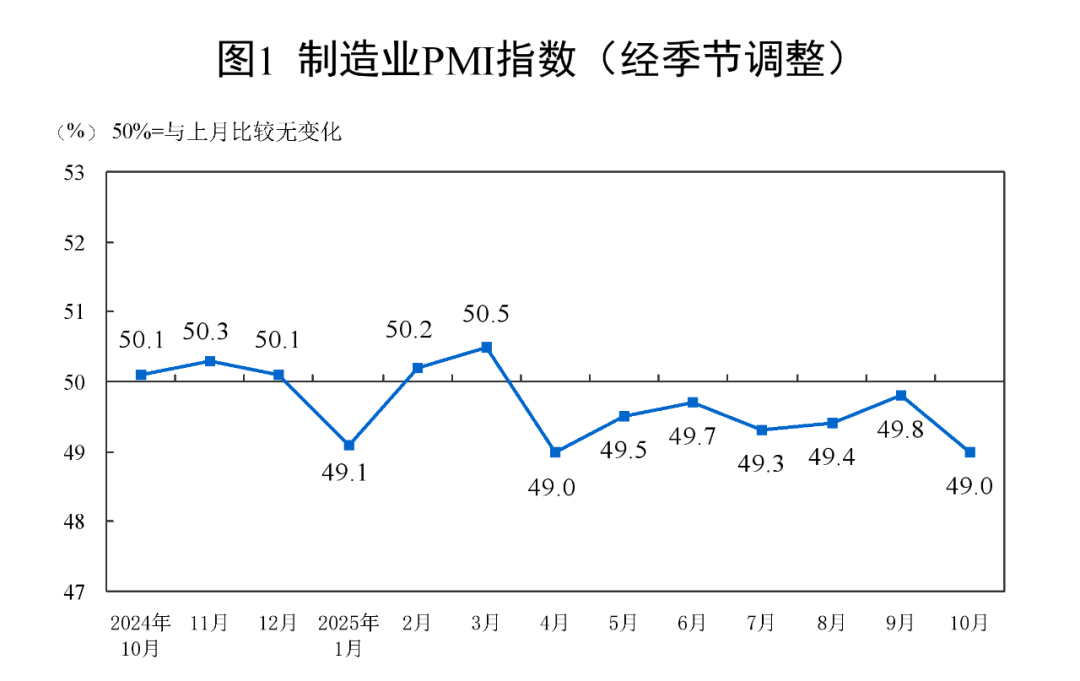
刚刚,国家统计局公布重要数据!
Zheng Quan Ri Bao Wang· 2025-10-31 03:25
Group 1: Manufacturing Sector - The manufacturing Purchasing Managers' Index (PMI) decreased to 49.0% in October, down 0.8 percentage points from the previous month, indicating a slowdown in production activities [1][2] - The production index and new orders index for the manufacturing sector were 49.7% and 48.8%, respectively, reflecting declines of 2.2 and 0.9 percentage points from last month [2] - Large enterprises maintained a PMI above the critical point, with large, medium, and small enterprises' PMIs at 49.9%, 48.7%, and 47.1%, respectively, showing varying degrees of decline [2] Group 2: Key Industries - High-tech manufacturing, equipment manufacturing, and consumer goods industries continued to expand, with PMIs of 50.5%, 50.2%, and 50.1%, respectively, all above the overall manufacturing level [3] - High-energy-consuming industries saw a PMI of 47.3%, down 0.2 percentage points, indicating a decrease in economic activity [3] Group 3: Non-Manufacturing Sector - The non-manufacturing business activity index rose to 50.1%, up 0.1 percentage points, indicating a slight recovery in the sector [4] - The service sector's business activity index increased to 50.2%, with significant growth in sectors closely related to consumer travel, such as rail transport and accommodation, which had indices above 60.0% [4] - The construction sector's business activity index fell to 49.1%, down 0.2 percentage points, indicating a slight decline in activity [4] Group 4: Composite PMI - The composite PMI output index stood at 50.0%, indicating overall stability in production and business activities across sectors [5]
10月份制造业采购经理指数有所回落 非制造业商务活动指数略有回升
Guo Jia Tong Ji Ju· 2025-10-31 02:32
Group 1: Manufacturing PMI Insights - In October, the manufacturing PMI decreased to 49.0%, down 0.8 percentage points from the previous month, indicating a slowdown in production activities [1][2] - Both production index and new orders index fell to 49.7% and 48.8%, respectively, reflecting a decline in manufacturing production and market demand [2] - Large enterprises maintained a PMI above the critical point, with indices at 50.9% for production and 50.1% for new orders, indicating sustained demand in this segment [2][3] Group 2: Non-Manufacturing PMI Insights - The non-manufacturing business activity index rose to 50.1%, up 0.1 percentage points from the previous month, indicating a slight expansion in the sector [4] - The service industry business activity index increased to 50.2%, with significant growth in sectors closely related to consumer travel, such as rail and air transport, which saw indices above 60.0% [4] - The construction industry business activity index slightly decreased to 49.1%, but the business activity expectation index improved to 56.0%, suggesting a positive outlook for future market conditions [4] Group 3: Composite PMI Insights - The composite PMI output index stood at 50.0%, indicating overall stability in production and business activities across sectors [5] - The manufacturing production index and non-manufacturing business activity index were recorded at 49.7% and 50.1%, respectively, contributing to the composite index's position at the critical point [5]
10月份制造业采购经理指数为49.0% 专家解读
Guo Jia Tong Ji Ju· 2025-10-31 02:03
Group 1: Manufacturing PMI Analysis - In October, the manufacturing PMI decreased to 49.0%, down 0.8 percentage points from the previous month, indicating a slowdown in production activities [1][2] - Both production index and new orders index fell to 49.7% and 48.8%, respectively, reflecting a decline in manufacturing production and market demand [2] - Large enterprises maintained a PMI above the critical point, with indices at 50.9% for production and 50.1% for new orders, indicating sustained demand in this segment [2] Group 2: Key Industry Performance - High-tech manufacturing, equipment manufacturing, and consumer goods industries continued to expand, with PMIs of 50.5%, 50.2%, and 50.1%, respectively, significantly above the overall manufacturing level [3] - Conversely, high-energy-consuming industries saw a PMI of 47.3%, indicating a decline in economic activity [3] - Market expectations remain optimistic, with a production and business activity expectation index of 52.8%, suggesting confidence among manufacturers [3] Group 3: Non-Manufacturing PMI Insights - The non-manufacturing business activity index rose to 50.1%, up 0.1 percentage points, indicating a slight recovery in this sector [4] - The service industry business activity index increased to 50.2%, with sectors like rail transport and accommodation showing strong activity levels due to holiday effects [4] - The construction industry business activity index fell to 49.1%, indicating a slight decline, but the business activity expectation index improved to 56.0%, reflecting better future outlooks [4] Group 4: Composite PMI Overview - The composite PMI output index stood at 50.0%, indicating overall stability in production and business activities across sectors [5] - The manufacturing production index and non-manufacturing business activity index were recorded at 49.7% and 50.1%, respectively, contributing to the composite index's position at the critical point [5]
10月份制造业采购经理指数有所回落 非制造业商务活动指数略有回升
Yang Shi Wang· 2025-10-31 02:01
Group 1: Manufacturing PMI Insights - In October, the manufacturing purchasing managers' index (PMI) decreased to 49.0%, down 0.8 percentage points from the previous month, indicating a slowdown in production activities [1][2] - Both production index and new orders index fell to 49.7% and 48.8%, respectively, reflecting a decline in manufacturing production and market demand [2] - Large enterprises maintained a PMI above the critical point, with indices at 50.9% for production and 50.1% for new orders, indicating sustained expansion in this segment [2][3] Group 2: Non-Manufacturing PMI Insights - The non-manufacturing business activity index rose to 50.1%, up 0.1 percentage points from the previous month, indicating a slight recovery in this sector [1][4] - The service industry business activity index increased to 50.2%, with sectors like railway transport and accommodation showing strong activity levels above 60.0% [4] - The construction industry business activity index slightly decreased to 49.1%, but the business activity expectation index improved to 56.0%, suggesting a more optimistic outlook [4] Group 3: Composite PMI Overview - The composite PMI output index stood at 50.0%, indicating overall stability in production and business activities across sectors [1][5] - The manufacturing production index and non-manufacturing business activity index were recorded at 49.7% and 50.1%, respectively, contributing to the composite index's position at the critical point [5]