
IT

Search documents
美股Q4财报季启幕:汇丰与花旗一致看好“超预期”,IT板块仍是增长引擎
智通财经网· 2026-01-12 09:32
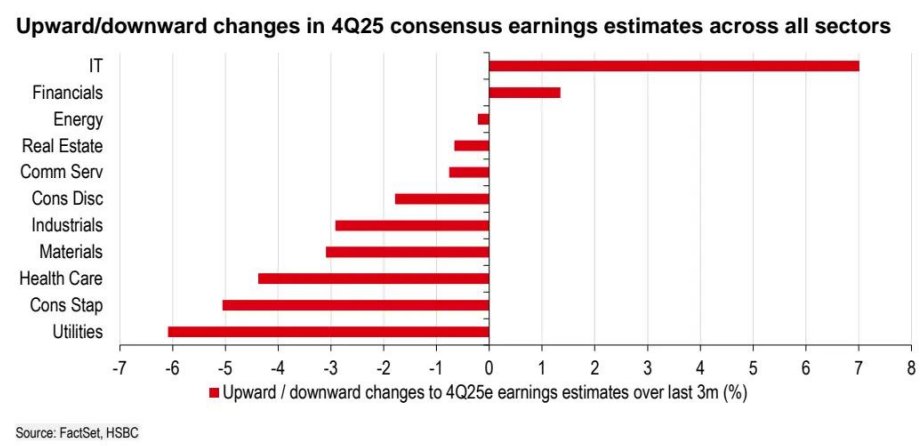
Core Viewpoint - The upcoming earnings season for the S&P 500 index is expected to show a slowdown in earnings growth, but surprises may still occur, particularly in the technology sector, which is projected to lead with double-digit growth [1][2][11]. Group 1: Earnings Expectations - Market consensus anticipates an 8% growth in earnings per share (EPS) for Q4, a decrease from previous quarters that saw double-digit growth [2][3]. - HSBC notes that despite the expected slowdown, past predictions have often underestimated actual earnings, with profit margins expected to slightly increase [2][3]. - Citigroup forecasts that the S&P 500 companies will exceed earnings expectations by approximately 4% in Q4 2025, with EPS reaching $275 [1][11]. Group 2: Sector Performance - The technology sector is expected to achieve a year-over-year EPS growth of about 26%, while other sectors like financials, industrials, and utilities are anticipated to experience significant slowdowns [3][11]. - Financial sector faces a challenging comparison base but remains optimistic about its fundamentals [3][11]. - Communication services and energy sectors are projected to have the highest potential for upward revisions in earnings expectations [11][14]. Group 3: Market Concentration - The concentration of earnings among the "Magnificent Seven" (Mag 7) companies is increasing, with these firms accounting for 26% of S&P 500 earnings and approximately 40% when including technology stocks [5][6]. - The trend of rising concentration is expected to continue, particularly as large-scale data center operators are projected to account for 30-34% of total capital expenditures by 2025-2026 [5]. Group 4: Forward Guidance and Macroeconomic Factors - Investors are particularly focused on forward guidance for 2026 and beyond, with Citigroup projecting an EPS of $320 for 2026, surpassing the consensus estimate of $312 [1][11]. - Key macroeconomic factors such as labor productivity, industrial production, and stable inflation dynamics are expected to support upward revisions in earnings forecasts [11][14]. - The analysis indicates that maintaining a strong productivity growth rate is crucial for sustaining earnings growth in the S&P 500 [14].

脑机接口获20亿融资 行情里的资金门道
Sou Hu Cai Jing· 2026-01-12 00:42
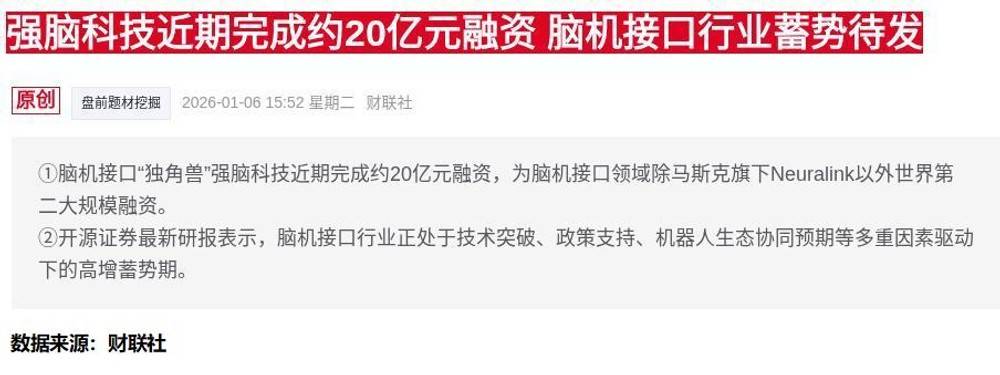
Group 1 - The core point of the news is that the brain-computer interface sector is gaining traction, with a recent $2 billion financing round led by established institutions and listed companies, indicating strong investor interest and potential growth in the industry [1] - The "14th Five-Year Plan" has highlighted the importance of the brain-computer interface sector, with specific goals set for 2030 to position the industry among the world's leaders [1] - According to Open Source Securities, the sector is currently in a "high growth accumulation period," with projections estimating a global market size of $12.4 billion by 2034, growing at an annual rate of 17% [1] Group 2 - The article discusses how stock price movements are often influenced by unseen large capital transactions, rather than being purely random or based on luck [3] - It highlights that certain stocks, particularly in sectors like steel, electric power equipment, and IT, experienced sudden price increases due to prior accumulation of capital, which was not immediately visible to the average investor [3][5] - The use of quantitative data systems allows for the identification of trading patterns among institutional and retail investors, revealing when significant capital movements occur [5][7] Group 3 - The brain-computer interface sector, like other industries, does not experience sudden price changes without underlying capital movements; news serves as a catalyst rather than the cause [9] - The article emphasizes that monitoring capital movements through quantitative data can provide insights into potential stock price movements, reducing the need for speculation [10] - The focus on understanding capital actions rather than chasing market trends can lead to more informed investment decisions [10]
杰创智能:拟不超过40亿元采购IT设备及零配件 用于开展云计算业务及相关技术产品研发
Zheng Quan Shi Bao Wang· 2026-01-08 11:40
Core Viewpoint - The company, Jiechuang Intelligent (301248), announced on January 8 that it plans to procure IT equipment and components from multiple suppliers for a total amount not exceeding 40 billion yuan to advance its artificial intelligence strategy and business transformation [1] Group 1 - The procurement is aimed at developing cloud computing business and related technology products [1] - The expected delivery time for the procured equipment is June 2026 [1]

IT人请收好这份跳槽决策--跳槽五大误区
3 6 Ke· 2026-01-06 01:05
Core Insights - The article discusses the common misconceptions IT professionals have regarding job changes, emphasizing the need for careful consideration of new opportunities and the potential risks involved. Group 1: Misconceptions About Job Change Motivations - Many IT professionals mistakenly believe that changing jobs will resolve their career bottlenecks, often viewing a new environment as a "safe haven" without analyzing the root causes of their dissatisfaction [1][4] - Impulsive job changes driven by dissatisfaction can lead to repeating the same issues in a new role, as seen in the example of an IT manager who moved from a traditional company to a tech firm only to face similar challenges [1][4] Group 2: Misconceptions About Self-Assessment - IT professionals often fall into the trap of "technical omnipotence," overestimating their technical skills while neglecting the importance of soft skills such as business understanding and communication [3] - A common sentiment among IT professionals is the feeling of being undervalued in their current roles, leading to a strong desire to prove their worth in a new position without adequate research [4] Group 3: Misconceptions About Evaluating New Opportunities - Many IT professionals are easily swayed by superficial promises from potential employers regarding their commitment to digital transformation, failing to investigate the company's actual digital strategy and culture [5] - New hires often overlook the "legacy issues" they may inherit, such as disorganized technical frameworks and low team morale, which can hinder their ability to implement strategic initiatives [6] Group 4: Misconceptions About Survival Strategies After Job Change - New employees often misunderstand the concept of "slow is fast," mistakenly believing that technical skills alone will secure their position without building trust and understanding organizational dynamics [8] - Some IT professionals continue to operate independently after joining a new company, neglecting to build alliances with key stakeholders, which can lead to challenges in executing digital projects [9] Group 5: Misconceptions About Long-Term Career Development - Frequent job changes can damage an IT professional's reputation, making it difficult to secure higher-level positions due to perceived lack of stability and loyalty [11] - Many IT professionals mistakenly believe that changing jobs will solve all their problems, overlooking the importance of internal solutions and continuous skill development [12][14]
“同事介绍私活,甲方说酬金 12 万,但同事只给我 5 万,这合理么?我肝了两个多月,每天熬到一两点”
程序员的那些事· 2026-01-05 15:41
Group 1 - The article discusses the importance of maintaining a proper mindset when engaging in freelance work, particularly in the context of compensation and relationships with colleagues [2] - It emphasizes that freelancers should evaluate their own costs and the fairness of the compensation received, rather than focusing on how much their colleagues earn from the same project [2] - The article suggests that maintaining good relationships with colleagues can lead to more opportunities for freelance work in the future [2] Group 2 - The article provides an analogy comparing freelance work to a company project, highlighting that employees typically do not expect to receive a large share of profits from a project completed for their employer [2] - It points out that the colleague who referred the freelance opportunity may have incurred costs or invested effort that is not immediately visible to the freelancer [2] - The overall message encourages freelancers to appreciate the opportunities provided by others and to foster positive professional relationships [2]

行业景气度系列十:去库延续,需求仍待改善
Hua Tai Qi Huo· 2026-01-05 01:16
Report Industry Investment Rating - Not provided in the given content Core Viewpoints Manufacturing - Overall: In December, the manufacturing PMI's five - year percentile was at 57.6%, with a change of 37.3%. Four industries had their manufacturing PMI in the expansion range, 4 less than the previous month and 3 less than the same period last year [4]. - Supply: Slightly declined. The 3 - month average of the manufacturing PMI production index in December was 50.5, a 0.1 - percentage - point decrease from the previous month. Five industries showed month - on - month improvement, while 10 industries declined [4]. - Demand: Still needed improvement. The 3 - month average of the manufacturing PMI new orders in December was 49.6, a 0.4 - percentage - point increase from the previous month. Three industries showed month - on - month improvement, and 12 industries declined [4]. - Inventory: Continued destocking. The 3 - month average of the manufacturing PMI finished - goods inventory in December remained flat at 47.9. Five industries saw inventory increase, and 10 industries saw inventory decrease [4]. Non - Manufacturing - Overall: In December, the non - manufacturing PMI's five - year percentile was at 22.0%, with a change of 10.2%. Eleven industries had their non - manufacturing PMI in the expansion range, 5 more than the previous month and 1 more than the same period last year [5]. - Supply: Employment remained at a low level. The 3 - month average of the non - manufacturing PMI employee index in December was 45.5, a 0.4 - percentage - point increase from the previous month. Both the service and construction sectors increased by 0.4 percentage points [5]. - Demand: Still needed improvement. The 3 - month average of the non - manufacturing PMI new orders in December was 46.3, a 0.4 - percentage - point increase from the previous month. The service sector's new orders increased by 0.2 percentage points, and the construction sector's new orders increased by 1.7 percentage points [5]. - Inventory: Continued destocking. The 3 - month average of the non - manufacturing PMI inventory in December was 45.3, with no change from the previous month. The service sector's inventory remained unchanged, and the construction sector's inventory increased by 0.8 percentage points [5]. Summary by Directory Overview - Manufacturing PMI: In December, the manufacturing PMI's five - year percentile was at 57.6%, with a change of 37.3%. Four industries had their manufacturing PMI in the expansion range, 4 less than the previous month and 3 less than the same period last year [10]. - Non - Manufacturing PMI: In December, the non - manufacturing PMI's five - year percentile was at 22.0%, with a change of 10.2%. Eleven industries had their non - manufacturing PMI in the expansion range, 5 more than the previous month and 1 more than the same period last year [10]. Demand - Manufacturing: The 3 - month average of the manufacturing PMI new orders in December was 49.6, a 0.4 - percentage - point increase from the previous month. Three industries showed month - on - month improvement, and 12 industries declined. - Non - Manufacturing: The 3 - month average of the non - manufacturing PMI new orders in December was 46.3, a 0.4 - percentage - point increase from the previous month. The service sector's new orders increased by 0.2 percentage points, and the construction sector's new orders increased by 1.7 percentage points. Five industries showed month - on - month improvement, and 10 industries declined. Pay attention to the improvement in textiles and pharmaceuticals and the decline in petroleum [16]. Supply - Manufacturing: The 3 - month average of the manufacturing PMI production index in December was 50.5, a 0.1 - percentage - point decrease from the previous month. Five industries showed month - on - month improvement, and 10 industries declined. The manufacturing PMI employee index in December was 48.3, a 0.1 - percentage - point decrease from the previous month. Five industries showed month - on - month improvement, and 10 industries declined. - Non - Manufacturing: The 3 - month average of the non - manufacturing PMI employee index in December was 45.5, a 0.4 - percentage - point increase from the previous month. The service and construction sectors both increased by 0.4 percentage points. Eleven industries showed month - on - month improvement, and 3 industries declined. Pay attention to the decline in non - ferrous metals and农副食品 and the improvement in ferrous metals [25]. Price - Manufacturing: The 3 - month average of the manufacturing PMI ex - factory price index in December was 48.2, a 0.2 - percentage - point increase from the previous month. Seven industries saw their ex - factory prices improve, and 8 industries declined. In terms of profit, the profit trend in December increased by 0.4 percentage points, and the overall continued to converge. - Non - Manufacturing: The 3 - month average of the non - manufacturing charge price index in December was 48.3, a 0.2 - percentage - point increase from the previous month. The service sector increased by 0.3 percentage points, and the construction sector decreased by 0.2 percentage points. Eight industries showed month - on - month improvement, and 7 industries declined. In terms of profit, the profit in December remained unchanged. The service sector decreased by 0.1 percentage points, and the construction sector increased by 0.5 percentage points. Pay attention to the improvement in non - ferrous metals and the decline in petroleum [34]. Inventory - Manufacturing: The 3 - month average of the manufacturing PMI finished - goods inventory in December remained flat at 47.9. Five industries saw inventory increase, and 10 industries saw inventory decrease. The manufacturing PMI raw - material inventory in November decreased by 0.2 percentage points to 47.5. Seven industries saw inventory increase, and 8 industries saw inventory decrease. - Non - Manufacturing: The 3 - month average of the non - manufacturing PMI inventory in December was 45.3, with no change from the previous month. The service sector's inventory remained unchanged, and the construction sector's inventory increased by 0.8 percentage points. Five industries saw inventory increase, and 10 industries saw inventory decrease. Pay attention to the destocking of non - metallic products and the increase in construction inventory [42]. Main Manufacturing Industry PMI Charts - The report provides data on the PMI of various manufacturing industries, including general equipment, special equipment, automobiles, computers, motors, pharmaceuticals,农副食品, textiles, non - ferrous metals, petroleum, chemicals, ferrous metals, non - metallic products, metal products, and chemical fiber and rubber products, showing values, month - on - month changes, three - year averages, and year - on - year changes [53][54][57][58][59][66][67][68].
为什么最赚钱的IT生意往往不起眼?
虎嗅APP· 2025-12-31 11:37
Core Insights - Dell's financial report reveals that over 80% of its PC revenue in FY2024 comes from commercial machines, indicating that flashy gaming laptops are a minority in its product lineup [2] - In the current economic climate, consumer spending is tight, while the commercial sector is providing a rare source of stability for tech giants [3] - Companies prioritize stability and sustainability over flashy features, leading IT giants like Dell and HP to focus on the lucrative commercial business [4] Market Dynamics - The commercial sector has high entry barriers, making it difficult for new players to enter, which results in a natural oligopoly [7] - Customer stickiness is strong in the commercial business, as selling hardware is just the beginning; long-term maintenance, software licensing, and asset management follow [8] - The lock-in effect is significant, as once companies choose their IT systems, switching costs increase, leading to stable and sustainable cash flows [9] Evaluation Criteria - In the commercial market, safety and compliance take precedence over design and cutting-edge technology, with total cost of ownership (TCO) and predictability being key concerns [11] - The procurement decision-making process in commercial settings often prioritizes financial and operational metrics over user experience [16] - Trust is a critical factor in the commercial sector, and establishing a reliable relationship can lead to long-term growth [12] Huawei's Strategy - Huawei's "Huawei Qingyun" has made significant strides in the commercial sector, serving over 100,000 industry clients and implementing over 90 scenario-based solutions [14] - The company aims to balance cost, efficiency, and user experience by leveraging its consumer product capabilities in commercial settings [16][17] - Huawei's approach includes integrating AI and collaborative capabilities into commercial products, enhancing user experience while meeting compliance requirements [19] Brand Positioning - Huawei Qingyun has developed a unified brand expression, which is crucial for accelerating business growth in a market dominated by established players [21] - The company is positioned as a pioneer in the HarmonyOS commercial sector, providing not just hardware but also a sustainable value network through ecosystem collaboration [22] - The HarmonyOS enterprise version aims to provide a secure and controllable technology foundation for businesses, facilitating digital transformation across various industries [24] Future Outlook - The competition in the commercial sector will shift from merely providing durable or cheaper products to balancing organizational management security with employee efficiency [27] - Companies that can build resilient digital foundations for various industries will secure their place in the next decade of digitalization [27]

中青旅股价涨1.01%,国泰基金旗下1只基金重仓,持有30万股浮盈赚取3万元
Xin Lang Cai Jing· 2025-12-30 03:21
Group 1 - The core viewpoint of the news is that Zhongqing Travel Holdings Co., Ltd. has shown a slight increase in stock price, reaching 10.05 yuan per share, with a total market capitalization of 7.275 billion yuan [1] - Zhongqing Travel's main business segments include IT products (44.11%), integrated marketing services (15.83%), tourism services (15.81%), scenic area services (9.47%), real estate sales (5.43%), hotel services (2.67%), technical services (2.49%), tourism products (2.42%), leasing services (1.75%), and others (0.02%) [1] - The company is located in Dongzhimen South Street, Beijing, and was established on November 25, 1997, with its listing date on December 3, 1997 [1] Group 2 - According to data, Guotai Fund has a significant holding in Zhongqing Travel, with its fund "Guotai State-Owned Enterprise Reform Stock A" reducing its stake by 300,000 shares in the third quarter, now holding 300,000 shares, which represents 4.52% of the fund's net value [2] - The fund has a total scale of 58.6695 million yuan and has achieved a return of 6.2% this year, ranking 3712 out of 4195 in its category [2] - The fund manager, Zhang Ronghe, has been in position for 2 years and 208 days, with the fund's total asset scale at 4.156 billion yuan [3]

信雅达股价涨1.02%,华宝基金旗下1只基金位居十大流通股东,持有629.72万股浮盈赚取100.75万元
Xin Lang Cai Jing· 2025-12-30 01:59
Group 1 - The core viewpoint of the news is that Xinyada Technology Co., Ltd. has shown a slight increase in stock price, reaching 15.84 yuan per share, with a total market capitalization of 7.386 billion yuan as of December 30 [1] - Xinyada's main business is focused on software technology development and consulting services, with 99.30% of its revenue coming from the IT industry, 0.65% from the environmental sector, and 0.05% from other business activities [1] Group 2 - Among the top shareholders of Xinyada, Huabao Fund's Huabao CSI Financial Technology Theme ETF increased its holdings by 3.1255 million shares in the third quarter, now holding a total of 6.2972 million shares, which represents 1.38% of the circulating shares [2] - The Huabao CSI Financial Technology Theme ETF has a current scale of 12.319 billion yuan and has achieved a year-to-date return of 17.4%, ranking 2980 out of 4195 in its category [2] - The fund manager, Chen Jianhua, has a tenure of 13 years and 12 days, with the fund's best return during his tenure being 177.41% and the worst being -49.65% [2]

IBM前CEO郭士纳去世,曾深刻影响任正非!
Sou Hu Cai Jing· 2025-12-29 11:38
Core Insights - The passing of former IBM CEO Lou Gerstner has had a profound impact on figures like Ren Zhengfei, highlighting Gerstner's legendary status in the IT industry [1] - Gerstner took over IBM during a crisis in 1993, when the company faced three consecutive years of losses totaling $8 billion, and successfully turned it around, leading IBM to rank among the top ten in the Fortune 500 [1] - Gerstner's management philosophy emphasized a clear, pragmatic, and customer-oriented approach rather than relying on technical expertise, which allowed IBM to achieve a historic turnaround [1] Group 1 - Gerstner's management principles can be summarized in three key points: maintaining technological leadership with a customer-centric focus, grounding decisions in reality, and ensuring execution as a guarantee [2] - The transformation of great companies relies not on technological miracles but on returning to the essence of business, which is Gerstner's most valuable legacy to management [2] - Ren Zhengfei's admiration for IBM's management model led Huawei to invest heavily in adopting IBM's management processes, laying the foundation for its evolution into a world-class enterprise [1][2] Group 2 - The importance of effective management is emphasized, as shrinking a company's scale can lead to a loss of competitiveness, while expanding without effective management can lead to failure [2] - Companies must strengthen management and service to survive in a challenging environment, as external factors are often beyond control [2] - The necessity for companies to find the right mentors during critical phases is underscored, with IBM serving as a prime example [2]
