
纺织

Search documents
第三批优先控制化学品名录酝酿,涉石化塑料橡胶等领域
Di Yi Cai Jing· 2025-11-22 03:26
Core Insights - The Ministry of Ecology and Environment has initiated the process to include another batch of chemical substances in the priority control list to enhance the management of new pollutants and ensure ecological safety and public health [1][2] Group 1: Priority Control Chemical List - The third batch of the priority control chemical list includes 24 types of chemical substances, primarily affecting industries such as petrochemicals, plastics, rubber, pharmaceuticals, textiles, dyes, coatings, pesticides, leather, and electroplating [1] - The previous two batches of the priority control chemical list included a total of 40 types of chemical substances, which encompass hazardous materials like short-chain chlorinated paraffins, formaldehyde, mercury and its compounds, hexavalent chromium compounds, lead compounds, and various carcinogens [1][2] Group 2: Environmental Risk Management - The "New Pollutant Management Action Plan" aims to complete environmental risk screening and assessment for high-concern and high-usage chemical substances by 2025, and to establish a regulatory framework for managing toxic and harmful chemical substances [2][5] - The priority control chemical list focuses on substances that pose significant environmental and health risks, considering factors such as persistence, bioaccumulation, and toxicity to aquatic environments [2][3] Group 3: Implementation and Compliance - Companies are required to provide detailed information on the production and usage of chemicals listed in the priority control list, including quantities, types, and applications, as part of their environmental impact assessments [4] - Facilities involved in the production or storage of priority control chemicals must implement measures to prevent soil and groundwater contamination, including the installation of monitoring devices [4]

凤竹纺织振幅16.60%,上榜营业部合计净买入76.95万元
Zheng Quan Shi Bao Wang· 2025-11-21 13:42
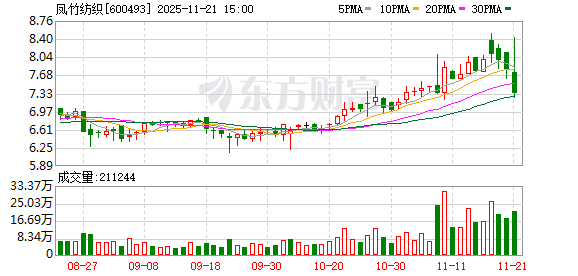
10月31日公司发布的三季报数据显示,前三季度公司共实现营业收入6.88亿元,同比下降5.54%,实现 净利润1573.54万元,同比下降74.86%。(数据宝) 凤竹纺织11月21日交易公开信息 上交所公开信息显示,当日该股因日振幅值达16.60%上榜,营业部席位合计净买入76.95万元。 证券时报·数据宝统计显示,上榜的前五大买卖营业部合计成交6103.94万元,其中,买入成交额为 3090.44万元,卖出成交额为3013.50万元,合计净买入76.95万元。 具体来看,今日上榜营业部中,第一大买入营业部为瑞银证券有限责任公司上海花园石桥路证券营业 部,买入金额为921.45万元,第一大卖出营业部为高盛(中国)证券有限责任公司上海浦东新区世纪大道 证券营业部,卖出金额为747.88万元。 资金流向方面,今日该股主力资金净流出50.67万元,其中,特大单净流入126.86万元,大单资金净流出 177.53万元。近5日主力资金净流出34.50万元。 凤竹纺织(600493)今日下跌5.66%,全天换手率7.77%,成交额1.62亿元,振幅16.60%。龙虎榜数据显 示,营业部席位合计净买入76.95万元。 | ...

陇西巧织文化产业有限公司成立 注册资本5万人民币
Sou Hu Cai Jing· 2025-11-21 11:52
Group 1 - A new company named Longxi Qiaozhi Cultural Industry Co., Ltd. has been established with a registered capital of 50,000 RMB [1] - The legal representative of the company is Yang Fangfang [1] - The business scope includes various activities such as artistic creation, sales of textile products, embroidery processing, and manufacturing of arts and crafts [1] Group 2 - The company is involved in the retail and sales of a wide range of products including daily necessities, sports equipment, and leather goods [1] - It also offers services such as conference and exhibition services, labor services (excluding labor dispatch), and internet sales [1] - The company engages in the manufacturing of industrial textile products and provides information technology consulting services [1]
滇港澳企业家昆明共觅东盟合作新机遇
Zhong Guo Xin Wen Wang· 2025-11-21 11:24
Group 1 - The 2025 Yunnan-Hong Kong-Macao Entrepreneurs Forum opened in Kunming, focusing on exploring cooperation opportunities with ASEAN in sectors such as cultural tourism, healthcare, biomedicine, and highland specialty agriculture [1] - Yunnan has a close economic relationship with the Guangdong-Hong Kong-Macao Greater Bay Area, serving as a major supplier of agricultural products and flowers, with 70% of the flowers in the Bay Area sourced from Yunnan [1] - Entrepreneurs from Yunnan, Hong Kong, and Macao are looking towards the large market of South and Southeast Asia, which has a population of 2.5 billion, to leverage their respective advantages for mutual development [1] Group 2 - As of the end of 2024, 101 overseas enterprises from Yunnan have been established in Hong Kong, with several Yunnan companies listed there [2] - The Hong Kong government has initiated a program to assist mainland enterprises in expanding internationally, highlighted by dialogue sessions on "going global" and "listing in Hong Kong" during the forum [2] - Kunming Longjin Pharmaceutical Co., Ltd. is actively exploring opportunities in ASEAN, particularly in the cultivation and research of traditional Chinese medicine, and aims to collaborate with Hong Kong and Macao institutions for project implementation [2]
金鹰股份:金鹰集团累计质押股份约7179万股
Mei Ri Jing Ji Xin Wen· 2025-11-21 10:27
Group 1 - The core point of the news is that Jinying Co., Ltd. announced that its controlling shareholder, Zhejiang Jinying Group, holds approximately 183 million shares, accounting for 50.25% of the total share capital, and has pledged about 71.79 million shares, which is 39.17% of its holdings and 19.68% of the total share capital [1] - As of the first half of 2025, the revenue composition of Jinying Co., Ltd. is as follows: textile industry accounts for 58.15%, machinery industry 36.7%, apparel 2.81%, new energy 1.46%, and other businesses 0.67% [1] - The current market capitalization of Jinying Co., Ltd. is 2.4 billion yuan [2]

全球感知|越南最低工资拟上调7.2% 中资企业“用工烦恼”待解
Xin Hua Cai Jing· 2025-11-21 07:09
越南内务部预测,此次最低工资标准调整将使企业平均成本上升约0.5%至0.6%,其中纺织、服装、皮 革及鞋类等劳动密集型行业的成本增幅更为显著,预计达1.1%至1.2%。 越南中小企业协会副主席苏怀南指出,在当前经济复苏乏力的背景下,中小企业已面临原材料价格上涨 和终端需求疲弱等多重挑战,此次调薪将进一步加重经营负担。尤其对制造业及劳动密集型行业中利润 率较低的企业而言,可能被迫采取裁员或推迟设备更新、技术改造与创新投资等措施,以缓解不断攀升 的劳动力成本压力。 新华财经上海11月21日电(谢贤保) 近日,越南政府颁布新规,明确自2026年1月1日起上调最低工资 标准,平均涨幅约为7.2%,上调幅度创历年之最。预计本轮调整将推高越南企业用工成本,纺织、服 装、鞋类等劳动密集型行业所受影响尤为突出。在此背景下,中资企业应提前制定应对策略,优化人力 资源配置与成本结构,以保障生产经营稳健运行。 最低工资上调7.2% 11月10日,越南政府正式颁布第293/2025/N-CP号法令,宣布自2026年1月1日起全面上调全国最低工资 标准。根据最新规定,越南四个地区的月最低工资将上涨25万(约合72元人民币)至35万越南 ...
汕头好布“牵手”虎门靓衫,共探跨区域产业协作新路
2 1 Shi Ji Jing Ji Bao Dao· 2025-11-21 01:26
Core Insights - The collaboration between Shantou and Humen aims to enhance the textile and apparel supply chain by connecting fabric sources with clothing production, focusing on mutual industry needs [1][2] - A strategic cooperation agreement was signed between Shantou International Textile City and Humen Fumin Group, involving six leading Shantou companies and several well-known Humen brands [1][2] - The partnership will implement a mechanism for quarterly meetings, annual procurement plans, and dynamic demand responses, emphasizing rapid sampling and synchronized development of numerous SKUs [1][2] Industry Overview - Shantou is a key textile production area in China, with an industrial output value exceeding 111.8 billion yuan in 2023, producing 60% of the country's bras and underwear, and holding an 80% market share in nylon fabric [2] - The collaboration addresses Humen's structural challenge of relying on external high-end fabric purchases, aiming to enhance cost efficiency and market competitiveness through direct sourcing [2] - Some Humen companies have reported a 15% reduction in production costs and a 20% decrease in new product launch cycles due to preliminary trials of this collaboration [2] Future Prospects - The partnership plans to establish a cross-border live streaming base, exploring a new "front store, back factory" model, leveraging Shantou's raw material procurement advantages and Humen's e-commerce network [2] - The collaboration is expected to optimize resource allocation and deepen integration between the two regions, contributing to the high-quality development of Guangdong's apparel industry [3]
廊坊鑫晴门帘有限公司成立 注册资本10万人民币
Sou Hu Cai Jing· 2025-11-20 22:50
Core Viewpoint - Langfang Xinqing Curtain Co., Ltd. has been established with a registered capital of 100,000 RMB, indicating a new player in the textile and construction materials industry [1] Company Overview - The legal representative of the company is Wei Wenliang, suggesting a centralized management structure [1] - The company operates in various sectors including manufacturing and sales of industrial and household textile products, plastic products, insulation materials, and fireproof materials [1] Business Scope - The company’s general business activities include: - Manufacturing and sales of industrial textile products [1] - Manufacturing and sales of household textile products [1] - Manufacturing and sales of plastic products [1] - Manufacturing and sales of insulation and soundproof materials [1] - Manufacturing and sales of fireproof sealing materials [1] - Sales of construction decoration materials and hardware products [1] - Retail of home goods and daily necessities [1] - Network technology services and information technology consulting [1] Licensing and Regulatory Compliance - The company is authorized to engage in construction engineering and labor subcontracting, which requires approval from relevant authorities [1]
A股三大指数高开低走全线转跌,创业板指回落翻绿,早盘一度涨2%,沪指、深成指涨幅大幅收窄!近4000股下跌
Ge Long Hui· 2025-11-20 03:07
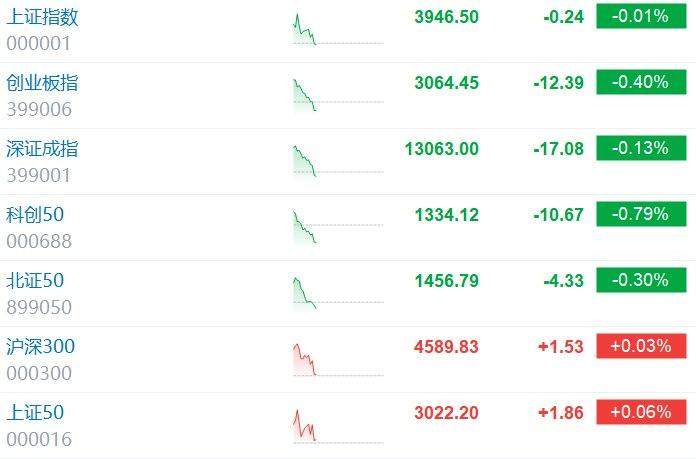
Core Viewpoint - A-shares experienced a decline after an initial rise, with the ChiNext index turning negative after a nearly 2% increase in early trading, indicating a volatile market sentiment [1]. Market Performance - The Shanghai Composite Index closed at 3946.50, down by 0.01% or 0.24 points [2]. - The ChiNext index ended at 3064.45, decreasing by 0.40% or 12.39 points [2]. - The Shenzhen Component Index closed at 13063.00, down by 0.13% or 17.08 points [2]. - The STAR 50 index finished at 1334.12, declining by 0.79% or 10.67 points [2]. - The North Star 50 index closed at 1456.79, down by 0.30% or 4.33 points [2]. - The CSI 300 index slightly increased to 4589.83, up by 0.03% or 1.53 points [2]. - The FJE 50 index rose to 3022.20, increasing by 0.06% or 1.86 points [2]. Sector Performance - Sectors such as tourism and hotels, food consumption, and textiles and apparel saw significant declines, contributing to a broader market downturn with nearly 3500 stocks in the Shanghai and Shenzhen markets experiencing losses [1].

五大维度发力,打造 “心安企业” 滨州样板
Zhong Guo Fa Zhan Wang· 2025-11-19 06:54
Core Viewpoint - Shandong Binzhou is a major city for the development of the private economy, with private enterprises accounting for 98.99% of the total business entities, contributing over 90% of the business quantity, over 80% of tax revenue, and nearly 70% of fixed asset investment. The city has implemented the "Heart-Safe Enterprises" initiative to promote the growth of the private economy by establishing standards that cover various aspects of enterprise management [1]. Group 1: Party Building and Thought Leadership - The city emphasizes the integration of party building with industrial development, creating a mechanism for collaboration between departments, industry associations, and key enterprises to enhance the effectiveness of party-led initiatives [2]. - The county-level initiatives, such as the "Red Alliance" in Huimin County, have been recognized as exemplary cases of innovation in enterprise party building [2]. - The focus on key industries like aluminum, chemicals, and textiles aims to strengthen the political and business capabilities of private enterprise leaders [2]. Group 2: Compliance and Risk Management - Binzhou has established a comprehensive compliance service platform, being the first in the province to issue guidelines for enterprise compliance, which includes free legal health checks for 333 companies [3]. - The city has developed a "cloud compliance classroom" to provide training on internal audits and legal management, reaching over 50,000 participants [3]. - Legal services have been extended to over 140 enterprises through on-site assistance and targeted compliance training sessions [4]. Group 3: Cultural Empowerment - A systematic approach to enterprise culture has been initiated, with a focus on integrating party building and corporate culture to enhance organizational cohesion and creativity [5]. - Various activities, including training sessions and cultural exchange events, have been organized to promote cultural development among private enterprises [5]. - The city has launched a campaign to collect and promote exemplary cases of corporate culture, enhancing the visibility of successful cultural initiatives [6]. Group 4: Psychological Support and Well-being - The establishment of a national-level psychological health service center for private enterprise employees aims to provide comprehensive mental health services, including individual consultations and group therapy [7]. - A professional team of psychologists has conducted numerous activities to support mental well-being, benefiting over 80,000 individuals [7]. - A digital platform has been created to offer psychological assessments and support, reaching over 115,000 participants through various online activities [7]. Group 5: Safety and Risk Prevention - The city has prioritized safety training for high-risk sectors, conducting specialized lectures and group activities to address psychological health needs [8]. - Safety awareness campaigns have been launched, providing practical guidance on mental health and safety practices to enterprises [8]. - A comprehensive policy push has been implemented to ensure the adherence to safety regulations across critical industries, with over 115,000 policy documents disseminated to support enterprises in maintaining operational stability [8].