
通信

Search documents
美国猛然惊醒:中国太精,嘴上说我不行,手里却攒了不少好牌
Sou Hu Cai Jing· 2026-02-14 03:43
Trade Relations - The U.S. has imposed tariffs on Chinese goods since 2018, initially at 10%, with plans to expand the range of taxed products to curb China's economic growth [1] - In response, China quickly retaliated with tariffs ranging from 10% to 25% on U.S. exports, particularly targeting key U.S. industries [3] Agricultural Impact - The tariffs have severely affected U.S. farmers, particularly in the soybean sector, leading to a significant drop in prices and income, with many farmers facing bankruptcy [3] - China shifted its soybean purchases from the U.S. to Brazil and Argentina, demonstrating a rapid adjustment in procurement strategies [3] Consumer Effects - U.S. consumers have experienced rising prices for various goods, including clothing and electronics, due to tariffs on products that relied on Chinese supply chains [5] - Retailers like Walmart and Target have raised prices, impacting the cost of living for ordinary Americans [5] Industrial Competitiveness - The trade war has not yielded clear benefits for either side, as China's ability to adapt its supply chain has mitigated the impact of U.S. tariffs [7] - China's comprehensive industrial system allows it to maintain a strong position against external pressures, while U.S. farmers and consumers bear the brunt of the trade conflict [7] Military Spending and Capabilities - Despite higher military spending, the U.S. has faced challenges in delivering effective military equipment, while China has managed to produce comparable military assets at lower costs [9] - The U.S. is experiencing a reduction in its aircraft carrier fleet, which may affect its global deployment capabilities [11] Naval Development - China is progressing steadily in its aircraft carrier development, with plans for new vessels like the Fujian, which will enhance its naval capabilities [13] - The U.S. faces delays in its new carrier programs, impacting its naval strength [11] Technological Advancements - China is advancing its military technology through a phased approach, showcasing mature technologies while developing next-generation equipment [14] - The focus on maintaining a robust industrial base has allowed China to excel in key sectors like high-speed rail, 5G, and electric vehicles [18][20] Long-term Outlook - The competition between the U.S. and China reveals that while both have strengths, China's complete industrial chain and ongoing investments are solidifying its position [22] - The U.S. is struggling with the consequences of offshoring its manufacturing, which may hinder its competitiveness against China in the long run [22]


新华财经早报:2月14日
Xin Hua Cai Jing· 2026-02-14 00:10
Group 1: Industry Developments - The "Modern Capital Urban Circle Spatial Collaborative Planning (2023-2035)" has been released, aiming to enhance the capital's functions and create a high-quality development growth pole [1] - The Ministry of Industry and Information Technology has called for accelerated development of the low-altitude industry, emphasizing top-level planning and the establishment of a standard system [1] - The State Council has approved the upgrade of the Xiong'an High-tech Industrial Development Zone to a national high-tech industrial development zone, covering an area of 20.84 square kilometers [1] Group 2: Financial Data - As of the end of January, the broad money supply (M2) reached 347.19 trillion yuan, a year-on-year increase of 9% [1] - The social financing scale stood at 449.11 trillion yuan at the end of January, with a year-on-year growth of 8.2% [1] - The January consumer price index (CPI) in the U.S. rose by 2.4% year-on-year, a decrease from 2.7% in December [2] Group 3: Company Announcements - China Shenhua reported that its second phase unit 4 has officially commenced commercial operations, with coal sales in January increasing by 9.9% year-on-year [4] - Gaode Infrared has signed a product order contract worth approximately 1.851 billion yuan [4] - Haiyou Engineering has won overseas project bids, with the company's share exceeding 800 million USD [4]
数说蛇年A股,多个纪录!
Zhong Guo Zheng Quan Bao· 2026-02-13 14:05
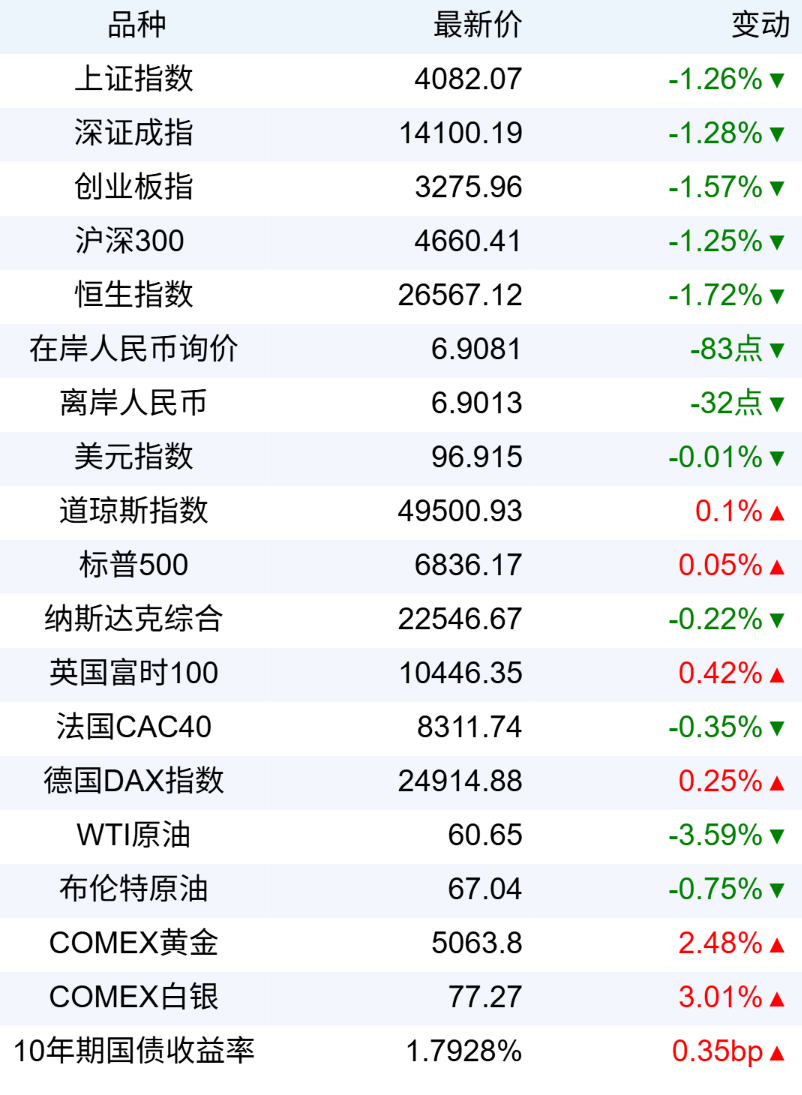
Core Insights - The A-share market experienced significant fluctuations and growth during the Year of the Snake, with major indices showing substantial increases in value [2][3]. Market Performance - The Shanghai Composite Index, Shenzhen Component Index, ChiNext Index, and Sci-Tech Innovation Board Index recorded cumulative increases of 25.58%, 38.84%, 58.73%, and 64.20% respectively [3][4]. - The total market capitalization of A-shares reached a record high of 124.45 trillion yuan, an increase of 32.87 trillion yuan since the beginning of the Year of the Snake [3][5]. Trading Volume - The total trading volume for A-shares exceeded 482 trillion yuan, with an average daily trading volume of 1.89 trillion yuan, both figures marking historical highs [5][6]. Sector Performance - The non-ferrous metals and technology sectors led the market, with respective increases of 112.63% and 90.83% [12][13]. - A total of 776 stocks saw their prices rise by over 100%, with 198 stocks increasing by more than 200% [14][15]. Notable Stocks - The top-performing stocks included Shangwei New Materials, which surged by 1836.53%, and Tianpu Co., which rose by 942.69% [15][16]. - The number of stocks with a market capitalization exceeding 100 billion yuan increased from 128 to 185 during the Year of the Snake, indicating a significant expansion of the large-cap segment [17]. Financing and Investment Trends - The margin financing balance reached a record high of 26,293.37 billion yuan, with an increase of 8,640 billion yuan since the beginning of the year [9][10]. - The electronic, power equipment, non-ferrous metals, and communication sectors attracted net buying amounts exceeding 700 billion yuan [9].
协同通信(01613):没有未获认购供股股份于配售事项下获配售
智通财经网· 2026-02-13 12:35
Group 1 - The core point of the article is that the company, XunTong Communication (01613), announced that there were no unallocated shares from the rights issue available for placement, resulting in no net proceeds to be distributed to non-participating shareholders [1] - The total number of shares to be issued and allocated from the rights issue, including unallocated shares, is 87.1231 million shares, which represents approximately 9.71% of the total shares available for subscription under the rights issue [1]
有色、通信四季度外资持仓规模上升
Huajin Securities· 2026-02-13 11:12
Group 1 - The total scale of the Stock Connect holdings reached approximately 2.59 trillion yuan in Q4 2025, an increase of 54.06 billion yuan compared to the previous quarter [4][8] - The proportion of holdings in the main board increased by 1.04 percentage points, while the proportion in the ChiNext and Sci-Tech Innovation Board decreased by 0.65 and 0.39 percentage points, respectively [4] - The proportion of holdings in cyclical, growth, and stable styles increased by 2.37, 0.08, and 0.05 percentage points, while consumer and financial styles decreased by 2.37 and 0.15 percentage points [4] Group 2 - The largest sectors by Stock Connect holdings in Q4 were new energy (17.78%, -0.12 percentage points), electronics (13.91%, -0.33 percentage points), and non-ferrous metals (7.18%, +1.96 percentage points) [8] - Non-ferrous metals, communication, and basic chemicals saw significant increases in holdings, while pharmaceuticals, food and beverage, and automotive sectors experienced notable declines [8][14] - The net inflow for non-ferrous metals was 24.872 billion yuan, for communication was 11.278 billion yuan, and for basic chemicals was 5.711 billion yuan, while pharmaceuticals saw a net outflow of 25.665 billion yuan [8] Group 3 - The sectors with the highest overweight ratios were new energy (11.34%), electronics (2.80%), and non-ferrous metals (2.56%), while the lowest were banking (-3.93%), oil and petrochemicals (-2.37%), and computers (-2.26%) [15] - The overweight ratios for non-ferrous metals, communication, and basic chemicals increased by 1.40, 0.47, and 0.29 percentage points, respectively, while those for pharmaceuticals, food and beverage, and banking decreased [15] Group 4 - Core assets and growth stocks such as Zhongji Xuchuang, China Ping An, and Siyuan Electric saw significant changes in foreign holdings, with the concentration of top five holdings decreasing [18] - The top three stocks by Stock Connect holdings were Ningde Times (254.343 billion yuan), Midea Group (77.049 billion yuan), and Kweichow Moutai (75.812 billion yuan) [18] - The largest net inflows were seen in Ningde Times (8.813 billion yuan), Luxshare Precision (5.737 billion yuan), and Weichai Power (5.124 billion yuan) [18] Group 5 - Stock Connect funds are expected to continue increasing their positions in core assets, technology, and cyclical sectors in Q1 2026 [21] - The ongoing Federal Reserve rate cut cycle may favor technology growth and certain cyclical sectors, attracting foreign capital [21] - The expected earnings growth in technology and cyclical sectors, along with favorable policies, may further enhance the attractiveness of these sectors to foreign investors [21][23]
创业板指系列指数走强,创业板ETF易方达(159915)本周交投活跃,日均成交额近30亿元
Sou Hu Cai Jing· 2026-02-13 09:58
Group 1 - The ChiNext Mid-Cap 200 Index increased by 3.5%, the ChiNext Growth Index rose by 2.5%, and the overall ChiNext Index saw a 1.2% increase this week [1][3] - The average daily trading volume of the ChiNext ETF managed by E Fund (159915) approached 3 billion yuan [1] - China Galaxy Securities suggests that the spring market trend is likely to continue in the short term, with a high probability of sector rotation and an increased focus on the fundamentals of performance, particularly in the technology innovation sector [1] Group 2 - The ChiNext Mid-Cap 200 Index consists of 200 medium-sized stocks with good liquidity, reflecting the overall performance of representative companies in the ChiNext market [4] - The information technology sector accounts for over 40% of the ChiNext Mid-Cap 200 Index, while the power equipment, communication, and electronics industries together account for nearly 60% [4] - There are currently 17 ETFs tracking the ChiNext Index, 5 tracking the ChiNext Mid-Cap 200 Index, and 1 tracking the ChiNext Growth Index, with varying fee rates and tracking errors [4] Group 3 - The rolling price-to-earnings (P/E) ratio for the ChiNext Index is 42.7 times, for the ChiNext Mid-Cap 200 Index is 114.7 times, and for the ChiNext Growth Index is 41.4 times [3] - The rolling P/E ratio percentile indicates that the ChiNext Index is at a 41.3% percentile, while the ChiNext Growth Index is at 48.0% [3][5] - The cumulative performance over the past year shows the ChiNext Index increased by 47.9%, the ChiNext Mid-Cap 200 Index by 27.3%, and the ChiNext Growth Index by 70.3% [7]


蛇年大幅收涨:沪指24.83%,深指37.73%,创业板指62.31%
Guan Cha Zhe Wang· 2026-02-13 08:16
Core Viewpoint - The A-share market has shown a slow bull pattern in the Year of the Snake (2025), with significant gains across major indices, driven by policy support, economic recovery, and external environment fluctuations [2][4]. Market Performance - As of the last trading day of the Year of the Snake, the Shanghai Composite Index closed at 4082.07, the Shenzhen Component Index at 14100.19, the ChiNext Index at 3380.83, and the North Star 50 at 1529.77 [2]. - The Shanghai Composite Index increased by 24.83% for the year, while the Shenzhen Component Index rose by 37.73%. The ChiNext Index led with a 62.31% increase, followed by the North Star 50 and the Sci-Tech 50, which rose by 42.59% and 48.65%, respectively [2]. Sector Performance - In 2025, the non-ferrous metals sector topped the performance chart with a 109.89% increase, followed by the communication, electronics, and power equipment sectors, which rose by 90.78%, 58.08%, and 57.80%, respectively. Other sectors like computers, automobiles, and pharmaceuticals saw increases between 15% and 30% [3]. - Concept sectors also performed well, with the optical module (CPO) index leading at 119.25%, followed by the storage chip index at 98.63%, the lithography machine index at 74.61%, the semiconductor index at 70.07%, and the robotics index at 55.11% [3]. Individual Stock Performance - Nearly 4700 stocks saw price increases, with 779 stocks doubling in price and over 100 stocks increasing by more than 200%. The top three performers, excluding newly listed stocks, were Upway New Materials, Tianpu Co., and Jiamei Packaging, with increases exceeding 1800%, 900%, and 800%, respectively. Only 23 stocks fell by more than 40%, with 8 stocks declining over 50% [3]. Trading Activity - The A-share market experienced high trading activity, with daily trading exceeding 1 trillion yuan becoming the norm. The average daily trading volume rose to 1.89 trillion yuan, a nearly 70% increase compared to the previous year, with days exceeding 2 trillion yuan accounting for 35% of trading days [3]. Future Outlook - The investment environment for the A-share market in the Year of the Horse (2026) is expected to continue improving, with a slow bull market likely to persist. Key drivers include policy benefits, economic recovery, and technological leadership. Sectors such as semiconductors and artificial intelligence are anticipated to maintain strong performance, while caution is advised for cyclical sectors like non-ferrous metals and new energy [4].
中银量化多策略行业轮动周报–20260212
Bank of China Securities· 2026-02-13 07:50
Investment Rating - The report does not explicitly state an overall investment rating for the industry but provides insights into sector allocations and performance metrics. Core Insights - The current allocation in the multi-strategy industry configuration system includes: Basic Chemicals (22.4%), Home Appliances (10.1%), Telecommunications (10.0%), Pharmaceuticals (7.7%), and others [1]. - The best-performing sectors this week were Non-ferrous Metals (6.2%), Oil & Petrochemicals (5.1%), and Basic Chemicals (4.7%), while the worst were Food & Beverage (-4.1%), Retail (-3.1%), and Agriculture (-1.9%) [3][10]. - The composite strategy achieved a cumulative return of 2.6% this week, outperforming the benchmark by 1.3% [3]. Summary by Sections Recent Industry Performance Review - The average weekly return for the 30 sectors was 1.3%, with a monthly average return of 1.2% [10]. - The top three sectors for the week were Non-ferrous Metals (6.2%), Oil & Petrochemicals (5.1%), and Basic Chemicals (4.7%) [11]. Industry Valuation Risk Warning - Current valuation alerts indicate that sectors such as Retail, Computers, Non-ferrous Metals, Defense, Oil & Petrochemicals, Electronics, Media, Machinery, Coal, and Textiles have PB ratios above the 95th percentile of their historical range, signaling potential overvaluation [13][14]. Top Performing Strategies and Recent Performance - The S1 strategy focusing on industry profitability tracking has the highest weight at 21.4%, while the S3 macro style rotation strategy has the lowest at 18.0% [3]. - The top three sectors based on the S1 strategy are Telecommunications, Basic Chemicals, and Home Appliances [16]. Composite Strategy and Performance Review - The composite strategy has significantly increased its positions in consumer and mid-cycle sectors while reducing exposure to TMT and upstream cyclical sectors [3]. Macro Style Rotation Strategy - The top six sectors favored by current macro indicators are Banking, Telecommunications, Oil & Petrochemicals, Construction, Home Appliances, and Coal [24]. Long-term Reversal Strategy - The recommended sectors for the long-term reversal strategy include Comprehensive, Pharmaceuticals, Basic Chemicals, Electric Equipment & New Energy, and Consumer Services [28].
中银量化多策略行业轮动周报–20260212-20260213
Bank of China Securities· 2026-02-13 07:31
Core Insights - The report highlights the current industry allocation of the Bank of China’s multi-strategy system, with the highest weights in basic chemicals (22.4%), home appliances (10.1%), and telecommunications (10.0) [1] - The report indicates that the S1 industry profitability tracking strategy has outperformed the benchmark by 1.4%, while the S2 implied sentiment momentum strategy has achieved an excess return of 2.7% [2] - The macro style industry rotation strategy (S3) has yielded a monthly excess return of 1.9%, and the long-term reversal strategy (S4) has provided a 1.0% excess return [2] Recent Industry Performance Review - The best-performing sectors this week include non-ferrous metals (6.2%), petroleum and petrochemicals (5.1%), and basic chemicals (4.7%), while the worst performers are food and beverage (-4.1%), commercial retail (-3.1%), and agriculture, forestry, animal husbandry, and fishery (-1.9%) [3][10] - The average weekly return for the 30 CITIC primary industries is 1.3%, with an average return of 1.2% over the past month [10] Industry Valuation Risk Warning - The report employs a valuation warning system based on the past six years' PB ratios, identifying industries with PB ratios above the 95th percentile as overvalued [13] - Current industries triggering high valuation warnings include commercial retail, computers, non-ferrous metals, defense and military, petroleum and petrochemicals, electronics, media, machinery, coal, and textiles [14] Single Strategy Performance - The S1 high profitability industry rotation strategy currently ranks communication, basic chemicals, and home appliances as the top three industries based on profitability expectations [15][16] - The S2 implied sentiment momentum strategy ranks building materials, light industry manufacturing, and basic chemicals as the top three industries based on sentiment indicators [20] - The S3 macro style rotation strategy identifies banking, telecommunications, petroleum and petrochemicals, construction, home appliances, and coal as the top six industries based on macroeconomic indicators [24] Long-term Reversal Strategy Recommendations - The long-term reversal strategy recommends industries including comprehensive, pharmaceuticals, basic chemicals, electric power equipment and new energy, and consumer services for investment [28]
机构:春季行情未完,可持股过节,A500ETF基金(512050)一键布局A股核心资产
Mei Ri Jing Ji Xin Wen· 2026-02-13 07:06
Group 1 - The A-share market experienced a collective decline, with the A500 ETF (512050) dropping by 0.88% and trading volume exceeding 10.9 billion yuan, leading its peers [1] - The market sentiment is influenced by risk aversion and profit-taking ahead of the Spring Festival, although the spring market trend is expected to continue with limited risks during the holiday [1] - The A500 ETF (512050) offers investors a convenient way to invest in core A-share assets, benefiting from low fees (0.2%), strong liquidity, and a large scale exceeding 40 billion yuan [1] Group 2 - The A500 ETF tracks the CSI A500 Index, employing a dual strategy of industry-balanced allocation and leading stock selection, covering all 35 sub-industries [1] - The ETF is designed to integrate value and growth attributes, with a natural "barbell" investment characteristic, particularly overweighting sectors like AI, pharmaceuticals, and renewable energy compared to the CSI 300 [1] - Investors are encouraged to consider related products such as the A500 ETF (512050) and the A500 Enhanced ETF (512370) [2]