
基金

Search documents
安信基金明星产品突发人事变动,揭开共管真相?
Xin Lang Cai Jing· 2026-02-27 16:26
Core Viewpoint - The departure of Chen Zhenyu, the deputy general manager of Anxin Fund, from the management of Anxin Value Growth Mixed Fund, despite its solid performance, indicates a significant internal restructuring and power dynamics within the company [1][4]. Group 1: Management Changes - Chen Zhenyu's resignation from Anxin Value Growth, where he achieved an annualized return of 13.71%, raises questions about the internal governance and the dynamics of power within Anxin Fund [1][3]. - The management structure, characterized by a "deputy general manager nominally in charge with junior managers executing," suggests a potential "shadow management" scenario, prompting discussions about the actual contributions of senior leaders in fund management [2][3]. Group 2: Institutional Investor Behavior - The recent departures of multiple fund managers from Anxin New Growth Fund, following significant outperformance, coincide with a sharp withdrawal of institutional investors, indicating a strategic exit aligned with profit-taking and tax considerations [3][4]. - The high institutional ownership of 96.22% in Anxin New Growth Fund prior to the mass exit highlights the fund's tailored nature for large investors, raising concerns about the implications for retail investors left behind [3][4]. Group 3: Implications for Fund Stability - The frequent changes in fund managers, with 42 products experiencing management changes since 2025, pose challenges to the stability of investment research and management within Anxin Fund [3][4]. - The transition of power and the shift from a focus on scale and star managers to addressing sustainability pressures post-institutional exits reflect a critical juncture for Anxin Fund [4].
新一批香港互认基金获批
Zhong Guo Ji Jin Bao· 2026-02-27 16:24
Core Viewpoint - The approval of new mutual funds under the Hong Kong Mutual Recognition Fund scheme marks a significant development in cross-border investment opportunities between Hong Kong and mainland China, enhancing the asset allocation options for investors [1][3]. Group 1: New Fund Approvals - Several mutual funds, including Morgan Asia Equity High Dividend Fund and Fidelity Global Investment Fund - Hong Kong Bond Fund, have been approved under the new mutual recognition regulations effective from January 1, 2025 [1]. - This approval represents the latest batch of mutual recognition funds since the implementation of the new regulations [2]. Group 2: Fund Flow and Market Dynamics - As of January 31, 2026, the cumulative net outflow of funds from Hong Kong to mainland China reached approximately 1260.24 billion RMB, maintaining a level above 1200 billion RMB for six consecutive months [4]. - The mutual recognition mechanism has led to a diversification of asset allocation awareness among investors, allowing foreign asset management firms to introduce overseas strategies and products into the Chinese market [5][6]. Group 3: Regulatory Changes and Market Growth - The new mutual recognition regulations optimize the rules by relaxing sales ratio limits, allowing management functions to be delegated to overseas affiliates, and expanding the types of funds eligible for recognition [5]. - The sales of Hong Kong mutual funds in mainland China have seen rapid growth, with net outflows increasing from 426.65 billion RMB at the end of December 2024 to 1260.24 billion RMB by January 31, 2026 [6]. Group 4: Market Competition and Trends - The Hong Kong mutual fund market is characterized by a strong presence of leading firms, with Morgan Asset Management holding over 40% market share, while competition remains intense among mid-tier firms [8]. - The current market shows a divergence where equity products are attracting significant inflows, while bond products are experiencing outflows, indicating shifting investor preferences [8].


公募基金总规模连续10个月刷新历史纪录
Zheng Quan Ri Bao· 2026-02-27 16:17
Group 1 - The total net asset value of public funds in China reached 37.77 trillion yuan as of January 2026, marking a slight increase from 37.71 trillion yuan at the end of 2025, and has maintained above the 37 trillion yuan mark for three consecutive months [1] - The public fund industry in China has seen a steady expansion, with the total scale increasing by over 5 trillion yuan in the past year [1] - As of January 2026, money market funds and bond funds each exceeded 10 trillion yuan in scale, reaching 15.27 trillion yuan and 10.53 trillion yuan respectively [1] Group 2 - In January 2026, bond funds and stock funds experienced a decline in both scale and share, with bond funds decreasing by 405.21 billion yuan and stock funds by 343.82 billion yuan compared to December 2025 [2] - Conversely, mixed funds saw the largest growth in January 2026, increasing by 330.23 billion yuan, while money market funds also grew by 237.91 billion yuan [2] - The number of public funds has increased, particularly in equity funds, with 52 new stock funds and 33 new mixed funds added [2] Group 3 - Analysts believe that the outlook for the A-share and Hong Kong stock markets post-Spring Festival is optimistic, with expectations of a new upward trend [3] - Factors supporting the A-share market include a decline in risk-free returns, ongoing capital market reforms, and favorable domestic demand policies [3] - Emerging technologies are expected to remain a key investment theme, alongside value stocks which are anticipated to have a resurgence [4]
稳健型公募基金产品频频新增代销合作机构
Zheng Quan Ri Bao· 2026-02-27 16:17
Core Viewpoint - The recent announcements from multiple public fund institutions indicate a shift towards distributing more stable and low-risk investment products, reflecting changes in market conditions and policy guidance [1][2][3]. Group 1: New Distribution Partnerships - Morgan Fund has added Shanghai Zhongou Wealth Fund Sales Co., Ltd. as a distributor for its low-volatility Hong Kong Stock Connect ETF [2]. - Vanguard Fund has signed a sales service agreement with Beijing Du Xiaoman Fund Sales Co., Ltd., allowing the sale of 14 funds, of which 10 are medium-risk and 4 are low-risk, with no high-risk products included [2]. - Guohai Franklin Fund announced that Teng'an Fund Sales (Shenzhen) Co., Ltd. will sell two of its funds, both categorized as medium-low risk [2]. Group 2: Product Characteristics - The newly added products predominantly include low-volatility dividends, pure bonds, and stable fixed-income products, with a notable absence of equity funds [2]. - The current market environment and policy direction have led to a cautious risk appetite among investors, favoring products with lower volatility and more stable returns [2][3]. Group 3: Marketing and Assessment Differences - There are significant differences in marketing logic and assessment criteria between stable products and equity funds. Stable products focus on risk control and long-term returns, targeting risk-averse investors [4]. - In contrast, equity funds emphasize growth potential and high returns, appealing to aggressive investors [4]. - The assessment for stable products centers on sustainable growth, customer satisfaction, and retention, while equity funds focus on performance rankings and market engagement [4]. Group 4: Future Outlook - As investor risk awareness increases, the channel value of stable products is expected to become more prominent [5]. - Fund companies will need to optimize their low-volatility strategies, enhance fixed-income product returns, and improve risk control systems for stable products to capture channel resources effectively [5][6]. - Sales channels must also focus on product selection, investor suitability management, and after-sales service to transition from a "sales-driven" to a "configuration-driven" approach [6].
资源主题ETF开年领跑 机构热议配置价值
Xin Lang Cai Jing· 2026-02-27 15:22
Group 1: Market Overview - The global market has seen increased demand for safe-haven assets due to geopolitical tensions and rising international oil prices, leading to significant inflows into resource-themed ETFs such as oil, rare earths, and precious metals [1][2] - Institutions generally hold a bullish view on commodities like oil, non-ferrous metals, and precious metals, anticipating a "cycle revaluation and structural differentiation" in the market [1] Group 2: Performance of Resource ETFs - Several resource-themed ETFs have shown strong performance post-Spring Festival, with oil and gas ETFs like Huatai-PB and Yinhua rising over 9%, and rare metal ETFs increasing by more than 8.4% [2] - The total scale of oil and gas ETFs has increased significantly, with the Guotai Zhongzheng Oil and Gas Industry ETF growing by over 38.4 million yuan and the Penghua National Oil and Gas ETF increasing by over 14 million yuan [2] Group 3: Oil Market Insights - The oil market is now driven by geopolitical risks, with expectations of high volatility in oil prices over the next month [3] - Companies with oil and gas resources and those in offshore oil and gas service engineering are recommended for investment due to their potential benefits from high industry demand [3] Group 4: Precious Metals Market - Gold and silver prices have rebounded after experiencing volatility, with gold prices reaching 5200 USD/oz and silver prices surpassing 90 USD/oz [4] - Significant growth in gold ETFs has been observed, with the Huaan Fund's gold ETF increasing by over 4.3 billion yuan, leading the market [4] Group 5: Future Price Predictions - Analysts predict that gold prices could rise further, potentially reaching 6200 USD/oz in the coming months due to persistent geopolitical risks and continued support from monetary easing policies [6] - The demand for gold is expected to increase, driven by strong investment interest and central bank purchases [6]
存续规模近2900亿元 公募FOF新发市场升温
Xin Lang Cai Jing· 2026-02-27 15:22
Core Insights - The public FOF (Fund of Funds) market is experiencing a resurgence with new product launches and increasing total assets under management, reaching a record high of 289.8 billion yuan as of February 24, 2026 [1][2] - The number of FOF products has grown significantly, with 34 new products launched in 2026 alone, indicating a robust market recovery [1][2] - The competitive landscape is intensifying, with a concentration of market share among a few large institutions, leading to potential risks for smaller funds [4][5][7] Group 1: Market Growth and New Products - As of February 24, 2026, there are 576 FOF products in the market, with a total scale of 289.8 billion yuan, marking a year-on-year increase of 27 products and 45.6 billion yuan compared to the end of 2025 [1][2] - The issuance of new FOF products has accelerated, with 34 new products launched in 2026, 13 of which have raised over 1 billion yuan [1][2] - The recent launches include three FOF products with a three-month holding period, indicating a trend towards longer investment horizons [1] Group 2: Historical Context and Recovery - The FOF market faced a decline from 2022 to 2024, with total assets dropping to 1.33 trillion yuan by the end of 2024, but began to recover in 2025 with 76 new products issued [2] - By the end of 2025, the total number of FOF products reached 549, with a total scale of 244.2 billion yuan, reflecting a year-on-year growth of 10.02% in number and 83.39% in scale [2] Group 3: Performance and Competition - Eight FOF products have seen an increase of over 10% in 2026, with notable performers like Guotai Industry Rotation Stock FOF achieving a rise of 20.07% [3] - The competition is becoming fierce, with only one FOF product exceeding 10 billion yuan in scale, while 123 products have less than 50 million yuan, representing 21.35% of the market [4][5] - The top ten institutions manage 57.49% of the total FOF market, highlighting a "Matthew Effect" where larger firms dominate the market [5][6][7]
年内30余只基金“黯然退场”
Xin Lang Cai Jing· 2026-02-27 15:22
Group 1 - Over 30 funds have entered the liquidation process since 2026, primarily due to insufficient scale, with many initiated funds triggering termination clauses after failing to reach a net asset value of 200 million RMB within three years [1][2] - As of February 25, 2026, 31 funds have completed liquidation, with most facing scale challenges that led to the activation of termination clauses [2][3] - Mixed funds account for the majority of liquidated funds, totaling 15, followed by 9 bond funds, 2 equity funds, and 5 fund of funds (FOF) [3] Group 2 - Initiated funds face a "three-year test," where if their scale is below 200 million RMB after three years, they automatically enter liquidation without the need for a shareholder meeting [4][5] - Among the 31 liquidated funds, 24 are initiated funds, representing over 70% of the total, including several pension-targeted FOF products [4] - As of February 25, 2026, there are 4,560 initiated funds in the market, with 2,260 (nearly half) having a scale below 200 million RMB [4] Group 3 - The A-share market has seen increased style rotation in 2026, with significant disparities between industries; some sectors have risen over 30%, while others, like banking, have declined nearly 7% [6][7] - Certain thematic funds, such as those focused on automotive and dividends, are struggling, with some triggering liquidation clauses due to low asset values [6][7] - The market sentiment for 2026 is expected to remain positive, with a potential for more diverse opportunities, despite the pronounced differentiation among sectors [7]
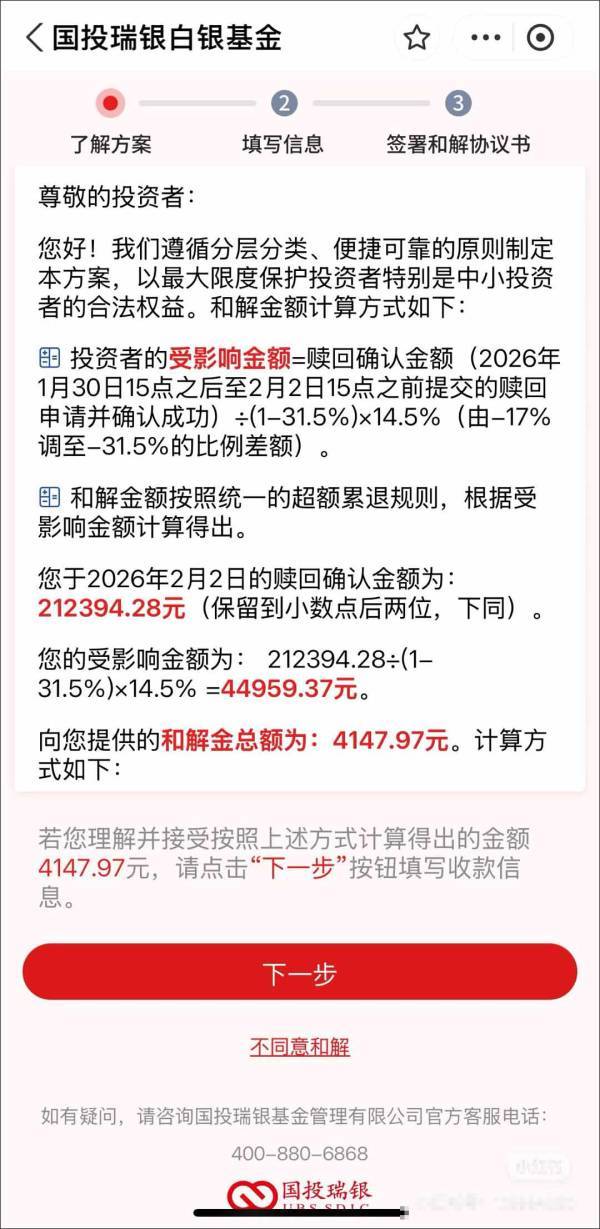
损失4万5,和解金4100多,国投白银基金补偿方案引争议,18万人参与投诉
Sou Hu Cai Jing· 2026-02-27 15:10
Core Viewpoint - The compensation plan for the Guotai Junan Silver Fund (LOF) has sparked dissatisfaction among investors due to perceived inadequacies in addressing their losses, particularly as the compensation amount is significantly lower than the losses incurred [1][4]. Group 1: Incident Overview - The Guotai Junan Silver Fund experienced a drastic net asset value drop of 31.5% following a valuation adjustment announced on February 2, which was triggered by a historic plunge in the international silver market [4][5]. - The fund's valuation method was changed from domestic silver futures settlement prices to international silver futures prices, leading to a significant discrepancy in expected losses for investors [5][11]. Group 2: Compensation Plan Details - The compensation plan is not a legal obligation but a voluntary settlement funded by the company's own resources, aimed at addressing investor grievances [7][12]. - The compensation is structured in a tiered manner, with full compensation for losses under 1,000 yuan, while higher losses receive diminishing compensation rates [11][12]. - The plan specifically targets individual investors who redeemed their shares between January 30 and February 2, excluding institutional investors and those who did not redeem [7][11]. Group 3: Investor Reactions - Many investors have expressed dissatisfaction with the compensation plan, questioning the fairness of the tiered compensation structure that penalizes larger losses with lower reimbursement rates [12][14]. - A significant number of investors have initiated complaints against the fund, indicating a widespread sentiment of unfair treatment [14][15]. Group 4: Regulatory Context - The valuation adjustment was deemed to have a legal basis under the guidelines issued by the China Securities Regulatory Commission, which allows for adjustments in response to significant market changes [14][16]. - The fund management's rationale for the adjustment was supported by research indicating a high correlation between domestic and international silver prices, although the basis for this research has been questioned for its clarity and transparency [16][17].
永赢基金储可凡:港股短期避险情绪主导,互联网和医疗中长期逻辑不变
Xin Lang Cai Jing· 2026-02-27 13:25
Core Viewpoint - The Hong Kong stock market has experienced significant corrections, particularly in the internet and healthcare sectors, with the Hang Seng Technology Index down over 10% and the Hong Kong Stock Connect Healthcare Index down over 4.5% since February [1] Group 1: Market Performance - The recent pullback in the Hong Kong stock market is attributed more to short-term geopolitical factors affecting market sentiment rather than fundamental issues [1] - The high proportion of foreign capital in the Hong Kong investor structure makes it sensitive to geopolitical changes, leading to profit-taking and risk aversion among investors [1] Group 2: Healthcare Sector Insights - The healthcare sector in Hong Kong is characterized by high-quality, scarce assets, including leaders in internet healthcare, traditional Chinese medicine services, AI pharmaceuticals, and surgical robotics [2] - The CXO and internet healthcare segments are highlighted as core support areas due to their high growth rates and revenue certainty, with leading CXO companies showing superior income and profit growth compared to other pharmaceutical sub-sectors [2] - Internet healthcare is noted as one of the fastest-growing segments in pharmaceutical retail, leveraging AI and big data technologies to enhance patient access and prescription efficiency [2] Group 3: Internet Sector Valuation - The current price-to-earnings (PE) ratio of the Hong Kong Stock Connect Internet Index is only 22 times, placing it in the 20th percentile historically, indicating a significant valuation discount compared to global tech assets [2] - The internet giants are actively embracing AI technology, integrating model development and cloud computing as key growth areas, suggesting that the long-term growth logic remains intact [3]
吴清:推动资本市场对外开放迈向更深层次、更高水平
Xin Jing Bao· 2026-02-27 13:21
Group 1 - The core viewpoint of the articles highlights the positive developments in China's capital market since the implementation of the new "National Nine Articles," with increased foreign participation and confidence in the long-term growth of the Chinese economy and capital market [1][2] - The participating foreign institutions emphasized the need for continuous improvement in the adaptability and coverage of capital market services to the real economy, as well as enhancing the investment value of listed companies and investor protection [1] - Suggestions were made to improve cross-border investment and financing facilitation, align with international standards and regulatory rules, and support the dual openness of industry institutions to enhance the global resource allocation capabilities of local institutions [1] Group 2 - The China Securities Regulatory Commission (CSRC) plans to implement the key measures for high-quality development of the capital market as outlined in the 14th Five-Year Plan, focusing on risk prevention, strong regulation, and promoting high-quality development [2] - The CSRC aims to deepen comprehensive reforms in investment and financing, enhance the system, products, and service framework of the capital market, and improve its inclusiveness, adaptability, attractiveness, and competitiveness [2] - The importance of foreign institutions as key participants in the Chinese capital market is emphasized, with a call for them to leverage their global resource allocation, international perspective, and professional experience to contribute to the high-quality development of the capital market [2]