
金融业

Search documents
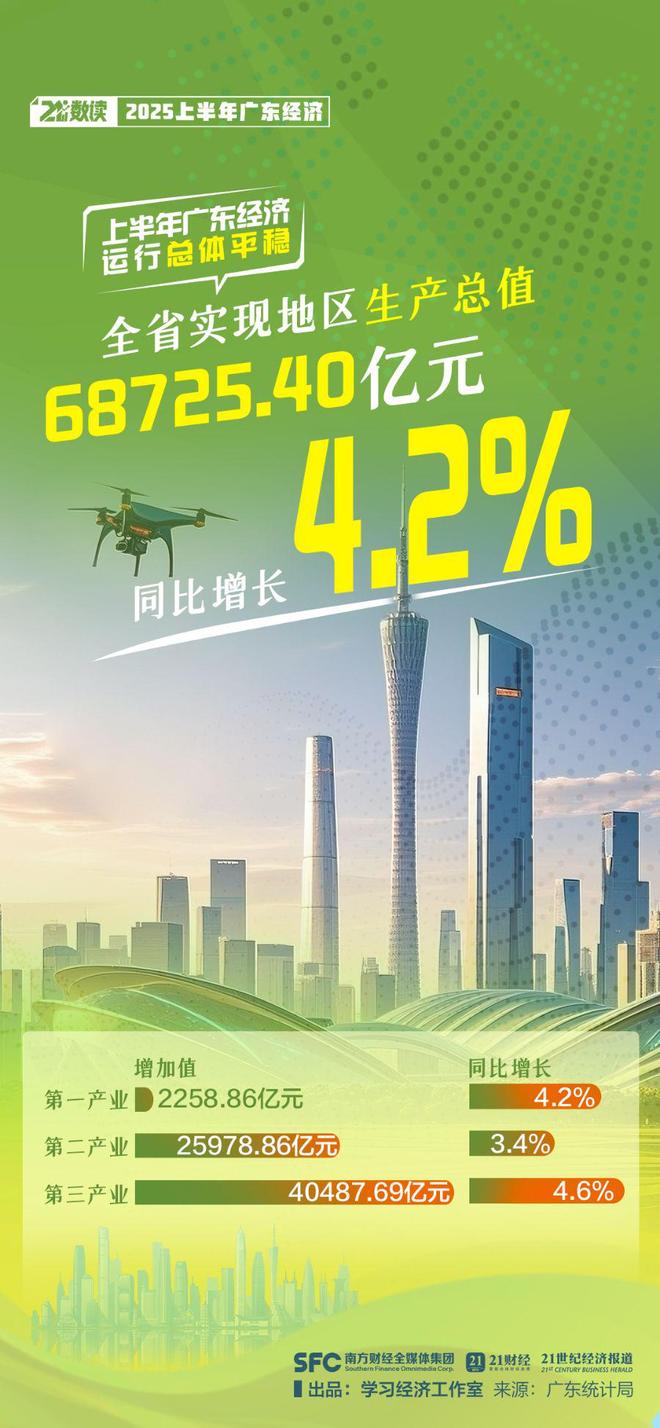
上半年广东GDP同比增长4.2% 实现68725.4亿元 经济运行总体平稳稳中向好
Nan Fang Ri Bao Wang Luo Ban· 2025-07-21 07:35
Economic Overview - Guangdong's GDP reached 68,725.4 billion yuan in the first half of the year, with a year-on-year growth of 4.2%, an increase of 0.1 percentage points from the first quarter [1] - The primary industry added value was 2,258.86 billion yuan, growing by 4.2%; the secondary industry added value was 25,978.86 billion yuan, growing by 3.4%; and the tertiary industry added value was 40,487.69 billion yuan, growing by 4.6% [1] Industrial Performance - The industrial output value above designated size grew by 4% year-on-year, with a 0.1 percentage point acceleration from the first quarter, and June saw a growth of 5.3% [3] - Manufacturing sector growth was 4.5%, with key industries such as computer, communication, and other electronic equipment manufacturing increasing by 7.3%, and electrical machinery and equipment manufacturing by 7.8% [3] - New momentum industries showed strong growth, with advanced manufacturing and high-tech manufacturing increasing by 5.9% and 6% respectively, accounting for 55.4% and 33% of the industrial output value above designated size [3] Investment Trends - Fixed asset investment in Guangdong decreased by 9.7% year-on-year, but industrial investment accounted for 38.1%, with significant growth in automotive manufacturing and petroleum, coal, and other fuel processing industries [4] - Industrial technology transformation investment grew by 1.8%, with a notable increase of 12.8% in the computer, communication, and other electronic equipment manufacturing sector [4] Service Sector Growth - The added value of the service industry increased by 4.6% year-on-year, with transportation and storage, and financial services growing by 6.6% and 7% respectively [5] - Revenue from large-scale service enterprises grew by 7.5%, with transportation, storage, and postal services seeing a 9.3% increase [5] Consumer Market Dynamics - The total retail sales of consumer goods increased by 3.5% year-on-year, with a 1 percentage point acceleration from the first quarter [6] - Urban retail sales grew by 3.8%, while rural retail sales increased by 1.4%, indicating a stronger urban consumption trend [7] - Significant growth was observed in categories related to old-for-new exchanges, with home appliances and audio-visual equipment sales increasing by 44.9% [8]
上半年四川资阳GDP同比增长7%
Xin Hua Cai Jing· 2025-07-21 06:19
Economic Overview - The GDP of Ziyang City for the first half of 2025 reached 53.01 billion yuan, reflecting a year-on-year growth of 7% [1] - The primary industry added value was 7.16 billion yuan, growing by 3.0%; the secondary industry added value was 16.31 billion yuan, increasing by 11.6%; and the tertiary industry added value was 29.54 billion yuan, rising by 5.7% [1] Agricultural Sector - The total output value of agriculture, forestry, animal husbandry, and fishery in Ziyang City was 13.14 billion yuan, with a year-on-year growth of 3.0% [1] - The production of pork, beef, and mutton increased by 2.5% and 5.1% respectively, with a total meat output of 123,000 tons, growing by 0.7% [1] - Aquatic product output reached 46,000 tons, marking a growth of 6.4% [1] Investment and Industrial Growth - Fixed asset investment in Ziyang City grew by 8.7% year-on-year [1] - The added value of industrial enterprises above designated size increased by 15.8% [1] - Key industries showed significant growth: equipment manufacturing grew by 21.6%, clean energy by 31.8%, electronic information by 39.3%, and food and light textile industries by 4.4% [1] - Among 31 major industry categories, 23 experienced positive growth, with 18 achieving double-digit growth [1] Service Sector Performance - The added value of the service industry increased by 5.7% year-on-year [2] - Notable growth in sectors included leasing and business services at 11.0%, information transmission, software, and IT services at 10.5%, and accommodation and catering at 7.2% [2] Consumer Market Trends - The total retail sales of social consumer goods reached 21.43 billion yuan, with a year-on-year growth of 4.4% [2] - Retail sales of gold, silver, and jewelry increased by 22.5%, while home appliances and audio-visual equipment grew by 23.8% [2]
GDP同比增长4.2%!图解广东上半年经济成绩单
2 1 Shi Ji Jing Ji Bao Dao· 2025-07-18 12:23
Economic Overview - Guangdong's GDP for the first half of 2025 reached 68,725.40 billion yuan, showing a year-on-year growth of 4.2% at constant prices [1][4] - The primary industry added value was 2,258.86 billion yuan, growing by 4.2%; the secondary industry added value was 25,978.86 billion yuan, with a growth of 3.4%; the tertiary industry added value was 40,487.69 billion yuan, increasing by 4.6% [1][4] Industrial Performance - The industrial added value for large-scale industries in Guangdong increased by 4.0% year-on-year, with a growth acceleration of 0.1 percentage points compared to the first quarter [3] - In June, the industrial growth rate was 5.3%, with mining industry value decreasing by 0.3%, manufacturing growing by 4.5%, and the production and supply of electricity, heat, gas, and water declining by 0.1% [3] Service Sector - The service sector's added value grew by 4.6% year-on-year, with an acceleration of 0.3 percentage points from the first quarter [3] - Notably, the transportation, storage, and postal services, as well as the financial sector, saw growth rates of 6.6% and 7.0%, respectively, surpassing the overall service sector growth by 2.0 and 2.4 percentage points [3][14] Consumer Market - The total retail sales of consumer goods in Guangdong increased by 3.5% year-on-year, with a growth acceleration of 1.0 percentage point compared to the first quarter [3] - Retail sales of goods grew by 3.6%, while catering revenue increased by 2.7% [3] Income Levels - The per capita disposable income in Guangdong reached 28,343 yuan, reflecting a nominal year-on-year growth of 4.5%, and a real growth of 4.9% after adjusting for price factors [3][21] - Urban residents had a per capita disposable income of 33,918 yuan (4.0% nominal growth), while rural residents had 14,624 yuan (5.7% nominal growth) [21]

上半年北京地区生产总值同比增5.5%
Bei Jing Qing Nian Bao· 2025-07-18 01:37
Economic Overview - Beijing's GDP grew by 5.5% year-on-year in the first half of 2025, indicating a stable and improving economic trend [1] - The contribution rate of key industries, including information transmission, software, IT services, finance, and manufacturing, reached 87.0%, up by 2.7 percentage points year-on-year [2] Key Industries - The information transmission, software, and IT services sector saw an 11.1% increase in added value, with revenue growth in integrated circuit design, application software development, and IoT services exceeding 15% [2] - The financial sector's added value grew by 8.1%, supporting the real economy [2] - The industrial sector's added value increased by 7.0%, with significant contributions from the new energy vehicle sector and strong demand in integrated circuits and consumer electronics [2] Investment and Consumption - Fixed asset investment in Beijing rose by 14.1% year-on-year, with equipment purchase investment nearly doubling [4] - The share of service consumption in total household spending reached 58.9%, up by 1.3 percentage points year-on-year, driven by growth in information, transportation, and cultural entertainment sectors [4] - New consumption formats, such as convenience stores and supermarkets, saw retail sales growth of over 20% through online channels [4] Market Dynamics - Nearly 150,000 new enterprises were established in Beijing in the first half of the year, a year-on-year increase of about 20% [5] - The manufacturing purchasing managers' index has shown a two-month consecutive rise, indicating improved market expectations [5] - The real estate market saw a 5.4% increase in new commodity housing sales area, with pure commodity residential sales up by 33.8% [5] Employment and Income - The urban unemployment rate averaged 4.1%, stable compared to the first quarter, while per capita disposable income increased by 4.8% year-on-year [6][12] - Rural residents' income grew by 6.1%, outpacing urban residents by 1.5 percentage points, with the urban-rural income ratio at 2.20 [13] Innovation and New Industries - The digital economy's added value grew by 8.7%, with core industries increasing by 10.5% [8] - High-tech manufacturing and strategic emerging industries saw added value growth of 9.9% and 16.8%, respectively, significantly contributing to industrial growth [8] - The revenue of "specialized, refined, characteristic, and innovative" enterprises increased by 4.9%, surpassing the average growth of industrial and service enterprises [7]

集体爆发!
中国基金报· 2025-07-17 11:58
Core Viewpoint - The Hong Kong stock market saw a collective surge in the pharmaceutical and biotechnology sector, with notable gains in companies like Li Auto and China Biologic Products [2][4][12]. Group 1: Market Performance - The Hang Seng Index closed at 24,498.95 points, down 0.08%, while the Hang Seng Tech Index rose by 0.56% to 5,448.85 points [2]. - The total market turnover was HKD 236.4 billion, a decrease from the previous trading day, with net inflows from southbound funds amounting to HKD 1.855 billion [2]. - Among the constituent stocks, 43 rose and 40 fell, with Li Auto leading the gains at 9.73% [4]. Group 2: Notable Stock Movements - Li Auto's stock price increased by 9.73%, closing at HKD 124.10, with a year-to-date increase of 32.09% [5][19]. - China Biologic Products rose by 5.90%, with a significant year-to-date increase of 114.68% [5]. - The pharmaceutical sector saw a strong performance, with the Wande Pharmaceutical and Biotechnology Index rising by 4.65% [15]. Group 3: Sector Analysis - The healthcare sector increased by 5.17%, while the materials and energy sectors experienced declines of 1% and 0.94%, respectively [6]. - The CAR-T index rose by 8.19%, and the unprofitable biotech index increased by 6.28%, indicating strong investor interest in these areas [9]. Group 4: Regulatory Developments - The National Healthcare Security Administration and the National Health Commission introduced measures to support the high-quality development of innovative drugs, which is expected to enhance the role of commercial insurance in the multi-level medical security system [17]. - This regulatory change is anticipated to positively impact the upstream supply chain, including research reagents and CXO industries, with expected performance improvements starting from mid-2025 [17]. Group 5: Company-Specific News - Li Auto announced the opening of pre-orders for its i8 model, leading to a stock price increase of nearly 10% [18][19]. - The expected price range for the i8 is between RMB 350,000 and RMB 400,000, with the official price to be announced on July 29 [22].

总量仍稳定,结构需平衡
Haitong Securities International· 2025-07-16 11:14
Economic Overview - In Q2 2025, China's GDP grew by 5.3% year-on-year, exceeding the annual target of 5%[6] - The GDP growth rate for Q2 was 5.2%, with a seasonally adjusted annualized rate of 4.5%, showing slight stability despite external pressures[6] Production Insights - The industrial added value for the first half of the year increased by 6.4%, with June's growth at 6.8%, up from 5.8% in May[13] - The capacity utilization rate for the industrial sector was 74.0%, slightly down from 74.1% in Q1, indicating ongoing structural issues in certain industries[8] Consumption Trends - Retail sales of consumer goods rose by 5.0% year-on-year in the first half, but June saw a decline to 4.8%, marking a drop of 1.6 percentage points from May[25] - Service consumption maintained a high growth rate, with a 6.0% increase in June, although it showed signs of marginal weakening compared to May[20] Investment Dynamics - Fixed asset investment growth slowed to 2.8% year-on-year in Q2, with June's growth at just 0.4%, the first negative month-on-month change of the year[34] - Real estate investment faced significant challenges, with sales area and sales revenue down by 5.5% and 10.8% year-on-year in June, respectively[39] Risks and Challenges - The overall economic environment remains unbalanced, with low inflation and structural issues persisting, necessitating policy support to boost demand[10] - Trade uncertainties and potential domestic demand declines pose significant risks to economic stability[45]
AI赋能“千行百业”,如何锚定新兴龙头?
Xin Lang Ji Jin· 2025-07-16 07:05
Group 1 - AI technology is rapidly transforming various industries, enhancing efficiency and reducing costs through digital transformation [3][10] - In the industrial sector, AI models are used to predict demand fluctuations based on multi-source data, significantly shortening product inventory cycles and improving operational efficiency [3] - In agriculture, AI has penetrated multiple stages including breeding, production, processing, supply, and sales, facilitating a shift from traditional farming to management roles for agricultural workers [5][6][7][8] Group 2 - In the breeding stage, intelligent breeding robots equipped with domestic AI models enable autonomous field observation and gene analysis, significantly shortening the cultivation cycle of high-yield, disease-resistant varieties [6][9] - In the production stage, AI-driven agricultural machinery, powered by Beidou, 5G, and AI algorithms, allows for autonomous operations, enhancing efficiency in pest diagnosis and disaster monitoring [7][9] - In the supply and sales stage, AI algorithms manage the entire process from fruit grading and sorting to channel distribution and order inventory matching, thereby reducing marketing costs [8][9] Group 3 - The financial industry, being data-intensive, is actively exploring the application of generative AI across various business scenarios, including intelligent services, investment research, financial risk control, and production empowerment [10] - By 2030, it is projected that China's AI adoption rate will exceed 30%, contributing 0.2-0.3 percentage points to the country's GDP growth [10] - Investors interested in AI development may consider focusing on the Sci-Tech Innovation Board AI ETF and its related funds, which track emerging AI enterprises [10]

郑学工:上半年经济稳步前行 向新向好
Guo Jia Tong Ji Ju· 2025-07-16 02:04
Economic Overview - In the first half of the year, China's GDP reached 66,053.6 billion yuan, with a year-on-year growth of 5.3% [2] - The contribution rates of the three industries to economic growth were 3.6% for the primary industry, 36.2% for the secondary industry, and 60.2% for the tertiary industry [2] Industry Performance - The industrial production showed a robust growth with an industrial added value increase of 6.2% year-on-year, contributing 1.9 percentage points to economic growth [3][4] - The manufacturing sector's added value grew by 6.6%, contributing 1.7 percentage points to economic growth [3] - The service sector, particularly information transmission, software, and IT services, saw significant growth with added values increasing by 11.1% and 9.6% respectively, contributing a total of 1.0 percentage point to economic growth [3] Domestic Demand - Final consumption expenditure contributed 52.0% to economic growth in the first half, driving GDP growth by 2.8 percentage points [5] - Investment demand showed a steady increase, with total capital formation contributing 16.8% to economic growth, adding 0.9 percentage points to GDP [5] - Net exports maintained a stable growth trend, contributing 31.2% to economic growth, which added 1.7 percentage points to GDP [5] New Economic Drivers - The digital economy is gaining momentum, with the revenue of large-scale information transmission, software, and IT service enterprises growing by 11.4% from January to May, outperforming the overall service sector by 3.3 percentage points [6] - The equipment manufacturing and high-tech manufacturing sectors saw added value growth of 10.2% and 9.5% respectively, exceeding the overall industrial growth rates [7] - High-quality investments in equipment manufacturing and high-tech services increased by 7.5% and 8.6% respectively, indicating a focus on optimizing and upgrading industries [7]
2025年二季度和上半年国内生产总值初步核算结果
Guo Jia Tong Ji Ju· 2025-07-16 01:30
Group 1 - The core viewpoint of the article is the preliminary calculation results of China's GDP for the second quarter and the first half of 2025, indicating a steady growth trend in various sectors [1][2][3] - The total GDP for the second quarter of 2025 is reported at 34,177.8 billion yuan, with a year-on-year growth of 5.2% [2] - The GDP for the first half of 2025 stands at 66,053.6 billion yuan, reflecting a growth of 5.3% compared to the same period last year [2] Group 2 - The primary industry, which includes agriculture, forestry, animal husbandry, and fishery, recorded a GDP of 19,459 billion yuan in Q2 2025, growing by 3.8% year-on-year [2] - The secondary industry, encompassing manufacturing and construction, achieved a GDP of 127,147 billion yuan in Q2 2025, with a growth rate of 4.8% [2] - The tertiary industry, which includes services, reported a GDP of 195,172 billion yuan in Q2 2025, showing a growth of 5.7% [2] Group 3 - The manufacturing sector specifically saw a GDP of 87,771 billion yuan in Q2 2025, with a notable growth of 6.5% [2] - The construction industry, however, faced a decline with a GDP of 23,781 billion yuan, reflecting a decrease of 0.6% [2] - The information transmission, software, and IT services sector experienced significant growth, with a GDP of 18,750 billion yuan and a year-on-year increase of 11.8% [2] Group 4 - The financial industry reported a GDP of 25,737 billion yuan in Q2 2025, growing by 5.8% year-on-year [2] - The real estate sector maintained a GDP of 21,072 billion yuan, with a stagnant growth rate of 1.0% [2] - The wholesale and retail trade sector achieved a GDP of 35,129 billion yuan, reflecting a growth of 6.0% [2]
经济运行向新向好
Sou Hu Cai Jing· 2025-07-15 22:43
Economic Overview - In the first half of the year, China's GDP reached 66,053.6 billion yuan, with a year-on-year growth of 5.3% [2] - The GDP for the second quarter was 34,177.8 billion yuan, showing a year-on-year growth of 5.2% [2] Industry Performance - The primary industry added value was 31.17 billion yuan, growing by 3.7%; the secondary industry added value was 239.05 billion yuan, growing by 5.3%; and the tertiary industry added value was 390.31 billion yuan, growing by 5.5% [2] - Industrial production increased by 6.2% year-on-year, with manufacturing growing by 6.6% [4] - The information transmission, software, and IT services sectors saw an increase of 11.1%, while leasing and business services grew by 9.6% [4] Domestic Demand and Consumption - Final consumption expenditure contributed 52.0% to economic growth in the first half, with a contribution of 52.3% in the second quarter [5] - Capital formation contributed 16.8% to economic growth in the first half, with a contribution of 24.7% in the second quarter [5] - Net exports contributed 31.2% to economic growth in the first half, with a contribution of 23.0% in the second quarter [5] New Economic Drivers - The information transmission, software, and IT services sector saw a revenue growth of 11.4% from January to May [6] - The added value of equipment manufacturing and high-tech manufacturing increased by 10.2% and 9.5% respectively in the first half [6] - Investment in equipment manufacturing grew by 7.5%, while high-tech service industry investment increased by 8.6% [6]