
乘用车

Search documents
乘用车企拐点将至,关注汽零强势赛道&客户 | 投研报告
Zhong Guo Neng Yuan Wang· 2025-09-25 01:55
Core Viewpoint - The automotive industry is experiencing a recovery in fundamentals, particularly in the commercial vehicle sector, with significant contributions from the sales of buses and heavy trucks, leading to a valuation rebound in the sector [1][2]. Group 1: Commercial Vehicles and Parts - The commercial vehicle sector has shown improved fundamentals, with a notable increase in sales of buses and heavy trucks contributing to the sector's valuation recovery [1][2]. - The automotive parts sector is influenced by the progress in humanoid robotics, as many companies are diversifying into this area due to the similarities and synergies with automotive components [1][2]. - The automotive parts sector achieved a revenue of 357.29 billion yuan in Q2 2025, reflecting a year-on-year increase of 7.6% [3][4]. Group 2: Price Wars and Profitability - The passenger vehicle sector saw a revenue growth of 10.4% year-on-year in Q2 2025, driven by the launch of high-end models by domestic manufacturers, despite a decline in net profit due to intense price competition [3][4]. - The average selling price of vehicles increased by 0.20 million yuan per vehicle in Q2 2025, indicating a shift towards higher-end models [3]. - The net profit for the passenger vehicle sector dropped by 19.6% year-on-year to 8.84 billion yuan in Q2 2025, primarily due to the impact of price wars on gross margins [3][4]. Group 3: Market Outlook - The passenger vehicle market is expected to see a recovery in profitability as the price war eases, with several key models set to launch in Q3 and Q4 2025 [3][6]. - The commercial vehicle market is anticipated to continue its upward trend due to ongoing policy support and a recovery in domestic demand [5][6]. - The bus sector is projected to benefit from a resurgence in tourism and government subsidies for public transport, leading to sustained market vitality [5]. Group 4: Investment Recommendations - Companies in the passenger vehicle sector that are in a strong product cycle, such as Great Wall Motors and Xpeng Motors, are recommended for investment [6]. - In the automotive parts sector, companies with strong supply chains and those involved in humanoid robotics and intelligent driving are highlighted as potential investment opportunities [6]. - Leading companies in the commercial vehicle sector, such as Weichai Power and Yutong Bus, are also recommended due to their expected benefits from industry recovery [6].
新股首日 | 奇瑞汽车(09973)首挂上市 早盘高开11.22% 奇瑞为中国第二大自主品牌乘用车公司
Zhi Tong Cai Jing· 2025-09-25 01:36
智通财经APP获悉,奇瑞汽车(09973)首挂上市,公告显示,每股定价30.75港元,共发行2.97亿股股份, 每手100股,所得款项净额约88.79亿港元。截至发稿,涨11.22%,报34.2港元,成交额6.78亿港元。 公开资料显示,自1997年成立以来,奇瑞始终坚持引领行业创新和深耕国际市场,为全球用户提供高品 质的乘用车。根据弗若斯特沙利文的资料,以2024年的全球乘用车销量计算,奇瑞是中国第二大自主品 牌乘用车公司和全球第十一大乘用车公司。值得注意的是,奇瑞汽车是2024年全球排名前二十的乘用车 公司中,唯一实现新能源汽车、燃油车、国内销量、海外销量四项指标同比增幅均超25%的企业。 根据弗若斯特沙利文资料,自2003年以来,奇瑞汽车连续22年位居中国自主品牌乘用车公司乘用车出口 量第一。此外,该公司在多个主要乘用车市场的销量中名列前茅。例如,截至2024年9月30日止九个 月,分别在欧洲、南美和中东及北非地区销量位列中国自主品牌乘用车公司第一,以及在北美及亚洲 (中国除外)销量位列中国自主品牌乘用车公司第二。 ...
奇瑞汽车首挂上市 早盘高开11.22% 奇瑞为中国第二大自主品牌乘用车公司
Zhi Tong Cai Jing· 2025-09-25 01:30
Core Viewpoint - Chery Automobile (09973) has successfully listed, pricing each share at HKD 30.75, with a total issuance of 297 million shares, resulting in a net amount of approximately HKD 8.879 billion. The stock has seen an increase of 11.22%, trading at HKD 34.2 with a transaction volume of HKD 678 million [1] Group 1: Company Performance - Since its establishment in 1997, Chery has focused on industry innovation and international market penetration, providing high-quality passenger vehicles to global users [1] - According to Frost & Sullivan, Chery ranks as the second largest domestic brand passenger vehicle company in China and the eleventh largest globally based on projected 2024 passenger vehicle sales [1] - Chery is the only company among the top twenty global passenger vehicle manufacturers in 2024 to achieve over 25% year-on-year growth in four key metrics: new energy vehicles, fuel vehicles, domestic sales, and overseas sales [1] Group 2: Export and Market Position - Chery has maintained the top position in passenger vehicle exports among Chinese domestic brands for 22 consecutive years since 2003 [1] - The company ranks first among Chinese domestic brands in passenger vehicle sales in Europe, South America, and the Middle East and North Africa as of the nine months ending September 30, 2024, and second in North America and Asia (excluding China) [1]
乘联分会:今年9月1日—21日全国乘用车新能源市场零售69.7万辆
Bei Jing Shang Bao· 2025-09-24 09:41
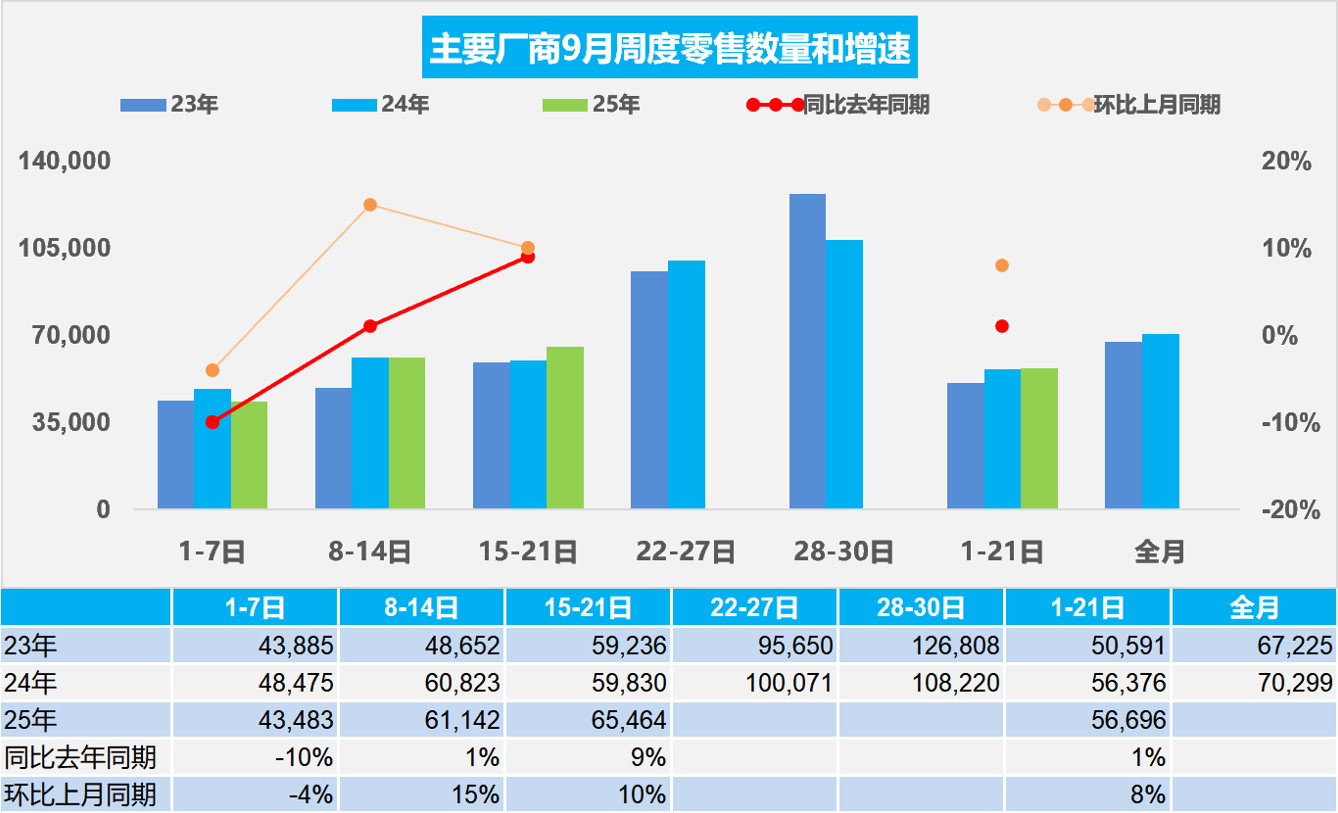
北京商报讯(记者刘晓梦)9月24日,中国汽车流通协会乘用车市场信息联席分会发布的数据显示,今年9 月1日—21日,全国乘用车新能源市场零售69.7万辆,同比增长10%。 ...
乘联分会:今年9月1日—21日全国乘用车市场零售119.1万辆
Bei Jing Shang Bao· 2025-09-24 09:41
北京商报讯(记者刘晓梦)9月24日,中国汽车流通协会乘用车市场信息联席分会发布的数据显示,今年9 月1日—21日,全国乘用车市场零售119.1万辆,同比增长1%。 ...
乘联分会:9月1-21日全国乘用车市场零售119.1万辆 同比去年同期增长1%
智通财经网· 2025-09-24 08:40
Group 1 - The core viewpoint of the article highlights the performance of the passenger car market in China, indicating a stable retail trend in September 2025 compared to previous years, with a slight year-on-year growth [1][5] - From September 1 to 21, 2025, the national retail sales of passenger cars reached 1.191 million units, a year-on-year increase of 1% and an 8% increase compared to the previous month [1][5] - The cumulative retail sales for the year reached 15.955 million units, reflecting a 9% year-on-year growth [1][5] Group 2 - The retail sales of new energy vehicles from September 1 to 21, 2025, amounted to 697,000 units, marking a 10% year-on-year increase and an 11% increase from the previous month [1][5] - The penetration rate of new energy vehicles in the passenger car market reached 58.5%, with cumulative retail sales for the year at 8.267 million units, a 24% year-on-year increase [1][5] - The article notes that the market is entering the traditional peak season of "Golden September and Silver October," with various local subsidies encouraging consumer purchases [5] Group 3 - The wholesale performance of passenger cars from September 1 to 21, 2025, showed 1.307 million units sold, a 0% year-on-year change and a 16% increase from the previous month [9] - Cumulative wholesale sales for the year reached 19.349 million units, reflecting a 12% year-on-year growth [9] - The article discusses the cautious approach of manufacturers in increasing domestic sales while maintaining price stability and reducing dealer inventory pressure [9]

乘用车板块9月24日跌2.47%,上汽集团领跌,主力资金净流出9.27亿元
Zheng Xing Xing Ye Ri Bao· 2025-09-24 08:39
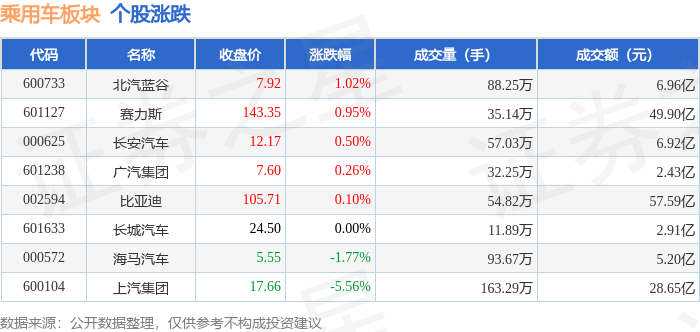
证券之星消息,9月24日乘用车板块较上一交易日下跌2.47%,上汽集团领跌。当日上证指数报收于 3853.64,上涨0.83%。深证成指报收于13356.14,上涨1.8%。乘用车板块个股涨跌见下表: 从资金流向上来看,当日乘用车板块主力资金净流出9.27亿元,游资资金净流入2.67亿元,散户资金净流 入6.6亿元。乘用车板块个股资金流向见下表: | 代码 | 名称 | 主力净流入(元) | 主力净占比 游资净流入 (元) | | 游资净占比 散户净流入 (元) | | 散户净点比 | | --- | --- | --- | --- | --- | --- | --- | --- | | 601127 | 赛力斯 | 6873.26万 | 1.38% | -7316.25万 | -1.47% | 442.99万 | 0.09% | | 601238 广汽集团 | | 1853.07万 | 7.62% | 678.23万 | 2.79% | -2531.30万 | -10.41% | | 601633 长城汽车 | | -207.19万 | -0.71% | 11.97万 | 0.04% | 195.22万 | ...






乘联分会:9月1—21日全国乘用车市场零售119.1万辆 同比增长1%
Zheng Quan Shi Bao Wang· 2025-09-24 08:31
Core Insights - The retail sales of passenger cars in China from September 1 to 21 reached 1.191 million units, representing a year-on-year growth of 1% and an increase of 8% compared to the same period last month [1] - Cumulatively, the retail sales of passenger cars in China for the year have reached 15.955 million units, showing a year-on-year growth of 9% [1] - The retail sales of new energy vehicles (NEVs) in China from September 1 to 21 amounted to 697,000 units, reflecting a year-on-year increase of 10% and an 11% growth compared to the previous month [1] - The penetration rate of the new energy vehicle market in China stands at 58.5%, with cumulative retail sales for the year reaching 8.267 million units, which is a 24% year-on-year increase [1]
汽车行业2025年半年报综述:乘用车企拐点将至,关注汽零强势赛道、客户
CHINA DRAGON SECURITIES· 2025-09-24 04:10
Investment Rating - The report maintains a "Recommended" investment rating for the automotive industry [2] Core Insights - The automotive sector is experiencing a turning point, with a focus on strong automotive parts sectors and key customers [1] - The commercial vehicle sector shows improvement, while humanoid robot valuations are recovering [5] - The passenger vehicle market continues to show high demand, with significant growth in L2.5 and above intelligent driving penetration [23] - Price wars are suppressing profitability, but a turning point for the sector is expected in Q3 [9] - The performance of automotive parts companies is diverging, with a focus on strong customers and growth sectors [6] Summary by Sections Passenger Vehicles - The passenger vehicle market maintained high demand, with wholesale sales reaching 7.003 million units in Q2 2025, a year-on-year increase of 13.2% [23] - The average price of new vehicles increased by 0.20 million yuan per vehicle in Q2 2025, driven by the launch of high-end models by domestic manufacturers [36] - The passenger vehicle sector achieved revenue of 531.8 billion yuan in Q2 2025, with a year-on-year growth of 10.4% [36] - The net profit attributable to the parent company in Q2 2025 was 8.84 billion yuan, a decrease of 19.6% year-on-year due to intense price competition [40] - New energy passenger vehicle sales reached 3.59 million units in Q2 2025, with a penetration rate of 51.3% [23] Automotive Parts - The automotive parts sector achieved revenue of 357.29 billion yuan in Q2 2025, a year-on-year increase of 7.6% [6] - The net profit attributable to the parent company in Q2 2025 was 19.84 billion yuan, a year-on-year increase of 7.2% [6] - Companies in the automotive parts sector are focusing on advantageous sectors and high-growth customers to enhance profitability [6] Commercial Vehicles - The commercial vehicle sector is expected to see a recovery in market conditions, supported by government policies and increasing demand for new energy buses [6] - The bus sector achieved revenue growth of 4.3% year-on-year in Q2 2025, while the heavy truck sector saw a revenue increase of 1.0% [6] - The heavy truck sector's net profit attributable to the parent company in Q2 2025 was 3.38 billion yuan, a decrease of 16.0% year-on-year [6] Investment Recommendations - The report suggests focusing on companies in strong product cycles such as Great Wall Motors, Seres, SAIC Motor, and XPeng Motors [6] - It also highlights key automotive parts companies like Longsheng Technology, Junsheng Electronics, and Desay SV [6] - For commercial vehicles, it recommends focusing on leading companies like Weichai Power and Yutong Bus [6]
海马汽车跌2.30%,成交额1.71亿元,主力资金净流出1031.82万元
Xin Lang Cai Jing· 2025-09-24 02:12
Core Viewpoint - Haima Automobile's stock has shown a significant increase this year, with a 32.06% rise, despite a recent decline in share price and net outflow of funds [1][2]. Financial Performance - For the first half of 2025, Haima Automobile reported a revenue of 669 million yuan, representing a year-on-year growth of 7.74%. However, the net profit attributable to shareholders was a loss of 74.52 million yuan, which is an increase in loss by 50.85% compared to the previous year [2]. - Cumulatively, Haima Automobile has distributed a total of 153 million yuan in dividends since its A-share listing, with no dividends paid in the last three years [3]. Shareholder Information - As of September 19, 2025, the number of shareholders for Haima Automobile increased to 92,700, marking a 9.43% rise from the previous period. The average number of circulating shares per person decreased by 8.62% to 17,719 shares [2]. - The third-largest circulating shareholder is Hong Kong Central Clearing Limited, holding 15.89 million shares, which is an increase of 676,800 shares from the previous period [3]. Market Activity - On September 24, Haima Automobile's stock price fell by 2.30% to 5.52 yuan per share, with a trading volume of 171 million yuan and a turnover rate of 1.86%. The total market capitalization stands at 9.078 billion yuan [1]. - The stock has experienced a 5.34% increase over the last five trading days, a 16.46% increase over the last 20 days, and a 22.39% increase over the last 60 days [1].
