
商贸零售

Search documents
解码南向资金累计净买入首破5万亿港元 港股定价权增强 市场正循环显现
Zheng Quan Shi Bao· 2025-11-12 18:58
Core Viewpoint - The continuous inflow of southbound funds into the Hong Kong stock market has reached a record high, indicating a significant transformation in market liquidity and activity, driven by strategic allocation needs from mainland investors seeking undervalued assets and high-quality stocks [1][2][4]. Group 1: Market Performance - As of November 10, southbound funds have net inflows of 66.54 billion HKD, bringing the total for the year to 1.305 trillion HKD, and cumulative inflows since the launch of the Hong Kong Stock Connect have surpassed 5 trillion HKD [2][3]. - Major indices in the Hong Kong market, including the Hang Seng Index, Hang Seng Tech Index, and Hang Seng China Enterprises Index, have all seen year-to-date increases of over 30%, ranking among the top global markets [2]. Group 2: Factors Driving Inflows - The influx of southbound funds is driven by five key factors: valuation discounts compared to A-shares, demand for technology leaders and high-dividend assets in a declining domestic interest rate environment, improved connectivity mechanisms, long-term investment needs from insurance and public funds, and global liquidity easing expectations [3][4]. - The phenomenon of "asset scarcity" is also noted, where abundant funds are seeking quality assets, leading to increased southbound investments in the Hong Kong market [4]. Group 3: Market Dynamics and Trends - Southbound funds accounted for approximately 34.64% of the total trading volume in the Hong Kong market in 2024, a significant increase from previous years [5]. - The market capitalization held by southbound funds is around 6.21 trillion HKD, representing 12.93% of the total market, with insurance and public funds making up over 40% of this capital [6]. Group 4: Future Outlook - The Hong Kong market is expected to benefit from a "positive cycle" as more mainland companies list in Hong Kong, attracting further capital inflows and enhancing liquidity [7]. - Despite significant gains this year, the valuation of the Hong Kong market remains attractive compared to global peers, providing further incentives for mainland investors to allocate capital southward [8].
新消费行业周报:10月CPI同比转正,关注提振消费方向-20251112
Shanghai Securities· 2025-11-12 12:25
Investment Rating - The industry investment rating is "Overweight (Maintain)" [1] Core Viewpoints - The Ministry of Finance continues to implement measures to boost consumption, including providing financial subsidies for personal consumption loans and encouraging private investment [5] - The Consumer Price Index (CPI) showed a year-on-year increase of 0.2% in October 2025, indicating effective policies to expand domestic demand [5] - The demand for trendy toys is rapidly growing, driven by Generation Z and emotional value, with AI technology integration expected to enhance growth in the sector [6] - The long-term investment advantages of gold are highlighted, with expected growth in demand due to anticipated interest rate cuts and changing consumer preferences [7] - Recent tax policy adjustments for gold are expected to accelerate industry compliance and reshape market dynamics [8] - The sports and outdoor industry is seen as a significant contributor to economic growth, with ongoing government support for high-quality development [9] - The beauty and personal care industry is transitioning from penetration expansion to quality upgrades, with a focus on domestic brands and technological advantages [10] Summary by Sections Industry Overview - The retail industry index rose by 0.31% in the week of November 3-7, 2025, ranking 17th among 31 primary industries [4] Economic Policies - The Ministry of Finance's actions aim to stimulate consumption and enhance financial cooperation with local governments [5] Consumer Trends - The CPI and core CPI show positive trends, indicating a recovery in consumer spending [5] Sector-Specific Insights - Trendy toys are experiencing rapid demand growth, with AI integration expected to drive innovation [6] - The gold and jewelry sector is poised for growth due to changing consumer preferences and favorable tax policies [7][8] - The sports and outdoor sector is benefiting from government reforms and increased consumer confidence [9] - The beauty industry is shifting towards quality and brand loyalty, with a focus on domestic products [10] Investment Recommendations - Suggested companies to watch include: - Gold and jewelry: Laopuyin, Laofengxiang, Chaohongji [11] - Trendy toys: Pop Mart, Bluc, TOPTOY, Lezitiancheng [11] - Sports and outdoor: Anta, Li Ning, 361 Degrees, Bosideng [11] - Beauty and personal care: Proya, Mao Ge Ping, Jinbo Biological, Runben, Dengkang Oral, Baiya [11]
11月12日沪深两市强势个股与概念板块
2 1 Shi Ji Jing Ji Bao Dao· 2025-11-12 10:45
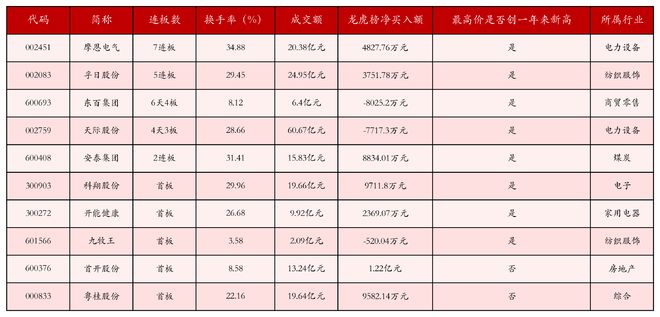
Group 1: Strong Stocks - As of November 12, the Shanghai Composite Index fell by 0.07% to 4000.14 points, the Shenzhen Component Index decreased by 0.36% to 13240.62 points, and the ChiNext Index dropped by 0.39% to 3122.03 points [1] - The top three strong stocks today are Moen Electric (002451) with a 7-day continuous rise, Furui Shares (002083) with a 5-day continuous rise, and Dongbai Group (600693) with 4 rises in 6 days [1] - Moen Electric had a turnover rate of 34.88% and a transaction amount of 2.038 billion yuan, while Furui Shares had a turnover rate of 29.45% and a transaction amount of 2.495 billion yuan [1] Group 2: Strong Concept Sectors - The top three concept sectors with the highest increase are Cell Immunotherapy, Combustible Ice, and Monkeypox Concept [2] - The Cell Immunotherapy sector saw a decline of 2.2%, with 71.19% of its component stocks rising [2] - The Monkeypox Concept sector had a decline of 1.57%, with 76.0% of its component stocks increasing [2]


A股平均股价13.93元 20股股价不足2元
Zheng Quan Shi Bao Wang· 2025-11-12 09:24
Core Points - The average stock price of A-shares is 13.93 yuan, with 20 stocks priced below 2 yuan, the lowest being *ST Yuan Cheng at 0.58 yuan [1] - As of November 12, the Shanghai Composite Index closed at 4000.14 points, indicating a relatively low proportion of both high-priced and low-priced stocks in the A-share market [1] - Among the low-priced stocks, 8 are ST stocks, accounting for 40% of the total [1] Low-Priced Stocks Summary - The lowest priced stock is *ST Yuan Cheng at 0.58 yuan, followed by *ST Su Wu at 0.98 yuan and *ST Jin Ke at 1.40 yuan [1] - In terms of market performance, 4 of the low-priced stocks increased in price, with Haihang Holdings, *ST Hui Feng, and *ST Su Wu showing gains of 1.09%, 1.08%, and 1.03% respectively [1] - Conversely, 12 stocks declined, with Chongqing Steel, Rongsheng Development, and Yabo Co. experiencing drops of 1.88%, 1.74%, and 1.53% respectively [1] Low-Priced Stocks Table - The table lists various low-priced stocks along with their latest closing prices, daily price changes, turnover rates, price-to-book ratios, and industries [1]




武汉市江汉区祝发顺商贸行(个体工商户)成立 注册资本1万人民币
Sou Hu Cai Jing· 2025-11-12 06:21
Core Insights - A new business named Wuhan Jianghan District Zhufashun Trading Firm has been established, with a registered capital of 10,000 RMB [1] - The legal representative of the firm is Zhu Hengxin [1] Business Scope - The company operates in various sectors including internet sales (excluding items requiring permits), retail and wholesale of clothing and accessories, retail of shoes and hats, sales of watches and timing instruments, sales of bags, daily necessities, leather products, and leather [1] - The business is allowed to operate independently in accordance with laws and regulations that do not prohibit or restrict its activities [1]
【盘中播报】沪指涨0.27% 石油石化行业涨幅最大
Zheng Quan Shi Bao Wang· 2025-11-12 03:28
Market Overview - The Shanghai Composite Index increased by 0.27% as of 10:28 AM, with a trading volume of 61.67 billion shares and a transaction value of 893.47 billion yuan, a decrease of 6.50% compared to the previous trading day [1] Industry Performance - The top-performing industries included: - Oil and Petrochemicals: Increased by 1.77% with a transaction value of 8.62 billion yuan, led by Sinopec Oilfield Service, which rose by 10.21% [1] - Banking: Increased by 1.52% with a transaction value of 15.41 billion yuan, led by Agricultural Bank of China, which rose by 2.89% [1] - Home Appliances: Increased by 1.01% with a transaction value of 14.36 billion yuan, led by Beiyikang, which rose by 10.78% [1] - The worst-performing industries included: - Communication: Decreased by 1.33% with a transaction value of 34.89 billion yuan, led by Yongding Co., which fell by 5.45% [2] - Electric Power Equipment: Decreased by 1.25% with a transaction value of 148.46 billion yuan, led by Canadian Solar, which fell by 13.92% [2] - National Defense and Military Industry: Decreased by 0.92% with a transaction value of 16.72 billion yuan, led by Triangle Defense, which fell by 7.34% [2] Stock Performance - A total of 1,864 stocks rose, with 49 hitting the daily limit, while 3,394 stocks fell, with 2 hitting the lower limit [1]





华泰期货:指数震荡调整,等待多头布局机会
Xin Lang Cai Jing· 2025-11-12 02:45
Group 1 - The core focus is on the development of private enterprises in China, with a meeting chaired by the National Development and Reform Commission to discuss the "14th Five-Year Plan" and gather suggestions for accelerating the service industry [1] - The meeting included participants from various sectors such as industrial automation, software and information services, industrial internet, and the catering industry [1] - In the overseas market, the U.S. Senate passed a bill to end the government shutdown, with the House of Representatives set to vote on it [1] Group 2 - In the stock market, A-shares opened high but closed lower, with the Shanghai Composite Index down 0.39% at 4002.76 points and the ChiNext Index down 1.4% [1] - Sector performance was mixed, with retail, real estate, steel, and basic chemicals leading gains, while telecommunications, electronics, computers, and coal sectors saw declines [1] - The trading volume in the Shanghai and Shenzhen markets was below 2 trillion yuan [1] Group 3 - In the futures market, the basis of stock index futures has decreased, with increased trading volume for IH and IF contracts, while overall stock index futures positions have declined [1] - The market is entering a phase of consolidation, with reduced trading activity and both bullish and bearish forces weakening [2] - There is a possibility of further adjustment for the Shanghai Composite Index towards the next support level, which may present a buying opportunity for bulls [2]
18个行业获融资净买入,银行行业净买入金额最多
Zheng Quan Shi Bao Wang· 2025-11-12 02:37
Summary of Key Points Core Viewpoint - As of November 11, the latest market financing balance reached 24,871.64 billion yuan, reflecting an increase of 4.008 billion yuan from the previous trading day, with 18 out of 31 primary industries showing an increase in financing balance [1][2] Industry Financing Balance Changes - The banking industry saw the largest increase in financing balance, up by 0.423 billion yuan to 756.86 billion yuan [1] - Other industries with notable increases include: - Retail: up by 0.359 billion yuan to 272.74 billion yuan, a growth of 1.33% [1] - Agriculture, Forestry, Animal Husbandry, and Fishery: up by 0.347 billion yuan to 280.88 billion yuan, a growth of 1.25% [1] - Pharmaceutical and Biological: up by 0.344 billion yuan to 1,677.17 billion yuan, a growth of 0.21% [1] - Industries with the largest decreases in financing balance include: - Electronics: down by 15.47 billion yuan to 3,626.15 billion yuan, a decline of 0.42% [2] - Communication: down by 8.60 billion yuan to 1,098.62 billion yuan, a decline of 0.78% [2] - Computer: down by 8.48 billion yuan to 1,822.49 billion yuan, a decline of 0.46% [2] Financing Balance by Industry - The following industries had significant financing balances as of November 11: - Electronics: 3,626.15 billion yuan [2] - Communication: 1,098.62 billion yuan [2] - Computer: 1,822.49 billion yuan [2] - Non-banking Financial: 1,916.84 billion yuan [1] - Power Equipment: 2,211.06 billion yuan [1]
314股获杠杆资金大手笔加仓
Zheng Quan Shi Bao Wang· 2025-11-12 02:24
Market Overview - On November 11, the Shanghai Composite Index fell by 0.39%, while the total margin balance in the market reached 2505.298 billion yuan, an increase of 3.882 billion yuan compared to the previous trading day [1] - The margin balance in the Shanghai Stock Exchange was 1275.565 billion yuan, up by 3.043 billion yuan; in the Shenzhen Stock Exchange, it was 1221.835 billion yuan, up by 0.852 billion yuan; and in the Beijing Stock Exchange, it was 7.899 billion yuan, down by 0.014 billion yuan [1] Industry Analysis - Among the industries tracked by Shenwan, 18 sectors saw an increase in margin balances, with the banking sector leading with an increase of 0.423 billion yuan, followed by retail and agriculture sectors with increases of 0.359 billion yuan and 0.347 billion yuan, respectively [1] Stock Performance - A total of 1822 stocks experienced an increase in margin balances, accounting for 48.66% of the market, with 314 stocks seeing an increase of over 5% [1] - The stock with the highest increase in margin balance was Reet Technology, with a latest margin balance of 9.2716 million yuan, reflecting a 78.19% increase from the previous trading day, and its stock price rose by 0.79% [1] - Other notable stocks with significant margin balance increases included Jindike and Lusi Co., with increases of 59.04% and 50.08%, respectively [1] Top Gainers and Losers - Among the top 20 stocks with the highest margin balance increases, the average increase in stock prices was 6.13%, with notable gainers including Huanlejia, Jindike, and Juhua Technology, each rising by 19.99% [2] - Conversely, the stocks with the largest declines included Haima Automobile, Huadian Technology, and Liujin Technology, with declines of 1.97%, 1.88%, and 1.15%, respectively [2] Margin Balance Decrease - In contrast, 1922 stocks saw a decrease in margin balances, with 225 stocks experiencing a decline of over 5% [4] - The stock with the largest decrease in margin balance was Zhongcheng Consulting, with a latest margin balance of 1.3765 million yuan, down by 34.42% from the previous trading day [5] - Other stocks with significant declines included Meibang Technology and Sanwei Equipment, with decreases of 32.91% and 28.11%, respectively [5]

28股获融资净买入额超1亿元 宝丰能源居首
Zheng Quan Shi Bao Wang· 2025-11-12 01:21
Core Viewpoint - On November 11, among the 31 first-level industries tracked by Shenwan, 18 industries experienced net financing inflows, with the banking sector leading at a net inflow of 423 million yuan [1] Industry Summary - The banking industry had the highest net financing inflow on November 11, amounting to 423 million yuan [1] - Other industries with significant net financing inflows included retail, agriculture, pharmaceuticals, construction, chemicals, and non-ferrous metals [1] Company Summary - A total of 1,822 individual stocks received net financing inflows on November 11, with 164 stocks having inflows exceeding 30 million yuan [1] - Among these, 28 stocks had net financing inflows over 100 million yuan [1] - Baofeng Energy topped the list with a net inflow of 268 million yuan, followed by Jiangbolong, China Duty Free Group, Baiwei Storage, Sungrow Power Supply, Dongshan Precision, Juhua Technology, Haima Automobile, and Xinyeyinxi [1]
