装备制造业

Search documents
——2025年11月PMI点评:出口改善推动制造业PMI回稳
EBSCN· 2025-11-30 12:18
Manufacturing Sector - The manufacturing PMI for November 2025 is 49.2%, a slight increase of 0.2 percentage points from the previous month, but still below the seasonal level[2][5] - New export orders index rose significantly by 1.7 percentage points to 47.6%, driven by the easing of US-China tariffs and improved trade conditions[5][19] - Small enterprise PMI increased by 2.0 percentage points to 49.1%, marking a six-month high, indicating a recovery in the external trade environment[5][12] Non-Manufacturing Sector - The non-manufacturing PMI decreased to 49.5%, down 0.7 percentage points from the previous month, reflecting a decline in service-related activities post-holiday[2][28] - The construction PMI rose by 0.5 percentage points to 49.6%, indicating a low-level recovery in building activities, supported by ongoing infrastructure projects[32][34] Price and Inventory Dynamics - Raw material purchase prices and factory gate prices indices increased to 53.6% and 48.2%, respectively, showing an improvement in the supply-demand relationship[24][25] - The finished goods inventory index fell by 0.8 percentage points to 47.3%, indicating a faster reduction in inventory levels, which may support future price increases[24][27]
11月制造业PMI回升至49.2%:高技术制造业PMI为50.1%,连续10个月位于临界点以上
Mei Ri Jing Ji Xin Wen· 2025-11-30 12:07
Group 1: Manufacturing Sector - In November, China's manufacturing PMI rose to 49.2%, an increase of 0.2 percentage points from October, indicating an improvement in economic conditions [1] - The production index and new orders index were reported at 50.0% and 49.2%, respectively, with increases of 0.3 and 0.4 percentage points from the previous month [1] - The high-tech manufacturing PMI stood at 50.1%, remaining above the critical point for ten consecutive months, reflecting ongoing expansion in this sector [1][3] Group 2: Market Demand and Orders - The new orders index for manufacturing increased by 0.4 percentage points to 49.2%, suggesting a recovery in market demand [2] - The new export orders index rose by 1.7 percentage points to 47.6%, contributing significantly to the increase in the new orders index [2] - Recent policy measures, including the introduction of 500 billion yuan in new policy financial tools, are expected to stimulate infrastructure and manufacturing investments, thereby boosting domestic market demand [2] Group 3: Inventory and Production Trends - The raw materials inventory index remained below the prosperity line at 47.3%, indicating a continued destocking trend, while the finished goods inventory index also decreased, suggesting accelerated destocking [3] - The difference between the new orders index and the finished goods inventory index expanded by 1.2 percentage points, indicating that companies are focusing on reducing inventory levels [2][3] Group 4: Sector-Specific Insights - The high-tech manufacturing sector continues to show resilience and growth, with a PMI of 50.1%, despite a slight decline from the previous month [3] - The equipment manufacturing PMI fell to 49.8% and the consumer goods manufacturing PMI dropped to 49.4%, both entering contraction territory, indicating a potential need for policy adjustments to stimulate these sectors [3] - The construction sector's business activity index improved to 49.6%, driven by the completion of the 500 billion yuan policy financial tool, which is expected to support infrastructure investment [5]
2025年11月PMI数据解读:11月PMI:供需弱修复,蓄势待春归
ZHESHANG SECURITIES· 2025-11-30 09:16
Economic Indicators - The manufacturing Purchasing Managers' Index (PMI) for November is at 49.2%, a 0.2 percentage point increase from the previous month, indicating economic improvement[1] - The composite PMI output index is at 49.7%, suggesting overall stability in production and business activities[1] - The production index stands at 50.0%, reflecting stability in manufacturing production[2] Sector Performance - High-tech manufacturing PMI is at 50.1%, indicating expansion, while equipment manufacturing and consumer goods PMIs are at 49.8% and 49.4%, respectively, both in contraction territory[1] - New orders index is at 49.2%, showing a low-level recovery in market demand, but still weaker than production levels[3] - New export orders index increased to 47.6%, a rise of 1.7 percentage points, with significant improvements across various sectors[3] Price Trends - The purchasing price index for raw materials is at 53.6%, up 1.1 percentage points, indicating rising input costs[7] - The factory price index is at 48.2%, reflecting a narrowing decline in output prices[7] Non-Manufacturing Sector - The non-manufacturing business activity index decreased to 49.5%, a drop of 0.6 percentage points, indicating a slowdown in non-manufacturing activities[8] - The construction business activity index improved to 49.6%, showing low-level recovery in the construction sector[8] Overall Outlook - The overall economic activity is stabilizing, with expectations for continued upward momentum into December, supporting the annual GDP growth target of around 5%[1][9] - The report highlights the resilience of exports, with a 10.0% year-on-year increase in container throughput at ports in November[4]
11月份制造业采购经理指数回升
新华网财经· 2025-11-30 05:19
Core Viewpoint - The overall economic climate in China remains stable, with slight improvements in manufacturing and construction sectors, while non-manufacturing activities show signs of decline [1][9]. Manufacturing Sector - The manufacturing Purchasing Managers' Index (PMI) rose to 49.2% in November, an increase of 0.2 percentage points from the previous month, indicating a slight improvement in economic conditions [1][3]. - The production index and new orders index were reported at 50.0% and 49.2%, respectively, with increases of 0.3 and 0.4 percentage points, suggesting recovery in both production and demand [6]. - Small enterprises showed significant recovery with a PMI of 49.1%, up 2.0 percentage points, marking a six-month high [2][6]. - High-tech manufacturing PMI remained above the critical point at 50.1%, continuing its growth trend for ten consecutive months [6]. Non-Manufacturing Sector - The non-manufacturing business activity index fell to 49.5%, down 0.6 percentage points from the previous month, indicating a slowdown in the sector [9][12]. - The service sector's business activity index decreased to 49.5%, a drop of 0.7 percentage points, influenced by the end of holiday effects [13]. - The construction business activity index improved to 49.6%, up 0.5 percentage points, reflecting a recovery in construction activities [8][13]. Market Expectations - The production and business activity expectation index rose to 53.1%, indicating increased confidence among manufacturing enterprises regarding market developments [7]. - The construction sector's business activity expectation index increased to 57.9%, suggesting a positive outlook for upcoming industry developments [13].


11月制造业PMI回升至49.2%,制造业出口趋稳
第一财经· 2025-11-30 04:34
Core Viewpoint - The article discusses the recent trends in China's manufacturing and non-manufacturing sectors, highlighting improvements in manufacturing PMI and challenges in the non-manufacturing sector due to seasonal factors and economic pressures [3][10]. Manufacturing Sector - The manufacturing PMI for November is reported at 49.2%, a slight increase of 0.2 percentage points from the previous month, indicating a modest recovery in market confidence [3][4]. - New export orders index rose to 47.6%, up by 1.7 percentage points, reflecting a stabilization in manufacturing exports across various industries, including high-tech and consumer goods [5]. - The production index for manufacturing stands at 50%, indicating a return to the expansion zone after a brief contraction, with equipment manufacturing, high-tech manufacturing, and consumer goods all showing positive growth [4][5]. - Finished goods inventory index decreased to 47.3%, suggesting smoother sales activities for enterprises [6]. - Raw material prices are on the rise, with the purchasing price index at 53.6%, indicating upward pressure on production costs [8]. Non-Manufacturing Sector - The non-manufacturing business activity index fell to 49.5%, down 0.6 percentage points, primarily due to the seasonal decline in consumer-related services following the holiday peak [10][11]. - The construction industry showed improvement with a business activity index of 49.6%, indicating a slight recovery in construction activities [11]. - Despite the slowdown in non-manufacturing activities, there are positive indicators such as sustained financial activities and optimism in the construction sector, which may support economic stability towards year-end [11].

11月制造业PMI回升至49.2%,制造业出口趋稳
Di Yi Cai Jing· 2025-11-30 03:49
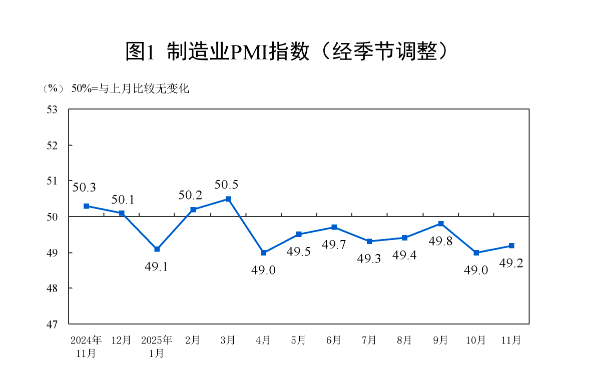
随着稳增长政策不断落地见效,以及10月末中美经贸会谈取得积极成果,国家统计局11月30日发布的11 月份中国制造业采购经理指数(PMI)为49.2%,比上月上升0.2个百分点。 受上月黄金周假期高基数影响,消费相关服务业活动呈现淡季回落特征。11月份,非制造业商务活动指 数为49.5%,比上月下降0.6个百分点。综合PMI产出指数为49.7%,比上月下降0.3个百分点。 中国物流与采购联合会特约分析师张立群认为,11月份制造业PMI指数小幅回升,表明市场信心有所改 善。"十五五"发展目标鼓舞人心,对市场信心产生积极影响。同时也要注意到制造业PMI指数仍处于荣 枯线之下,市场引导的需求收缩仍比较突出,经济仍有下行压力。 张立群强调,要围绕"十五五"良好开局进一步加强宏观经济政策逆周期调节力度,显著加大政府公共产 品、公共服务投资规模,有效有力带动企业订单增加,尽快扭转市场引导的需求收缩发展趋势。 尽管国际经济环境仍然复杂,但中美经贸磋商达成主要成果共识带动11月我国外贸环境有所改善,制造 业出口也趋稳运行。新出口订单指数为47.6%,较上月上升1.7个百分点,指数升幅较为明显。出口趋稳 运行带动制造业市场需求整 ...
国家统计局:11月份制造业采购经理指数小幅回升 非制造业商务活动指数有所回落
Guo Jia Tong Ji Ju· 2025-11-30 01:58
Group 1: Manufacturing PMI Insights - In November, the manufacturing PMI rose to 49.2%, indicating a slight improvement in economic conditions, up by 0.2 percentage points from the previous month [2][3] - Both production index and new orders index improved, reaching 50.0% and 49.2% respectively, with production index crossing the critical point, suggesting better demand and supply dynamics [3] - Small enterprises showed significant recovery with a PMI of 49.1%, up by 2.0 percentage points, marking a six-month high, while large enterprises saw a decline to 49.3% [3] Group 2: Non-Manufacturing PMI Insights - The non-manufacturing business activity index fell to 49.5%, down by 0.6 percentage points, indicating a decrease in the non-manufacturing sector's economic activity [2][5] - The service sector's business activity index dropped to 49.5%, influenced by the end of holiday effects, with certain industries like real estate showing weaker market activity [5] - The construction sector's business activity index improved to 49.6%, up by 0.5 percentage points, reflecting a slight recovery in confidence among construction enterprises [5] Group 3: Composite PMI Insights - The composite PMI output index decreased to 49.7%, down by 0.3 percentage points, with manufacturing production index at 50.0% and non-manufacturing business activity index at 49.5% [6]
国家统计局:11月制造业PMI为49.2% 景气水平有所改善
Guo Jia Tong Ji Ju· 2025-11-30 01:48
Group 1: Manufacturing PMI Insights - The manufacturing Purchasing Managers' Index (PMI) rose to 49.2% in November, indicating a slight improvement in economic conditions, up 0.2 percentage points from the previous month [1][2][3] - Production and new orders indices improved, with production index at 50.0% and new orders index at 49.2%, both showing increases of 0.3 and 0.4 percentage points respectively [3] - Small enterprises showed significant recovery with a PMI of 49.1%, up 2.0 percentage points, marking a six-month high, while large enterprises' PMI fell to 49.3%, down 0.6 percentage points [3] Group 2: Non-Manufacturing Sector Analysis - The non-manufacturing business activity index decreased to 49.5%, down 0.6 percentage points, indicating a decline in the sector's economic conditions [1][2][5] - The service industry index fell to 49.5%, a decrease of 0.7 percentage points, influenced by the end of holiday effects, with certain sectors like railway transport and financial services maintaining indices above 55.0% [5] - The construction industry index improved to 49.6%, up 0.5 percentage points, reflecting a slight recovery in the sector's economic activity [6] Group 3: Overall Economic Outlook - The comprehensive PMI output index decreased to 49.7%, down 0.3 percentage points, with manufacturing production and non-manufacturing business activity indices at 50.0% and 49.5% respectively [1][6] - The production and business activity expectation index rose to 53.1%, indicating increased confidence among manufacturing enterprises regarding future market developments [4]
全年实现利润超7.4万亿元
Ren Min Ri Bao Hai Wai Ban· 2025-11-28 09:47
Core Viewpoint - In 2024, China's industrial enterprises above designated size achieved a revenue of 137.77 trillion yuan, marking a 2.1% increase from the previous year, while total profits reached 74,310.5 billion yuan, a decrease of 3.3% year-on-year. However, there are signs of recovery in the industrial sector, particularly in high-tech manufacturing and consumer goods manufacturing, driven by timely policy measures [4][5][10]. Group 1: Industrial Performance - In December 2024, profits of industrial enterprises turned from a year-on-year decline of 7.3% in November to a growth of 11%, with revenue increasing by 4.2%, an acceleration of 3.7 percentage points from November [5]. - Over 90% of industries and 60% of products reported growth in 2024, with 39 out of 41 major industrial sectors showing an increase in value added, representing a growth rate of 95.1%, up 26.8 percentage points from the previous year [5]. - The industrial capacity utilization rate improved to 75% in 2024, with quarterly rates rising from 73.6% in Q1 to 76.2% in Q4, indicating a continuous improvement in industrial capacity utilization [6]. Group 2: High-Tech Manufacturing and New Growth Drivers - High-tech manufacturing profits grew by 4.5% in 2024, surpassing the average growth rate of 7.8 percentage points for industrial enterprises, contributing to a 0.8 percentage point increase in overall industrial profits [7]. - Specific sectors such as optical electronic device manufacturing and aerospace manufacturing saw profit increases of 66.9% and 13.4%, respectively, while smart device manufacturing sectors experienced even higher growth rates [7]. Group 3: Consumer Goods Manufacturing - Consumer goods manufacturing profits increased by 3.4% in 2024, supported by policies aimed at expanding domestic demand and rising industrial exports [8]. - Key sectors within consumer goods, including chemical fibers and beverages, reported significant profit growth, with increases of 33.6% and 7.1%, respectively [8]. Group 4: Sector-Specific Growth - The non-ferrous metal smelting and rolling industry grew by 15.2%, while the oil and gas extraction industry saw a 14.2% increase in profits in 2024 [9]. - The electricity, heat, gas, and water production and supply sector achieved a profit total of 7,897.6 billion yuan, reflecting a growth of 14.5% [9].
浙商证券李超:大家要对牛市有信心,看好科技与红利
Xin Lang Zheng Quan· 2025-11-28 08:17
Group 1 - The 2025 Analyst Conference and the 7th Sina Finance "Golden Unicorn" Best Analyst Awards highlighted optimistic projections for China's economy and capital markets in 2026, led by Li Chao's team from Zheshang Securities, which won first place in macroeconomic analysis [1] - Li Chao introduced a four-level analytical framework that emphasizes high-quality development as the core anchor for economic growth, addressing key variables such as US-China relations, social stability, structural transformation, and economic growth [3] - The framework indicates that 2026 will focus on structural transformation under high-quality development, with exports providing essential support for economic growth despite trade friction [3] Group 2 - Li Chao predicts a bull market in 2026 driven by declining interest rates, a trend observed globally where liquidity boosts asset valuations even during economic downturns [4] - Previous declines in interest rates in China did not lead to a bull market due to suppressed market risk appetite, but confidence has been improving since 2025, paving the way for liquidity to flow into capital markets [5] - The current interest rate environment and the trend of confidence recovery in China create conditions for replicating the historical bull market patterns seen in the US and Japan during their respective long-term interest rate declines [5] Group 3 - Investment strategies focus on two main asset types benefiting from lower interest rates: technology stocks and dividend stocks, each responding differently to risk appetite influenced by US-China relations [6] - Technology stocks are expected to see long-term valuation re-pricing due to lower discount rates on future cash flows, supported by a 9.6% year-on-year increase in high-tech manufacturing value added [6] - Dividend stocks offer relative yield advantages in a low bond yield environment, making them a stable choice for asset allocation, with significant valuation recovery potential in the A-share market [6][7] Group 4 - Li Chao's investment strategy suggests prioritizing dividend stocks during heightened US-China tensions and shifting to technology stocks when risk appetite improves, providing a practical decision-making framework for investors [7] - The outlook for 2026 is based on a systematic analysis of economic fundamentals, policy logic, and market trends, emphasizing the importance of understanding the marginal changes in key variables [8] - The overall message encourages maintaining an optimistic view of the market while being mindful of the ongoing structural transformation towards high-quality development [8]