能源

Search documents
美国CPI如何影响美联储议息,黄金能否创新高
Sou Hu Cai Jing· 2026-01-11 04:44
Group 1: Market Overview - Oil prices and gold prices have been pushed up due to geopolitical tensions in oil-producing countries like Venezuela and Iran [1][5] - US stock markets saw significant gains, with the Dow Jones up 2.32%, Nasdaq up 1.88%, and S&P 500 up 1.57% for the week [1] - European indices also performed well, with the UK FTSE 100 up 1.74%, Germany's DAX 30 up 2.94%, and France's CAC 40 up 2.04% [1] Group 2: Economic Data and Federal Reserve - Upcoming economic data releases include the US Consumer Price Index (CPI) and GDP data from Germany and the UK, which are expected to influence market sentiment [1][4] - The US unemployment rate has decreased more than expected, alleviating concerns about a sharp deterioration in the job market, although analysts caution that this data may be affected by the government shutdown [3] - The market anticipates at least two interest rate cuts by the Federal Reserve in 2026, with expectations that inflation will decline to around 2% by the end of the year [3] Group 3: Commodity Prices - WTI crude oil near-month contract rose by 3.14% to $59.12 per barrel, while Brent crude oil increased by 4.26% to $63.34 per barrel [5] - Gold prices surged, with COMEX gold futures for January delivery rising by 4.08% to $4,490.30 per ounce [5][6] - HSBC predicts that gold prices may reach $5,000 per ounce in the first half of 2026 due to geopolitical risks [6] Group 4: UK Economic Outlook - The UK is expected to show economic improvement in November, with a projected monthly growth of 0.2%, the fastest since June of the previous year [7] - Upcoming bond auctions in the UK and other European countries are expected to maintain high levels of government debt issuance [7]

【陇上评论】为高质量发展夯实基础
Xin Lang Cai Jing· 2026-01-11 01:43
Core Viewpoint - The article emphasizes the strategic deployment of the "Five Strengths" initiative in Gansu, particularly highlighting the newly added "Strong Foundation" action as essential for addressing deep-rooted issues and ensuring long-term development in the region [1][2]. Summary by Sections Strong Foundation Action - The "Strong Foundation" action aims to address Gansu's developmental challenges, including insufficient development and imbalanced industrial growth between urban and rural areas [1]. - It targets systemic and fundamental issues related to high-quality development, such as weak foundational research, inadequate resource support, and the need for an improved business environment [1][3]. Role of Strong Foundation - The "Strong Foundation" serves as both a "ballast" and a "connector" within the "Five Strengths" framework, providing essential support for technological innovation and industrial upgrades [2]. - It facilitates the flow of resources and collaboration between county-level and provincial initiatives, creating a conducive environment for high-quality development [2]. Multi-Dimensional System Engineering - The "Strong Foundation" encompasses both hard infrastructure (transportation, water conservancy, energy) and soft infrastructure (institutional frameworks, talent aggregation, innovation ecosystems) [3]. - The initiative requires a systematic approach to balance traditional and new infrastructure development, ensuring a comprehensive and efficient modern infrastructure system [3]. - Emphasis is placed on project management, optimizing approval processes, and enhancing financing channels to ensure effective project implementation [3].
获OpenAI 、软银10亿美元联合投资,SB Energy,正在成为AI算力竞争的底牌
创业邦· 2026-01-10 10:38
Core Viewpoint - The AI competition is shifting from algorithmic advancements to a focus on foundational infrastructure, including energy, land, and data center capabilities, as evidenced by the investment in SB Energy by OpenAI and SoftBank [2][3]. Group 1: Investment and Strategic Partnerships - OpenAI and SoftBank have jointly invested $1 billion in SB Energy, with each contributing $500 million to support the development of data centers in the U.S. [2][4]. - This investment is part of the larger Stargate initiative, which aims to invest $500 billion in AI-specific data centers and infrastructure over four years [3][9]. - SB Energy has previously secured $800 million from Ares Infrastructure Opportunities Fund to support its energy and data center projects [6]. Group 2: Energy Supply and Infrastructure - The competition for AI capabilities is increasingly centered around stable and scalable energy supply, which is crucial for the operation of AI data centers [6][10]. - SB Energy has developed significant energy infrastructure, including a 1.36 GW storage facility in California and a 900 MW solar park in Texas, which will serve as a core power supplier for local data centers [12][13]. - Unlike traditional energy companies, SB Energy's competitive edge lies in its comprehensive capabilities across energy development, grid integration, and data center infrastructure [13]. Group 3: OpenAI's Choice of SB Energy - OpenAI's decision to partner with SB Energy reflects a fundamental shift in infrastructure needs, prioritizing stable energy supply over traditional data center resources [15][16]. - The operational model of SB Energy aligns with OpenAI's requirements for long-term, customized data center solutions rather than short-term leasing [19]. - The deep capital connection between SoftBank and OpenAI positions SB Energy as a core partner in OpenAI's long-term strategy, integrating capital, technology, and infrastructure [20]. Group 4: Future Developments and Trends - The collaboration will see SB Energy responsible for constructing and operating a 1.2 GW data center in Texas, which will be strategically located near solar energy resources [22][25]. - SB Energy is also advancing plans for a second data center capable of supporting over 1 GW of computational infrastructure, aligning with the needs of leading AI platforms [25]. - OpenAI aims to integrate its technology with SB Energy's operations, enhancing internal processes through the use of AI models [27][28]. Group 5: Conclusion on Industry Trends - The value of SB Energy lies in its representation of a broader industry trend where AI competition is increasingly focused on real-world infrastructure rather than just cloud-based algorithms [30]. - The success of AI companies will depend on their ability to secure stable energy supplies and efficient infrastructure, establishing a critical barrier to entry in the competitive landscape [30].


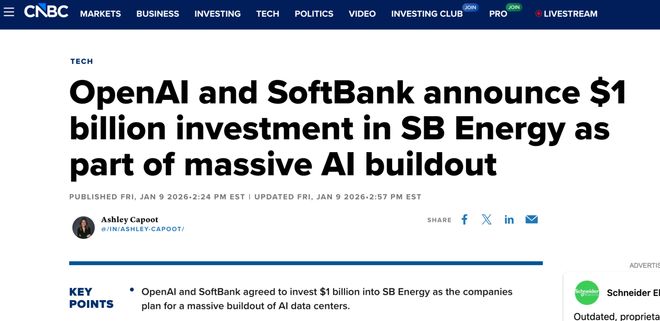
加码AI基础设施:OpenAI与软银宣布向SB Energy投资10亿美元
Huan Qiu Wang Zi Xun· 2026-01-10 07:05
Group 1 - OpenAI and SoftBank plan to invest $1 billion in SB Energy to support the development of OpenAI's artificial intelligence infrastructure [1][3] - This collaboration is part of the $500 billion "Stargate" initiative, which also involves Oracle, and aims to enhance AI capabilities through advanced data center construction [3] - SB Energy will build and operate a data center in Texas with a capacity of 1.2 gigawatts, which was announced in September of the previous year [3][4] Group 2 - SB Energy is developing multiple gigawatt-scale data center parks, with the first facilities expected to be operational by 2026 [4] - The partnership between SoftBank and OpenAI has strengthened over the past year, highlighted by a $40 billion funding round led by SoftBank, marking the largest private financing in the tech sector to date [4] - OpenAI has signed infrastructure agreements totaling over $1.4 trillion to meet its growth demands, with expectations of achieving over $20 billion in annual revenue by 2025 [4]

牛市梦碎?大宗商品行情进入新阶段
对冲研投· 2026-01-10 04:05
Core Viewpoint - The current commodity market is experiencing a complex transition from a liquidity-driven, euphoric "fill-the-gap" rally to a new phase characterized by a tug-of-war between narratives and realities, leading to significant differentiation among commodities [18]. Market Performance - The recent market performance indicates that the idea of a "super bull market" where all commodities rise together may be an unrealistic wish [2]. - The rally began in mid-December 2022, driven by simultaneous easing policies from major central banks, including the Federal Reserve and domestic macro policies, which boosted market confidence and liquidity [2]. Market Dynamics - The market is currently facing a "cold reality" of extreme differentiation, where the price of crude oil remains weak, and some commodities, like polysilicon, have seen sharp declines due to high costs that downstream industries cannot absorb [3]. - The market is influenced by a mix of long-term narratives (such as monetary easing, energy transition, and geopolitical tensions) and short-term realities (like demand pressures and policy responses) [4][9]. Historical Context - Historical commodity supercycles have been driven by structural forces and have lasted decades, with five notable cycles identified over the past two centuries, each linked to significant industrialization and geopolitical events [11][12]. - The current market may not be in a full-fledged supercycle but rather in a "strong cycle" or "structural market" driven by specific narratives and supply constraints [14]. Future Outlook - The market is expected to see increased differentiation, with a return to a broad-based rally being unlikely. Different commodities will follow their own fundamentals, with those tied closely to long-term narratives likely to show stronger resilience [15]. - Volatility is anticipated to become the new norm, with market sentiment being highly sensitive to macro data, policy signals, and industry news [15]. - The ability of the market to find upward momentum will depend on whether real consumption and inventory replenishment can meet the high prices, rather than just remaining at a financial level [16]. Investment Considerations - Investors are advised to focus on the driving logic behind commodities rather than trying to predict market tops or bottoms, and to accept that volatility will be a primary characteristic of the market [17]. - Risk management should be prioritized over the pursuit of high returns, especially in a high-volatility environment [17].

见证历史 大涨!美联储 大消息!
Zhong Guo Ji Jin Bao· 2026-01-10 00:11
美东时间1月9日周五收盘,美国股市集体收涨,道指、标普500指数创收盘新高,热门科技股普涨,中概股涨跌不一。 受美联储降息预期以及加剧避险需求的地缘政治紧张局势提振,本周国际贵金属期货普遍收涨。 来看具体市场情况—— 美国三大股指全线收涨 芯片股大涨 昨夜今晨,美股三大股指全线收涨。截至收盘,道琼斯工业平均指数涨0.48%,报49504.07点;标普500指数涨0.65%,报6966.28点;纳斯达克综合指数涨 0.81%,报23671.35点。 【导读】美股集体收涨,芯片股普涨,中概股涨跌不一;交易员预计1月美联储降息可能性为零 中概股多数下跌,纳斯达克中国金龙指数跌1.3%。热门中概股方面,阿里巴巴、小鹏汽车跌超2%,网易、贝壳跌逾1%,京东集团、理想汽车、中通快递 纷纷下跌。 从周度表现看,三大指数集体上涨。其中,纳指累涨1.88%,道指累涨2.32%,标普500指数累涨1.57%。 板块方面,昨夜今晨美股大型科技股多数上涨,万得美国科技七巨头指数涨0.48%。 个股方面,特斯拉涨超2%,Meta涨逾1%,谷歌、亚马逊、微软、苹果微涨。 谷歌股价创历史新高,市值一度突破4万亿美元。 苹果结束日线7连跌。 ...


见证历史,大涨!美联储,大消息!
Zhong Guo Ji Jin Bao· 2026-01-10 00:08
Market Performance - US stock markets closed higher, with the Dow Jones and S&P 500 reaching record closing highs, while major tech stocks saw broad gains [1][3] - The three major US indices all rose, with the Dow Jones increasing by 0.48% to 49,504.07 points, the S&P 500 up 0.65% to 6,966.28 points, and the Nasdaq Composite rising 0.81% to 23,671.35 points [3] - Weekly performance showed all three indices increased, with the Nasdaq up 1.88%, the Dow up 2.32%, and the S&P 500 up 1.57% [4] Sector Performance - Major tech stocks mostly rose, with the US Tech Seven Index increasing by 0.48% [5] - Notable individual stock performances included Tesla rising over 2%, Meta increasing by more than 1%, and slight gains for Google, Amazon, Microsoft, and Apple [6] Chip Sector Insights - The chip sector experienced significant gains, driven by increased demand for AI computing data centers, leading to rising prices for memory chips and components [11] - Intel rose over 10%, SanDisk increased nearly 13%, and other companies like Lam Research, Applied Materials, and ASML saw gains exceeding 6% [11] - SanDisk's stock price was reported at $377.41, with a year-to-date increase of 58.99%, while Intel's stock was at $45.53, up 23.37% year-to-date [12] Chinese Stocks Performance - Chinese stocks showed mixed results, with the Nasdaq Golden Dragon China Index declining by 1.3% [12] - Major Chinese stocks such as Alibaba and Xpeng Motors fell over 2%, while Netease and Beike dropped more than 1% [12][13] Economic Indicators - The US non-farm payroll report for December showed an increase of 50,000 jobs, below expectations, with an unemployment rate of 4.4% [15] - The labor market appears balanced rather than weak, indicating a stable economic condition that may not necessitate significant changes in monetary policy [16] - Traders expect almost zero probability of a Federal Reserve rate cut in January, with the likelihood of maintaining current rates rising to 95% [17]



国企改革深化提升行动主体任务基本完成
Zheng Quan Shi Bao· 2026-01-09 17:48
Group 1 - The core message of the news is that the State-owned Assets Supervision and Administration Commission (SASAC) has completed the main tasks of the deepening reform action, but emphasizes that reform efforts must continue to institutionalize and sustain the results achieved [1] - During the 14th Five-Year Plan period, significant progress has been made in state-owned enterprises (SOEs) regarding industrial layout optimization, technological innovation, corporate governance, and regulatory mechanisms [1] - New central enterprises such as China Yajiang Group and China Resource Environment Group have been established, and local governments have conducted 116 strategic reorganizations involving 229 first-level enterprises to focus on pillar industries [1] Group 2 - Traditional industries are accelerating their transformation and upgrading, with companies like Ansteel and China National Building Material increasing their high-end products and new materials business [2] - Central enterprises achieved over 11 trillion yuan in revenue from strategic emerging industries in the first 11 months of 2025 [2] - R&D expenditure of central enterprises has grown by an average of 6.5% annually since the 14th Five-Year Plan, with basic research investment increasing at an annual rate of 19% [2] Group 3 - The regulatory system for state-owned assets is continuously improving, with enhanced regulatory effectiveness [3] - Currently, 89 central enterprises are piloting treasury management platforms for online procurement, identifying over 1,000 issues related to false trade and other problems [3]

马斯克断言:全球AI胜负关键,并非算法,而是电力!
Sou Hu Cai Jing· 2026-01-09 17:22
Core Insights - Musk predicts that AGI will emerge by 2026, leading to significant job displacement in professions such as white-collar jobs and surgery, but he believes this will usher in an era of "universal high income" with abundant goods and services at minimal costs [1][3][20] Group 1: Predictions on AGI and Economic Impact - Musk forecasts that AGI may appear in 2026, potentially displacing jobs in various sectors, yet he reassures that society will transition to a prosperous era with low prices [3][20][39] - The abundance of goods and services will lead to prices that only account for materials and electricity costs [3][20][39] Group 2: China's Position in AI - Musk emphasizes that China is likely to lead the world in AI computing power, potentially possessing more chips than any other country [3][21][39] - He attributes China's advantage to its projected electricity generation capacity, estimating that by 2026, China's power generation could reach approximately three times that of the U.S. [3][21][39] Group 3: Energy as a Critical Factor - Current U.S. efforts to restrict China's access to advanced semiconductor chips may ultimately be ineffective, as China is expected to resolve its chip issues [5][23][49] - The primary challenge in AI development is not computing power or algorithms, but rather electricity supply [5][23][49] - A report from Goldman Sachs indicates that electricity shortages could hinder the U.S. AI race, while China is steadily increasing its energy production [5][23][49] Group 4: Future Energy Capacity - Goldman Sachs estimates that by 2030, China's backup power capacity could reach 400 gigawatts, which is three times the total demand of global data centers [5][11][61] - OpenAI has called for the U.S. to accelerate its power grid development to avoid falling behind in the AI competition, highlighting electricity as a strategic asset [5][11][61] - Morgan Stanley has revised its forecast for the electricity shortfall in U.S. data centers, equating it to the power consumption of several large cities [5][11][61]

G7对华挂出免战牌,马克龙带头对话中国:可以跟金砖握手言和
Sou Hu Cai Jing· 2026-01-09 14:12
Group 1 - French President Macron's call for G7 to stop being an "anti-China club" and to consider inviting China to the G7 summit reflects a significant shift in diplomatic strategy [1][4] - The G7 is facing internal divisions and economic challenges, with the group's collective paralysis highlighted by the inability to issue a joint statement at the 2025 summit in Canada due to disagreements among members [3][5] - The economic performance of France is struggling, with a GDP growth rate of only 0.7% in 2025 and an unemployment rate of 8%, prompting Macron to seek opportunities in the Chinese market [5][13] Group 2 - Japan's strong opposition to Macron's invitation to China stems from fears of losing its unique position as the only Asian member of the G7, which has historically allowed it to act as a regional representative [7] - NATO's involvement in G7 economic matters indicates a deeper U.S. pressure to maintain unity against China, despite internal divisions within NATO regarding its role in the Asia-Pacific region [9] - The BRICS nations are expanding, with Indonesia joining in 2025, leading to a significant increase in their global economic influence, which is approaching that of the G7 [11][14] Group 3 - Macron's outreach to China is driven by economic interests, as French companies like Airbus and wine producers heavily rely on the Chinese market for their business [11][13] - The unilateral actions of the Trump administration have alienated European allies, pushing France to advocate for "strategic autonomy" and to engage in dialogue with China to address global economic imbalances [13] - The G7's declining moral authority is evident in its inconsistent responses to global issues, which contrasts with the BRICS nations' focus on practical cooperation and development [14][16]