
大数据

Search documents
【新思想引领新征程·非凡“十四五”】激发脱贫地区新动能 推进乡村全面振兴
Yang Shi Wang· 2026-01-22 11:47
央视网消息(新闻联播):习近平总书记强调,巩固拓展脱贫攻坚成果是全面推进乡村振兴的底线任 务。 "十四五"期间,我国持续巩固拓展脱贫攻坚成果,守住了不发生规模性返贫致贫的底线。如今,广大脱 贫地区发展活力不断增强,为扎实推进乡村全面振兴,谱写中国式现代化新篇章注入强劲动力。 进入新的一年,我国巩固拓展脱贫攻坚成果同乡村振兴有效衔接5年过渡期的各项目标任务已圆满完 成,广大脱贫地区正向乡村全面振兴的目标大步迈进。 如今的脱贫地区,基础设施条件持续改善。在贵州北盘江上,花江峡谷大桥的建成不仅连通了关岭、贞 丰两个曾经的国家级贫困县,更为当地的乡村振兴开辟了新通道。今年元旦假期,贞丰县旅游综合收入 同比增长超过6%。"十四五"期间,全国农村自来水普及率从84%提升到96%,行政村5G通达率超过了 90%,农村公路总里程已经超过了464万公里。曾经作为脱贫攻坚主战场的中西部地区,快递业务收入 和业务量占全国的比重分别提高5.4个和7.5个百分点,有效促进了中西部地区更好融入全国统一大市 场。 如今的脱贫地区,随着乡村建设行动的推进,一个个颜值更高、更加宜居的"宝藏"乡村不断涌现,吸引 了大量年轻人才返乡创业。 如今, ...
政前方观察丨投资青年就是投资未来,贵州这么干
Sou Hu Cai Jing· 2026-01-19 11:31
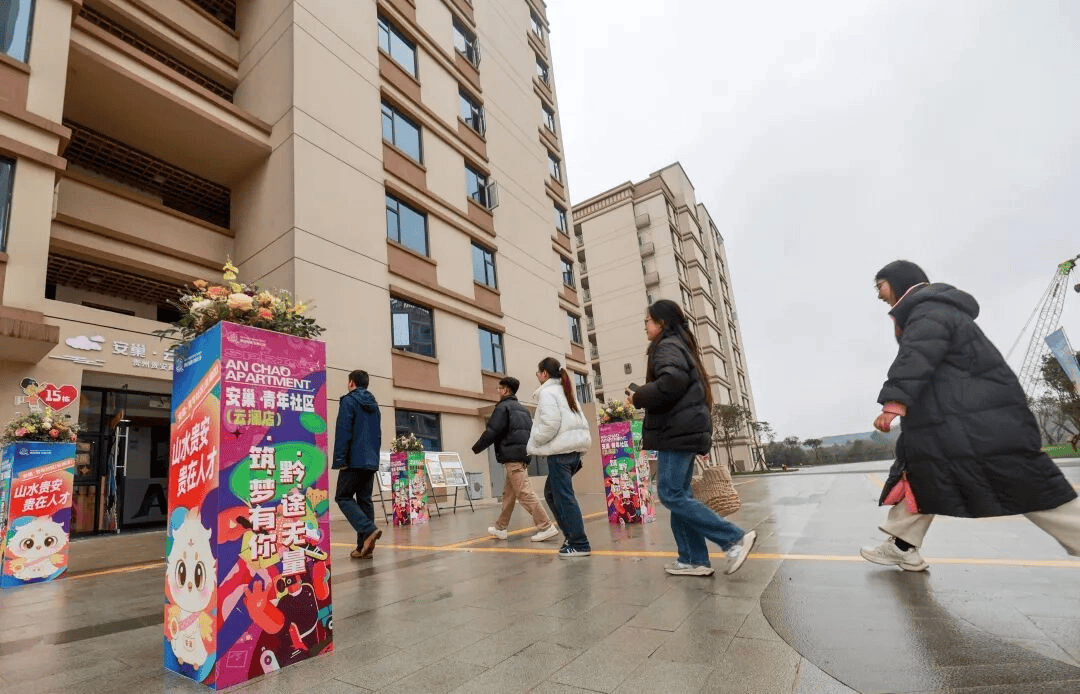
求职青年走进人才公寓。(图/袁福洪) 十年树木,百年树人。大家固然知道每名青年都是一支潜力股,但投资青年使其成长成才,除了培育时间上要足够耐心,培育实践中也要讲究方式方法。 最近几年,"投资于人"热度逐年升高,这一理念倡导将更多资金资源投入到人的能力提升、健康维护、职业发展和潜力开发中。 要这样投资,青年朋友们可就不困了。毕竟,能力提升、职业发展、潜力开发,哪一个不是和我们青年息息相关。 然而,投资不仅要看潜力,也要看回报率。 日前,对《贵州省中长期青年发展规划(2019—2025年)》(下称《规划》)的总结评估显示,《规划》目标任务已如期完成,贵州青年发展总体向好。 贵州有1155万青年,并在全国率先建设"青年友好型成长型省份"。《规划》实施7年来,贵州对青年友好,青年在贵州成长。 循着《规划》总结评估给出的答卷,如果用投资的眼光瞧一瞧,这场"双向奔赴"背后,回报率怎么样? 上小红书,集齐30个赞,免费续住7天——这是贵阳市青年驿站给来筑找工作、考试、创业的青年朋友送上的一份见面礼。 告别成百上千元的住宿成本和找房租房的烦琐,青年驿站不仅是个单纯的落脚点,还是个被政策服务、技能培训、求职信息环绕的服务区,鼓 ...

从十万亿度电看中国经济“新能量”
2 1 Shi Ji Jing Ji Bao Dao· 2026-01-19 11:17
Core Insights - The milestone of 1 trillion kilowatt-hours in electricity consumption by 2025 signifies a transformative shift in China's economy from high energy consumption to high efficiency [2][5] - This growth reflects a deeper change in economic structure, emphasizing innovation-driven growth over resource dependency [2][5] Group 1: Electricity Consumption Trends - By 2025, China's total electricity consumption is projected to reach 1,036.82 billion kilowatt-hours, representing a 5% year-on-year increase [2] - The proportion of electricity consumption from manufacturing is decreasing, while high-tech manufacturing, modern services, and residential consumption are on the rise [2][3] Group 2: Economic Transformation - The transition from factor-driven growth to innovation-driven growth is evident, with emerging sectors like digital economy, smart manufacturing, and green energy gaining momentum [2][3] - The rise of data centers, cloud computing, and AI is leading to a rapid increase in electricity consumption in the information technology sector [3] Group 3: Clean Energy and Sustainability - Clean energy generation now accounts for over one-third of total electricity production, with wind and solar power capacities leading globally [4] - The development of carbon trading markets and advancements in energy storage technology are expected to enhance the connection between economic growth and carbon neutrality [4] Group 4: Smart Energy Management - The integration of big data and AI in energy management allows for real-time data collection and analysis, improving the efficiency of electricity supply [4] - Technologies such as smart grids and virtual power plants enable flexible energy supply, reducing waste and enhancing economic resilience [4]
这个“10万亿” 意味着什么
Ren Min Ri Bao· 2026-01-19 01:37
Core Insights - In 2025, China's total electricity consumption is projected to exceed 10 trillion kilowatt-hours for the first time globally, reflecting significant economic growth and energy security improvements [2][10] Group 1: Electricity Consumption Growth - China's electricity consumption in 2025 is expected to reach 10,368.2 billion kilowatt-hours, more than double that of the United States and surpassing the total consumption of the EU, Russia, India, and Japan combined [2] - The electricity consumption in 2025 will be nearly double that of 2015, showcasing an unprecedented growth rate among major economies [2][3] Group 2: Industrial and Sectoral Changes - The secondary industry is projected to consume 66,366 billion kilowatt-hours, accounting for approximately 64% of total consumption, with significant contributions from high-value-added and technology-intensive sectors [3] - The electricity consumption in the computer, communication, and other electronic device manufacturing sectors is expected to exceed 50 billion kilowatt-hours, surpassing traditional industries like steel and chemicals [3][4] - The third industry is anticipated to consume nearly 2 trillion kilowatt-hours, with a year-on-year growth of 8.2%, driven by sectors such as electric vehicle charging and information technology services [4] Group 3: Electrification and Energy Efficiency - The electrification rate of end-use energy is around 30%, which is higher than that of major developed economies, contributing to increased electricity consumption [5] - Smart irrigation systems in agriculture have improved efficiency by approximately 65%, indicating advancements in energy use in traditional sectors [6] Group 4: Power Supply and Infrastructure - China has the world's largest power supply system, with renewable energy sources accounting for over one-third of total electricity generation, and wind and solar capacity surpassing thermal power for the first time [7][8] - The construction of ultra-high voltage transmission lines has strengthened the energy supply network, facilitating the transfer of clean energy from western regions to eastern load centers [8][9] - The national electricity market has seen a significant increase in transaction volume, doubling from 10.7 trillion kilowatt-hours to 23.8 trillion kilowatt-hours, now accounting for over 60% of total electricity consumption [9]
2025年我国全社会用电量超10万亿千瓦时 意味着什么
Ren Min Ri Bao· 2026-01-18 23:32
Core Insights - China's total electricity consumption is projected to exceed 10 trillion kilowatt-hours by 2025, marking a significant milestone as the first country to reach this level globally [1] - This consumption level is more than double that of the United States and surpasses the combined total of the European Union, Russia, India, and Japan [1] - The growth in electricity consumption reflects China's robust manufacturing capabilities and enhanced energy security [1] Electricity Consumption Trends - By 2025, the secondary industry is expected to consume 66,366 billion kilowatt-hours, accounting for approximately 64% of total electricity consumption [2] - The semiconductor industry, driven by AI applications, is experiencing a surge in demand, with companies like Huahong Semiconductor reporting over 43% year-on-year growth in electricity consumption [2] - The electricity consumption structure is shifting, with the computer and communication equipment manufacturing sector surpassing traditional industries like steel and chemicals for the first time [2] Industrial and Service Sector Developments - High-end manufacturing and technology-intensive industries are becoming the primary contributors to electricity consumption growth, with new energy vehicles and wind power equipment manufacturing seeing growth rates exceeding 20% and 30%, respectively [3] - The service sector is also a significant driver of electricity consumption, with the third industry expected to consume nearly 2 trillion kilowatt-hours by 2025, reflecting an 8.2% year-on-year increase [3] Electrification and Rural Development - The electrification rate of end-use energy is around 30%, surpassing that of major developed economies, contributing to increased electricity consumption [4] - Rural electrification initiatives have led to significant investments, with over 800 billion yuan allocated to improve rural power grids, narrowing the electricity consumption gap between urban and rural residents [5] Power Supply and Infrastructure - China's power supply system is the largest globally, with renewable energy sources accounting for over one-third of total electricity generation [6] - The construction of high-voltage transmission lines has strengthened the electricity grid, facilitating the transfer of clean energy from western regions to eastern load centers [7] - The national electricity market has seen a significant increase in trading volume, doubling from 10.7 trillion kilowatt-hours to 23.8 trillion kilowatt-hours since the 13th Five-Year Plan [8] Conclusion - The anticipated electricity consumption of 10 trillion kilowatt-hours signifies an upgrade in power supply capabilities, reflecting China's economic transition towards higher quality and improved living standards [9]
全球首次,2025年我国全社会用电量超10万亿千瓦时—— 这个“10万亿”,意味着什么(经济新方位)
Ren Min Ri Bao· 2026-01-18 22:05
Group 1 - In 2025, China's total electricity consumption is projected to exceed 10 trillion kilowatt-hours for the first time, which is more than double the annual electricity consumption of the United States and higher than the combined total of the EU, Russia, India, and Japan [1] - The electricity consumption growth reflects China's status as a manufacturing powerhouse and indicates a significant improvement in energy security [1] - The electricity consumption in the secondary industry is expected to reach 66,366 billion kilowatt-hours, accounting for approximately 64% of total consumption, with a notable shift towards high-value-added and technology-intensive industries [2] Group 2 - The demand for electricity in the semiconductor industry is surging, with companies like Huahong Semiconductor reporting over 43% year-on-year growth in electricity consumption due to increased production [2] - The electricity consumption in the computer, communication, and other electronic equipment manufacturing sectors is projected to surpass 50 billion kilowatt-hours for the first time, overtaking traditional industries like steel and chemicals [2] - The third industry is also contributing significantly to electricity consumption, with a projected growth of 8.2% year-on-year, reaching nearly 2 trillion kilowatt-hours by 2025 [3] Group 3 - The electrification rate of end-use energy in China is around 30%, which is higher than that of major developed economies, contributing to increased electricity consumption [4] - The implementation of smart irrigation systems in agriculture has improved efficiency by approximately 65%, showcasing the impact of electrification on traditional sectors [5] - The gap in electricity consumption between urban and rural residents is gradually narrowing, supported by significant investments in rural power grid upgrades [5] Group 4 - China's power supply system is the largest globally, with renewable energy sources like wind and solar surpassing thermal power for the first time [6] - The country has built the world's largest clean coal power supply system, with over 95% of coal power units meeting ultra-low emissions standards [6] - The construction of high-voltage transmission lines has strengthened the electricity grid, facilitating the transfer of clean energy from resource-rich regions to consumption centers [7] Group 5 - The establishment of a unified national electricity market has significantly increased electricity trading volume, doubling from 10.7 trillion kilowatt-hours to 23.8 trillion kilowatt-hours since the 13th Five-Year Plan [8] - The electricity market's role as a regulator and price guide has been enhanced, contributing to the efficient allocation of resources [8] - The energy sector is actively promoting a new energy system and advancing green and low-carbon transitions, supporting high-quality development of renewable energy [8]
视频丨年用电量首超10万亿度 展现中国经济发展活力
Yang Shi Xin Wen Ke Hu Duan· 2026-01-18 12:50
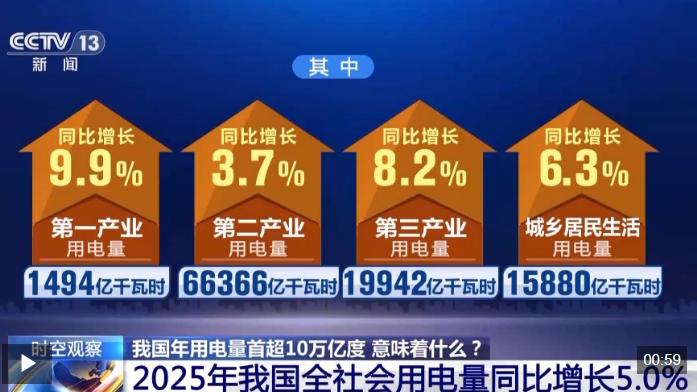
Core Insights - China's total electricity consumption is projected to exceed 10 trillion kilowatt-hours in 2025, marking the first time any country has reached this milestone, which is more than double the annual electricity consumption of the United States and surpasses the combined consumption of the EU, Russia, India, and Japan [2][4][5] Group 1: Electricity Consumption Breakdown - In 2025, total electricity consumption is expected to reach 10,368.2 billion kilowatt-hours, representing a year-on-year growth of 5.0% [2] - The breakdown of electricity consumption by sector includes: - Primary industry: 149.4 billion kilowatt-hours, up 9.9% - Secondary industry: 6,636.6 billion kilowatt-hours, up 3.7% - Tertiary industry: 199.4 billion kilowatt-hours, up 8.2% - Urban and rural residential electricity: 158.8 billion kilowatt-hours, up 6.3% [2] Group 2: Driving Forces Behind Growth - The tertiary sector and residential electricity consumption are the main drivers of overall electricity growth, contributing to 50% of the increase [4] - Within the tertiary sector, the electric vehicle charging and swapping services, as well as information transmission, software, and IT services, have seen significant growth rates of 48.8% and 17.0%, respectively [4][6] Group 3: Structural Changes in Energy Consumption - The second industry remains the primary electricity consumer, accounting for approximately 64%, with growth shifting from high-energy-consuming industries to high-end manufacturing [6] - In 2025, electricity consumption in the computer, communication, and other electronic device manufacturing sectors is expected to exceed 50 billion kilowatt-hours, surpassing traditional industries like steel and chemicals [6] Group 4: Digital Economy and Innovation - The digital economy is experiencing rapid growth, with the "East Data West Computing" initiative driving significant increases in electricity consumption in the data industry, particularly in Guizhou, where internet data service electricity consumption surged by 95.01% [8] - The demand for computing power is also rising exponentially, as evidenced by the Huawei Cloud data center in Guian New Area, which has seen a 56.92% increase in electricity consumption [8] Group 5: Implications of Exceeding 10 Trillion Kilowatt-Hours - The surpassing of 10 trillion kilowatt-hours indicates a robust and stable economic development across various sectors, reflecting the resilience of China's energy infrastructure and the strong integration capabilities of its modern industrial system [4][5] - The shift towards high-tech, high-value-added industries and the increasing share of green electricity supply signal a positive outlook for the development of a new energy system centered around renewable sources [8]
10万亿千瓦时,普通人能从中感知什么
2 1 Shi Ji Jing Ji Bao Dao· 2026-01-17 12:11
Core Insights - The total electricity consumption in China is projected to reach 10.3682 trillion kilowatt-hours by 2025, marking a significant milestone as it is the first time the country's electricity consumption surpasses 10 trillion kilowatt-hours. This figure is more than double the annual electricity consumption of the United States and exceeds the combined annual consumption of the EU, Russia, India, and Japan [1][9]. Group 1: Energy Structure - The shift towards electric vehicles is evident, with non-fossil energy sources expected to account for over 60% of installed capacity by 2025, indicating a significant transition towards cleaner energy. One-third of the total electricity consumed will be green energy [3][11]. - In 2025, China's automobile production and sales are projected to reach historical highs of 34.531 million and 34.40 million units, respectively, with a year-on-year growth of 10.4% and 9.4%. New energy vehicle sales are expected to exceed 16 million units, making up over 50% of new car sales [3][11]. Group 2: Technological Transformation - The industrial sector, which is the largest consumer of electricity, is undergoing a technological revolution characterized by advancements in AI, quantum technology, and automation. In the past year, the electricity consumption of the secondary industry reached 66,366 billion kilowatt-hours, accounting for approximately 64% of total consumption [5][13]. - The computer, communication, and other electronic equipment manufacturing sectors are expected to consume over 50 billion kilowatt-hours of electricity in 2025, surpassing traditional industries like steel and chemicals [5][13]. Group 3: Quality of Life - The electricity consumption of the tertiary industry is projected to reach 19,942 billion kilowatt-hours by 2025, with a year-on-year growth of 8.2%. Urban and rural residential electricity consumption is expected to reach 15,880 billion kilowatt-hours, growing by 6.3% [6][14]. - The increase in electricity consumption in the service sector indicates a vibrant social and market environment, with the electric vehicle sector driving a nearly 50% increase in charging service electricity consumption [6][15].
我国年用电量突破10万亿度,在全球单一国家中尚属首次
Yang Shi Xin Wen· 2026-01-17 10:37
Core Insights - China's total electricity consumption is projected to exceed 10 trillion kilowatt-hours for the first time in 2025, marking a significant milestone in energy consumption growth [1][2] - The growth in electricity consumption reflects a shift towards high-end manufacturing and digital economy, indicating a structural transformation in the economy [5][6][7] Group 1: Electricity Consumption Data - In 2025, total electricity consumption is expected to reach 10,368.2 billion kilowatt-hours, representing a year-on-year growth of 5.0% [1] - The breakdown of electricity consumption shows that the primary industry consumed 149.4 billion kilowatt-hours (up 9.9%), the secondary industry 6,636.6 billion kilowatt-hours (up 3.7%), and the tertiary industry 1,994.2 billion kilowatt-hours (up 8.2%) [1] - The contribution of the tertiary industry and urban-rural residential electricity consumption to the overall growth is 50% [1] Group 2: Global Comparison - China has become the first country to surpass 10 trillion kilowatt-hours in annual electricity consumption, which is more than double that of the United States and exceeds the combined consumption of the EU, Russia, India, and Japan [2] - The electricity consumption has doubled from 5 trillion kilowatt-hours in 2015 to 10 trillion in 2025, showcasing unprecedented growth among major economies [2] Group 3: Energy Supply and Infrastructure - By 2025, China aims to establish a clean and low-carbon power generation system, with non-fossil energy sources accounting for over 60% of total installed capacity [3] - The installed capacity of wind and solar power reached 1.76 billion kilowatts by November 2025, a 34% increase from the previous year [3] - The construction of four ultra-high voltage transmission corridors has been completed, enhancing the cross-regional transmission capacity to 370 million kilowatts [3] Group 4: Energy Storage Development - By the end of 2025, China's pumped storage capacity is expected to exceed 66 million kilowatts, maintaining its position as the world leader for ten consecutive years [4] - The installed capacity of new energy storage has surpassed 10 million kilowatts, growing over 30 times compared to the end of the 13th Five-Year Plan [4] Group 5: Economic Transformation Reflected in Electricity Usage - The second industry, accounting for approximately 64% of total electricity consumption, is shifting from high-energy-consuming sectors to high-end manufacturing [6] - In Jiangsu, the electricity consumption of the computer, communication, and other electronic equipment manufacturing sectors has surpassed 50 billion kilowatt-hours, overtaking traditional industries [6] - The growth in electricity consumption in the tertiary sector, particularly in electric vehicle charging services, has surged nearly 50%, reflecting a consumer shift towards green transportation [7]
面临数据治理难题 “不差钱”的合合信息拟赴港融资
Zhong Guo Jing Ying Bao· 2026-01-16 19:40
Core Viewpoint - The company Hehe Information (688615.SH) is seeking to expand its capital layout by applying for a listing on the Hong Kong Stock Exchange after less than a year on the STAR Market, despite facing challenges in its business model and compliance risks related to data governance [1]. Group 1: Business Performance - Hehe Information's revenue model integrates commercial data with document recognition data, providing services to both individual and enterprise clients through various applications and solutions [2]. - The company's revenue for 2022, 2023, and 2024 is projected to be 988 million yuan, 1.187 billion yuan, and 1.438 billion yuan respectively, with a net profit of 284 million yuan, 323 million yuan, and 400 million yuan [2]. - The overall gross margin has consistently remained above 84%, with C-end products achieving nearly 90% gross margin and B-end products above 60% [2]. Group 2: Revenue Sources - The majority of revenue is derived from the "Scan All" product, which accounted for 72.3%, 76.2%, and 77.3% of total revenue from 2022 to 2024, increasing to 80.6% in the first three quarters of 2025 [3]. - The revenue contribution from the "Business Card" product has remained low, while the "Qixinbao" product's revenue share has declined from 7.8% in 2022 to 3.4% in 2025 [3]. Group 3: Financial Health - As of the third quarter of 2025, the company holds financial assets valued at 1.879 billion yuan, indicating a strong cash position [5]. - The company has a dividend payout ratio close to 50%, having distributed 200 million yuan in cash dividends for the 2024 fiscal year [5]. Group 4: Compliance and Regulatory Challenges - The company faces significant compliance challenges due to varying data protection regulations across different countries, which complicates its global operations [5]. - There have been complaints regarding the "Qixinbao" product, highlighting potential issues with data handling and customer service [6]. - The company was fined 115,500 yuan by the People's Bank of China for failing to report required information regarding its credit reporting products, reflecting compliance risks in its operations [7]. Group 5: Research and Development - The company plans to use funds raised from the Hong Kong listing to enhance R&D capabilities and pursue potential acquisitions, although its R&D expense ratio has decreased from 28.3% in 2022 to 25.4% in 2025 [5]. - The company is currently in the process of developing new products to reduce reliance on its flagship offerings [3].