
电子等

Search documents
直线猛拉5%,阿里AI突传大消息,剑指ChatGPT!百亿港股互联网ETF(513770)水下拉升涨近1%,腾讯三季报来袭
Xin Lang Ji Jin· 2025-11-13 11:31
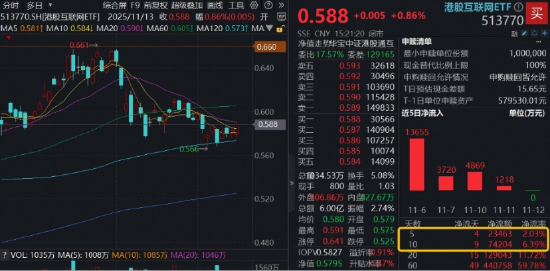
Group 1 - The Hong Kong stock market showed volatility, with the Hang Seng Index recovering to 27,000 points, driven by Alibaba's stock performance, which rose by 3.32% after initially dropping [1][3] - Alibaba has secretly launched the "Qianwen" project, creating a personal AI assistant app to compete with ChatGPT, marking a significant shift towards consumer-facing AI applications [3] - The overall outlook for Hong Kong stocks remains positive, with institutions expecting Tencent's revenue and net profit to grow by 13% in the upcoming earnings report [3][4] Group 2 - Current valuations in the Hong Kong stock market, particularly in the technology sector, are considered low, providing room for further upward movement [4] - The Hong Kong Internet ETF (513770) has seen significant inflows, with 9 out of the last 10 days recording increased investments, totaling 742 million yuan [4] - The Hong Kong Internet sector has shown higher elasticity this year, outperforming the Hang Seng Tech Index, with the China Securities Hong Kong Internet Index up by 40.81% [6] Group 3 - The China Securities Hong Kong Internet Index has a low price-to-earnings ratio of 24.44, significantly lower than the NASDAQ and ChiNext indices, indicating potential for value re-evaluation [6] - The Hong Kong Internet ETF has a current scale exceeding 11.8 billion yuan, with an average daily trading volume of over 600 million yuan, indicating strong liquidity [6] - The ETF is designed to track major internet companies, with Alibaba, Tencent, and Xiaomi being the top three holdings, collectively accounting for over 73% of the index [5]

11月12日A股创业板主力资金流向
Jin Tou Wang· 2025-11-12 08:16
Group 1 - The main focus of the news is the significant inflow and outflow of capital in the A-share ChiNext market, highlighting specific companies that attracted or lost substantial investments [1][2]. - The top three companies with net capital inflow are Ningde Times, Shannon Chip Creation, and Lens Technology, with inflows of 838 million, 732 million, and 463 million respectively [1][4]. - The top three companies with net capital outflow are Sunshine Power, Oriental Fortune, and Guide Compass, with outflows of 1.426 billion, 700 million, and 686 million respectively [2][4]. Group 2 - Ningde Times experienced a slight increase in stock price by 0.20% [4]. - Shannon Chip Creation saw a significant rise in stock price by 10.47% [4]. - Lens Technology had a stock price increase of 3.58% [4]. - Sunshine Power's stock price decreased by 2.78% [4]. - Oriental Fortune's stock price fell by 0.96% [4]. - Guide Compass experienced a decline in stock price by 2.63% [4].





A股:行情见顶了吗?信号明显了,做好准备吧,下周可能这样走
Sou Hu Cai Jing· 2025-11-09 17:07
Core Viewpoint - The A-share market is currently experiencing a tug-of-war around the 4000-point mark, with a critical trading volume threshold of 2.5 trillion yuan that needs to be surpassed for a sustained upward movement [1][3]. Market Conditions - The A-share market has been in a "vacuum period" with a lack of strong catalysts, as the third-quarter reports have just been released and the annual reports are still pending [3]. - There has been a significant net outflow of 236.9 billion yuan from the A-share market, indicating a retreat of existing funds despite a year-on-year revenue growth of 58.27% and net profit growth of 53.58% for listed companies [3][5]. - Foreign capital has shown a cautious attitude, with recent net outflows from northbound funds despite the optimization of the Qualified Foreign Institutional Investor (QFII) system [3][8]. Technical Analysis - The market is showing signs of a potential top, with all three major indices exhibiting a divergence pattern, where the indices are rising while key technical indicators like MACD are not reaching new highs [3][5]. - The current trading volume is around 2 trillion yuan, which is approximately 20% lower than the peak in August, indicating a volume-price divergence that could hinder a breakout [5]. Sector Performance - There is a noticeable rotation among sectors, with recent leaders like pharmaceuticals and AI applications experiencing adjustments, while sectors such as power generation and chemicals have taken the lead [5][6]. - The technology sector is showing significant differentiation, with high valuations in AI-related stocks, while leading companies maintain stability due to their technological advantages [6]. Policy Support - Recent policy measures from the central bank and the China Securities Regulatory Commission (CSRC) have provided a supportive environment for the market, including a 700 billion yuan reverse repurchase operation to ensure liquidity [8]. - The market sentiment has cooled compared to previous bullish trends, with a more rational investor mindset reflected in the changes in trading volume [8]. Investment Strategies - Institutional funds are quietly adjusting their portfolios, with social security and public funds showing significant overlap in holdings, particularly in technology innovation sectors [8]. - The current A-share market valuation is significantly lower compared to 2015, with a healthier market structure as hard tech companies have risen in prominence [10]. Upcoming Events - The market is expected to face critical tests in the coming week, focusing on trading volume expansion, sustainability of leading sectors, and the movement of northbound funds [11]. - Key economic data will be released on November 14, which may provide new directional guidance for the market [13].
官渡区盛建博消防器材经营部(个体工商户)成立 注册资本5万人民币
Sou Hu Cai Jing· 2025-11-06 14:48
Core Insights - A new individual business named "Guandu District Shengjianbo Fire Equipment Business" has been established, with a registered capital of 50,000 RMB [1] Company Overview - The legal representative of the business is Wu Jianming [1] - The business scope includes sales of fire equipment, fire technology services, mechanical equipment sales, wholesale and retail of hardware products, electronic product sales, security equipment sales, instrument sales, plastic product sales, sanitary ware sales, and sales of computer software and hardware [1] - The company is also involved in technical services, development, consulting, exchange, transfer, promotion, sales of building materials, and sales of metal products, operating independently within the scope of its business license [1]
金工ETF点评:跨境ETF单日净流入67.28亿元,银行、综合行业拥挤变幅较大
Tai Ping Yang Zheng Quan· 2025-11-06 12:12
- The industry crowding monitoring model was constructed to monitor the crowding level of Shenwan primary industry indices daily. The model identified that the crowding levels of power equipment and environmental protection were high, while non-bank and home appliances had lower crowding levels. Additionally, significant changes in crowding levels were observed in banking and agriculture, forestry, animal husbandry, and fishery industries[3] - The Z-score model for premium rate was developed to screen ETF products with potential arbitrage opportunities. The model uses rolling calculations to identify signals and warns of potential risks of price corrections for the identified ETFs[4] - Daily net capital inflow for broad-based ETFs was 24.71 billion yuan, with top inflows observed in the following ETFs: China Securities A500ETF (+7.83 billion yuan), A500ETF (+5.14 billion yuan), and SSE 50ETF (+2.61 billion yuan). Conversely, the top outflows were seen in CSI 300ETF (-7.13 billion yuan), CSI 300ETF E Fund (-2.21 billion yuan), and ChiNext ETF (-0.43 billion yuan)[5] - Daily net capital inflow for industry-themed ETFs was 41.72 billion yuan, with top inflows observed in the following ETFs: Securities ETF (+7.78 billion yuan), Banking ETF (+6.03 billion yuan), and Power Grid Equipment ETF (+3.98 billion yuan). Conversely, the top outflows were seen in Wine ETF (-2.71 billion yuan), Robotics ETF E Fund (-2.23 billion yuan), and Battery ETF (-1.26 billion yuan)[5] - Daily net capital inflow for style-strategy ETFs was 7.92 billion yuan, with top inflows observed in the following ETFs: Dividend ETF E Fund (+3.44 billion yuan), Dividend Low Volatility ETF (+1.75 billion yuan), and Dividend Low Volatility ETF (+1.01 billion yuan). Conversely, the top outflows were seen in Dividend ETF (-0.36 billion yuan), Dividend State-Owned Enterprise ETF (-0.27 billion yuan), and Dividend Low Volatility 50ETF (-0.20 billion yuan)[5] - Daily net capital inflow for cross-border ETFs was 67.28 billion yuan, with top inflows observed in the following ETFs: Hang Seng Technology ETF (+12.00 billion yuan), Hang Seng Technology Index ETF (+9.20 billion yuan), and Hong Kong Non-Bank ETF (+6.53 billion yuan). Conversely, the top outflows were seen in Saudi ETF (-0.19 billion yuan), H-Share ETF (-0.18 billion yuan), and Hong Kong Stock Connect 100ETF (-0.08 billion yuan)[5]
科创板今日大宗交易成交4.76亿元
Zheng Quan Shi Bao Wang· 2025-11-05 15:00
Core Insights - A total of 13 stocks from the STAR Market experienced block trading on November 5, with a cumulative transaction amount of 476 million yuan [1][2] Group 1: Trading Overview - On November 5, there were 26 block trades involving 641.80 million shares, totaling 476 million yuan [1] - The stock with the highest transaction amount was Zhongwei Company, with 3 block trades totaling 1.02 million shares and 275 million yuan [1] - Other notable stocks in terms of transaction amounts included Hongwei Technology and Jingwei Hengrun, with block trading amounts of 57.62 million yuan and 31.30 million yuan, respectively [1] Group 2: Price and Discount Analysis - The stocks with the highest discount rates relative to their closing prices included Jingwei Hengrun, Galun Electronics, and Yaokang Biology, with discount rates of 15.89%, 14.02%, and 9.03% respectively [1] - The average increase for STAR Market stocks involved in block trading was 0.75%, with 256 stocks rising, accounting for 43.32% of the total [1] Group 3: Fund Flow Analysis - Among the stocks that experienced block trading, 7 stocks saw net inflows of main funds, with the highest inflows in Nanya New Materials, Zhongwei Company, and XGIMI Technology, amounting to 75.38 million yuan, 64.01 million yuan, and 28.85 million yuan respectively [2] - Conversely, stocks with the highest net outflows included Plitec, Jingwei Hengrun, and Galun Electronics, with outflows of 26.20 million yuan, 18.74 million yuan, and 10.38 million yuan respectively [2]





眭纪刚|解读十五五规划:发挥科技在产业发展中的引领作用
Guan Cha Zhe Wang· 2025-11-05 01:24
Group 1: Core Objectives of the 15th Five-Year Plan - The 15th Five-Year Plan emphasizes accelerating high-level technological self-reliance and leading the development of new productive forces to seize historical opportunities presented by the new round of technological and industrial revolutions [1][2] - The plan highlights the importance of technology as a precursor to industrial development, drawing parallels with historical examples from developed countries that capitalized on past technological revolutions [1][2] Group 2: New Technological Revolution and Industrial Transformation - The current technological revolution, characterized by advancements in artificial intelligence, quantum information, and biotechnology, is driving a paradigm shift in industrial development and fostering the growth of emerging industries [2][4] - Breakthroughs in biotechnology are expected to revolutionize the prevention and treatment of diseases, thereby propelling the future development of the biotechnology sector [2] Group 3: Importance of Technological Dominance - Occupying technological high ground is crucial for gaining competitive advantages in global technology competition, influencing both economic and political landscapes [4][5] - Mastery of core technologies enables countries to transition from technology followers to standard setters, reshaping international order and competition dynamics [5] Group 4: Manufacturing Sector's Role - The manufacturing sector is identified as a pillar of national economic development, with its overall capacity and level determining a country's economic strength and comprehensive national power [6][7] - The plan stresses maintaining a reasonable proportion of manufacturing to counteract trends of outsourcing and to enhance economic resilience [7] Group 5: Relationship Between Technological Innovation and High-Quality Development - Technological innovation is pivotal in transitioning economic development drivers from traditional factors to innovation elements such as technology and human capital, which are essential for achieving high-quality development [9][10] - At the micro level, companies must innovate to enhance product performance and production efficiency, fostering a competitive environment that promotes overall economic quality [9][10]

策略观点:无风区行船更需定力-20251104
China Post Securities· 2025-11-04 08:33
Market Performance Review - The major stock indices showed mixed performance in October, with the Shanghai Composite Index rising by 1.85% while the Shenzhen Component Index and ChiNext Index fell by 1.10% and 1.56% respectively [3][12] - By style, stable style increased by 3.40%, financial style by 2.44%, while consumer style decreased by 0.83% and growth style fell by 1.56% [3][12] - The market experienced increased volatility due to internal and external political factors, with a technical correction in early October followed by a rebound due to favorable political developments [4][12] Industry Insights - Resource sectors led the gains, with coal rising by 10.02%, steel by 5.16%, and non-ferrous metals by 5.00%. Conversely, the media and automotive sectors saw declines of -6.04% and -3.58% respectively [16][17] - The market rotation was evident, with funds shifting from the previously leading TMT sectors to resource sectors, driven by supply disruptions in coal and steel production [16][17] Future Outlook and Investment Views - The report anticipates a "windless zone" for the A-share market in November, with limited political support and a focus on macroeconomic fundamentals and corporate earnings [4][30] - Investment strategies should focus on policy themes and high-performing stocks, particularly in sectors like commercial aviation and low-altitude economy, as previous leaders face pressure [5][31] High-Frequency Data Tracking - The dynamic HMM timing model indicates a current market correction risk, suggesting a re-entry signal for investors [18][20] - Personal investor sentiment showed slight recovery, with the sentiment index at -3.51% as of October 31, indicating significant volatility without a clear trend [22][26] Dividend Yield Analysis - The analysis of dividend yield suggests that bank stocks, which have seen significant price increases, may now offer less attractive value due to high previous gains [27][29] - The current bank dividend yield is under scrutiny, with a necessary increase in cash dividend payout to maintain adequate compensation for risk [27][29]
11.4犀牛财经早报:55只公募前三季度净值增长率超100% 商业银行加速处置不良资产
Xi Niu Cai Jing· 2025-11-04 01:39
Group 1 - 55 public funds achieved a net value growth rate exceeding 100% in the first three quarters, providing a positive investment experience for holders [1] - Nearly 70% of non-ferrous metal stocks reported profit growth in the first three quarters, with 96 out of 141 companies showing year-on-year net profit increases [1] - The Hong Kong stock market led global IPO fundraising with over HKD 210 billion in the first ten months of the year, marking a 203.5% year-on-year increase [1] Group 2 - Commercial banks are intensifying the disposal of non-performing assets, with announcements of loan transfers exceeding 100 billion yuan, focusing on personal housing and consumption loans [2] - The 11th batch of national drug procurement included 55 drugs, with 445 companies participating, aiming to stabilize clinical needs and ensure quality [3] Group 3 - The lithium carbonate industry is recovering, with prices rising from 72,000 yuan/ton to 82,280 yuan/ton, driven by unexpected demand and inventory reduction [4] - The price of DDR5 memory surged by 25% in a week due to supply chain disruptions caused by major manufacturers halting contract quotes [4] Group 4 - The coal price has significantly increased in the second half of the year, leading to a 22.83% quarter-on-quarter profit growth for coal companies, with 37 listed companies reporting a total net profit of 29.942 billion yuan [4] - The dividend willingness in the coal industry has increased, with over 40% of companies showing a dividend yield exceeding 3% [4] Group 5 - Fosun Pharma plans to spin off its vaccine subsidiary, Fosun Antigen, for a Hong Kong listing, which is not expected to affect its control over the subsidiary [7] - Junsheng Electronics has set the final price for its H-share issuance at HKD 22 per share, with trading expected to begin on November 6, 2025 [7] Group 6 - The stock of Lifan Shuke is under investigation for information disclosure violations, posing a risk of forced delisting if found guilty [8] - Wan Tong Development's shareholder reduced holdings by 24.5944 million shares, decreasing ownership to 4.52% [9] Group 7 - Hailanxin's subsidiary won a bid for a marine science observation network project in Sanya, valued at 1.097 billion yuan, enhancing its capabilities in underwater observation and data integration [10] Group 8 - U.S. stock indices showed mixed results, with the Nasdaq rising 0.46% and the Dow Jones falling 0.47%, influenced by disappointing manufacturing data and strong performances from tech stocks like Nvidia and Amazon [11]
11月3日主力资金流向日报
Zheng Quan Shi Bao Wang· 2025-11-03 13:12
Market Overview - On November 3, the Shanghai Composite Index rose by 0.55%, the Shenzhen Component Index increased by 0.19%, the ChiNext Index went up by 0.29%, and the CSI 300 Index gained 0.27% [1] - Among the tradable A-shares, 3,534 stocks increased, accounting for 65.05%, while 1,801 stocks declined [1] Capital Flow - The main capital experienced a net outflow of 23.944 billion yuan, marking three consecutive trading days of net outflows [1] - The ChiNext saw a net outflow of 7.530 billion yuan, the Sci-Tech Innovation Board had a net outflow of 4.928 billion yuan, and the CSI 300 constituents experienced a net outflow of 9.504 billion yuan [1] Industry Performance - Out of the 28 first-level industries classified by Shenwan, 22 industries saw an increase, with the media and coal industries leading with gains of 3.12% and 2.52%, respectively [1] - The industries with the largest declines were non-ferrous metals and household appliances, which fell by 1.21% and 0.66%, respectively [1] Industry Capital Inflow and Outflow - Nine industries had net capital inflows, with the media industry leading at a net inflow of 2.031 billion yuan and a daily increase of 3.12% [2] - The banking sector followed with a daily increase of 1.33% and a net inflow of 1.831 billion yuan [2] - The non-ferrous metals industry had the largest net outflow, with a decline of 1.21% and a net outflow of 7.054 billion yuan [2] - The electronics industry also saw a significant net outflow of 4.571 billion yuan, with a slight decline of 0.08% [2] Individual Stock Performance - A total of 2,041 stocks experienced net capital inflows, with 808 stocks having inflows exceeding 10 million yuan, and 110 stocks with inflows over 100 million yuan [2] - The stock with the highest net inflow was TBEA, which rose by 10.01% with a net inflow of 1.666 billion yuan [2] - Other notable stocks with significant inflows included Zhaoyi Innovation and Sungrow Power, with net inflows of 1.113 billion yuan and 1.050 billion yuan, respectively [2] - Conversely, 142 stocks had net outflows exceeding 100 million yuan, with Northern Rare Earth, SMIC, and 360 having the largest outflows of 1.182 billion yuan, 1.111 billion yuan, and 973 million yuan, respectively [2]



