
芯片半导体

Search documents
仲量联行:新经济动能支撑深圳办公楼租赁市场韧性
Zheng Quan Shi Bao Wang· 2026-01-20 10:59
Group 1: Shenzhen Grade A Office Market - In 2025, Shenzhen's Grade A office market will see a peak in supply with 15 new projects totaling nearly 1.16 million square meters, the highest level in three years, while the overall vacancy rate will rise by 1.8 percentage points to 26.2% [1] - The rental market is experiencing downward pressure, with new rental prices continuing to decline and lease negotiations increasingly favoring tenants, leading to a year-on-year rental drop of 11.1% [1] - The main drivers of rental demand in Shenzhen are the expansion of the consumer electronics sector, the acceleration of brand internationalization, and the growth of strategic emerging industries such as artificial intelligence and semiconductor [1] Group 2: Logistics and Real Estate Trends - Capital is increasingly flowing into hard technology sectors, fostering the growth of new productive forces, with a resurgence in demand for consumer electronics and accelerated applications of AI driving the need for R&D and operational spaces [2] - Office location decisions are shifting from a single price focus to a comprehensive evaluation of cost-effectiveness, property management, and supporting facilities, benefiting high-quality office spaces in core business districts and emerging areas with mature amenities [2] - Some ongoing and existing office projects are alleviating vacancy pressures by incorporating hotel operations, with high-end hotel average room rates in Shenzhen expected to rise by 5.3% to 1,078 yuan and occupancy rates increasing by 5.9 percentage points to 82.0% [2] Group 3: Hotel Market Insights - The national hotel market is anticipated to experience structural highlights, with the potential expansion of public REITs to commercial real estate by 2026, providing new capital operation and exit channels for mature high-quality hotel assets in Shenzhen [3]
科技企业主导深圳写字楼市场需求,市场竞争预计维持高强度
Di Yi Cai Jing· 2026-01-20 09:31
Core Viewpoint - The overall vacancy rate of Grade A office buildings in Shenzhen rose to 26.2% in 2025, reflecting structural pressures in the market due to high new supply and a transformation in leasing demand from enterprises [1][2] Group 1: Market Overview - The Shenzhen Grade A office market is undergoing structural adjustments, with a "total pressure and structural differentiation" pattern emerging due to high levels of new supply and changes in leasing demand [1] - The technology sector dominates the market demand, accounting for nearly 30% of the transaction area, with the smart manufacturing sector showing particularly active leasing demand [1][2] Group 2: Demand Drivers - The main drivers of new leasing demand in Shenzhen's office market are threefold: expansion in the consumer electronics industry, accelerated overseas branding leading to increased demand for related professional services, and the rapid development of strategic emerging industries like artificial intelligence and semiconductor chips [2] - Approximately 30% of the new leasing demand in 2025 will come from expansions, upgrades, and new establishments in the aforementioned sectors [1] Group 3: Supply and Vacancy Trends - The overall vacancy rate for Grade A office buildings in Shenzhen increased by 1.8 percentage points year-on-year to 26.2% in 2025, indicating further structural pressure [2] - An estimated 1.5 million square meters of new supply is expected to enter the market in 2026, with short-term structural supply-demand contradictions likely to persist, maintaining high competition and pressure on rental prices [2] Group 4: Future Outlook - The demand for office space is anticipated to continue rising due to the recovery in consumer electronics demand and the accelerated application of artificial intelligence, which will drive the expansion of smart manufacturing and consumer electronics companies [2]
华映资本:锚定新质生产力赛道,以数字化主线构建创新投资生态
Jing Ji Guan Cha Wang· 2026-01-20 08:14
Core Insights - Huaying Capital, founded in 2008, is a leading private equity investment institution in China, focusing on innovation-driven investments with a core emphasis on digitalization [1] - The company has developed a dual-currency management system, managing over 13 billion RMB, primarily investing in A and B rounds while also engaging in early-stage and later-stage investments [1] - Huaying Capital has invested in over 300 projects across key sectors such as technology, consumer, enterprise services, and digital economy, supporting both mature listed companies and high-potential innovative firms [1] Investment Strategy - The company aligns with the national strategy of "new productive forces," focusing on systematic and forward-looking investments in core areas like artificial intelligence, semiconductor chips, and aerospace economy [2] - Huaying Capital has established an investment matrix covering critical tracks of new productive forces, with a comprehensive investment approach in the AI and embodied intelligence sectors [2] - In the semiconductor field, the company has invested in key segments from design to equipment, supporting domestic chip development and breaking technological barriers [2] Future Outlook - The long-term investment strategy centered on digitalization and new productive forces has created a competitive advantage for Huaying Capital, providing a replicable path for the venture capital industry to support national strategies and empower the real economy [3] - The company aims to continue deepening its focus on innovative sectors, providing long-term capital to foster the growth of technology innovation enterprises and contribute to the development of globally competitive Chinese firms [3]
杨德龙:2026年我国资本市场投资机会明显增多|立方大家谈
Sou Hu Cai Jing· 2026-01-19 12:29
Economic Growth - The overall economy achieved stable growth, with GDP growth projected at 5% for the year, reflecting a recovery and improvement trend [1] - Quarterly GDP growth rates for 2025 are forecasted at 5.4%, 5.2%, 4.8%, and 4.5% respectively [1] - China's trade surplus reached a historic high of over $1.1 trillion, showcasing the competitiveness of Chinese export products [1] Domestic Demand - The main issue in domestic demand is the imbalance of strong supply versus weak demand, with stable prices indicating insufficient demand [1] - Policies to stabilize consumption include promoting trade-in programs and subsidies for certain products, which have positively impacted sales [1] - Retail sales growth remains relatively low, indicating the need for further policies to enhance residents' income and unlock greater consumption potential [1] Income Disparity - Rural residents experienced a real income growth rate of 6%, significantly higher than the 4.2% growth for urban residents, indicating structural improvement [2] - The decline in labor demand in some urban factories has led to a return of laborers to rural areas, contributing to faster income growth in rural regions [2] Investment Opportunities - The new energy sector is witnessing a differentiated market, with some areas showing profit improvements while others face significant losses, emphasizing the need for value investment [3] - The stock market is currently in a phase of adjustment, with expectations for stronger performance around the Spring Festival [4] - The technology sector is expected to remain a dominant feature, with emerging industries such as robotics, semiconductor chips, and biomedicine identified as beneficiaries of economic transformation [3][4]
杨德龙:市场短期调整有利于长期走势更加稳健
Xin Lang Cai Jing· 2026-01-16 09:12
Group 1 - The A-share market has continued the year-end rally that started in mid-December last year, achieving a 17-day consecutive rise and briefly surpassing the 4100-point mark, indicating a significant recovery in overall market risk appetite [1][7] - The strong upward momentum is primarily supported by two factors: the AI sector and other hot sectors attracting substantial capital, leading to strong profit-making effects, and January typically being the month with the highest credit issuance, with new credit generally reaching around 3 trillion to 4 trillion yuan [1][7] - After continuous upward movement, the market shows signs of short-term overheating, with daily trading volume nearing 4 trillion yuan, a historical high, and margin financing balance exceeding 2.6 trillion yuan, also a record [1][7] Group 2 - Following the 17-day rise, nearly 30 listed companies have issued profit warnings for 2025, contrasting with the usual trend of companies reporting positive forecasts first, indicating potential overheating and high valuations in certain sectors [2][8] - The current market rally is characterized as a structural bull market, with economic fundamentals reflecting the performance of traditional industries like real estate and retail remaining sluggish, while the market surge is concentrated in technology innovation sectors [2][8] - The disparity between market performance and economic fundamentals is largely due to differing perspectives, with traditional industries lagging while emerging sectors receive significant capital inflow, particularly in the context of the ongoing AI technology revolution [3][9] Group 3 - The economic growth rate for 2025 is projected to be around 5%, achieving the initial target, but with significant disparities between emerging and traditional industries [4][10] - As growth stabilization policies take effect, improvements in economic data are expected, potentially leading to opportunities for a rotation in the A-share market, especially in consumer sectors [4][10] - The current 17-day rally has ended and adjustments have begun, emphasizing the importance of value investing and selecting quality industries, companies, or funds based on fundamentals to better capture long-term opportunities in the slow bull market [4][11]
任泽平:A股此轮大牛市十年一遇
Xin Lang Cai Jing· 2026-01-12 23:31
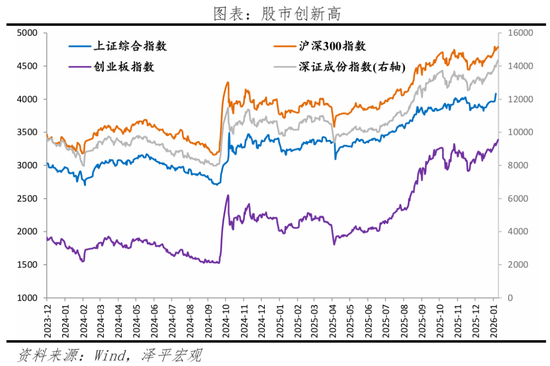
Core Viewpoint - A new bull market has begun since September 24, 2024, driven by significant policy easing, abundant liquidity, and a new wave of technological revolution, termed the "Confidence Bull" [2][31][34]. Group 1: Characteristics of the Bull Market - This bull market is described as a once-in-a-decade event, comparable to previous major bull markets in 2004-2007 and 2014-2015, with the current market driven by policy easing and technological advancements [4][34]. - The bull market has already seen substantial gains, with the Shanghai Composite Index rising by 45.5% and the ChiNext Index by 109.8% from September 24, 2024, to January 12, 2026 [7][35]. - Trading volume has surged from a few hundred billion before September 2024 to over 3 trillion recently, indicating a significant increase in market activity [9][37]. Group 2: Drivers of the Bull Market - The bull market is supported by three main drivers: continuous policy easing, a new technological revolution, and abundant liquidity, creating a combination of policy, technology, and liquidity-driven confidence [11][37]. - Policy easing has included interest rate cuts, relaxed housing market restrictions, and substantial fiscal measures, which have significantly boosted market risk appetite [38]. - The technological revolution is characterized by advancements in artificial intelligence, semiconductors, robotics, and innovative pharmaceuticals, leading to a strong performance in high-risk growth sectors [12][38]. Group 3: Historical Missions of the Bull Market - The bull market is expected to support the development of new productive forces, assist in major power competition, and repair household balance sheets, highlighting its strategic importance [15][41]. - It aims to provide capital market support for new economy sectors, which often struggle to secure financing through traditional banking systems [41]. - The bull market is also seen as a means to counteract the negative wealth effects from the real estate market downturn, with the A-share market's value increasing from under 70 trillion to over 100 trillion, creating a wealth effect of over 30 trillion [16][42]. Group 4: Future Outlook - The sustainability of the bull market will depend on continued macroeconomic policy easing, including further interest rate cuts and fiscal measures to stimulate demand [44]. - There is a need for effective regulation of leverage in the market to ensure healthy development, given the characteristics of the A-share market, which is primarily retail investor-driven [45][46]. - The potential for a long-term bull market could significantly impact the recovery of consumer spending and the real estate market, particularly in major cities [42][44].

重大!明天这四个方向要盯紧了,政策与全球巨头都在猛推,节奏别踏错
Sou Hu Cai Jing· 2026-01-10 01:11
Market Overview - The market is expected to face a technical test on January 8, with the index deviating from the 5-day moving average, indicating a potential need for a pullback or consolidation [1] - The market may attempt to test resistance around 4098 points, but caution is advised as a quick rise could lead to a pullback [3] - Key support levels to watch are around 4071 points and 4056 points, indicating a current state of consolidation [3] Sector Focus - **Commercial Aerospace**: Driven by SpaceX's ambitious plans to scale production, the domestic industry is seeing advancements in reusable rocket technology and increased visibility of orders. Key companies include Zhongguang Fanglong and Aerospace Development [5] - **Semiconductors**: The demand for high-performance storage chips is rising due to AI applications, with companies like SanDisk experiencing significant stock price increases. The advanced packaging market is also growing rapidly, particularly in China [7][8] - **Industrial AI**: Supported by government initiatives, the integration of AI in manufacturing processes is expected to enhance efficiency and reduce costs. Companies like Hand Information and Baoxin Software are positioned well in this sector [10] - **Robotics**: The open-source movement led by NVIDIA is accelerating the development of robots, particularly humanoid robots, making them more accessible for various applications. The global humanoid robot market is projected to grow over 26% annually [12] Investment Opportunities - The market is in a phase of sector rotation, with a focus on commercial aerospace, semiconductors, industrial AI, and robotics as key areas for potential investment. These sectors align with global trends and domestic policy support [13]

你不娶他娘 他不管你叫爹
债券笔记· 2026-01-08 11:20
Group 1 - The semiconductor sector experienced a surge due to the Ministry of Commerce's announcement on strengthening export controls on dual-use items to Japan [3] - The article discusses Japan's historical behavior of being submissive to stronger powers while lacking gratitude towards benefactors, highlighting a pattern of "fear of power but lack of virtue" [4][5][6] - Japan's historical invasions and aggressive actions, such as the First Sino-Japanese War and World War II, are cited as examples of its ungratefulness and disregard for historical accountability [6][7] Group 2 - The article emphasizes the need for a strong response to Japan's behavior, advocating for reinforced export controls to target its military capabilities and prevent access to essential military materials [7] - It suggests that military exercises in the Taiwan Strait and surrounding areas should be conducted regularly to demonstrate a commitment to sovereignty and deter Japanese interference [7] - The narrative encourages a firm attitude towards adversaries, drawing parallels between personal experiences of bullying and the need for assertiveness in international relations [8][9]

杨德龙:新年牛市氛围愈来愈浓 市场赚钱效应明显提高
Xin Lang Cai Jing· 2026-01-08 03:22
Core Viewpoint - The A-share and Hong Kong stock markets are experiencing a continuous upward trend, with the Shanghai Composite Index achieving a historic "14 consecutive days of gains," confirming the ongoing "policy bull" market since September 24, 2024 [1][7]. Policy and Economic Environment - Economic growth stabilization policies are gradually taking effect, expected to improve economic data in 2026 and boost demand through moderate price recovery [1][7]. - The new "National Nine Articles" has significantly changed the A-share market ecosystem, with companies increasing cash dividends and stock buybacks to reward investors [1][7]. - The central bank has introduced policy tools to support the capital market and attract incremental capital [1][7]. Market Dynamics - In 2025, the Shanghai Composite Index broke the 4000-point mark for the third time, with concerns that it might be a market peak; however, it is viewed as the starting point for a new market phase [1][7]. - The market is expected to transition from a structural bull to a comprehensive bull market in 2026, driven by the increasing participation of retail investors [2][8]. Investor Behavior - The public fund sales in 2025 exceeded 1 trillion units, with equity funds accounting for over half [2][8]. - In December 2025, 2.6 million new stock accounts were opened, marking a 30.54% year-on-year increase, indicating a strong trend of household savings moving into the capital market [2][8]. - By the end of 2025, the total number of A-share accounts approached 400 million, with individual investors making up over 99% of the market, highlighting its retail-driven nature [2][8]. Market Performance - The A-share market saw an overall increase in 2025, with the Shanghai Composite Index rising by 18.41% and the ChiNext Index increasing by over 50%, reflecting a broadening market profit effect [3][9]. - The current bull market is characterized by a slow and steady increase, potentially lasting 3-10 years, marking a significant shift in A-share market dynamics [3][9]. Future Outlook - The 2026 market is expected to continue the trends of 2025, with technology stocks remaining a key investment focus, alongside sectors like consumption, new energy, and military industry [4][10]. - The bull market is seen as a once-in-a-decade opportunity, with the potential to set historical records in duration [4][10]. Economic Impact - The bull market aims to boost consumption by enhancing household balance sheets and consumer confidence, thereby stimulating domestic demand [5][11]. - It is also expected to stabilize the real estate market as investors may redirect profits from the stock market into property purchases [5][11]. - The market's prosperity will support the development of innovative technology companies, fostering economic transformation and new growth drivers [6][11].
新年“起势” 项目“奔腾”
Xin Hua Ri Bao· 2026-01-07 19:07
Group 1 - The city of Nantong is initiating a major project construction mobilization meeting to accelerate project development and economic growth at the start of the new year [1] - Nantong aims to start 200 projects with an investment of over 5 million yuan and 500 projects over 1 billion yuan by the end of the year, with all major provincial and municipal projects commencing by September [1] - The high-tech industry in Nantong is exemplified by Amphenol's packaging workshop, which boasts a transmission efficiency of 224G per second, significantly surpassing 5G speeds [1] Group 2 - The observed projects include a mix of provincial major projects, foreign investment projects, high-tech projects addressing supply chain issues, and expansions of existing enterprises [2] - In 2025, Nantong has 60 projects listed as provincial major projects, with 38 already commencing on schedule, leading the province in new project starts [2] - There has been a year-on-year increase of 35.2% in newly recognized service projects and 25.6% in technology innovation projects, showcasing Nantong's commitment to rapid project execution [2]