
科技股

Search documents
银行分化,科技止跌,黄金七连涨
Ge Long Hui· 2025-09-04 04:09
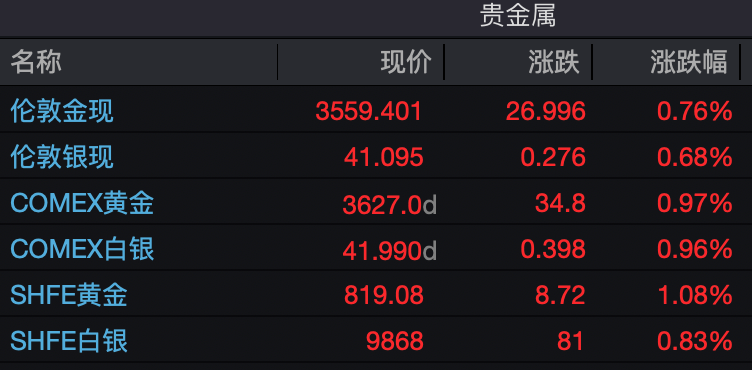
Market Overview - US stock market showed mixed results with the Dow Jones down 0.05%, while the Nasdaq rose by 1.02% and the S&P 500 increased by 0.51% [1] - The banking and technology sectors exhibited divergence, with Chinese concept stocks rebounding from lows and gold prices rising for the seventh consecutive day [1] Banking Sector - Overall, bank stocks showed minor fluctuations; Goldman Sachs, JPMorgan Chase, and Morgan Stanley experienced slight declines, while Citigroup, Zions Bank, United Bank, and US Bancorp saw small gains [3] Technology Sector - Technology stocks stabilized after previous declines, with Google surging by 9.14%, Apple increasing by 3.81%, and Tesla rising by 1.44%. Other major tech companies like Microsoft, Amazon, Netflix, and META recorded slight gains, while Intel, NVIDIA, Qualcomm, and AMD faced minor declines [3] Chinese Concept Stocks - Chinese concept stocks rebounded from earlier lows, with the China Golden Dragon Index down by 0.19%. Notable movements included Pinduoduo rising by 2.22%, Tencent Music up by 1.71%, and iQIYI increasing by 1.12%. However, NIO fell by 3.95%, and XPeng dropped by 2.6%, with other companies like Li Auto, Alibaba, and JD.com also experiencing declines of over 1% [3] Gold Market - COMEX gold prices experienced a slight increase of 0.56%, closing at $3,619.7 per ounce, marking a seventh consecutive day of gains. The intraday trading range saw a low of $3,592.4 and a high of $3,640.1 per ounce [3]




创业板指涨超1%
第一财经· 2025-09-04 02:08
Group 1 - The BC battery sector is leading the market with notable gains, including Robert's Technology up by 5.84%, Aiko up by 4.55%, and Junda up by 4.3% [2] - The A-share market opened with mixed results, with the Shanghai Composite Index down by 0.15% at 3807.76 points, while the Shenzhen Component Index rose by 0.44% to 12526.3 points, and the ChiNext Index increased by 1.18% to 2933.68 points [3] - Various sectors are active, including HJT batteries, CPO, and precious metals, while the automotive and oil & gas sectors are experiencing declines [3] Group 2 - The Hong Kong stock market opened with the Hang Seng Index up by 0.57% and the Hang Seng Tech Index up by 0.74%, with technology stocks generally rising, including Tencent Music up nearly 3% and Baidu up over 1% [4]

黄金白银深夜飙涨!美联储新主席热门人选主张“多次降息”
Zheng Quan Shi Bao· 2025-09-03 22:47
Group 1: Federal Reserve Signals - The Federal Reserve has confirmed signals for interest rate cuts, with Governor Waller stating that he believes the next meeting should result in a rate cut and expects multiple cuts in the coming months [1] - Waller emphasized that the pace of rate cuts can be adjusted based on economic data, indicating flexibility in the approach [1] - He projected that the U.S. inflation rate will return to 2% within 6-7 months and stated that tariffs will not lead to long-term inflation [1] Group 2: Market Reactions - Following the Fed's announcement, gold and silver prices surged, with international gold reaching a historic high, and COMEX gold surpassing $3,600 per ounce [2] - The U.S. stock market saw significant gains, particularly in technology stocks, with the Nasdaq index rising over 1% [2][3] - Major tech companies experienced substantial stock price increases, with Google rising over 8% and Apple and Tesla both increasing by over 3% [3][4] Group 3: Performance of Chinese Tech Stocks - Chinese tech stocks showed mixed performance, with Xiaomi Group rising by 5% and BYD increasing nearly 3% [5] - Other Chinese tech companies, such as Alibaba and JD, experienced declines, with Alibaba falling by 1.59% [5]
帮主郑重聊市场:美股这一跌,俩关键信号得细品
Sou Hu Cai Jing· 2025-09-03 02:07
Group 1 - The recent decline in US stock markets, with the Dow Jones dropping 249 points, is attributed to rising bond yields and uncertainties surrounding Trump's tariffs [1][3][4] - The 30-year US Treasury yield approaching 5% and the 10-year yield reaching 4.29% are significant, as higher bond yields can divert funds from the stock market, particularly affecting high-valuation tech stocks like Nvidia and Tesla [3][4] - Global long-term bond yields are also rising, with countries like the UK, France, and Germany experiencing their highest yields in decades, raising concerns about national debt levels and market reactions [3] Group 2 - The recent court ruling declaring many of Trump's global tariffs illegal adds uncertainty to the market, as potential changes in tariffs could impact costs and profits for import-export businesses [3][4] - The strong performance of US stocks in August, with the Dow rising over 3% and the S&P experiencing four consecutive months of gains, has led to profit-taking in September, contributing to market pressure [4] - The current market situation is described as a crossroads, with investors needing to monitor both bond yield stability and the developments regarding Trump's tariffs [4]

黄金,再创历史新高
Zheng Quan Shi Bao· 2025-09-03 00:03
Group 1: US Stock Market Performance - The three major US stock indices closed lower, with the Dow Jones Industrial Average down 0.55% to 45295.81 points, the S&P 500 down 0.69% to 6415.54 points, and the Nasdaq Composite down 0.82% to 21279.63 points [3] - Major technology stocks experienced declines, with Nvidia down nearly 2%, Amazon, Tesla, and Apple each down over 1%, and Google down 0.73% [3] - Bank stocks also fell, with Goldman Sachs down nearly 2%, Citigroup and Morgan Stanley down over 1%, and Bank of America down 0.66% [3] Group 2: Sector Performance - Energy stocks mostly rose, with Occidental Petroleum up nearly 1%, Chevron up 0.75%, and ExxonMobil up 0.34%, while Schlumberger fell over 2% [3] - Airline stocks mostly declined, with Southwest Airlines down nearly 2%, Delta Airlines down over 1%, and United Airlines down 0.3%, while American Airlines rose 0.15% [4] - Semiconductor stocks also saw declines, with the Philadelphia Semiconductor Index down 1.12%, ARM down over 4%, and several other major semiconductor companies down over 2% [4] Group 3: Chinese Stocks Performance - Chinese stocks in the US showed relative strength, with the Nasdaq Golden Dragon China Index up 0.52% [5] - Notable gainers included Baozun up over 11%, Huya up over 8%, and BeiGene up over 8%, while notable decliners included Kingsoft Cloud down nearly 6% and Youdao down over 5% [5] Group 4: Gold Market Performance - International gold prices continued to rise, with COMEX gold futures breaking through $3600 per ounce, marking a historic high [6] - London gold prices also surged, reaching over $3540 per ounce, also a historic high [7] - Gold stocks in the US market generally rose, with Harmony Gold up over 7% and Caledonia Mining up over 3% [8]
爆买!超1万亿港元!
证券时报· 2025-09-02 12:48
互联互通机制下,港股通为希望多元化资产配置的内地投资者提供了机遇,也为香港市场注入了新的 流动性和活力。 9月2日,南向资金净买入92.81亿港元,年度净买入额超1万亿港元,创下互联互通机制开通以来的最高 纪录。截至目前,南向资金累计净买入港股市场的金额接近4.7万亿港元,同样刷新了历史纪录。 在内地投资者加码买入的背景下,南向资金在港股市场的成交占比也在不断提升。受访人士表示,今年以 来,港股市场因南向资金持续流入,流动性已有明显提升,对于估值与交易层面均有正向推动。未来随着 海外资金的重新回流,或将进一步带来推升效应。 年度净买入额突破万亿港元 今年以来,受益于估值修复、海外货币政策转向,以及国内刺激政策预期上升等因素,港股市场出现明显 回升。截至目前,恒生指数、恒生科技指数的年度涨幅均在20%以上。 在港股市场回暖的背景下,今年以来,南向资金加码净流入港股市场。9月2日,南向资金净买入92.81亿 港元,使得年度净买入额已超万亿港元关口,创下互联互通机制开通以来的最高纪录。 拉长时间来看,2020年至2024年,南向资金成交净买入额分别为6721.25亿港元、4543.96亿港元、 3862.81亿港元 ...

高盛流动性专家:美股系统性需求已枯竭,预计9月将“充满挑战”
华尔街见闻· 2025-09-02 10:29
Core Viewpoint - Goldman Sachs warns that as September, historically the worst-performing month for U.S. stocks, approaches, a key support for the market—systematic demand—has nearly dried up, indicating that the market will face significant challenges this month [1][2]. Group 1: Seasonal Trends and CTA Impact - September has been recognized as a month of "seasonal panic," with the S&P 500 historically showing an average return of -1.17% since 1928, and the latter half of the month being particularly poor with an average return of -1.38% [2][3]. - The buying power of CTA funds, which have been significant drivers of market gains in recent months, has been exhausted, with their U.S. stock positions reaching a full 100% [3][4]. - CTA funds' purchasing power has dropped sharply from $27.66 billion in July to $12.56 billion in August, with expectations of only $2.96 billion in purchases for the entire month of September [3][5]. Group 2: Downside Risks and Institutional Positioning - If the market enters a downward trend, CTA funds may be forced to liquidate positions, potentially selling $22.25 billion in global stocks within a week, including $4.84 billion in U.S. stocks [4]. - In a more severe downturn, CTA models could lead to a massive sell-off of up to $217.92 billion in global stocks, with $73.69 billion attributed to U.S. stocks [5][6]. - Institutional investors have been net sellers of U.S. stocks for two consecutive months, reflecting a cautious stance as September approaches [7][10]. Group 3: Market Dynamics and Fund Flows - Despite recent market rebounds, Goldman Sachs' sentiment indicators remain negative, suggesting that overall positioning is still relatively balanced, with most investors having room to increase their positions [8][12]. - Hedge funds have shown a significant shift towards emerging markets, particularly Chinese assets, with net inflows into these markets exceeding historical averages [14][15]. - Retail investors remain active in individual stock trading but continue to funnel funds into passive investment vehicles like ETFs, leading to a divergence between active and passive fund flows [16][17]. Group 4: Market Stabilizers and Volatility - The internal structure of the market provides stabilizing forces, with dealers in a record long gamma position, which helps absorb market volatility by buying during downturns and selling during upswings [19]. - The low correlation among stocks indicates a highly differentiated market, moving away from a "Beta market" to an "Alpha market" where selective stock picking is essential for profitability [19]. - Implied volatility for the S&P 500 is at a near-year low, making options pricing extremely attractive for hedging against potential market movements [19].

高盛流动性专家:美股系统性需求已枯竭,预计9月将“充满挑战”
美股IPO· 2025-09-02 07:41
Core Viewpoint - Goldman Sachs warns that the CTA (Commodity Trading Advisor) positions have reached a 100% full position status, indicating a lack of supportive capital inflow for the historically weak month of September in the U.S. stock market [1][3][4] Group 1: Market Conditions - September is historically the worst-performing month for the S&P 500, with an average return of -1.17%, and the latter half of the month shows even worse performance with an average return of -1.38% [4] - The purchasing power of CTA funds has significantly decreased from $27.66 billion in July to $12.56 billion in August, with expectations of only $2.96 billion in purchases for the entire month of September [5] - If the market enters a downward trend, CTA funds may be forced to liquidate positions, potentially selling $22.25 billion in global stocks within a week, including $4.84 billion in U.S. stocks [6] Group 2: Investor Sentiment - Institutional investors have been net sellers of U.S. stocks for two consecutive months and are cautious about September, despite recent market rebounds [9] - The net leverage ratio of hedge funds remains below the year-to-date high, indicating a lack of strong directional bets [10] Group 3: Market Dynamics - There is a significant rotation of hedge fund capital into emerging markets, particularly in Chinese assets, with net inflows into emerging markets exceeding three standard deviations above the past ten-year average [11][12] - Retail investors are increasingly active in individual stock trading but continue to favor passive funds like ETFs, leading to a divergence between active and passive fund flows [13] - The amount of funds flowing into U.S. money market funds is 16.5 times that of stock funds, highlighting a "cash is king" sentiment despite the S&P index rising [14] Group 4: Market Stabilizers - The internal market structure provides stabilizing forces, with dealers in a record long gamma state, which helps absorb market volatility [15] - The low correlation among stocks indicates a shift to an "Alpha market," where selective stock picking is essential for profitability [15] - The implied volatility of the S&P 500 is at a near-year low, making options pricing extremely cheap, which is advantageous for hedging against potential market events in September [15]

外资热捧A股,人民币汇率走强,破7关口渐行渐近?
Sou Hu Cai Jing· 2025-09-01 18:26
Group 1 - The Chinese stock market is experiencing a significant rise, with the RMB exchange rate strengthening due to optimistic sentiment and foreign capital inflows [1][3] - The offshore RMB exchange rate successfully broke the important level of 7.15, closing at 7.1222, approaching the psychological level of 7.1 [1] - The recent RMB midpoint rate reached its strongest level since October 2024, indicating potential for further appreciation [1][3] Group 2 - Foreign capital's active buying in the Chinese stock market is a key factor driving the RMB's strength, supported by a favorable current account surplus and capital inflows [3][4] - The Shanghai Composite Index surpassed 3800 points, with trading volume reaching 3 trillion yuan on August 27, marking a historically high trading day [3] - Technology stocks, particularly companies like Cambrian, are leading the current bull market, with significant revenue growth and stock price increases [3] Group 3 - International hedge funds and long-term investors are increasing their investments in the Chinese stock market, contributing to the RMB's appreciation from approximately 7.2 to 7.13 since early August [4] - Exporters have increased their currency conversion rates, indicating a higher rate of dollar selling, which supports the RMB [4] - Future catalysts for further RMB appreciation may include potential interest rate cuts by the Federal Reserve and positive developments in US-China trade negotiations [4]

外资流入A股助涨人民币 机构称年底有望“破7”
Sou Hu Cai Jing· 2025-09-01 16:18
Group 1 - The core viewpoint is that the Chinese yuan has upward momentum supported by increased foreign investment and favorable export conditions, with expectations of further appreciation against the US dollar [1][5][6] - The net settlement rate for exporters in July rose significantly to 54.9%, indicating increased selling of US dollars by exporters, which is a positive catalyst for the yuan [4][5] - The MSCI China Index reached a three-year high, reflecting improved investor confidence driven by government initiatives and a stable market environment due to reduced US-China trade tensions [1][5] Group 2 - The A-share market has seen high trading volumes, with August 27 recording a total trading volume of 3 trillion yuan, indicating strong market activity [2] - Technology stocks, particularly companies like Cambrian, have driven market enthusiasm, with Cambrian's stock price increasing by 134% in August alone [2] - Despite concerns about the sustainability of the current market rally, liquidity remains strong, and there is potential for further asset reallocation towards equities [3][5] Group 3 - The People's Bank of China has shown a strong stance on managing the yuan's appreciation, with the central parity rate reaching its strongest level since October 2024 [6] - Analysts predict that the US dollar may depreciate against the yuan, with expectations of the exchange rate reaching 7.1 in the next 1-2 months and potentially 7.0 by year-end [5][7] - The overall sentiment in the market remains positive, with expectations of continued foreign capital inflows and a favorable economic outlook for Chinese companies [3][4][5]