
银行业

Search documents
增长与通胀预期双双上调!韩国央行如期维持利率不变 暗示未来六个月仍将按兵不动
Zhi Tong Cai Jing· 2026-02-26 04:04
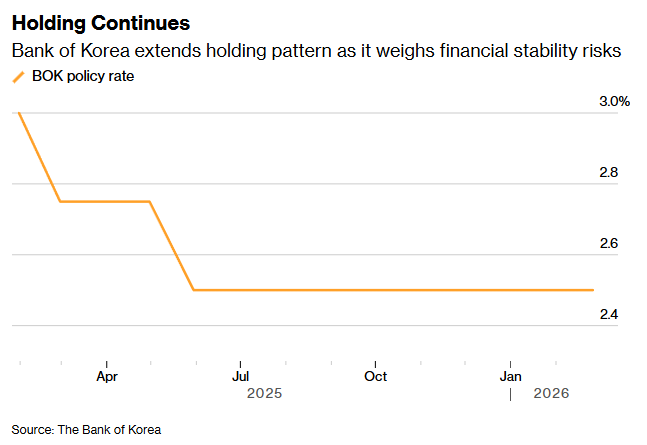
在上调经济增长和通胀预测后,韩国央行周四维持基准利率为2.5%不变,符合经济学家预期,延续了 自去年7月开始的暂停降息周期。与此同时,韩国央行暗示未来六个月内不太可能调整政策,为政策制 定者提供时间以观察相关风险。 韩国央行在权衡金融稳定风险之际延续观望态势 韩国央行周四的声明强化了风险均衡的观点。委员会指出,芯片出口支撑了经济增长,而通胀即便保持 在目标附近,也可能略有上升。同时,房地产市场和美国贸易政策带来的风险仍需进一步观察。 韩国央行此次按兵不动之际,近期经济数据已缓解了官员采取新政策行动的压力。1月份消费者价格同 比上涨2%,核心通胀也为2%,与央行目标一致。部分受股市上涨提振,2月份消费者信心升至去年11 月以来最高水平。与此同时,与人工智能相关的半导体需求支撑了出口表现。 经济学家Hyosung Kwon表示:"下一任韩国央行行长将面临多重交织的局面。经济在全球对计算机芯片 的强劲需求推动下正在获得动能。通胀仍稳定在2%的目标水平。但对首尔房价上涨的担忧依然存在。" 韩国首尔公寓价格已连续一年多(按周计算)上涨,并随着投资者增加按揭债务引发了对金融稳定风险的 担忧。不过,根据韩国房地产委员会的数 ...

支付里的年味儿
Jin Rong Shi Bao· 2026-02-26 04:02
Core Insights - The article highlights the enhanced payment services in Shanxi, particularly during the Spring Festival, which have significantly improved the experience for international tourists [1][2][3] Group 1: Payment Services for Tourists - Shanxi has implemented convenient payment services for international visitors, including ATMs that accept foreign cards and bilingual payment guides [1] - The number of tourists utilizing these services has increased, indicating a positive trend in payment experience [1] - The integration of mobile payment options has been well-received by foreign tourists, enhancing their overall travel experience [1][2] Group 2: Expansion of Payment Infrastructure - The People's Bank of China Shanxi Branch has established multiple payment service demonstration zones, covering key transportation hubs and tourist attractions [2] - A total of 8 provincial and 12 municipal payment service demonstration zones have been created to ensure comprehensive service coverage [2] - The payment service model includes a multi-layered approach that connects hubs, commercial areas, and scenic spots [2] Group 3: Catering to Diverse Demographics - The introduction of "零钱包" (small change bags) caters to the needs of elderly citizens who prefer cash payments, thus enhancing accessibility [3] - The total distribution of "零钱包" has reached 302,000, addressing the small cash payment needs of various demographic groups [3] - The number of merchants accepting foreign cards has expanded to 70,000, with a focus on key merchants [3] Group 4: Promotion of Payment Services - Shanxi has launched a promotional brand "晋善晋美 晋享支付" to raise awareness of its payment convenience initiatives [3] - The promotional strategy includes both offline and online efforts, utilizing various platforms to disseminate payment knowledge [3] - The brand's recognition and influence are continuously increasing, contributing to the overall improvement of payment services in the region [3]
日本央行鹰派委员呼吁进一步加息 与高市早苗的宽松倾向唱反调
Xin Lang Cai Jing· 2026-02-26 03:51
Core Viewpoint - The divergence between the Japanese government and the Bank of Japan's policy committee is increasing, as Prime Minister Fumio Kishida expresses a desire to continue loose monetary policy while a hawkish member calls for interest rate hikes [1][2]. Group 1: Monetary Policy Stance - Prime Minister Fumio Kishida has indicated a preference for the continuation of loose monetary policy [1][2]. - Hawkish committee member Takeda Haruhiko has called for an adjustment in the policy direction, suggesting that the price stability target has been largely achieved [1][2]. - Takeda voted in favor of interest rate hikes for the second consecutive time during the last policy meeting, surprising observers [1][2]. Group 2: Committee Changes - Prime Minister Kishida nominated two known supporters of loose monetary policy, Aoyama Gakuin University professor Sato Ayano and Chuo University professor Asada Tohiro, to replace outgoing committee members Noguchi Akira and Nakagawa Junko [1][2]. - Noguchi's five-year term will end next month, while Nakagawa's term will conclude in June [1][2]. Group 3: Upcoming Policy Meeting - The Bank of Japan is scheduled to hold a policy meeting on March 18-19, where it is expected to maintain the current policy stance [3].
针锋相对?高市提名两大鸽派入局后 日本央行“鹰王”强硬表态:应继续加息!
Zhi Tong Cai Jing· 2026-02-26 03:41
Core Viewpoint - The divergence between the Japanese government and the Bank of Japan (BOJ) regarding monetary policy is becoming evident, particularly with the recent calls for interest rate hikes from BOJ's most hawkish committee member, Hajime Takata, despite Prime Minister Fumio Kishida's preference for maintaining an accommodative monetary policy [1] Group 1: Monetary Policy Stance - Hajime Takata advocates for further adjustments to the BOJ's policy, suggesting that the inflation stability target has been largely achieved [1] - Takata's recent public statements follow his unexpected proposal for consecutive interest rate hikes during last month's policy meeting, indicating a shift in the internal dynamics of the BOJ [1] - The upcoming BOJ policy meeting on March 18-19 is widely expected to result in no changes to the current monetary policy [1] Group 2: Government and BOJ Relationship - Prime Minister Fumio Kishida has nominated two prominent dovish figures, Toichiro Asada and Ayano Sato, to the BOJ's policy board, which may further highlight the differences in monetary policy perspectives between the government and the central bank [1] - The nominations come as current committee members Asahi Noguchi and Junko Nakagawa are set to complete their terms, with Noguchi's term ending next month and Nakagawa's in June [1]
日本央行鹰派委员呼吁进一步加息 与首相鸽派提名形成对比
Ge Long Hui· 2026-02-26 02:45
Core Viewpoint - The divergence between the Bank of Japan's hawkish policy committee member Takeda and Prime Minister Kishida regarding monetary policy is becoming increasingly evident, with calls for further interest rate hikes amidst a backdrop of ongoing accommodative policies [1] Group 1: Monetary Policy - Takeda, a prominent member of the Bank of Japan, has called for further interest rate hikes, indicating a shift towards policy normalization as the inflation target appears to be nearly achieved [1] - This call for rate increases comes after Takeda's unexpected proposal for consecutive hikes during a recent policy meeting, marking his first public comments since then [1] - The internal conflict within the Bank of Japan is highlighted by Takeda's stance, contrasting with the government's preference for maintaining loose monetary policies, as evidenced by Kishida's recent appointments of two well-known supporters of such policies to the central bank [1]
1月份资金面充裕 债市收益率多数下行
Jin Rong Shi Bao· 2026-02-26 02:39
Core Viewpoint - The People's Bank of China (PBOC) is implementing a moderately accommodative monetary policy, with a focus on improving policy efficiency and effectiveness while maintaining liquidity in the financial system [1][2]. Group 1: Monetary Policy and Liquidity - In January 2026, the PBOC reduced the rates of various structural monetary policy tools by 0.25 percentage points, resulting in a net injection of 1 trillion yuan into the market [2][3]. - The average daily trading volume in the interbank market was 222.5 trillion yuan, reflecting a 6% month-on-month decrease but a 51% year-on-year increase [1][2]. - The PBOC's actions included a 9,000 billion yuan increase in Medium-term Lending Facility (MLF) and a total of 20,000 billion yuan in reverse repos, effectively countering the impacts of increased government bond issuance and seasonal cash withdrawals [2][3]. Group 2: Bond Market Performance - In January, the issuance of bonds in the interbank market reached 4.4 trillion yuan, a year-on-year increase of 22.1%, with net financing of 1.99 trillion yuan, marking a 136.1% month-on-month increase [4]. - The yields on various bonds mostly declined, with the 10-year government bond yield stabilizing between 1.8% and 1.9%, and the credit spreads narrowing [4][5]. - The yield curve for government bonds showed a mixed performance, with some maturities experiencing slight decreases while others saw minor increases [4]. Group 3: Interest Rate Swaps and Trading Activity - The interest rate swap curve saw a slight upward movement, with 6-month, 1-year, and 5-year Shibor 3M swap rates showing minor increases [6][7]. - The average daily transaction volume for RMB interest rate swaps increased by 23%, with a nominal principal amount of 4.4 trillion yuan [7]. - The trading of interest rate options surged by 280%, indicating a growing interest in hedging strategies within the market [7].
交银国际每日晨报-20260226
BOCOM International· 2026-02-26 02:37
交银国际研究 每日晨报 2026 年 2 月 26 日 今日焦点 | 金融行业 | | --- | | 银行业追踪:整体经营环境改善;关注股份 | | 制银行结构性机会 | | 金天 Timothy.Jin@bocomgroup.com | 伴随市场主体内生增长动力逐步修复,银行经营环境正在改善。以招商 银行(3968 HK/未评级)、中信银行(998 HK/未评级)等为代表的股份 制银行 2025 年经营业绩保持稳健。其中,招商银行作为公认的零售业务 标杆银行,当前中高端客群风险偏好在改善中,对营收贡献略有下降, 但整体营收、净利润等核心指标已有改善;中信银行作为传统对公银行, 净利润同比增速企稳回升。 2026 年是"十五五"规划的开局之年,财政、货币政策进一步发力有望 拉动企业端信贷需求,改善个人端投资和消费预期,助力银行业务发展 稳中向好;同时,净息差有所企稳,不良率保持低位,亦将为银行业绩 增长提供支撑。在长线资金持续入市过程中,建议重点关注基本面稳定、 同时股息较高的股份制银行的结构性机会。 | 全球主要指数 | | | | | --- | --- | --- | --- | | | 收盘价 | ...
京东集团首席经济学家沈建光2026年经济展望:分化中显韧性,攻坚中现机遇
Jin Rong Jie· 2026-02-26 02:29
Core Viewpoint - The article discusses the outlook for China's economy in 2026, emphasizing the need for a focus on domestic demand amidst external pressures and structural changes in the economy [2][4]. Economic Growth - In 2025, China's economy achieved a growth target of 5%, but the growth rate showed a declining trend throughout the year, with net exports contributing 32.7% to economic growth [2]. - The economic growth in 2026 is expected to be slightly lower than in 2025, with a focus on the quality and efficiency of growth [2]. Key Growth Engines - Infrastructure investment is set to lead the growth, with significant national projects accelerating due to policy support, including an increase in funding to approximately 295 billion yuan [2]. - Manufacturing investment is anticipated to recover, driven by technological innovation and the rise of new economic sectors such as semiconductors and artificial intelligence [2]. - Export resilience is expected to continue, with a projected growth rate of around 5% in 2026, supported by diversification into emerging markets and upgrades in export products [3]. Domestic Demand Challenges - 2026 is characterized as a year of "domestic demand challenges," with weak domestic demand and insufficient internal momentum being the primary concerns [4]. - Consumer spending faces constraints from high base effects, pressure on income growth (with disposable income growth slowing to 5% in 2025), and a significant decline in real estate wealth [4]. - Retail sales growth is expected to slow to around 3%, but service consumption presents a potential growth area, with significant room for improvement compared to the U.S. [4]. Policy Adjustments - Macro policy shifts are aimed at releasing potential and enhancing efficiency rather than merely increasing stimulus [5]. - Fiscal policy is projected to maintain a deficit rate of around 4%, focusing on quality and efficiency of spending [6]. - Monetary policy has shifted to include the promotion of reasonable price recovery as a key consideration, indicating a proactive approach to low inflation [6]. - Real estate policies will focus on controlling new supply, reducing inventory, and optimizing supply to stabilize the market [7].

日本央行委员高田创:需要进一步调整货币宽松水平
Xin Lang Cai Jing· 2026-02-26 02:26
Core Viewpoint - The Bank of Japan needs to further adjust its monetary easing policy and enhance communication, assuming that the stable inflation target has been largely achieved [1][4]. Group 1: Monetary Policy Adjustments - Takeda, a member of the Bank of Japan's policy committee, indicated that the central bank is in a phase of gradually adjusting its monetary easing levels, while the financial environment remains accommodative [3][6]. - Takeda proposed an interest rate hike last month, positioning him as one of the most hawkish members among the nine committee members [3][6]. Group 2: Inflation Risks - Takeda emphasized the necessity to remain vigilant regarding the risks of rising inflation during his speech to local business leaders in Kyoto [2][5]. Group 3: Market Response - The Bank of Japan should consider measures to respond to special fluctuations in the bond market, including increasing the scale of bond purchases [3][6].
每日投行/机构观点梳理(2026-02-25)
Jin Shi Shu Ju· 2026-02-26 01:52
Group 1: Gold Price Predictions - Morgan Stanley predicts that gold prices will reach $6,300 per ounce by the end of 2026, raising its long-term forecast to $4,500 per ounce [1] - UBS expects gold prices to touch $6,200 per ounce in the coming months, driven by persistent geopolitical risks and continued support from the Federal Reserve's easing policies [1] Group 2: Copper Price Outlook - Citigroup holds a bullish outlook on copper prices, forecasting a rise to $14,000 per ton in the next three months, citing strong demand from China and limited downside risks [1] - The bank maintains a long-term average copper price forecast of $13,000 per ton for 2026, indicating a balanced global copper market [1] Group 3: AI Impact on GDP - Goldman Sachs reports that AI contributed nearly zero to the U.S. GDP last year, as investments were offset by imports of chips and hardware [2] - A survey of executives revealed that while 70% of companies are actively using AI, about 80% believe it has not impacted employment or productivity [2] Group 4: S&P 500 Index Forecast - A Reuters survey indicates that the S&P 500 index is expected to rise nearly 10% to around 7,500 points by the end of 2026, supported by strong earnings and stable economic growth [3] - Despite a resilient market, risks remain from inflation trends, Federal Reserve policies, and geopolitical tensions [3] Group 5: Bond Market Dynamics - Societe Generale highlights that geopolitical uncertainties are supporting the safe-haven demand for bonds, leading to a dovish shift in market expectations for central bank interest rate paths [4] Group 6: UK Interest Rate Expectations - ING analysts suggest that the British pound may decline if the Bank of England's Governor hints at a potential rate cut in March [5][6] Group 7: Canadian Interest Rate Outlook - Scotiabank anticipates that the Bank of Canada will keep interest rates unchanged until the outcome of the USMCA negotiations becomes clearer [7] Group 8: Domestic AI Developments - CITIC Securities reports a surge in the usage of domestic AI models, indicating a significant expansion in AI inference demand and investment opportunities in domestic computing power [8] Group 9: Electronic Fabric Demand Cycle - CITIC Securities notes that the current electronic fabric demand cycle, driven by AI, may be more intense than previous storage cycles, with a projected 100% increase in demand for specialty fabrics by 2026 [9] Group 10: AI Industry Chain Outlook - CITIC JianTou expresses optimism about the AI industry chain, highlighting strong demand for computing power and the transition of large models towards monetization [10] Group 11: AIDC Growth and Equipment Demand - CITIC JianTou indicates that the AIDC construction phase will lead to significant demand for power capacity and related equipment, with a projected CAGR of 55% from 2025 to 2028 [11] Group 12: AIDC Sector Performance - Founder Securities anticipates continued high growth in the AIDC sector, driven by increased capital expenditures from leading internet companies and a growing demand for power equipment in the U.S. [12] Group 13: New Energy Vehicle Market Recovery - Galaxy Securities predicts a recovery in the automotive market post-Spring Festival, with several flagship new energy vehicle models set to launch, potentially boosting market demand [13]