传媒

Search documents
光大策略:关注业绩,持股过节,春节后A股或迎来新一轮的上涨行情
Xin Lang Cai Jing· 2026-02-01 11:42
Group 1 - The A-share market experienced a volatile upward trend in January 2026, with major indices showing gains, particularly the ChiNext 50 and CSI 500, while the Shanghai Composite Index rose by 3.8% [6][12][22] - The market is expected to enter a short-term correction phase before the Spring Festival, influenced by tightening liquidity and reduced trading enthusiasm among investors [4][38] - Historical data indicates that the A-share market typically performs better in the 20 trading days following the Spring Festival, with a 75% probability of gains compared to less than 45% before the holiday [38][40] Group 2 - In the upcoming spring market, small-cap stocks are anticipated to outperform, driven by increased risk appetite and the influx of retail investor capital [52][54] - The focus should be on growth and cyclical sectors, with industries such as electronics, power equipment, machinery, non-ferrous metals, and communications expected to perform well in February [2][54] - The Hong Kong market is advised to adopt a "growth + value" strategy, benefiting from earnings recovery, improved liquidity, and supportive policies [2][65] Group 3 - The spring market is characterized by a dual focus on growth and cyclical sectors, with historical trends showing that both categories often perform well during this period [54][61] - The technology sector, particularly AI and commercial aerospace, is highlighted as a key area for investment, with potential catalysts expected to drive performance [61][64] - The overall sentiment in the market is shifting from being driven by capital to being driven by earnings, indicating a transition towards long-term value investing [2][65]

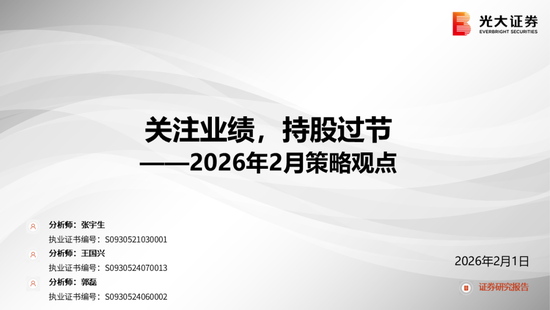
A股2026年2月观点及配置建议:指数震荡,涨价扩散-20260201
CMS· 2026-02-01 11:34
Market Outlook - The market is expected to remain volatile in February, with a potential for stronger performance post-Spring Festival due to policy catalysts and the upcoming Two Sessions [2][3][26] - The focus will shift towards cyclical price increases and AI applications, particularly in sectors like oil and petrochemicals, construction materials, and steel [2][3][26] Industry and Sector Recommendations - Recommended sectors include cyclical and technology areas, with a focus on high-growth industries such as electronics (semiconductors), media (advertising, gaming, film), machinery (automation, engineering), power equipment (batteries, grid equipment, photovoltaic), basic chemicals, and social services [4][6][21] - The report emphasizes the importance of sectors benefiting from the 14th Five-Year Plan, particularly in construction and infrastructure projects [3][4][21] Liquidity and Capital Supply - February is anticipated to see continued net inflows of incremental capital, with foreign capital expected to flow in before the Spring Festival and financing likely to rebound afterward [5][19] - Despite a positive trend in resident capital inflows, significant reductions in ETF holdings have offset these inflows, leading to a challenging trading environment [5][19] Economic and Earnings Trends - The report highlights a recovery in industrial profits, with a positive outlook for sectors experiencing price increases, such as industrial metals and AI-driven technology [6][18] - The earnings growth forecast remains focused on high-growth areas, particularly those benefiting from cyclical price increases and export advantages in mid-to-high-end manufacturing [6][18][21]
Clawdbot:Open Claw新起点:传媒
Huafu Securities· 2026-02-01 11:30
行 业 研 究 华福证券 Clawdbot :Open Claw 新起点 投资要点: 一、Clawdbot 更名 OpenClaw 行 业 动 态 跟 踪 据 AI 寒武纪,开源个人 AI 助手项目 Clawdbot 正式宣布其最终 名称为"OpenClaw"。根据腾讯科技,Clawdbot 运行在本地 Mac 或 服务器,通过聊天软件作为交互入口,可以直接操控本地文件、终端、 甚至浏览器。 二、Clawdbot 对"模型"的影响:模型的"Agent Coding 能力" 1、海外:根据 Github,它推荐使用 Anthropic Pro/Max (100/200) 搭 配 Opus 4.5,因为它在长上下文处理方面表现更强,并且具有更好的 抗提示词注入能力。 2、国内:根据 Minimax,项目上线初期,MiniMax 即接入其技术 生态,为开发者提供模型能力层面的支持。 三、Clawdbot 对"操作系统"的影响:Mac 和 Linux 成主力 1、Mac 系统:根据澎湃新闻,Clawdbot 让已经卖了一年多的 M4 Mac mini 海外社区迎来了一波明显的订单高峰。这主要是由于 Mac 系 统深度 ...
长江研究2026年2月金股推荐
Changjiang Securities· 2026-02-01 11:23
Market Outlook - The market is expected to maintain a fluctuating upward trend around the Spring Festival in February 2026, with a focus on the "Technology + Resources" mainline market[3] - Key attention should be given to the earnings reports of US tech stocks and the potential validation of AI industry trends[3] Investment Strategy - Focus on three main lines: - Technology sector, including optical modules, storage, semiconductor equipment, and energy storage, addressing the issues of electricity shortages in the US, chip shortages domestically, and global storage shortages[3] - Non-ferrous metals, with increased volatility expected after January, particularly in industrial metals and chemicals[3] - Hot topics such as robots participating in the Spring Festival Gala and updates on AI large models[3] Recommended Stocks - **Metals**: Shandong Gold (EPS: 1.78, PE: 30.6 in 2026E)[20] - **Chemicals**: Juhua Co. (EPS: 2.51, PE: 15.7 in 2026E)[20] - **New Energy**: Junda Co. (EPS: 1.67, PE: 60.5 in 2026E)[20] - **Machinery**: Dier Laser (EPS: 2.87, PE: 30.6 in 2026E)[20] - **Military Industry**: Aero Engine Corporation (EPS: 0.35, PE: 132.9 in 2026E)[20] - **Non-Banking**: New China Life (EPS: 10.68, PE: 7.8 in 2026E)[20] - **Automotive**: Top Group (EPS: 1.92, PE: 37.7 in 2026E)[20] - **Electronics**: Jingce Electronics (EPS: 1.15, PE: 115.3 in 2026E)[20] - **Communication**: Zhongji Xuchuang (EPS: 17.40, PE: 37.3 in 2026E)[20] - **Media**: Giant Network (EPS: 2.12, PE: 20.8 in 2026E)[20] Risk Factors - Economic recovery may fall short of expectations, leading to slow growth or stagnation due to factors like slow job growth and reduced market demand[22] - Significant changes in individual stock fundamentals could lead to substantial declines in revenue or net profit[22]






重回震荡,风格摇摆
Guotou Securities· 2026-02-01 11:11
- The report mentions a **cycle analysis model**, which is used to track market trends and identify potential stabilization signals. The model suggests that the market may have reached a small-scale stabilization point, indicating a shift into a short-term oscillation phase with a clearer oscillation range[2][7] - A **trend model** is also referenced, which remains in a bullish zone on a larger scale. This model supports the inference that the market's short-term movements are constrained within a two-way oscillation pattern[2][7] - The **industry rotation model** is highlighted, showing dispersed signals across various sectors. It identifies opportunities in low-valuation sectors like banking, adjusted sectors like media, and sectors that have been consolidating, such as communication and growth-oriented industries. This model suggests a balanced allocation strategy for the current market environment[7] - The **four-wheel drive industry model** is presented, which provides specific signals for sector opportunities. For example, it identifies potential opportunities in sectors like photovoltaic leaders, communication, and banking, as well as trading opportunities in growth-oriented sectors and media. The model uses signal types such as "potential opportunity" and "trading opportunity" to guide sector allocation[13]
中国变压器全球爆单;国际贵金属价格创纪录猛跌|周末要闻速递
21世纪经济报道· 2026-02-01 10:49
Group 1 - The China Securities Regulatory Commission (CSRC) emphasizes the need to consolidate the stable and positive momentum of the capital market, focusing on risk prevention, strong regulation, and promoting high-quality development [1] - The CSRC plans to deepen comprehensive reforms in capital market investment and financing, enhance the adaptability of regulations, and improve the convenience and attractiveness of refinancing systems [1] - The CSRC aims to support the construction of a modern industrial system and the development of new productivity, aligning with the "14th Five-Year Plan" development goals [1] Group 2 - The State Taxation Administration has clarified the standards for the value-added tax (VAT) threshold, raising the threshold for individual taxpayers from 500 yuan to 1000 yuan per transaction [2] - The National Bureau of Statistics reported that the manufacturing Purchasing Managers' Index (PMI) for January 2026 is 49.3%, a decrease of 0.8 percentage points from the previous month, indicating a tightening of market demand [3] - The Beijing Economic and Technological Development Zone is advancing the development of chip architecture innovations, focusing on integrated circuit manufacturing capabilities and artificial intelligence [4] Group 3 - The global AI computing power construction is accelerating, with transformer orders in China extending to 2027 due to high demand for power supply in data centers [5][6] - The Ministry of Finance announced that the securities transaction stamp duty is expected to reach 203.5 billion yuan in 2025, an increase of 57.8% [7] - The China Aerospace Science and Technology Corporation successfully tested a 240-ton reusable rocket engine, indicating advancements in commercial space technology [8] Group 4 - International precious metal prices have experienced significant declines, with gold and silver prices dropping sharply due to profit-taking and short-term trading activities [9] - The Industrial and Commercial Bank of China and China Construction Bank announced new limits on their gold accumulation businesses, reflecting changes in market conditions [10] - The CSRC is considering expanding the types of strategic investors, including various institutional investors, to enhance capital investment in listed companies [11] Group 5 - Zhongji Xuchuang expects a net profit increase of 89.5% to 128.2% in 2025, driven by strong demand for computing infrastructure [13][14] - Cambrian Technology anticipates turning a profit in 2025 with a projected net profit of 1.85 billion to 2.15 billion yuan, benefiting from the growing AI industry [15] - New Yisheng forecasts a net profit increase of 231% to 249% in 2025, supported by rising demand for high-speed products [16] Group 6 - Wenta Technology expects a significant net loss in 2025, ranging from 9 billion to 13.5 billion yuan, due to regulatory challenges affecting its subsidiaries [17] - Aerospace Development anticipates a net loss of 1 billion to 1.65 billion yuan in 2025, despite efforts to optimize its business structure [18] - BlueFocus announced plans for a share reduction by its major shareholder, indicating potential changes in ownership dynamics [19]

图解1月ETF涨跌幅、资金流
Ge Long Hui· 2026-02-01 09:04
Group 1 - In January 2026, the A-share ETF market showed a clear divergence, with over 200 billion yuan flowing into industry-themed ETFs such as non-ferrous metals, gold, chemicals, and satellite, while core broad-based ETFs like CSI 300 and CSI 1000 experienced a net outflow exceeding 1 trillion yuan [1][6] - The Shanghai Composite Index rose by 3.76% in January, reaching above the 4100-point mark, while the Sci-Tech 50 Index saw an increase of over 12% [2] - Significant gains were observed in various ETFs, with semiconductor and gold stock ETFs rising over 40%, and mining and non-ferrous metal ETFs increasing by over 20% [2][3] Group 2 - In January, the banking ETF fell by over 6%, along with declines in the automotive and battery ETFs [4] - On January 28, a notable increase in ETF trading volume was recorded, with the Huatai-PineBridge CSI 300 ETF exceeding 40 billion yuan in trading volume, marking the highest since 2015 for the SSE 50 ETF [5] - Over 1 trillion yuan was withdrawn from broad-based ETFs in January, with significant outflows from the CSI 300, CSI 1000, and SSE 50 ETFs, while industry-themed ETFs saw net inflows exceeding 10 billion yuan [6] Group 3 - In January, there was a substantial inflow of overseas funds into Chinese stock assets, with a net inflow of 16.659 billion USD into mainland Chinese stock funds, according to Goldman Sachs [7]
科技行业 2026 年 2 月金股推荐
Changjiang Securities· 2026-02-01 06:32
Investment Rating - The report provides a recommendation for the technology sector, specifically highlighting key stocks for February 2026 [6]. Core Insights - The report identifies several companies across different segments of the technology industry, including electronics, communications, computing, and media, suggesting a diversified investment approach [6]. - Key companies recommended include: - Electronics: Dongshan Precision, Lanke Technology - Communications: Wolong Materials, Haige Communications - Computing: Zhongkong Technology, Haiguang Information - Media: Kaiying Network, Giant Network [6]. Summary by Category Electronics - **Dongshan Precision**: Positioned for growth due to AI technology advancements, with a focus on optical communication and PCB sectors. The acquisition of Solstice Optoelectronics enhances its market position [9]. - **Lanke Technology**: Expected to benefit from the growth in AI servers and memory interface chips, with a projected increase in DDR5 penetration rates [10]. Communications - **Wolong Materials**: Strong in traditional materials and expanding into new energy products, with significant profit growth expected from 2025 to 2027 [10]. - **Haige Communications**: Focused on commercial aerospace and satellite communication, with anticipated profit recovery post-2025 [10]. Computing - **Zhongkong Technology**: Emphasizes industrial AI transformation, leveraging its self-developed industrial model TPT to enhance customer ROI and operational efficiency [11]. - **Haiguang Information**: A leader in high-end CPUs and DCUs, expected to see significant growth driven by domestic demand for AI computing [12]. Media - **Kaiying Network**: Anticipates new game launches in 2026, with a strong pipeline of products expected to drive revenue growth [13]. - **Giant Network**: Positive performance from existing games and new releases, with ongoing AI integration in gaming expected to enhance user engagement [13]. Financial Projections - The report includes earnings per share (EPS) and price-to-earnings (PE) ratios for the recommended companies, indicating expected growth in profitability from 2024 to 2027 [14].


A股1月强势收官!指数市值双升,春季行情获券商看好
Huan Qiu Wang· 2026-02-01 02:53
Market Overview - The A-share market started the year positively with all major indices showing gains, leading to a significant increase in market activity and a total market capitalization surge of over 6 trillion yuan in January [1][3] - As of January 30, the three major indices, the Shanghai Composite Index, Shenzhen Component Index, and ChiNext Index, recorded monthly increases of 3.76%, 5.03%, and 4.47% respectively, indicating a robust upward trend [3] Market Capitalization - By the end of January, the total market capitalization of A-shares reached 125.21 trillion yuan, reflecting a substantial increase of 6.3 trillion yuan compared to the end of the previous year, showcasing a significant recovery in market confidence and increased capital activity [3] Sector Performance - In January, a clear structural market trend emerged, with most of the 31 sectors in the Shenwan classification showing gains. The metals sector led with a monthly increase of 22.59%, followed by media and oil & petrochemicals with increases of 17.94% and 16.31% respectively [3] - Other sectors such as construction materials, basic chemicals, and electronics also saw gains exceeding 10%, demonstrating strong upward momentum [3] Analyst Insights - Multiple brokerages have expressed optimism regarding the continuation of the spring market rally. For instance,招商证券 highlighted the strong performance of resource prices and TMT sectors driven by AI trends, suggesting a focus on cyclical and technology sectors for February [4] -国信证券 noted that the current market liquidity remains relatively abundant, and despite significant net redemptions in broad-based ETFs, there is still active subscription in sector and thematic ETFs, indicating ongoing investor interest [4] -光大证券 also anticipates further positive developments in both policy and fundamentals, recommending a focus on growth sectors such as humanoid robots, AI, gaming, and film during the upcoming spring market [5]

美元流动性大退潮开启,A股减仓并留意风格变盘
鲁明量化全视角· 2026-02-01 02:52
Group 1 - The article discusses a significant retreat in dollar liquidity, impacting global asset prices, particularly commodities and cryptocurrencies, with the Shanghai Composite Index showing a weekly decline of 0.44% and the CSI 500 Index down by 2.56% [2] - The new Federal Reserve chair nominee, Kevin Warsh, is expected to lead to a major shift in U.S. monetary policy, including reduced support for the government and potential interest rate cuts, which could negatively affect the U.S. economy and significantly impact global commodity prices [3] - The article notes that the recent surge in gold prices, which rose by 12% mid-week, has been reversed, indicating a potential peak, and suggests that investors in gold should consider exiting positions [3] Group 2 - The article highlights a trend reversal in the market, with a slowdown in state-owned capital reductions and a general retreat of funds, leading to a recommendation for a medium position in the main board and a low position in small-cap stocks [4] - The article emphasizes that the main board is currently favored over small-cap stocks, reflecting a shift in market style preferences [4] - The short-term momentum model suggests focusing on the media industry as a potential area of interest [4]