
电子

Search documents
调研火爆,机构关注这些赛道
Huan Qiu Wang· 2026-02-23 01:47
Group 1 - Over 800 listed companies have disclosed institutional investor research records since the beginning of the year, with Daikin Heavy Industries being a popular target, attracting over 300 institutions for research [1][3] - In February, Tianneng Wind Power received research attention from over 200 institutions, indicating strong interest in the wind energy sector [1][3] - Daikin Heavy Industries revealed plans for major deliveries of overseas offshore wind monopile projects by 2026, primarily using the DAP delivery model [3] Group 2 - Tianneng Wind Power anticipates accelerated domestic offshore wind bidding and construction from 2025 to 2026, particularly in Guangdong, alongside global demand from Europe, Southeast Asia, Japan, and South Korea, suggesting sustained market growth [3] - Institutional interest is notably high in sectors such as machinery, automotive, and basic chemicals, with significant attention from institutions in the past month [3] - Citic Securities has conducted the most research, exceeding 200 times this year, reflecting a strong interest in A-share listed companies, particularly in bank stocks [3]



北交所策略专题报告:北交所ESG信披体系再完善:聚焦绩优股,掘金ESG组合领先的超额收益
KAIYUAN SECURITIES· 2026-02-23 00:55
ESG Framework Enhancement - The Beijing Stock Exchange (BSE) has added three new environmental guidelines to its ESG disclosure framework, focusing on pollutant emissions, energy utilization, and water resource management[4] - The updated guidelines aim to provide clearer and more actionable disclosure instructions for listed companies, marking a shift from framework establishment to detailed implementation[4] ESG Ratings and Performance - As of December 31, 2025, there are five companies rated AA, with the highest score being 8.78 for Jiahe Technology[36] - A total of 96 companies saw an increase in their ESG scores, with significant improvements in management practices driving these changes[5] Investment Returns - An ESG portfolio constructed from 39 BSE-listed companies with disclosed ESG reports achieved a cumulative return of 153% from January 1, 2024, to December 31, 2025, significantly outperforming comparable indices[6] - The annual returns for the ESG portfolio were 58.60% in 2024 and 59.52% in 2025, demonstrating strong stability and sustainability in returns[6] Risk Factors - The report highlights potential risks including policy changes, operational risks, and macroeconomic fluctuations that could impact ESG investments[6]
财报季高ROE公司受追捧,别被表象迷惑
Sou Hu Cai Jing· 2026-02-22 14:11
Group 1 - The core argument is that many investors are misled by superficial market appearances and fail to recognize the importance of actual trading behavior, which is crucial for investment decisions [1][2][4] - Companies with high return on equity (ROE) are seen as long-term investment opportunities, but investors often overlook the underlying trading dynamics that can affect stock performance [1][12] - Quantitative data, particularly "institutional inventory," provides insights into the active participation of institutional funds, helping to distinguish between genuine market movements and mere appearances [2][4][12] Group 2 - Price fluctuations in stocks can be misleading; for instance, a stock may show volatility while institutional inventory remains active, indicating ongoing institutional interest [4][8] - Conversely, a stock may appear to recover in price without institutional support, suggesting that such recoveries are not sustainable [4][8][11] - Continuous price movements can create emotional responses among investors, leading to premature exits or misguided entries; quantitative data can clarify these situations [9][11] Group 3 - The use of quantitative thinking helps investors establish a rational investment logic, moving away from emotional reactions to market news and trends [12] - Active institutional inventory indicates that a company's value is recognized by institutions, while stagnant inventory, even in high ROE companies, may signal superficial attractiveness [12]

特朗普关税被判违宪,影响几何?【国盛宏观熊园团队】
Xin Lang Cai Jing· 2026-02-22 12:47
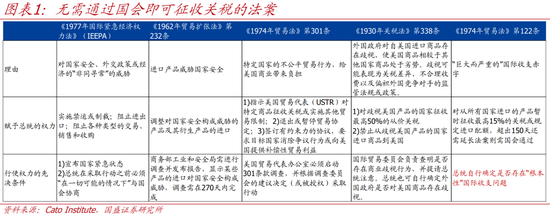
Core Conclusion - The U.S. Supreme Court ruled that Trump's IEEPA tariffs were unconstitutional, leading to the immediate termination of reciprocal tariffs and fentanyl tariffs, which aligns with market expectations. The handling of previously collected tariffs will be determined by lower courts [1][5][22]. Group 1: Tariff Changes - Following the Supreme Court's ruling, Trump announced a new 10% tariff under Section 122 as a temporary measure, which he later suggested could increase to 15%, pending formal confirmation [2][27][28]. - The Section 122 tariffs are intended as a stopgap, with expectations that the tariff framework will shift back to Sections 301 and 232 in the medium term [11][30][32]. - If the new 15% tariff is implemented, the effective tariff rate on China would decrease by 8.4 percentage points to 28.6%, potentially increasing U.S. exports to China by 9.1% and overall exports by 0.6% [23][35][37]. Group 2: Economic Impact - The ruling is expected to benefit U.S. stocks due to improved profitability from reduced tariffs, while concerns over deteriorating U.S. fiscal conditions have led to rising bond yields and a weaker dollar [4][18][25]. - The potential return of IEEPA tariff revenues could increase the U.S. deficit rate by 0.55 percentage points, with significant implications for fiscal policy [3][39][40]. - The market's reaction to the ruling included a rise in U.S. stocks, a decline in bonds and the dollar, and fluctuations in gold prices, which initially fell before rebounding [6][18][25].
26股获机构上调评级至“买入”:汽车、食品饮料、电子等板块多只个股上榜
Xin Lang Cai Jing· 2026-02-22 00:25
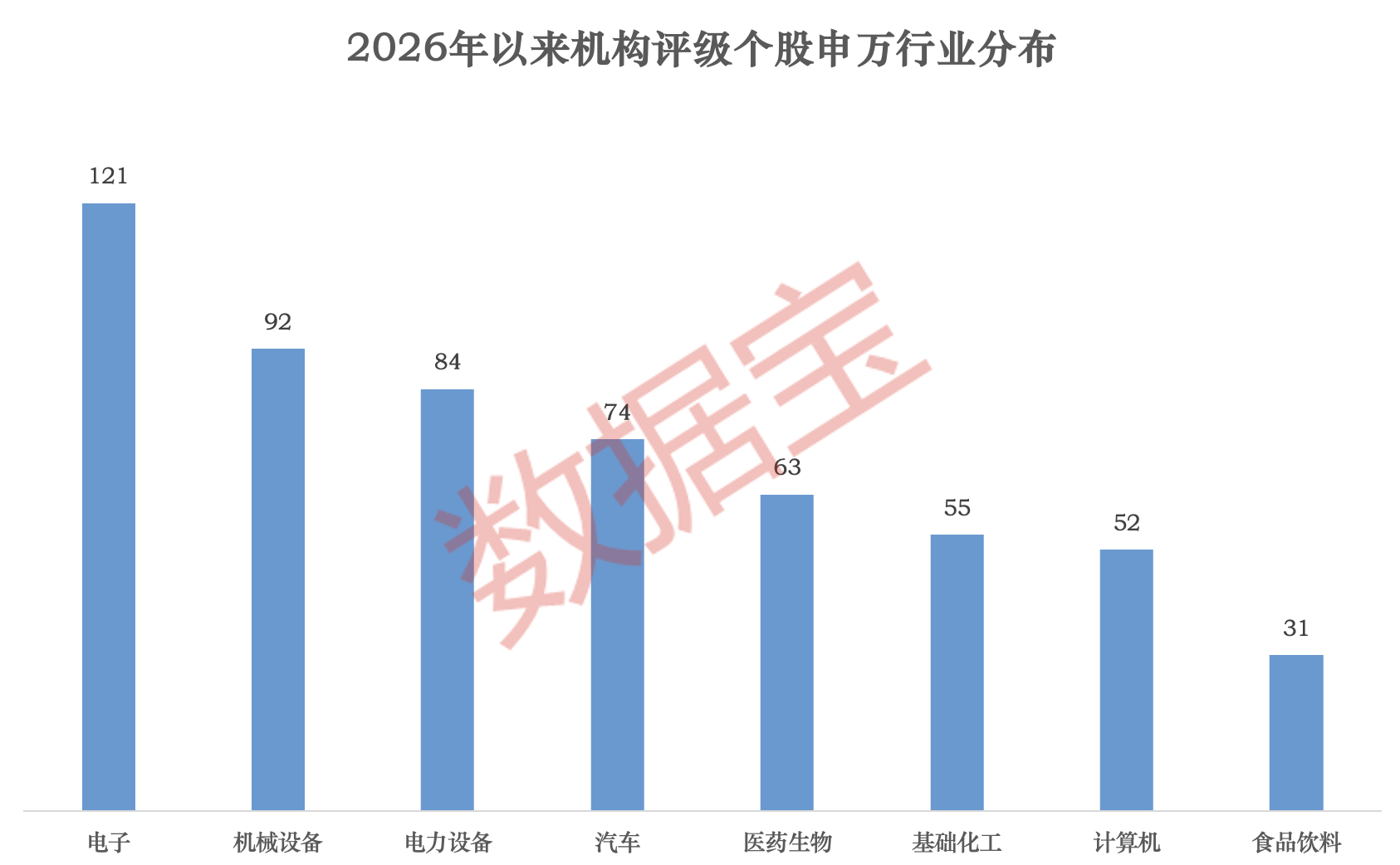
Group 1 - Since 2026, a total of 63 institutions have conducted 1,827 ratings, with 932 stocks receiving a "buy" rating from brokerage reports, including buy, overweight, strong buy, and recommend [1] - The stocks rated by institutions are primarily concentrated in the electronics, machinery equipment, and power equipment industries, with 121, 92, and 84 stocks respectively [1] - The automotive, pharmaceutical, basic chemicals, and computer sectors follow closely, each with over 50 rated stocks [1] Group 2 - Among the stocks rated by five or more institutions, Dongpeng Beverage, BYD, Wancheng Group, Kweichow Moutai, and China Duty Free rank highest, with 16, 15, 14, 14, and 14 institutions respectively [1] - A total of 26 stocks have had their ratings upgraded, including Weichai Power, Seres, Jianghuai Automobile, and Lin Tai New Materials from the automotive sector, as well as Wancheng Group, New Dairy, and Quanyuan Spring from the food and beverage sector [1] Group 3 - The companies with the highest institutional attention since 2026 include Dongpeng Beverage with a net profit of 4.465 billion yuan, a year-on-year increase of 34.22% [5] - BYD's net profit data is not specified, while Wancheng Group is projected to have a net profit of 1.315 billion yuan, a significant increase of 244.66% [5] - Kweichow Moutai and China Duty Free both received ratings from 14 institutions, but their net profit data is not disclosed [5] Group 4 - Weichai Power has a total market value of 235.07 billion yuan and has seen a price increase of 55.76% since 2026 [6] - Jianghuai Automobile has a market value of 128.85 billion yuan with a price increase of 15.47% [6] - Wancheng Group has a market value of 39.79 billion yuan with a modest price increase of 3.45% [6]




都认为中国会赢:美国以为手中的牌比中国多,但它错了
Sou Hu Cai Jing· 2026-02-21 08:52
Group 1 - The trade friction between the US and China, which began in 2018, has led to significant global attention, with many experts suggesting that the US underestimated China's economic resilience and supply chain strength [1][3] - The US initially imposed tariffs on steel and aluminum, followed by additional tariffs on Chinese goods, but these measures resulted in increased costs for American consumers and farmers, while China successfully found alternative markets [3][4] - China's trade surplus with the US is projected to reach a new high of $1 trillion by 2025, indicating that the US's strategy to reshape its manufacturing base through tariffs has not been effective [4][6] Group 2 - Experts argue that the US's inconsistent policies have led to a perception that China is a more reliable partner, causing other countries to shift their trade relationships towards China [6][9] - The trade war has prompted China to enhance its technological self-sufficiency, particularly in sectors like semiconductors, as the US's restrictions have spurred increased domestic investment [3][11] - The global trade landscape has shifted, with countries initially aligning with the US now adopting a more cautious approach, recognizing China's strength and resilience in the face of trade pressures [9][11] Group 3 - The US's talent outflow, particularly in fields like artificial intelligence, has been exacerbated by policies that inadvertently push skilled professionals back to China [7] - China's strategic response to the trade war includes diversifying its markets and strengthening economic ties with emerging markets, which enhances its global influence [11] - The ongoing trade tensions have highlighted the vulnerabilities in the US economy, particularly its reliance on Chinese manufacturing, as the US struggles to find alternatives for many Chinese imports [6][11]
泰国工业联合会:特朗普10%的全球关税将重创泰国电子产品和汽车行业出口
Ge Long Hui· 2026-02-21 08:26
Group 1 - The Thai Industrial Federation (FTI) reports that following the U.S. Supreme Court's limitation on "countervailing duties," Trump has invoked Section 122 of the Trade Act of 1974 to impose a 10% tariff on global imports, referred to as "global tariffs" [1] - This tariff policy will impact Thailand's exports of electronic products such as hard disk drives (HDD), printed circuit boards (PCB), and integrated circuits (IC), as Thailand is a major manufacturing base for these products [1] - The automotive and parts industry, particularly the tire sector, will face severe consequences as the new 10% tariff will compound existing anti-dumping duties, significantly increasing costs [1] Group 2 - Exports of household appliances, such as air conditioners and refrigerators, will also be adversely affected, given that the U.S. is a primary market for these products [1] - Thailand, being one of the major exporters of gems and jewelry, has substantial export volumes to the U.S. that will be impacted [1] - Conversely, Thai agricultural products and fisheries, including rice, durian, mangosteen, and various tropical fruits, have received tariff exemptions [1]
【兴证策略张启尧团队】2026年出海链有哪些投资机会?
Xin Lang Cai Jing· 2026-02-21 01:42
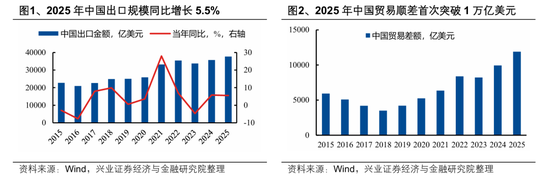
Group 1 - In 2025, China's foreign trade showed strong resilience, with total exports reaching a historical high, growing by 5.5% year-on-year, despite a complex external environment [1][57] - China's trade surplus exceeded $1 trillion for the first time, marking a significant increase of 19.8% year-on-year [1][57] - The net export of goods and services contributed 1.64 percentage points to GDP growth, the second-highest level since 2007, only behind 2021 [3] Group 2 - The diversification of external demand has strengthened, with emerging markets compensating for the decline in exports to the US, which fell by 19.79% year-on-year [6] - Exports to ASEAN, Africa, and the Middle East saw significant growth rates of 25.9%, 13.64%, and 9.7% respectively, contributing positively to the overall export scale [6] - The share of US exports in China's total exports decreased by 3.53 percentage points to 11.15% [6] Group 3 - The product structure of China's foreign trade is shifting towards higher value chains, with high-end products like electrical machinery, machinery, automobiles, and ships being the main export drivers [8] - Traditional light industrial products such as furniture and toys have seen a decline in export scale due to tariff friction and industrial chain relocation [8] Group 4 - The restructuring of global supply chains is creating significant opportunities for Chinese companies, with a notable increase in the number of Chinese enterprises establishing production capacities abroad, reaching 229 in 2025, nearly doubling from 2024 [18] - ASEAN, Mexico, and India are the primary destinations for Chinese production capacity outflows, with ASEAN covering a wide range of industries [18] Group 5 - The AI expansion cycle is a core focus in the Chinese capital market, with significant growth expected in AI computing hardware, supported by macro investment scales and healthy balance sheets of major tech companies [29][30] - The capital expenditure of major cloud service providers is projected to increase significantly, reflecting strong demand for AI computing [35] Group 6 - Cultural and technological value output is becoming a major trend for Chinese enterprises going abroad, with significant growth in IP exports and innovative products in sectors like gaming and new dining [39][41] - The Chinese innovative pharmaceutical sector is increasingly integrated into the global supply chain, with more products commercialized in the US and Europe [41] Group 7 - Key sectors with strong overseas expansion opportunities in 2026 include new energy (batteries, grid equipment), machinery, TMT (technology, media, telecommunications), and innovative pharmaceuticals [46] - The gaming industry is also highlighted for its potential, with significant overseas revenue growth expected [49]




晶科电子拟实施H股全流通,股价近期表现活跃
Xin Lang Cai Jing· 2026-02-20 05:14
Group 1 - The core point of the article is that JinkoSolar Holding Co., Ltd. (02551.HK) plans to implement full circulation of H-shares by converting 21,710,793 unlisted domestic shares into H-shares, which represents approximately 4.04% of the total issued share capital [1] Group 2 - The proposal is subject to approval from the China Securities Regulatory Commission and the Hong Kong Stock Exchange, and if completed, it may enhance the liquidity of the shares [1] Group 3 - Recent stock performance shows active trading, with the stock price at HKD 2.43 as of February 20, 2026, reflecting a daily increase of 2.53% and a cumulative increase of 5.65% over the past five days [1] Group 4 - Technical indicators show that the MACD histogram has turned positive and the KDJ indicator has entered the overbought zone, indicating increased short-term momentum [1] Group 5 - The capital flow is primarily characterized by net outflows from retail investors, although trading volume and turnover rate remain low [1]
新风向!外资机构“组团”出击
Xin Lang Cai Jing· 2026-02-20 03:25
Group 1 - Institutional investors have been actively visiting nearly 70 listed companies since February 9, with a focus on industries such as machinery, automotive, and basic chemicals [1][7] - Key topics of inquiry include the pricing logic of dyes and memory products, as well as domestic and international capacity layout planning [1][7] - Foreign institutions like BNP Paribas and TX Capital are also involved in company research, focusing on the globalization of capacity and long-term growth logic in wind energy and PCB sectors [1][7] Group 2 - Recent fluctuations in prices of raw materials, chemicals, and electronic components have led institutions to question the reasons for price increases, their sustainability, and companies' response strategies [2][8] - Baichuan Co. reported that due to tight TMP supply and rising prices, many companies have decided to halt or reduce production, leading to market supply constraints [2][8] - The dye sector has also seen price increases, with Zhejiang Longsheng announcing a price hike of 5000 yuan per ton for certain dye products due to rising costs of raw materials [2][8] Group 3 - The pace of capacity release among listed companies has become another major focus for institutions [9] - Fule New Materials is accelerating the commercialization of flexible sensors, with plans to complete a formal production line by the first quarter of 2025, aiming for an annual capacity exceeding 10,000 units [10] - Chongde Technology is optimizing production processes to steadily increase capacity utilization, while Hars's Thai production capacity is progressing as planned, expected to meet its target by the end of 2026 [10] Group 4 - Foreign institutions have shown increased interest in A-share listed companies, with firms like Bank of America and Citigroup participating in research activities [11] - Tianshun Wind Power has been a popular subject of inquiry, with foreign investors asking about its 2026 shipment volume and capacity situation [11] - The company anticipates a surge in domestic offshore wind project tenders and construction, particularly in Guangdong, which will drive market demand [11] Group 5 - The PCB sector has gained attention, with Okoyi, a supplier of PCB drill rods, being closely monitored by foreign institutions [12] - The company has developed capabilities in ultra-fine nano hard alloy materials and currently has a production capacity of 1,300 tons of rod material [12] - Recent reports from foreign institutions are optimistic about the Chinese stock market, particularly in sectors like AI-enabled smart manufacturing, high-end equipment localization, and the trend of going global [12]