工业

Search documents
永冠新材:累计回购11.5万股
Mei Ri Jing Ji Xin Wen· 2025-10-10 11:20
Group 1 - The company Yongguan New Materials (SH 603681) announced on October 10 that it has repurchased a total of 115,000 shares through centralized bidding, accounting for 0.06% of its total share capital, with a maximum purchase price of 15.42 CNY per share and a minimum of 12.2 CNY per share, totaling 1.440247 million CNY spent [1] - For the fiscal year 2024, the revenue composition of Yongguan New Materials is reported to be 98.95% from industrial operations and 1.05% from other businesses [1] - As of the report date, the market capitalization of Yongguan New Materials is 3.2 billion CNY [1]

杰克科技:累计回购约487万股
Mei Ri Jing Ji Xin Wen· 2025-10-10 08:43
Company Summary - Jack Technology (SH 603337) announced on October 10 that as of September 30, 2025, it has repurchased approximately 4.87 million shares through centralized bidding, accounting for 1.0228% of the total share capital, with a total expenditure of approximately 131 million yuan [1] - The highest purchase price was 31.94 yuan per share, while the lowest was 24.6 yuan per share [1] - For the first half of 2025, the company's revenue composition was 99.79% from industrial operations and 0.21% from other businesses [1] - As of the report date, Jack Technology's market capitalization is 21.6 billion yuan [1]

高价转债延续强势,关注低位补涨机会
Xiangcai Securities· 2025-10-10 08:27
1. Report Industry Investment Rating No relevant content provided. 2. Core Views of the Report - In September, convertible bonds underperformed underlying stocks overall, but there was significant differentiation among sectors. High - price convertible bonds continued their strong performance, and the high - price convertible bond index led the gains. The technology sector's rise slightly declined, while the financial sector was under pressure. Under the expectation of a bull market in the equity market, the double - low strategy continued to underperform the high - price and low - premium strategy [1][2][3]. - Although high - price convertible bonds have stronger equity characteristics, the double - low strategy still has the advantage of being offensive and defensive. Actively screening sectors and individual stocks according to market trends can help obtain excess returns. In the context of the continuous rise of convertible bonds, the valuation has reached a relatively high historical level, and the number of individual bonds triggering forced redemptions is increasing [3]. 3. Summary by Relevant Catalogs 3.1 Convertible Bond Monthly Market Tracking - Overall performance: In September (from September 1st to 30th), the CSI Convertible Bond Index rose 1.97%, while the CSI All - Share Index rose 2.65%. Year - to - date (as of September 30th), the CSI Convertible Bond Index and the CSI All - Share Index rose 17.11% and 23.68% respectively. The convertible bonds underperformed underlying stocks, but there was obvious differentiation among sectors. The CSI Convertible Bond Index underperformed the CSI 300 and CSI 500 indexes by 1 pct and 3 pct respectively, but outperformed the CSI 2000 index by 2 pct [11]. - Classification by price: In September, the Wind high - price convertible bond index rose 5.92%, with the growth rate narrowing compared to August, but still significantly leading the low - price (+3.14%) and medium - price (+3.26%) convertible bonds. Since May, high - price convertible bonds have continuously outperformed medium - and low - price ones. Year - to - date (as of September 30th), the high - price convertible bond index has accumulated a 27.47% increase, especially significantly outperforming medium - and low - price indexes in the third quarter [12]. - Classification by outstanding scale: In September, the Wind small - cap (+2.73%) and medium - cap (+2.89%) convertible bond indexes led the gains, significantly outperforming the large - cap convertible bonds (+0.14%). Year - to - date (as of September 30th), the small - cap convertible bond index rose 23.93%, far ahead of the large - cap (+10.56%) and medium - cap (+17.35%) convertible bonds [16]. - Classification by credit rating: In September, the AAA high - rating convertible bond index fell 1.36%, while the AA - and below convertible bond index rose 3.15%, underperforming the AA + (+3.75%) and AA (+4.23%) convertible bond indexes. Throughout the year, low - rating convertible bonds still significantly outperformed high - rating ones, reflecting a relatively high market risk appetite [18]. - Sector performance: In September, the technology sector's rise slightly declined, and the financial sector was under pressure. The information technology and industrial convertible bond indexes rose 4.28% and 4.11% respectively, with the information technology sector still being the best - performing one. Except for information technology, industrial, and material convertible bonds, the performance of convertible bonds in other sectors was stronger than that of underlying stocks. The convertible bonds and underlying stocks in the financial sector both declined in September [22]. 3.2 Convertible Bond Monthly Investment Recommendations 3.2.1 Strategy Recommendation: Select High - Growth Industries from Low - Price Convertible Bonds - September double - low portfolio performance: The double - low portfolio constructed in September selected the bottom 10% of individual bonds in terms of double - low values. After active screening, 10 individual bonds were obtained, mainly concentrated in the light manufacturing and non - ferrous metals industries. From September 1st to 30th, the portfolio's return rate was 5.92%, outperforming the CSI Convertible Bond Index by about 4 pct. Cumulatively, since its construction in June, the portfolio's cumulative return rate was 19.12%, outperforming the CSI Convertible Bond Index by 5.3 pct [31]. - October double - low portfolio recommendation: In the context of the continuous rise of convertible bonds, individual bonds with low double - low values face higher risks of delisting and forced redemption, and the number of eligible individual bonds has decreased. This month, 10 individual bonds were selected from the bottom 10% of double - low value rankings. These recommended individual bonds are mainly concentrated in non - ferrous metals, basic chemicals, and power equipment industries, with an average convertible bond price of 133 yuan, conversion value of 122 yuan, and conversion premium rate of 9% [35]. 3.2.2 Allocation Recommendation: Focus on Technology Growth and "Anti - involution" - Related Sectors - Convertible bonds have entered a high - valuation range. At this stage, more attention should be paid to the safety margin. Under the unbroken expectation of a bull market, sectors at a low level with the expectation of a catch - up can be focused on. It is recommended to pay attention to "anti - involution" - related sectors with long - term logic, such as photovoltaic, lithium battery, engineering machinery, and chemical industries, as well as the callback layout opportunities of high - growth sectors such as robotics, semiconductors, AI computing power, and innovative drugs [37].
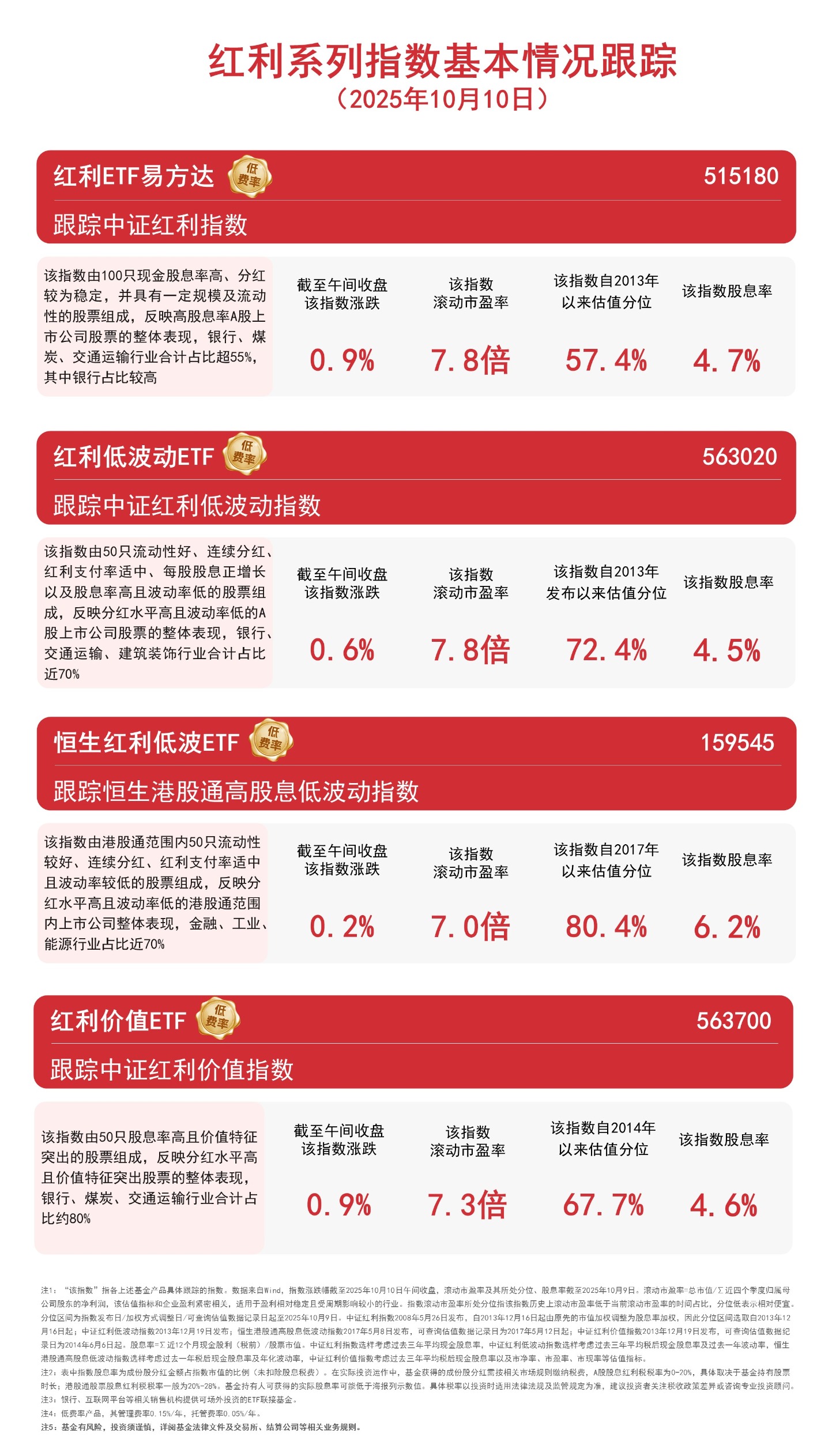
红利板块逆势走强,红利ETF易方达(515180)、红利低波动ETF(563020)连续“吸金”
Mei Ri Jing Ji Xin Wen· 2025-10-10 05:19
Core Viewpoint - The article discusses the performance of Hong Kong stocks under the Stock Connect program, highlighting the high dividend yield and low volatility of certain indices, particularly focusing on the financial, industrial, and energy sectors which account for nearly 70% of the overall performance [4]. Group 1: Index Performance - The Hong Kong Stock Connect high dividend low volatility index has a rolling price-to-earnings (P/E) ratio of 7.0 times, with a slight change of 0.2% [4]. - The China Securities Dividend Value Index, which tracks 50 stocks with high dividend yields and value characteristics, has a rolling P/E ratio of 7.3 times and a change of 0.9% [4]. - The index reflects the overall performance of stocks with high dividend levels and value characteristics, with the banking, coal, and transportation sectors collectively accounting for about 80% of the index [4]. Group 2: Historical Context and Methodology - The China Securities Dividend Index was launched on May 26, 2008, and was adjusted from a market capitalization-weighted index to a different weighting method starting December 16, 2013 [4]. - The China Securities Dividend Low Volatility Index was introduced on December 19, 2013, while the Hang Seng Stock Connect High Dividend Low Volatility Index was launched on May 8, 2017 [4]. - The dividend yield is calculated as the sum of the last 12 months of cash dividends (pre-tax) divided by the market value of the stock [4].

联诚精密:10月9日召开董事会会议
Mei Ri Jing Ji Xin Wen· 2025-10-09 13:02
Company Overview - Liancheng Precision (SZ 002921) announced on October 9 that its third board meeting was held in Jining, Shandong, where the agenda included the appointment of a vice general manager [1] - As of the report, Liancheng Precision has a market capitalization of 2.3 billion yuan [1] Financial Performance - For the first half of 2025, Liancheng Precision's revenue composition was 97.15% from industrial operations and 2.85% from other businesses [1]

ST长园:股东格力金投计划减持公司股份不超过约3956万股
Mei Ri Jing Ji Xin Wen· 2025-10-09 12:56
Group 1 - ST Changyuan announced that Zhuhai Gree Financial Investment Management Co., Ltd. and its concerted party Zhuhai Free Trade Zone Jinnuo Xin Trading Co., Ltd. hold approximately 190 million shares, accounting for 14.38% of the total share capital, making it the largest shareholder of Changyuan Group [1] - Gree Financial Investment plans to reduce its holdings by up to approximately 39.56 million shares, representing 3% of the total share capital, within 90 days from the date of the announcement through centralized bidding [1] - For the first half of 2025, ST Changyuan's revenue composition is 99.17% from industrial operations and 0.83% from other businesses [1] Group 2 - As of the report, ST Changyuan has a market capitalization of 4.5 billion yuan [2]

*ST海源:公司董事张奇彦辞职
Mei Ri Jing Ji Xin Wen· 2025-10-09 10:44
Group 1 - The company *ST Haiyuan announced the resignation of Mr. Zhang Qiyan from the board of directors due to personal reasons, and he will no longer hold any position in the company after his resignation [1] - As of the latest report, *ST Haiyuan has a market capitalization of 1.9 billion yuan [3] - For the first half of 2025, *ST Haiyuan's revenue composition is entirely from the industrial sector, with an industrial revenue share of 100.0% [2]

塞内加尔积极评价中企助塞产业转型与经济振兴
Xin Hua Wang· 2025-10-09 08:47
Group 1 - The China-Senegal Investment Forum held in Dakar focused on "Chinese Enterprises Supporting Senegal's Development," attracting over 300 participants, including government officials and representatives from more than 150 Chinese and Senegalese companies [1] - Senegal's Minister of Economy, Planning and Cooperation highlighted the long-standing partnership between China and Senegal, with over 100 Chinese enterprises operating in various sectors such as transportation, energy, agriculture, and digital economy, contributing significantly to Senegal's industrial transformation and economic revitalization [1] - The Senegalese Minister of Agriculture praised Chinese enterprises for their professionalism and innovation, emphasizing their role in supporting agricultural modernization and food security in Senegal [1] Group 2 - The Director of the Senegal Industrial Park Development and Promotion Agency noted the significant role of Chinese enterprises in the construction of industrial parks, with active participation from business associations in Fujian, Zhejiang, and Hunan provinces, enhancing cooperation in industrial investment, innovative technology, and new energy [2] - The Chinese Ambassador to Senegal stated that China is a sincere partner in Senegal's development, being the largest trading partner with an investment stock exceeding $430 million, creating 11,000 local jobs [2] - During the forum, multiple cooperation agreements were signed between China and Senegal in the fields of energy, finance, and environmental protection [3]
东南亚研究 | 美联储降息周期下的港股再审视
Sou Hu Cai Jing· 2025-10-08 02:25
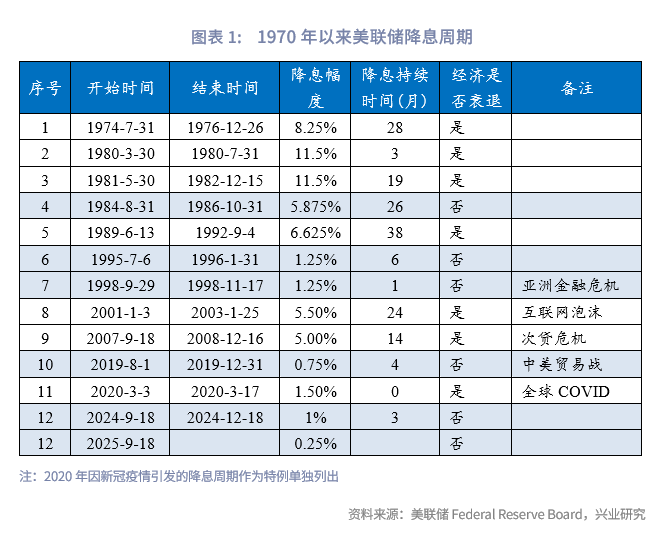
Core Viewpoint - The recent Federal Reserve interest rate cut on September 18, 2024, is set against a complex macroeconomic backdrop, including risks of stagflation in the U.S. and misalignment in the economic cycles of China and the U.S., suggesting that the Hong Kong stock market may not replicate historical trends but instead exhibit significant structural differentiation [1][2]. Group 1: Historical Context and Market Behavior - Historical experience indicates that during Fed rate cut cycles, the Hong Kong stock market typically shows a "preventive rate cut rally" or a "recessionary rate cut decline" pattern [1]. - In terms of market style, the Hang Seng Technology Index has demonstrated a "high win rate and high return" characteristic during preventive rate cut cycles, while other styles have not shown independent trends [1][2]. - Industry-wise, defensive sectors like utilities and consumer staples tend to perform better during recessionary rate cuts, while high-growth sectors such as technology and pharmaceuticals excel during preventive rate cuts [1][2][3]. Group 2: Current Economic Landscape - The current macroeconomic environment is more complex than historical experiences, with the U.S. economy facing stagflation risks and ongoing misalignment with China's economic cycle, making it difficult for the Hong Kong market to follow a straightforward trend [2][3]. - The upcoming October monetary policy meeting is crucial for assessing the future pace and intensity of rate cuts, influenced by various structural variables, including political pressures and the ongoing AI industry revolution [3][4]. Group 3: Future Outlook and Scenarios - The performance of the Hong Kong stock market in the next one to two quarters will depend not only on the Fed's rate cut path but also on the recovery process of the Chinese economy [2][52]. - Three potential scenarios are outlined: 1. **Baseline Scenario**: Gradual Fed rate cuts with a moderate recovery in the Chinese economy, favoring growth-sensitive sectors [52][53]. 2. **Optimistic Scenario**: More aggressive Fed cuts without triggering recession fears, leading to a favorable liquidity environment for growth stocks [55]. 3. **Pessimistic Scenario**: Fed pauses or slows rate cuts due to persistent inflation, putting pressure on the Hong Kong market, which will depend heavily on the recovery of the Chinese economy [56]. Group 4: Structural Opportunities - The analysis indicates that different types of rate cut cycles lead to distinct long-term performances in the Hong Kong market, with preventive rate cuts generally resulting in positive returns for the Hang Seng Index [9][10]. - The Hang Seng Technology Index has shown superior performance during preventive rate cuts, benefiting from lower discount rates and improved financing conditions [12][13]. - Defensive sectors tend to outperform during recessionary rate cuts, while growth sectors thrive in preventive cut environments, highlighting the importance of sector selection in investment strategies [13][14].
东京实力吊打全球,实力仅次于纽约,究竟靠什么赚钱?
Sou Hu Cai Jing· 2025-10-07 08:40
Economic Positioning - Tokyo ranks as the second largest city in the world by GDP, following New York, and holds the top position in Asia with a commercial land investment of $19.3 billion (approximately 2 trillion yen) [3] - The city has transformed from a small fishing village to a major economic center in just 80 years, contrasting with New York's 200-year ascent [5][8] Historical Development - Tokyo's rise began in the Edo period when the Tokugawa shogunate established the city as a political center, leading to its eventual prominence [7][8] - The Great Kanto Earthquake in 1923, which destroyed 60% of Tokyo's buildings, prompted a major urban reconstruction that modernized the city [12] Industrial and Financial Growth - Post-World War II, Tokyo experienced significant industrial growth, aided by the Korean War economic boom, and the establishment of the Shinkansen (bullet train) [12][13] - By the 1970s, Tokyo's financial sector began to internationalize, establishing itself as a global financial hub alongside New York and London [13][15] Current Economic Landscape - Despite the burst of Japan's real estate bubble, Tokyo's land prices remain high, reflecting its critical role in the global economy [16] - The city continues to face competition from other financial centers in the Asia-Pacific region, yet it maintains a strong competitive position [15][16]