
高技术制造业

Search documents
地区经济发展韧性进一步彰显
Jing Ji Ri Bao· 2025-11-04 01:04
Economic Overview - The economic performance report for the first three quarters has been released, showing resilience and progress despite external pressures and internal challenges [2] - 21 provinces have achieved growth rates that either exceed or match the national average of 5.2%, indicating strengthened economic resilience [3] Economic Scale - Guangdong and Jiangsu have both surpassed the 10 trillion yuan mark in GDP, reaching 10,517.698 billion yuan and 10,281.1 billion yuan respectively [2] - The threshold for the top ten economic provinces has increased from 3.7 trillion yuan to 4 trillion yuan compared to the same period last year [2] Growth Rates - Tibet leads with a growth rate of 7.1%, while Gansu has maintained a growth rate above the national average for 15 consecutive quarters at 6.1% [3] - The Yangtze River Delta region has shown strong economic performance, with a total economic output exceeding 25 trillion yuan, accounting for nearly one-quarter of the national total [3] Foreign Trade - The foreign trade data for the first three quarters reflects resilience, with Guangdong, Jiangsu, Zhejiang, Shanghai, and Shandong contributing over 80% to the national import and export growth [4] - Zhejiang's foreign trade reached historical highs, with total import and export values surpassing 4 trillion yuan [4] Domestic Demand - The implementation of proactive macro policies has effectively stabilized the economy, with significant growth in consumer spending observed in provinces like Hainan and Henan [5] - Hainan's retail sales grew by 8.6%, while Henan's retail sales increased by 6.2%, showcasing strong consumer demand [5] Innovation and New Industries - Technological innovation is becoming a key driver of high-quality development, with significant growth in high-tech manufacturing in regions like Shanghai and Jiangsu [6] - In the central and western regions, industries such as strategic emerging industries in Henan and high-tech manufacturing in Hubei have shown remarkable growth rates [6] Service Sector Development - The modern service industry is accelerating, with significant growth in information technology services in Beijing and research and development revenues in Hunan [7] - The film and television production industry in Henan has seen a dramatic increase in revenue, growing by 107.8% due to the rapid development of the micro-short drama industry [7] Future Outlook - Despite the complex external environment, provinces are actively planning for the fourth quarter to ensure the achievement of annual economic goals [7] - Guangdong and Shanghai have outlined strategies to enhance economic operations and contribute to national economic stability [7]

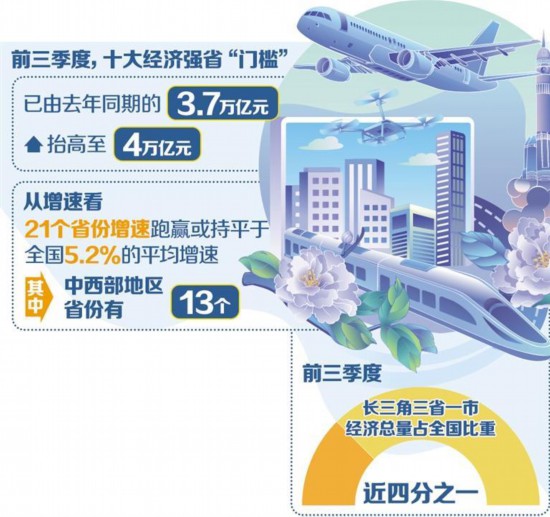
前三季度十大经济强省“门槛”跃上4万亿元台阶 地区经济发展韧性进一步彰显
Jing Ji Ri Bao· 2025-11-04 00:05
Core Insights - China's economy has shown resilience and progress despite external pressures and internal challenges, with 21 provinces achieving growth rates that either surpassed or matched the national average of 5.2% [1][3] Economic Performance - The top ten provinces by economic output are Guangdong, Jiangsu, Shandong, Zhejiang, Sichuan, Henan, Hubei, Fujian, Shanghai, and Hunan, with Guangdong and Jiangsu both exceeding 10 trillion yuan in GDP [2] - The economic threshold for the top ten provinces has increased from 3.7 trillion yuan to 4 trillion yuan compared to the previous year [2] Growth Rates - 21 provinces have growth rates that either exceed or match the national average, with Tibet leading at 7.1% growth [3] - Gansu has maintained a growth rate above the national average for 15 consecutive quarters, while Hubei's growth rate is 6% [3] Trade Performance - External trade data reflects resilience, with Guangdong, Jiangsu, Zhejiang, Shanghai, and Shandong contributing over 80% to national import and export growth, with Zhejiang achieving historical highs in trade values [4] Demand and Consumption - The implementation of proactive macro policies has effectively stabilized economic operations, with notable growth in retail sales in provinces like Hainan and Henan [5] - Hainan's retail sales grew by 8.6%, while Henan's retail sales increased by 6.2% [5] Innovation and New Growth Drivers - There is a significant focus on technological innovation, with high-tech manufacturing in regions like Shanghai and Jiangsu showing substantial growth [7] - In the central and western regions, industries such as strategic emerging industries in Henan and high-tech manufacturing in Hubei have also seen impressive growth rates [7] Future Outlook - Various provinces are actively planning for the fourth quarter to ensure the achievement of annual economic goals, with Guangdong and Shanghai emphasizing the need for effective policy implementation and economic management [8]
中国经济顶住压力稳中有进
Xin Hua Wang· 2025-11-03 23:47
Core Viewpoint - China's economy has shown resilience and progress amidst pressures, with solid foundations laid for achieving annual economic and social development goals [1] Economic Performance Characteristics - The GDP grew by 5.2% year-on-year in the first three quarters, maintaining a leading position among major global economies. Retail sales of consumer goods increased by 4.5%, accelerating by 1.2 percentage points compared to the same period last year. The industrial added value for large-scale enterprises rose by 6.2%, marking the highest growth since 2022 [2] - Strong momentum is evident, with the added value of equipment manufacturing and high-tech manufacturing increasing by 9.7% and 9.6%, respectively. Their shares in large-scale industrial output rose by 2.1 and 0.8 percentage points year-on-year. The integrated circuit and smart device manufacturing sectors saw increases of 22.4% and 12.2% [2] - Quality and efficiency have improved, with a 3.2% year-on-year increase in profits for large-scale industrial enterprises, and a significant 21.6% increase in September alone. Prices for key products like polysilicon and lithium carbonate have rebounded [2] - The economy demonstrated resilience with a 7.1% growth in goods exports, alongside an optimized export product structure. High-tech and electromechanical product exports grew by 11.9% and 9.6%, respectively, with exports to Belt and Road countries increasing by 12.4% [2] - There is significant potential for growth, with retail service sales rising by 5.2%. The production of civilian drones and industrial robots surged by 43.2% and 29.8%, while the output of new energy vehicles and lithium-ion batteries for vehicles increased by 29.7% and 46.9% [3] Social Welfare and Supply Security - The government has effectively ensured social welfare, particularly in grain production and energy supply. Measures have been taken to stabilize grain markets and minimize the impact of disasters on production and farmers' incomes. The summer grain harvest was successful, and the autumn harvest is expected to be strong [4] - Energy supply for the winter heating season is on track, with coal reserves at 220 million tons, sufficient for over 35 days. The underground gas storage has met its annual injection target, ensuring full capacity for winter [4][5] Investment Expansion - Expanding effective investment is crucial for stabilizing growth. The government has allocated 500 billion yuan for local government debt to enhance financial capacity and support investment projects, with 2300 projects supported and a total investment of approximately 7 trillion yuan [6] - The focus of investments includes digital economy, artificial intelligence, consumer infrastructure, and urban renewal projects in transportation, energy, and underground pipeline construction [6] - Recent forecasts from international economic organizations have raised China's economic growth expectations for 2025 by 0.8 percentage points compared to earlier predictions [6]
中国经济顶住压力稳中有进(锐财经)
Ren Min Ri Bao· 2025-11-03 20:35
Core Viewpoint - China's economy has shown resilience and progress in the first three quarters of the year, with effective investment and strong social welfare measures laying a solid foundation for achieving annual economic and social development goals [1][6]. Economic Performance - GDP growth reached 5.2% year-on-year, maintaining a leading position among major global economies [2] - Retail sales of consumer goods increased by 4.5%, accelerating by 1.2 percentage points compared to the same period last year [2] - Industrial added value grew by 6.2%, marking the highest growth for the same period since 2022 [2] Industrial Dynamics - The added value of equipment manufacturing and high-tech manufacturing increased by 9.7% and 9.6%, respectively, with their shares in large-scale industry rising by 2.1 and 0.8 percentage points year-on-year [2] - The integrated circuit manufacturing and smart device manufacturing sectors saw significant growth, with increases of 22.4% and 12.2% [2] Quality and Efficiency - Improvements in product prices and corporate profits were noted, with industrial enterprise profits rising by 3.2% year-on-year, and a notable 21.6% increase in September alone [2] - Prices for key products such as polysilicon, silicon wafers, and lithium carbonate have rebounded significantly [2] Resilience and Export Growth - Despite external challenges, merchandise exports maintained a growth rate of 7.1%, with high-tech and electromechanical product exports growing by 11.9% and 9.6%, respectively [2] - Exports to countries involved in the Belt and Road Initiative increased by 12.4% [2] Consumption and Potential - The service retail sector grew by 5.2%, driven by popular events such as sports and concerts [3] - The production of consumer drones and industrial robots surged by 43.2% and 29.8%, respectively, while new energy vehicles and lithium-ion batteries for vehicles saw increases of 29.7% and 46.9% [3] Social Welfare and Food Security - The government has effectively ensured food security and energy supply, with measures in place to stabilize grain markets and enhance disaster response capabilities [4] - As of October 27, coal reserves in national power plants reached 220 million tons, sufficient for over 35 days of use [4][5] Investment Expansion - The government has allocated 500 billion yuan for local government debt to support effective investment, with 2300 projects supported and a total investment of approximately 7 trillion yuan [6] - Key investment areas include digital economy, artificial intelligence, consumer infrastructure, and urban renewal projects [6] Future Outlook - International economic organizations have raised their forecasts for China's economic growth, indicating confidence in achieving annual development goals [6][7]
长三角三季报暗藏玄机:浙江5城“霸榜”增速榜,江苏为何失落?
2 1 Shi Ji Jing Ji Bao Dao· 2025-11-03 13:08
Economic Overview - The Yangtze River Delta (YRD) accounts for approximately 25% of China's GDP, with a total GDP of 251,797.17 billion yuan in the first three quarters of this year [1][5] - Among the 41 cities in the YRD, 28 cities outpaced the national average GDP growth rate of 5.2%, with 13 cities exceeding 6% [1][5] Economic Growth by Region - Zhejiang led the YRD with a GDP growth rate of 5.7%, followed by Shanghai, Jiangsu, and Anhui at 5.5%, 5.4%, and 5.4% respectively [5] - Jiangsu had the highest GDP total at 102,811 billion yuan, followed by Zhejiang at 68,495 billion yuan, Shanghai at 40,721.17 billion yuan, and Anhui at 39,770 billion yuan [6] Industrial Development - Advanced manufacturing is a key support for Jiangsu's economy, with significant contributions from high-tech manufacturing and digital core product manufacturing, both maintaining double-digit growth [4][12] - In Shanghai, the AI and integrated circuit sectors saw double-digit growth in output value, while Jiangsu's high-tech manufacturing increased by 27.8% [4][12] Consumption Trends - The consumption market in the YRD is steadily recovering, with policies like "old for new" driving sales in appliances, automobiles, and electronics [14] - Jiangsu's sports events, such as "Su Chao," have significantly boosted local consumption, with a 13% increase in sports service revenue [14][15] City-Specific Insights - Among the 13 cities with GDP growth exceeding 6%, all top five are from Zhejiang, indicating a strong manufacturing base and rapid advancement in traditional industries [6][7] - Shanghai's service sector, particularly information services, contributed significantly to its economic growth, with the tertiary industry accounting for 79.1% of its GDP [10][12] Future Directions - The YRD is focusing on enhancing traditional industries through digital transformation and innovation, with policies promoting smart factory development [8][12] - There is a strong emphasis on integrating consumption scenarios with digital economy advancements, particularly in Zhejiang, which is leveraging its e-commerce and digital payment systems [15][16]
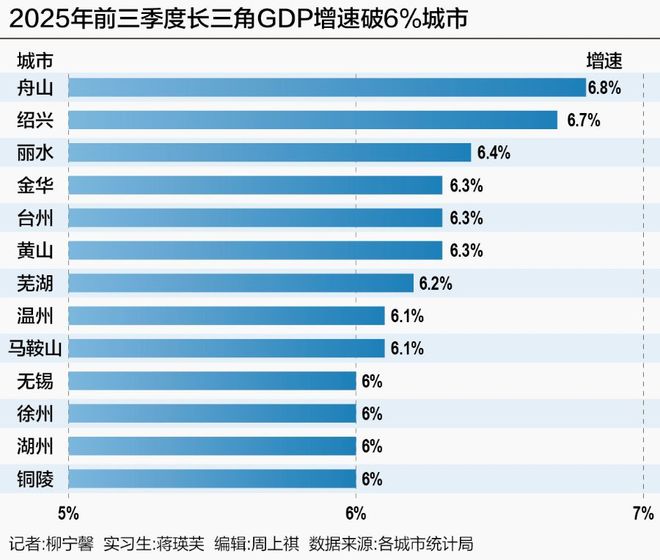
前三季度消费需求和重点产业结构升级呈现新的亮点
Sou Hu Cai Jing· 2025-11-03 10:40
Economic Performance - China's GDP grew by 5.2% year-on-year in the first three quarters, maintaining a leading position among major global economies [1][4] - Retail sales of consumer goods increased by 4.5%, accelerating by 1.2 percentage points compared to the same period last year [4] - Industrial added value for large-scale enterprises rose by 6.2%, marking the highest growth for the same period since 2022 [4] Economic Resilience - Despite external pressures, China's goods exports maintained a growth rate of 7.1% [5] - The export structure has improved, with high-tech and high-value-added products seeing growth rates of 11.9% and 9.6%, respectively [5] - Exports to countries involved in the Belt and Road Initiative increased by 12.4%, and exports to ASEAN countries have seen an upward trend for eight consecutive months [5] Innovation and Industry Growth - China's innovation index has entered the global top ten, supporting the development of emerging industries [4] - The added value of equipment manufacturing and high-tech manufacturing increased by 9.7% and 9.6%, respectively, with their shares in large-scale industry rising [4] - Production of civilian drones and industrial robots surged by 43.2% and 29.8%, while production of new energy vehicles and lithium-ion batteries for vehicles grew by 29.7% and 46.9% [5] Financial Support and Investment - Over 5 trillion yuan has been allocated to support more than 2,300 projects, with total project investments around 7 trillion yuan, focusing on digital economy, AI, and urban infrastructure [7] - The National Development and Reform Commission will continue to promote project construction to expand effective investment and drive high-quality development [7] Logistics and Cost Efficiency - The total logistics cost in China for the first three quarters was 14.2 trillion yuan, with a GDP ratio of 14.0%, a decrease of 0.1 percentage points from the previous year [10] - The logistics infrastructure network is being optimized, with significant advancements in digitalization and automation, leading to improved operational efficiency [10] - The implementation of the "Action Plan" aims to further reduce logistics costs and enhance service quality across the logistics sector [10]
10月PMI数据点评:制造业承压,仍需政策支撑
LIANCHU SECURITIES· 2025-11-03 07:13
Report Summary 1) Report Industry Investment Rating The document does not mention the report industry investment rating. 2) Core View of the Report The report analyzes the October 2025 PMI data, indicating that the manufacturing industry is under pressure and the economy still needs policy support. The manufacturing PMI has declined, with structural pressures intensifying, while the service industry has a mild uptick and the construction industry remains sluggish. Future economic improvement requires the implementation of policies such as anti - involution and expanding domestic demand [1][6]. 3) Summary by Related Catalogs Manufacturing Industry - **Overall Situation**: In October, the manufacturing PMI was 49.0%, down 0.8 percentage points from the previous month, falling below the boom - bust line for seven consecutive months, showing a weakening overall manufacturing industry due to factors like reduced working days, trade frictions, and high inventory [1]. - **Structural Pressures**: All four major sub - indicators of the manufacturing PMI declined. The production index dropped to 49.7%, the new order index to 48.8%, the raw material inventory to 47.3%, and the employment index to 48.3%, indicating weakness in production, demand, and employment [2]. - **Enterprise Scale**: The PMIs of large, medium, and small enterprises were 49.9%, 48.7%, and 47.1% respectively, all in the contraction range. Large enterprises entered the contraction range for the first time in the second half of the year, and small and medium - sized enterprises have been below the boom - bust line for many months [2]. - **Demand Side**: External demand contracted significantly, with the new export order index dropping 1.9 percentage points to 45.9% and the import index falling 1.3 percentage points to 46.8%. Domestic demand was relatively stable, and the domestic market's support for demand increased [3]. - **Industry Categories**: New - energy - related industries had better prosperity, while basic raw material industries were weak. The production index of equipment manufacturing, high - tech manufacturing, and consumer goods manufacturing decreased but remained in the expansion range, while the production index of basic raw material industries dropped below 48% [3]. - **PMI Quantity - Price Sub - Index**: The PMI quantity - price (ex - factory price index) sub - index weakened, reflecting the pressure of demand contraction and poor cost transmission. It may continue the contraction trend in the short term [5]. Service Industry - The service industry PMI was 50.2%, up 0.1 percentage points from the previous month, hovering around the boom - bust line for many months. Consumer service industries recovered significantly, while production - related service industries fell into the contraction range [5]. Construction Industry - The construction industry PMI was 49.1%, down 0.2 percentage points from the previous value, remaining in the contraction range for three consecutive months. The decline of the real estate market and the slowdown of infrastructure investment were the main reasons for the industry's downturn, but infrastructure - related construction activities showed signs of acceleration [5]. Future Outlook - Economic recovery requires policy support. The implementation of anti - involution and domestic - demand - expansion policies in the fourth quarter will help improve the economy. The injection of new policy - based financial tools, the early use of part of the 2026 fiscal budget, and the "15th Five - Year Plan" will provide impetus for the manufacturing industry [6].
2025年10月PMI数据点评:制造业景气水平回落,企业生产经营活动总体稳定
KAIYUAN SECURITIES· 2025-11-03 04:45
1. Report Industry Investment Rating No information provided in the content. 2. Core View of the Report - The manufacturing PMI in October 2025 was 49.0%, showing a decline in the manufacturing prosperity level, while the non - manufacturing PMI returned to the expansion range, and the comprehensive PMI was at the critical point, indicating that the overall production and business activities of enterprises were stable. With the easing of international situations and policy support, the overall prosperity of the manufacturing industry is expected to gradually stabilize and recover [3][5][7]. - In the bond market, bond yields are expected to rise trendily due to the revision of economic expectations [8]. 3. Summary by Relevant Content 3.1 PMI Data Overview - The manufacturing PMI in October 2025 was 49.0%, a month - on - month decrease of 0.8pct; the non - manufacturing PMI was 50.1%, a month - on - month increase of 0.1pct; the comprehensive PMI was 50.0%, a month - on - month decrease of 0.6pct [3]. 3.2 Reasons for the Decline in Manufacturing PMI - Seasonal factors: The pre - holiday demand was released in advance, and the number of working days decreased. The production index and new order index declined, leading to a seasonal decline in the manufacturing PMI [5]. - International environment: Due to the unclear results of China - US trade negotiations, the new export order index of the manufacturing industry dropped to 45.9%, the second - lowest point of the year, and the production and operation activity expectation index also declined [5]. 3.3 Structural Highlights in the Data - Key industries remained resilient: The PMIs of high - tech manufacturing, equipment manufacturing, and consumer goods industries were above 50%, higher than the overall manufacturing level and still in the expansion range [6]. - Non - manufacturing PMI returned to the expansion range: The service industry PMI increased by 0.1pct to 50.2% due to the holiday effect and promotional activities, and the business activity expectation index remained in a high - prosperity range. The construction industry's business activity expectation index increased by 3.6pct, indicating improved confidence [6]. 3.4 Bond Market Viewpoint - Due to the revision of economic expectations, bond yields are expected to rise trendily [8]. 3.5 Related Research Report References - In the second half of 2025, the economic growth rate may not decline significantly; structural problems such as prices are expected to improve trendily; the bond - stock allocation will continue to switch, with bond yields and the stock market expected to rise continuously [9].
10月份三大重点行业PMI继续位于扩张区间——我国经济总体产出保持稳定
Jing Ji Ri Bao· 2025-11-03 03:35
Group 1: Manufacturing Sector - In October, the Manufacturing Purchasing Managers' Index (PMI) was 49.0%, a decrease of 0.8 percentage points from the previous month, indicating a slowdown in manufacturing production activities [1] - The production index and new orders index for manufacturing were 49.7% and 48.8%, down 2.2 and 0.9 percentage points respectively, reflecting a decline in production and market demand [1] - High-tech manufacturing, equipment manufacturing, and consumer goods industries had PMIs of 50.5%, 50.2%, and 50.1% respectively, remaining in the expansion zone and significantly above the overall manufacturing level [1] Group 2: Enterprise Size Impact - The PMIs for large, medium, and small enterprises were 49.9%, 48.7%, and 47.1%, showing a decline of 1.1, 0.1, and 1.1 percentage points respectively, indicating a decrease in economic sentiment across all sizes [2] - Large enterprises maintained production and new orders indices at 50.9% and 50.1%, respectively, remaining in the expansion zone for six consecutive months [2] Group 3: Non-Manufacturing Sector - The Non-Manufacturing Business Activity Index was 50.1%, an increase of 0.1 percentage points from the previous month, indicating stability in non-manufacturing operations [2][3] - The service sector's business activity index rose to 50.2%, reflecting a slight recovery in service sector activity, while the construction sector's index fell to 49.1%, indicating a decline in construction activity [2][3] Group 4: Economic Outlook - The stability in non-manufacturing activities is supported by holiday consumption, with positive performance in travel, shopping, tourism, and dining sectors [3] - The gradual release of policies aimed at stabilizing growth is expected to strengthen domestic demand in the fourth quarter, providing solid support for achieving annual economic and social development goals [3]
10月份三大重点行业PMI继续位于扩张区间 我国经济总体产出保持稳定
Jing Ji Ri Bao· 2025-11-03 02:53
Core Insights - The manufacturing Purchasing Managers' Index (PMI) for October is at 49.0%, a decrease of 0.8 percentage points from the previous month, indicating a slowdown in manufacturing activity [1] - The non-manufacturing business activity index is at 50.1%, an increase of 0.1 percentage points from last month, suggesting stability in the non-manufacturing sector [1] - The comprehensive PMI output index is at 50.0%, down 0.6 percentage points from the previous month, reflecting overall economic stability [1] Manufacturing Sector - Manufacturing production and market demand have declined, with production index at 49.7% and new orders index at 48.8%, down 2.2 and 0.9 percentage points respectively [1] - Factors contributing to the slowdown include international trade uncertainties and seasonal factors related to holidays, which historically affect October production levels [1] - High-tech manufacturing, equipment manufacturing, and consumer goods industries have PMIs of 50.5%, 50.2%, and 50.1% respectively, indicating continued expansion and support for the manufacturing sector [1] Enterprise Size Analysis - The PMIs for large, medium, and small enterprises are 49.9%, 48.7%, and 47.1%, showing varying degrees of decline [2] - Large enterprises maintain production and new orders indices at 50.9% and 50.1%, respectively, indicating sustained expansion for six consecutive months [2] - Positive changes in market prices within the manufacturing sector are noted, with equipment manufacturing purchase and factory price indices rising for three consecutive months [2] Non-Manufacturing Sector - The non-manufacturing business activity index has increased to 50.1%, indicating expansion, with the service sector index at 50.2% [2][3] - The construction sector's business activity index is at 49.1%, reflecting a slight decline in activity [2] - Consumer spending in areas such as travel, shopping, and dining has shown positive performance, supporting the stability of the non-manufacturing sector [3] Economic Outlook - The stability in non-manufacturing activities is supported by holiday consumption, with investment and consumption-related activities showing positive changes [3] - The effectiveness of growth-stabilizing policies is expected to strengthen domestic demand in the fourth quarter, providing solid support for achieving annual economic and social development goals [3]